Contents7 sections
- How Fixed-Rate DeFi Borrowing Works vs. Variable Pools and Rollover Mechanics
- Zero-Coupon AMMs, Term Orderbooks, and Curated Fixed-Term Vaults
- What Happens at Maturity: Hard Liquidation vs. Variable-Rate Fallback
- Why Do Fixed-Term Loans Break at Maturity? Four Rollover Failure Vectors
- Refinancing Spread Jumps and Term-Tranche Liquidity Crunches
- Post-Maturity Liquidation Cliffs and Pendle PT Maturity Mismatch
- How Do Market Regimes Flip Identical Fixed APRs Across Liquidity Cycles?
- Low-Utilization Range vs. Bullish Yield-Expansion Rollover Repricing
- High-Volatility Drawdown and Utilization-Kink Liquidity Cascades
- Why Do Low Nominal APR and Healthy LTV Still Fail at Debt Expiry?
- Effective Annualized Roll Cost vs. Headline Fixed APR
- Why Healthy LTV and High Protocol TVL Mask Expiry Cliff Risk
- How Should Borrowers Verify Rollover Risk Across Spread, Depth, and Macro Regimes?
- On-Chain Term-Depth, Kink Distance, and Settlement Rule Audits
- Cross-Venue Rollover Liquidity Accessibility Pipeline
- Cross-Checking Macro Liquidity and Collateral Stress Regimes Before Rolling
- How Do You Execute a T-30 to T-0 Rollover Playbook and Buffer Sizing Plan?
- Structured T-30 to T-0 Refinancing and Liquidity-Fallback Milestones
- Sizing Collateral Drawdown Cushions and Validating Hedge Regimes
- Frequently Asked Questions
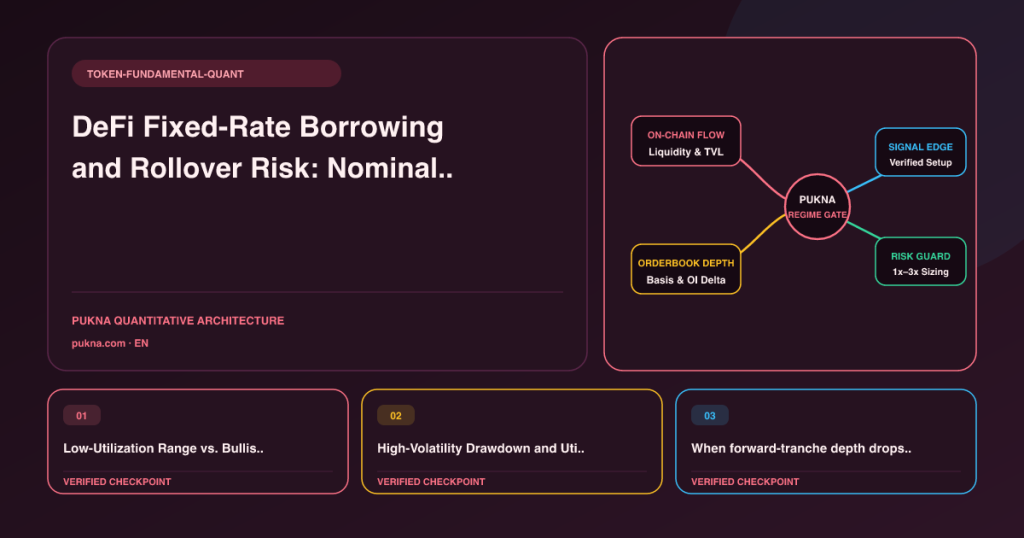
DeFi fixed-rate borrowing locks interest until a set expiry, trading continuous variable-pool drift for discrete rollover risk rather than pure LTV liquidation. A sub-6% nominal fixed APR flips into negative carry once pool utilization breaches the 80%–90% kink, forward tranche depth thins, or hard-expiry vaults liquidate healthy 40% LTV collateral. Underwriting fixed-rate DeFi borrowing and rollover risk therefore requires cross-checking post-maturity settlement code, target-tranche lender depth, collateral volatility, and wider stablecoin liquidity regimes.
How Fixed-Rate DeFi Borrowing Works vs. Variable Pools and Rollover Mechanics
Core Takeaway: Fixed-rate DeFi borrowing eliminates intra-term interest drift only until expiry, converting continuous variable-pool rate exposure into discrete maturity-date refinancing and settlement risk.
| Protocol Architecture | Pricing & Liquidity Engine | Post-Maturity Settlement | Early-Exit Friction | Primary Rollover Failure |
|---|---|---|---|---|
| Zero-Coupon Yield AMMs (e.g., Notional fCash, Pendle PT loops) | Discounted zero-coupon debt priced on a time-decaying AMM curve | Variable-rate fallback (unpaid debt converts to floating curve) | Mark-to-market AMM rate slippage plus swap fees | Thin next-tranche AMM depth and spiked variable fallback |
| Fixed-Term Auctions & Orderbooks (e.g., TermMax) | Peer-to-peer batch auctions or limit books matching discrete expiries | Strict repayment cutoff with grace-window default penalties | Orderbook spread or secondary match availability | Unfilled roll auctions and abrupt clearing-rate jumps |
| Curated Fixed-Term Vaults (e.g., Morpho fixed-term BTC loans) | Isolated curated pools quoting fixed term rates to approved collateral | Hard post-maturity liquidation if principal goes unpaid | Prepayment lockouts or fixed early-close fees | Forced collateral seizure at expiry despite healthy LTV |
| Variable-Rate Pools (e.g., Aave, Compound) | Piecewise utilization curve fed by pooled open-ended deposits | No maturity date; debt persists while LTV stays healthy | Near-zero exit friction unless pool utilization nears 100% | Continuous borrow-rate spikes above the utilization kink |
Zero-Coupon AMMs, Term Orderbooks, and Curated Fixed-Term Vaults
Fixed-rate DeFi borrowing guarantees a locked interest coupon over a finite calendar term, never an open-ended rate freeze. Variable pools such as Aave price debt block by block along DeFi lending pool utilization curves, keeping loans open indefinitely while collateral stays solvent. Fixed protocols eliminate intra-term drift, never the expiry clock.
Three smart-contract architectures anchor fixed on-chain debt. Zero-coupon AMMs such as Notional V3 let borrowers mint and sell discounted fCash tokens into liquidity pools, where the discount to par locks interest. Term orderbooks like TermMax clear borrowers against lenders through periodic auctions, while curated vaults on Morpho issue isolated fixed-term credit backed by BTC or blue-chip collateral.
What Happens at Maturity: Hard Liquidation vs. Variable-Rate Fallback
Loan rollover is the operational act of retiring maturing principal and opening a new fixed term before the expiry block arrives. Rollover risk measures the refinancing spread jump, lender shortage, or forced settlement triggered when that deadline hits. Smart-contract settlement code dictates how harshly a missed expiry bites.
Protocols diverge sharply at T=0. Zero-coupon markets with variable-rate fallback convert unpaid fixed debt into floating prime debt automatically, sparing solvent collateral from immediate seizure while exposing balances to punitive floating rates. Hard-expiry vaults trigger collateral seizure regardless of LTV. Once a contract enforces hard expiry or routes overdue debt into an 85%-utilized fallback pool, headline APR comparisons break down and expose borrowers to four specific failure vectors.
Why Do Fixed-Term Loans Break at Maturity? Four Rollover Failure Vectors
Core Takeaway: Rollover risk splits into four auditable economic and smart-contract failure vectors that damage fixed-rate borrowers even when spot collateral prices remain flat.
Refinancing Spread Jumps and Term-Tranche Liquidity Crunches
The first failure vector is a refinancing rate spread shock. A borrower who locks 5.8% fixed APR for 90 days can face an 11% to 14% next-maturity quote when stablecoin demand tightens ahead of expiry. One adverse roll turns positive carry negative overnight.
The second vector is a forward-tranche liquidity crunch. Aggregate protocol TVL sums locked capital across active expiries and passive reserves, masking how little deployable stablecoin supply actually sits inside the specific next-maturity pool. When a borrower rolls size through a shallow tranche, AMM curve depth and slippage push execution rates hundreds of basis points above the screen quote.
Post-Maturity Liquidation Cliffs and Pendle PT Maturity Mismatch
The third vector is hard post-maturity liquidation on healthy collateral. Fixed-term BTC credit facilities built on isolated vault architecture often enforce non-negotiable repayment timestamps to guarantee lender redemption. If a borrower misses the roll window through operational neglect or chain congestion, liquidators seize 40% LTV collateral and collect penalty haircuts. A healthy LTV will not stop a maturity clock.
The fourth vector is asset-liability maturity mismatch inside leveraged yield-token loops. Suppose a desk finances a 180-day Pendle Principal Token (PT) yielding 11% fixed with a 60-day fixed stablecoin loan at 6.5% on Notional V3. When debt matures 120 days early, the PT cannot redeem at par. Rising implied yields force either punitive debt refinancing or early secondary-market PT sales at a principal discount.
| Failure Vector | Trigger Condition | Affected Architecture | Quantified Cost Impact | Pre-Maturity Warning |
|---|---|---|---|---|
| Refinancing Spread Shock | Next-term implied borrow rate jumps above strategy yield | Zero-coupon AMMs, term auctions, curated vaults | +300 to +800 bps ongoing annualized carry erosion | Variable baseline climbs past 75% utilization |
| Term-Tranche Liquidity Crunch | Deployable lender depth in target expiry falls below 5x loan size | Zero-coupon AMMs and periodic auction books | +75 to +350 bps one-way entry/exit slippage | Forward-tranche LP withdrawals accelerate at T-14 |
| Hard Post-Maturity Liquidation | Principal remains unpaid past expiry block or grace window | Hard-expiry curated vaults and strict term loans | 5% to 12% liquidation penalty plus collateral slippage | Unfunded repayment wallet inside T-7 window |
| PT / Asset Maturity Mismatch | Fixed debt expires ahead of underlying PT or locked yield asset | Cross-protocol PT loops (e.g., Pendle + Notional) | 2% to 6% secondary-market PT discount on early exit | Debt tenor shorter than collateral redemption date |
When forward-tranche depth drops below 5x position size or fixed debt matures even one day before its yield-bearing collateral, static carry math breaks down. Beyond that boundary, rollover outcomes depend less on protocol UI than on which macro liquidity regime dominates at expiry.
How Do Market Regimes Flip Identical Fixed APRs Across Liquidity Cycles?
Core Takeaway: An identical 6% nominal fixed borrow rate works as cheap funding below 70% pool utilization yet flips into negative carry or forced unwinds above the 90% kink.
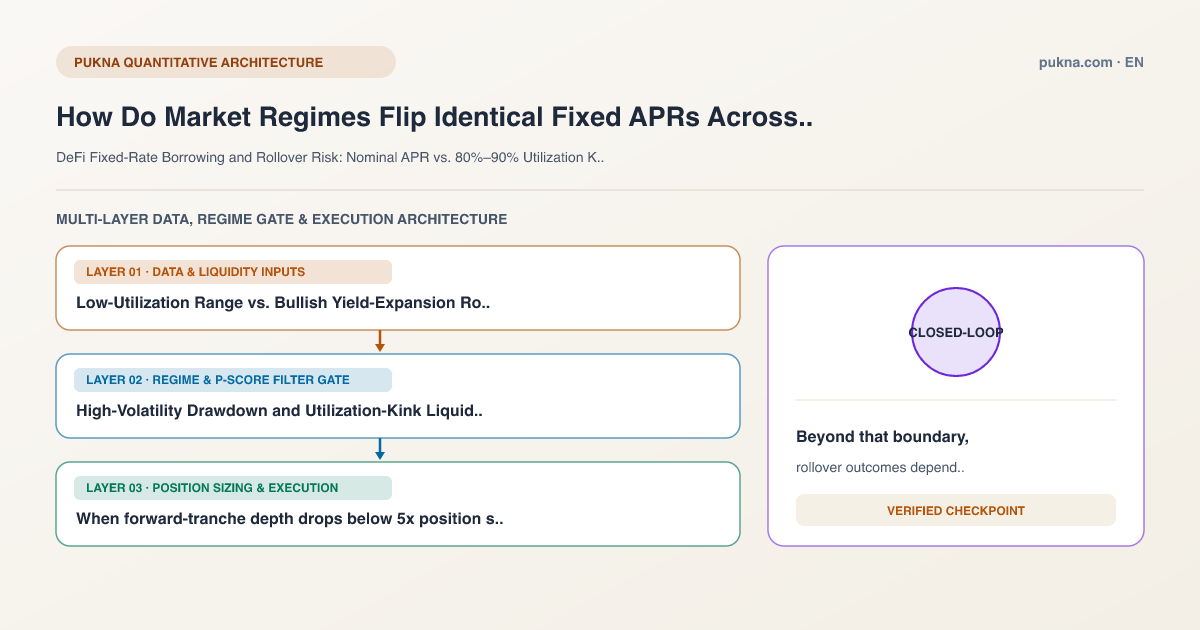
Low-Utilization Range vs. Bullish Yield-Expansion Rollover Repricing
In Regime 1—a calm, abundant-liquidity market with stablecoin pool utilization below 70% and low collateral volatility—fixed borrowing behaves predictably. Forward fixed APRs trade within 50 to 100 bps of variable baselines, and lender depth absorbs roll size with under 20 bps of slippage. Rolling 5 to 7 days before expiry preserves clean carry. Calm regimes hide how fragile short-dated rolls become.
In Regime 2—a bullish leverage and yield-expansion phase with pool utilization between 75% and 90%—that exact 6% expiring loan flips character. Expanding perpetual basis, climbing open interest, and exchange funding rates pressing against their funding cap pull arbitrage desks on-chain for stablecoin leverage. Aggressive bidding lifts next-term APRs past 10%, flipping carry negative.
High-Volatility Drawdown and Utilization-Kink Liquidity Cascades
Regime 3 pairs sharp collateral selloffs with utilization breaching the 90% kink. Risk-off lenders pull deposits from upcoming maturities to preserve exit optionality just as spot selloffs compress borrower LTV. Variable-fallback pools suffer a DeFi utilization-kink borrow-rate spike past 20% to 60% annualized while secondary AMM depth evaporates. The coupon stays 6%, yet the risk profile flips completely.
Cross-market volatility indicators typically flash stress before on-chain lending tranches freeze. Tracking Bitcoin implied volatility DVOL regimes alongside stablecoin utilization separates orderly rate repricing from systemic deleveraging. When DVOL expands sharply during a drawdown, borrowers lose LTV headroom and roll liquidity together.
| Market Regime | Utilization & DVOL State | Refinancing & Unwind Cost | Collateral LTV Stress | Optimal Roll Timing |
|---|---|---|---|---|
| Regime 1: Calm Liquidity | Pool utilization <70%; subdued DVOL and tight perp basis | Next-term spread +50–100 bps over variable; <20 bps slippage | Low; spot range preserves LTV cushion | Roll cleanly at T-7 to T-5 |
| Regime 2: Bullish Yield-Expansion | Utilization 75%–90%; elevated open interest and wide perpetual basis | Next-term APR surges +300–700 bps; carry loops flip negative | Low LTV stress, but severe funding-cost compression | Lock early at T-21 to T-14 or deleverage |
| Regime 3: Volatility & Liquidity Crunch | Utilization >90% kink; spiking DVOL and rapid spot drawdown | Variable fallback hits 20%–60%+ APR; AMM slippage >150 bps | Severe simultaneous LTV compression and exit illiquidity | Pre-repay or stage reserves before T-14 |
Once stablecoin utilization breaches the 80%–90% kink while implied volatility DVOL climbs into stress territory, reading a historical fixed APR linearly fails immediately. Avoiding maturity-week traps means stripping away four pervasive single-metric illusions.
Why Do Low Nominal APR and Healthy LTV Still Fail at Debt Expiry?
Core Takeaway: Nominal fixed APR omits annualized roll slippage on short tenors, while conservative LTV ratios and large headline TVL figures conceal hard-expiry cliffs and shallow target tranches.
Effective Annualized Roll Cost vs. Headline Fixed APR
Nominal fixed APR measures only the coupon quoted inside one discrete maturity; it never measures realized borrowing cost across repeated rolls. Every fixed-rate roll incurs entry and exit AMM price impact, auction clearing spreads, and gas or MEV friction. Short tenors amplify that friction brutally once annualized.
Calculate true capital cost with one direct accounting identity: Effective Annualized APR = Nominal Fixed APR + [Round-Trip Friction % × (365 / Tenor Days)]. Assume a 6.0% nominal loan carrying 1.0%–1.5% round-trip slippage and spread. On a 90-day term, that friction adds 406–608 bps annualized, pushing effective cost to 10.06%–12.08%. On a 30-day term, it adds 1,217–1,825 bps—driving real borrowing cost to 18.17%–24.25%.
This compounding drag mirrors futures roll drag mechanics in traditional derivatives, where rolling short-dated contracts quietly drains headline yield. Cross-protocol specification mismatches compound the error further. Comparing a zero-coupon AMM quote carrying mark-to-market exit slippage against a hard-expiry vault without pricing prepayment penalties produces broken funding math.
Why Healthy LTV and High Protocol TVL Mask Expiry Cliff Risk
Borrowers conditioned by open-ended lending pools frequently equate a 35% to 45% LTV with absolute safety. That assumption breaks at maturity. Hard-expiry vaults trigger liquidation at T=0 regardless of LTV, while variable-fallback contracts sweep unpaid balances onto floating curves where post-kink interest compounds rapidly.
Why does aggregate protocol TVL mislead borrowers at rollover? Because TVL sums every deposit across expiring pools, locked vaults, and variable reserves. A protocol showing hundreds of millions in headline TVL can hold under $5 million in deployable lender depth inside the exact 90-day forward tranche needed to roll size. Liquidity vanishes first in the tranche you actually need.
| Single Metric | Naive Linear Reading | Empirical Multi-Factor Reality | Invalidation Trigger |
|---|---|---|---|
| Nominal Fixed APR | Lower quoted rate than Aave guarantees cheaper borrowing | Short-tenor AMM impact and roll friction add 400–1,800 bps annualized | Annualized roll friction exceeds net carry spread |
| Current Collateral LTV | 35%–45% LTV protects collateral indefinitely | Hard-expiry smart contracts liquidate unpaid loans at T=0 regardless of LTV | Maturity passes unrefinanced on hard-expiry code |
| Headline Protocol TVL | Large protocol TVL ensures smooth institutional roll fills | Next-maturity tranche liquidity can be a small fraction of aggregate TVL | Target-tranche available depth falls below 5x loan size |
| Remaining Term Days | Rolling 24 hours before expiry minimizes double-interest overlap | Waiting until T-1 surrenders execution to thin books and congestion spikes | Roll delayed inside T-3 during rising utilization |
Single-metric distortions are not unique to fixed-rate borrowing; headline APYs and aggregate TVL mask exit depth, fee breakevens, and depeg risk across every DeFi liquidity vertical.
| Research Scenario | Core Criterion | Empirical Takeaway | Full Study |
|---|---|---|---|
| Screening AMM liquidity pools | Swap-fee APR vs. emissions and Vol/TVL | High LP APYs fail if swap fees do not offset AMM curve impermanent loss. | Crypto Liquidity Pools: AMM Curves, Impermanent Loss Math & Vol/TVL Screening → |
| Auditing DeFi lending markets | Pool utilization, exit depth, and base yield | High lending APYs often mask thin exit liquidity, subsidies, or tight liquidation margins. | DeFi Lending: High APY vs. Utilization, Exit Depth, and Liquidation Risk → |
| Evaluating liquid staking tokens | Reward accounting, exit queues, and depth | LSTs keep tokens transferable, but exit queues and thin books create depeg risk. | Liquid Staking: Yield vs. Exit Liquidity and Depeg Risk → |
| Modeling V2/V3 LP net returns | Net LP PnL vs. fee-to-IL breakeven thresholds | Gross impermanent loss differs from net loss once fees and reward breakevens are included. | DeFi Impermanent Loss Calculator: V2/V3 & Fee Breakeven → |
| Choosing staking vs. yield farming | Same-asset, same-period net dollar return | Higher headline APY can yield less in dollars once fees and asset price risk are counted. | Crypto Staking vs Yield Farming: Returns, Liquidity & Risk → |
Any borrowing decision anchored to raw nominal APR, spot LTV, or headline TVL fails the instant short-tenor slippage exceeds carry or forward depth thins. Clearing those blind spots requires a five-gate multi-factor audit before locking capital.
How Should Borrowers Verify Rollover Risk Across Spread, Depth, and Macro Regimes?
Core Takeaway: Disciplined rollover underwriting requires passing five quantitative gates linking target-tranche depth and settlement contracts with macro dollar funding, derivatives positioning, and collateral trend regimes.
On-Chain Term-Depth, Kink Distance, and Settlement Rule Audits
Start on-chain with three hard contract and liquidity gates before evaluating yield. First, confirm deployable lender depth inside the target next-maturity tranche covers at least 5x to 10x your loan principal, keeping simulated round-trip slippage below your annualized carry buffer.
Second, read the settlement contract to confirm whether expiry triggers hard liquidation, auto-roll, or variable fallback, and align debt maturity at or beyond yield-asset redemption on every PT loop. Third, measure buffer distance below the 80%–90% variable utilization kink.
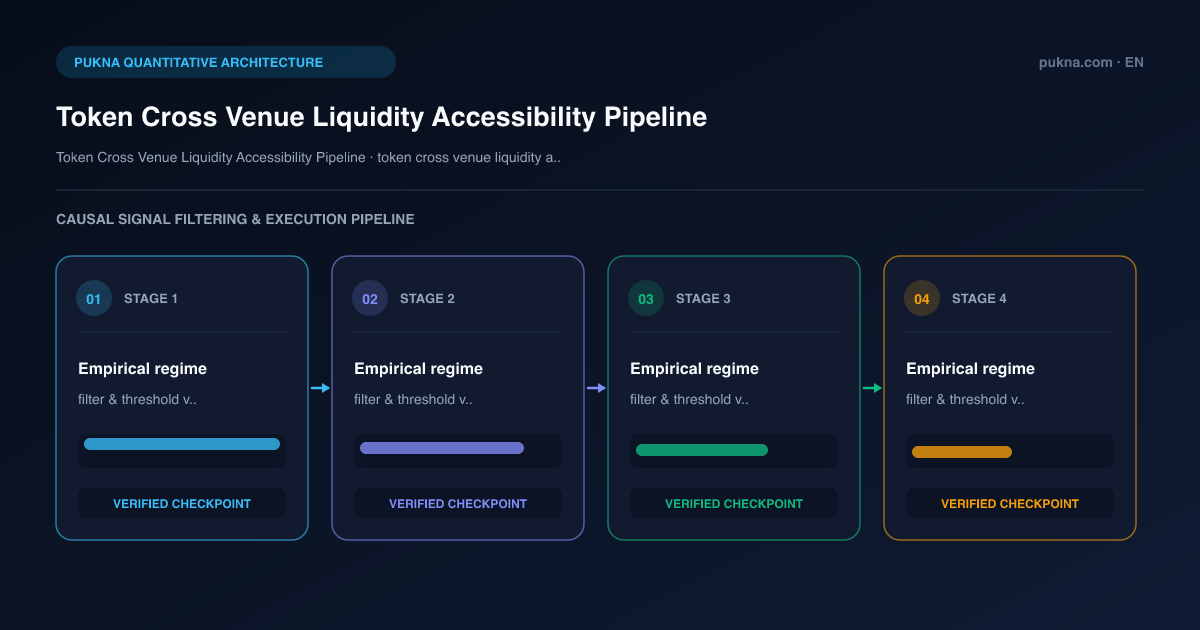
Cross-Venue Rollover Liquidity Accessibility Pipeline
| Checkpoint | Liquidity Layer | Empirical Criterion & Execution Guardrail |
|---|---|---|
| Phase 01 | Tranche Fragmentation | Measure deployable stablecoin lender depth inside the exact target expiry tranche (minimum 5x–10x loan principal), excluding locked aggregate TVL. |
| Phase 02 | Cross-Venue Backup Depth | Benchmark fixed-term AMM implied rates, auction books, and variable-pool utilization curves so fallback refinancing stays safely below the 80%–90% kink. |
| Phase 03 | Execution Microstructure | Simulate round-trip AMM price impact, auction spread, and collateral unwind depth; trim debt if annualized roll friction exceeds net carry. |
Cross-Checking Macro Liquidity and Collateral Stress Regimes Before Rolling
Protocol dashboards never reveal macro funding shocks until stablecoin pools have already repriced. Widening cross-currency basis in dollar funding markets, slowing stablecoin supply growth, and leveraged BTC account crowding often drain on-chain lending supply weeks before maturity. Check the macro exit door before locking term debt. Gate 4 tracks macro rate and liquidity direction, while Gate 5 checks multi-timeframe collateral volatility and trend stress.
| Verification Gate | Single-Protocol Manual Check | Cross-Market Quantitative Audit | Abort / Reprice Threshold |
|---|---|---|---|
| 1. Tranche Depth Ratio | Reads aggregate protocol TVL banner | Audits deployable liquidity in exact target expiry tranche | Available depth <5x principal or slippage >carry |
| 2. Utilization Kink Distance | Checks current spot variable APR only | Tracks 7d–30d utilization slope across fixed and fallback pools | Utilization breaches 80%–90% kink zone |
| 3. Contract & Maturity Match | Assumes variable-style LTV-only liquidation | Audits post-expiry code and aligns debt maturity >= asset maturity | Hard-expiry cutoff unhedged or PT expires after debt |
| 4. Macro & Liquidity Regime | Ignores off-chain rates and perp positioning | Cross-checks macro rates, dollar liquidity, sentiment, and perp crowding | Dollar liquidity tightens while funding & basis surge |
| 5. Collateral Stress Regime | Monitors spot collateral price on one chart | Evaluates multi-timeframe collateral trend and volatility dispersion | DVOL spikes alongside downward collateral breakdown |
Stitching macro rates, stablecoin flows, derivatives crowding, and collateral trends across disconnected tabs introduces costly lag when fixed tranches reprice rapidly. Single-protocol dashboards miss cross-market regime shifts. For a unified check, desks can audit macro, rate, liquidity, sentiment, derivatives, and on-chain stress inside Pukna’s 8-dimension, 39-indicator Environment Research Library and 43-token research library on app.pukna.com. That workflow pairs directly with 15m/1h/4h/1d causal candlestick signals across 42 major USDT collateral pairs.
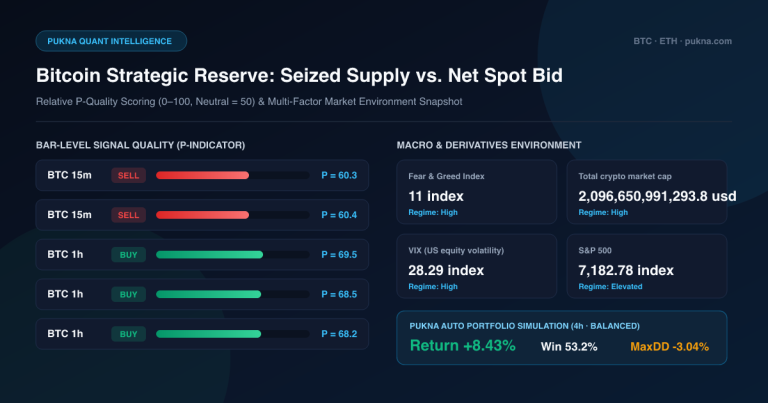
When reviewing collateral regime quality, treat the 0–100 P score strictly as a relative return-quality ranking across horizon_bars, never a win-rate probability. A P-score 50 neutral baseline reflects ordinary surrounding candles, while higher readings mark stronger combined best excursion and terminal return. This research layer neither executes on-chain loans nor tracks wallet expiries. Contract-level settlement audits stay mandatory, and deteriorating regimes demand calendar execution.
How Do You Execute a T-30 to T-0 Rollover Playbook and Buffer Sizing Plan?
Core Takeaway: Running staged refinancing checkpoints from T-30 to T-7 and sizing collateral cushions for spot drawdown plus roll friction prevents forced T-0 maturity liquidations.
Structured T-30 to T-0 Refinancing and Liquidity-Fallback Milestones
Waiting until maturity week hands execution control to shallow orderbooks, gas spikes, and MEV searchers. Institutional DeFi desks treat fixed-term debt expiry like a futures contract roll, starting execution reviews a full month out. Never let a maturity clock dictate your trade.
- T-30 to T-14 (Macro & Tranche Screening): Audit macro dollar liquidity, variable-pool utilization slope, and deployable lender depth in the next expiry tranche while term spreads remain elastic. Confirm exact settlement code and any post-expiry grace window.
- T-14 to T-7 (Primary Roll or Partial Deleveraging Window): Compute effective annualized roll APR including simulated AMM or auction slippage. If effective cost breaches strategy carry or target-tranche depth slips below 5x principal, roll early or retire 25% to 50% of debt while secondary depth holds.
- T-7 to T-3 (Fallback Reserve Staging): Pre-stage repayment stablecoins in an accessible wallet or pre-authorize a variable-pool refinancing line below the 80% utilization kink so sudden RPC outages never block settlement.
- T-3 to T-0 (On-Chain Cutoff Verification): Execute final principal repayment or term migration with at least 48 to 72 hours of block buffer before hard-expiry liquidation triggers activate.
Sizing Collateral Drawdown Cushions and Validating Hedge Regimes
Effective LTV ceilings must absorb spot collateral drawdowns, annualized roll slippage, and exit discounts simultaneously. Borrowing against staked ETH demands an extra 10% to 15% LTV cushion because liquid staking exit queues and thin orderbooks widen depeg discounts during forced unwinds. Market structure dictates how fast margins compress. Risk desks watch whether spot collateral holds bid acceptance near its point of control (POC) or slips into thin air pockets where tail-risk drawdown asymmetry accelerates liquidations.
Desks evaluating directional BTC or ETH hedges to cushion maturity-window drawdowns can run Pukna’s AUTO 1–3x integer-leverage equity-curve simulation before subscribing to real-time push alerts. Reviewing historical equity curves, AUTO strategy win rate, and peak-to-trough max drawdown anchors hedge sizing in empirical risk limits. Simulated win rate never equals the 0–100 P score.
Live hedge execution still incurs slippage drag, and historical equity curves never guarantee future performance. If an LTV buffer cannot survive a 25% to 35% spot drawdown plus 1.5% roll friction above maintenance limits, deleveraging before T-14 beats gambling on maturity-week depth. Cutting debt early always outperforms a forced T-0 unwind.
Frequently Asked Questions
What is rollover risk in DeFi fixed-rate borrowing, and how does it differ from variable-rate risk?
Rollover risk in DeFi fixed-rate borrowing is the refinancing spread jump, lender liquidity shortage, or forced settlement triggered when finite-term debt hits maturity. Variable-rate pools like Aave expose borrowers to continuous, block-by-block interest drift with no expiry date. Fixed loans remove intra-term drift but concentrate liquidity risk onto expiry day.
Why can a fixed-term DeFi loan liquidate healthy-LTV collateral after maturity?
Protocols using hard-expiry smart contracts treat unpaid principal after the maturity deadline as a contractual default, independent of collateral health. Unlike open-ended pools or variable-rate fallback models that roll expired debt onto a floating curve, hard-expiry vaults authorize liquidators to seize collateral to repay lenders on schedule. A conservative 35% to 45% LTV cannot override an expired loan clock.
How does maturity mismatch affect leveraged Pendle PT or yield-token fixed-rate loops?
Maturity mismatch strikes when fixed-rate debt expires before the underlying Pendle Principal Token or fixed-yield collateral redeems at par. At expiry, the borrower cannot settle from par redemption and must either refinance at a higher rate or sell the unmatured PT on a secondary AMM. Rising implied yields turn headline carry into immediate secondary-market principal loss.
Which quantitative indicators should borrowers check 14 to 30 days before rolling fixed DeFi debt?
First, verify three on-chain gates: target-tranche lender depth covering 5x to 10x loan size, distance below the 80%–90% utilization kink, and exact post-expiry settlement code. Next, measure annualized round-trip roll slippage against net strategy carry while checking implied volatility (DVOL) and macro dollar liquidity conditions. If any single gate fails, trim debt before maturity week.
Put this into practice
Create a free account to browse live signals and test your own rules.