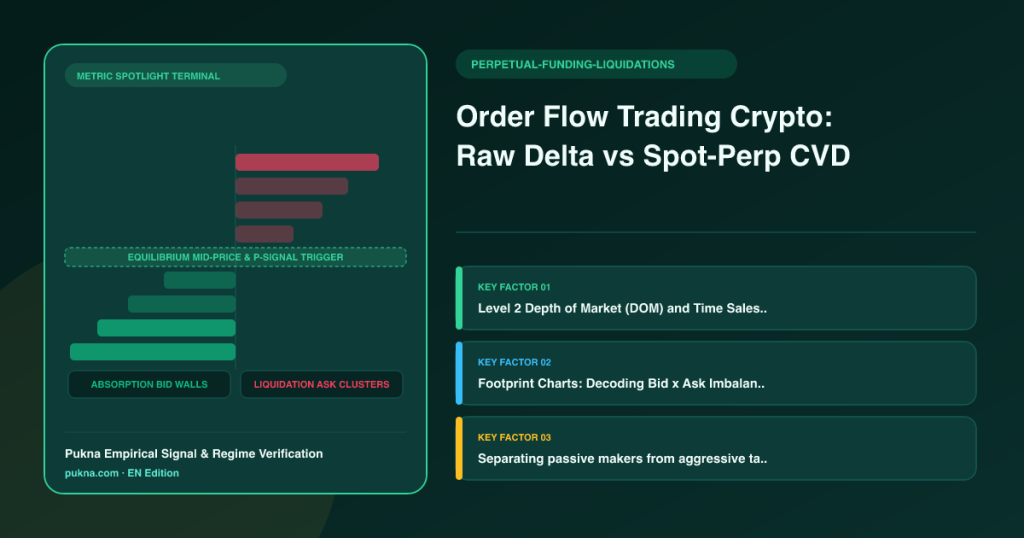
Order Flow Trading Crypto: Raw Delta vs Spot-Perp CVD
Single-exchange delta spikes and heavy bid walls routinely trap crypto buyers. Screen real demand using spot-perp CVD, limit absorption, and causal 4h/1d regime filters.
Screen perpetual funding, coin OI, and liquidation regimes with empirical filters.
Single-exchange delta spikes and heavy bid walls routinely trap crypto buyers. Screen real demand using spot-perp CVD, limit absorption, and causal 4h/1d regime filters.
Raw 8h funding and USD open interest misread perpetual crowding. Screen Z-scores (>+1.5), coin-unit OI deltas, and spot-perp basis across DVOL regimes before sizing 1–3x leverage.
Five lit ADL bars mark a 20% quintile, not closure odds, while thin-book cascades can cut 3/5 accounts in seconds. Screen venue formulas, regime bounds, and…
Bright BTC liquidation clusters aren't reversal magnets. Screen CEX inferred drift, 1%–2% book cascade absorption, and multi-factor funding checks before sizing.
Bright liquidation clusters are modeled OI zones, not price magnets. Filter ghost bands and separate range sweeps from trend cascades with Spot CVD and coin-unit OI.
Rising USD open interest can reflect spot repricing, not bullish inflows. Cross-check coin-denominated OI Z-scores, funding skew, and regime shifts within 1x–3x risk limits.
A Bitcoin long/short ratio above 1.0 is not a standalone bullish signal. Reconcile 4 venue formulas and cross-check Z>1.5 skew with OI, funding, and spot CVD…
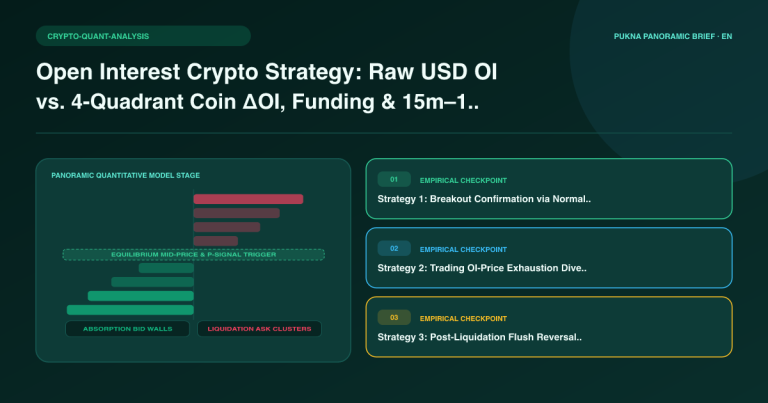
Raw USD OI spikes and high funding fail alone. Filter divergence via BTC-denominated OI, cross-exchange funding spreads, volatility regimes, and chart confluence.
Raw USD OI inflates with spot rallies and fails under crowded +0.05% funding. Pair coin-unit ΔOI, funding Z-scores, and P Relative Quality Scores for 15m–1d execution.
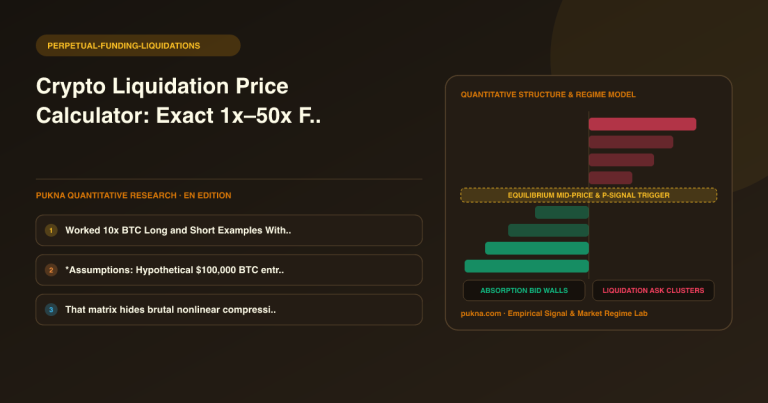
Use exact USDT-M and Coin-M liquidation formulas and a 1x–50x buffer table instead of 1/Leverage math. Filter leverage by MMR, Mark Price, fees, and funding bleed.
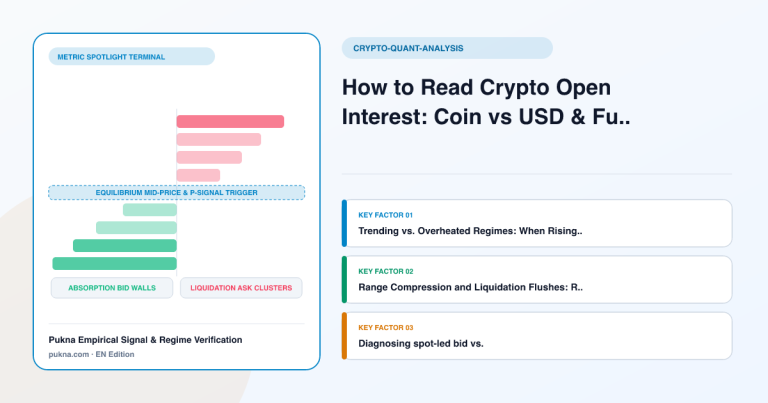
USD open interest inflates on price rallies even with zero new contracts. Pair coin-denominated OI with 30-day Z-scores, 8h funding, and spot CVD to separate trends…
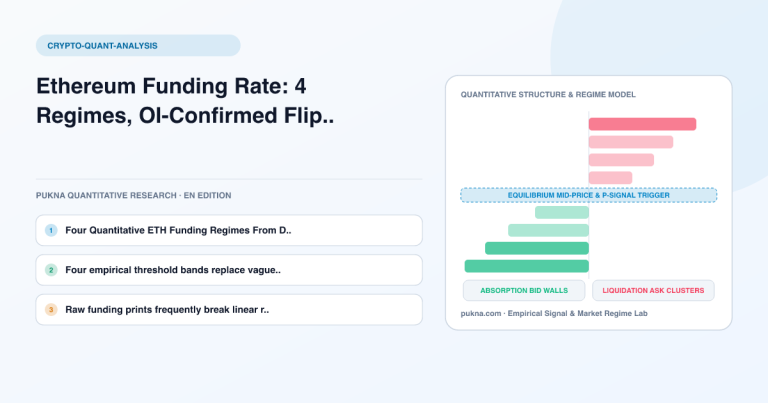
A +0.01% ETH funding print marks baseline carry, not bullish crowding. Screen setups with four regime thresholds, OI flip diagnostics, and Binance 8h vs. Hyperliquid 1h…
Positive funding does not automatically yield net carry once four-leg fees, basis drift, and margin risk are priced in.
Crypto Funding Rate Arbitrage Strategy: Net Carry vs 8-20 bps Fees, Basis, and Margin RiskNegative ETH funding flips often signal carry unwinds rather than automatic short squeezes, requiring OI regime confirmation.
Ethereum Funding Rate Flips Negative: Short Squeezes, OI Regimes & Cross-Venue MathHeadline long/short ratios count retail accounts rather than dollar size, so notional skew is needed to verify crowding.
Crypto Long/Short Ratio Strategy: Account vs. Notional Rules on Binance, OKX & BybitRaw USD open interest inflates passively during spot rallies and basis carry; coin-unit OI and Z>2.0 filters isolate real positioning.
Open Interest Guide: Raw USD OI vs. Z>2.0 FiltersCompare bar-close causal signals, fee-adjusted 15m–1d backtests, and regime filters.
Empirical guides to crypto options GEX, IV skew, DVOL, and Vol/OI flow.