Risk Reward Ratio Stop Loss: Net R vs 1x ATR Noise
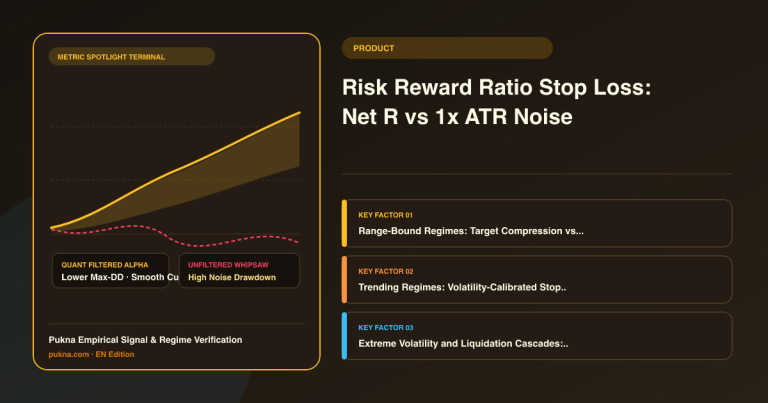
Nominal 1:3 targets fail when sub-1% stops sit inside 1x ATR noise and lose 0.25R+ to fees and slippage. Screen setups using trade expectancy, regime stops,…
Pukna Research Desk audits causal bar-level signals across 42 USDT pairs (15m/1h/4h/1d) using the 0–100 relative P-score. We publish out-of-sample backtests on CPI, DVOL, Extreme Fear funding regimes, and AUTO 1–3x max-drawdown guardrails.
Nominal 1:3 targets fail when sub-1% stops sit inside 1x ATR noise and lose 0.25R+ to fees and slippage. Screen setups using trade expectancy, regime stops,…
Unfiltered MACD crossovers whipsaw in choppy crypto ranges. Screen trades by market regime with 12/26/9 vs. fast settings, divergence limits, and 4h/1d + funding filters.
Static dip-buying and reflex shorting break when bear volatility shifts. Classify three sub-regimes with DVOL and perp basis, audit causal backtests, and enforce drawdown caps.
Raw AI backtests fail when crypto volatility shifts. Screen closed-bar causal signals with DVOL, book depth, and OI gates, then cap drawdowns at 1x–3x leverage.
A trailing stop tracks favorable crypto swings, yet never guarantees a fill. Screen fixed % vs. ATR distances against realized volatility, book depth, and drawdown risk.
Isolated bid-ask walls mislead traders during thin-book sweeps. Use L1-L3 feed comparisons, persistence-weighted OBI rules, and a regime-filtered execution checklist.
A 1:1 crypto hedge trades spot downside for funding drag and basis risk. Screen perps, dated futures, and protective puts by beta ratio, carry cost, and…
Isolated crypto candlestick shapes whipsaw in thin 24/7 books. Screen UTC closes with >=2.0x wick-to-body ratios, volume Z-scores >1.5, and ATR(14) volatility regimes.
Raw 10-40 bps spot spreads rarely survive live execution. Screen five arbitrage models by multi-leg fees, order-book depth, and market regime to isolate genuine net edge.
Full Kelly is highly sensitive to estimation errors. Compare Quarter- and Half-Kelly sizing using worked examples, leverage caps, correlation adjustments, and drawdown stress tests.
Static order walls cancel in milliseconds and never guarantee reversals. Benchmark ±0.5%–±2% OBI past ±0.25 against CVD flow, merged venue depth, and higher-timeframe regimes.
Fixed 5% stops can sit inside liquidation wicks. Compare 1.5x–3.5x ATR exits, DVOL, order-book depth, stop-limit buffers, and 1x–3x position sizing to manage drawdown.
Specialized editorial & empirical research teams covering derivatives, macro regimes, and execution.
Studies interest rates, cross-market sentiment, Bitcoin halving cycles, BTC dominance, ETH vs. BTC performance, an…
Pukna Derivatives & Volatility Desk analyzes perpetual funding-rate thresholds, DVOL term structure, CPI drawdown …
Pukna Research Desk audits causal bar-level signals across 42 USDT pairs (15m/1h/4h/1d) using the 0–100 relative P…
Pukna On-Chain & Liquidity Lab tracks stablecoin netflows, exchange reserves, order-book depth, and staking APR vs…
The Pukna Product & Execution Team turns 4-timeframe (15m/1h/4h/1d) causal signals on 42 USDT pairs into repeatabl…