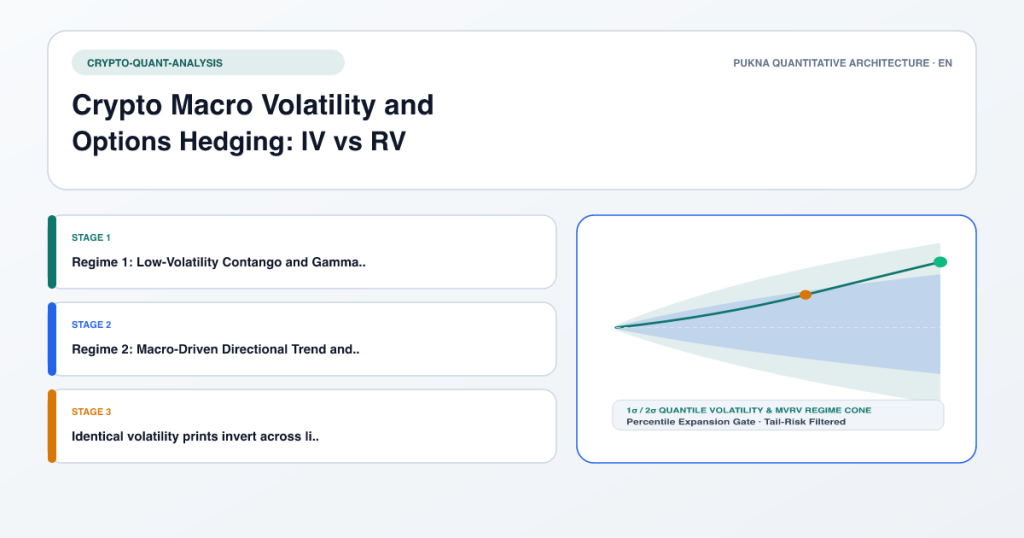
Contents6 sections
- How Do Macro Volatility Regimes Govern Crypto Options Hedging?
- Separating IV-RV Spreads From Nominal DVOL Readings
- Real Yield Headwinds and Dollar Liquidity Transmission
- How Do Macro Shocks Reprice Crypto IV, Skew, and Dealer Gamma?
- Regime 1: Low-Volatility Contango and Gamma Pinning
- Regime 2: Macro-Driven Directional Trend and Call-Put Divergence
- Regime 3: Event-Shock Backwardation and Liquidation Cascades
- Why Do Raw Options Readings Fail During Macro Events and Jumps?
- Pre-Event FOMC and CPI Vega Crush Traps
- Deribit Coin-Margined vs. CME and IBIT USD-Settled Skew Divergence
- Fat-Tailed Jump Slippage and Limit-Orderbook Skew
- Protective Puts vs. Collars, Spreads, and Dynamic Delta: Carry & Greek Budgets
- Sizing Protective Puts, Bear Put Spreads, and Zero-Cost Collars
- Band-Based Dynamic Delta Rebalancing vs. Perpetual Basis Carry
- Synthesizing Volatility Regimes Across Crypto Options Studies
- What Multi-Factor Workflow Controls Hedge Timing and Drawdown?
- The Four-Stage Pre-Hedge Quantitative Verification Protocol
- Auditing Leverage, Slippage, and Historical Drawdowns Before Execution
- Frequently Asked Questions
Macro shocks reprice crypto options through expected range, not spot direction, via the gap between implied and realized volatility. Buying front-end puts above the 85th-percentile Volatility Risk Premium (VRP) before CPI or FOMC prints bleeds to vega crush, while genuine stress confirms through backwardation and negative dealer gamma. Aligning macro liquidity regimes with cross-venue 25-delta skew decides whether spreads, collars, or dynamic delta hedges protect capital across the four regime thresholds mapped below.
How Do Macro Volatility Regimes Govern Crypto Options Hedging?
Option buyers pay for dispersion, not direction. Effective hedging comes down to whether macro risk sits underpriced below the 40th-percentile IV-minus-RV spread or stretched past the 85th percentile. Pairing payoff shape with term-structure slope and net dealer gamma stops recurring theta decay before spot breaks trend.
| Hedging Structure | Target Macro Regime | IV-RV (VRP) & Slope | Primary Greek Cost | Main Failure Mode |
|---|---|---|---|---|
| Long Protective Put | Low-vol macro transition | VRP < P40; steep contango | High daily Theta; long Vega | Vega crush if macro data prints calmly |
| Bear Put Spread | Scheduled CPI / FOMC risk | VRP P50–P85; kinked front | Capped tail Gamma; lower Theta | Under-hedges extreme 15%+ crash gaps |
| Zero-Cost Collar | Sustained macro tightening | Elevated IV; balanced skew | Short upside Delta; minimal Theta | Caps gains during sudden dovish pivots |
| Dynamic Delta Hedge | Post-shock liquidation panic | VRP > P85; backwardation | Realized Gamma & LOB slippage | Whipsaw churn in choppy range reversals |
Separating IV-RV Spreads From Nominal DVOL Readings
Headline implied volatility deceives in isolation. When desks quote high DVOL, they pad upfront premiums above trailing daily spot swings. Subtracting 7-day or 30-day realized moves isolates the implied volatility vs. realized volatility (VRP) spread. Prints below the 40th historical percentile flag underpriced convexity, whereas readings past the 85th show fear already baked into the strip.
Term-structure slope adds a second pricing boundary across quiet and stressed markets. In calm tape, 7-day IV typically trades 5 to 12 points below 30-day contracts in steady contango. Once front-end expiries invert above 30-day pricing into backwardation, market makers charge emergency spreads for cover. Naked weekly puts then rarely pay.
Real Yield Headwinds and Dollar Liquidity Transmission
Crypto surfaces never price macro stress in isolation. Shifting central-bank paths channel real yield headwinds and dollar liquidity impulse directly into 24/7 crypto beta. Rising Treasury yields lift funding hurdles for levered carry books, squeezing stablecoin credit and forcing multi-asset funds to hedge liquid weekend risk first. Front-end variance steepens long before cash equities reopen.
Cross-asset comparisons require calendar discipline because equity VIX annualizes across roughly 252 trading sessions while crypto runs 365 days a year. That continuous schedule produces a square-root scaling factor near 1.20x. Auditing 365-day scaled DVOL-versus-VIX regime mechanics separates crypto-native upside breakouts from synchronized macro tightening before you spend premium.
How Do Macro Shocks Reprice Crypto IV, Skew, and Dealer Gamma?
Identical volatility prints invert across liquidity regimes. A 60% DVOL quote offers cheap breakout convexity during quiet contango yet signals toxic vega exposure inside liquidation backwardation. Mapping term slope, 25-delta skew, and dealer positioning across three market states tells you when to buy gamma versus cap carry drag.
| Volatility Regime | Term Structure & DVOL | 25-Delta Skew | Net Dealer GEX | Optimal Hedge Shift |
|---|---|---|---|---|
| Low-Vol Contango Compression | 7d IV 5–12 pts below 30d; low DVOL | Near flat (-2 to +2 vol pts) | Positive (pinning dips & rallies) | Buy 30–60 DTE puts or calendars |
| Macro-Driven Directional Trend | Flat to mild contango; rising RV | Asymmetric (+call ease; -put tighten) | Mixed to mildly negative | Deploy bear put spreads or collars |
| Event-Shock Backwardation | 7d IV 10–25 pts above 30d; DVOL spike | Steep put wing (-10 to -18 vol pts) | Deeply negative (pro-cyclical flow) | Monetize puts; shift to banded delta |
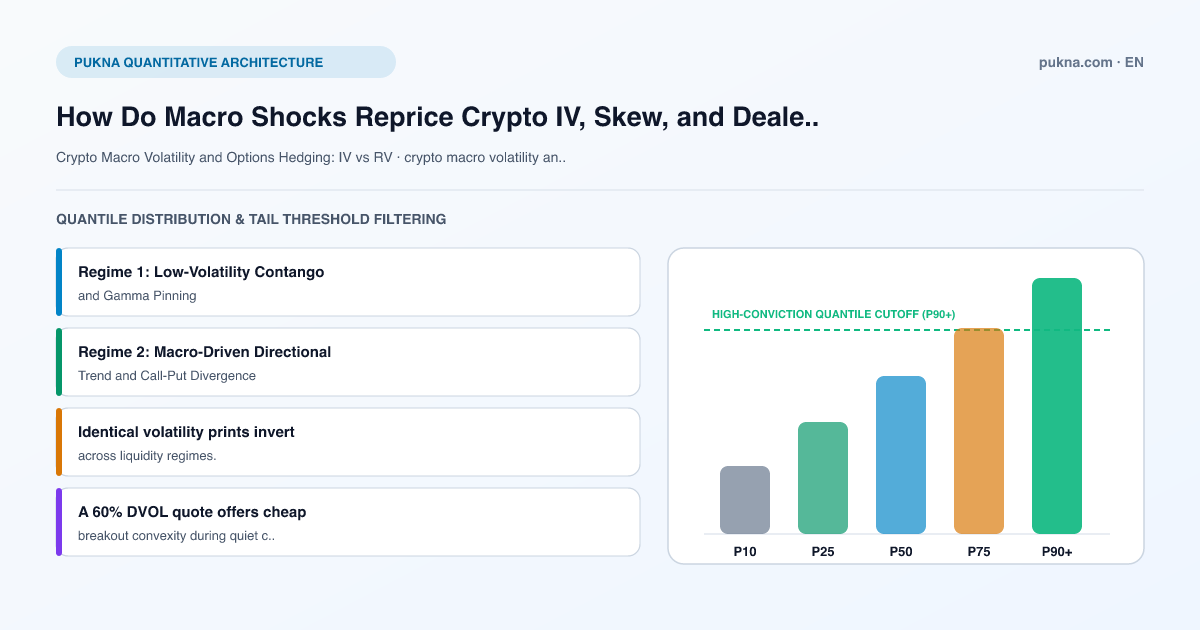
Regime 1: Low-Volatility Contango and Gamma Pinning
Quiet macro windows often mask coiled risk. When dealers sit net long options around dense open-interest strikes, positive Gamma Exposure (GEX) forces them to buy dips and sell rallies to stay delta-neutral. That mechanical cushion dampens realized swings and holds 7-day IV well beneath 30-day pricing. Buying 30- to 60-day puts here locks in cheap convexity before catalysts land.
Once stacked monthly open interest rolls off at settlement, opex-pin release and post-expiry delta-hedge unwind strip away the dealer cushion holding spot in place. Even modest data surprises then break multi-week ranges cleanly. Before trusting quiet compression, verify whether leveraged books are leaning one way via retail-versus-whale perpetual exposure imbalances.
Regime 2: Macro-Driven Directional Trend and Call-Put Divergence
Directional trends invert equity-style skew instincts. When real yields fall and dollar liquidity expands, funds chase upside gamma and push DVOL higher alongside positive call skew. Persistent hawkish repricing behaves differently: realized downside moves grind higher while front-end IV stays nearly flat instead of deeply inverted. Treating high DVOL as automatic panic confuses upside call chasing with crash stress.
As realized swings catch up to implied pricing during a macro trend, the VRP spread settles into a mid-range 40th-to-75th percentile band. Naked weekly puts grow costly here. Because keeping upside participation matters whenever central-bank language softens, bear put spreads or rolling collars defend drawdowns while capping daily theta bleed.
Regime 3: Event-Shock Backwardation and Liquidation Cascades
Forced deleveraging flips dealer flow overnight. Once spot breaks heavy put strikes during a macro shock, dealers turn short gamma and sell futures into thinning bids to hedge expanding deltas. That feedback loop lifts 7-day IV 10 to 25 points above 30-day levels and drives 25-delta put skew past -12 points. Emergency shelter now trades at peak markup.
Chasing fresh puts at peak inversion wrecks carry. Even a brief pause in selling clears front-month panic bids and triggers sharp vega collapse. Before paying peak markup for downside wings, audit washed-out open interest alongside spot investor panic-versus-euphoria thresholds to decide whether rolling existing puts into spreads beats adding naked gamma.
Why Do Raw Options Readings Fail During Macro Events and Jumps?
Single-metric options rules fail live books in three structural ways. Scheduled policy prints load event variance into front expiries, coin-margined collateral distorts venue skew, and weekend gaps overwhelm continuous delta hedges. Mapping each failure mode stops desks from paying peak spreads for brittle protection.
Pre-Event FOMC and CPI Vega Crush Traps
Event premium evaporates the second data hits the wire. Ahead of CPI or FOMC releases, market makers pack extra variance into 1-day to 7-day expiries. Front-end annualized IV routinely climbs 15 to 30 points while the VRP spread breaches the 85th percentile. Option quotes already price a violent move before spot budges a dollar.
Suppose a 3-day out-of-the-money put implies a 4.5% event move and spot only slips 2.2% after the print. Event variance resets to zero within minutes, cutting vega faster than put delta pays back. Reviewing coin-margined Delta and weekend Theta mechanics shows why defined-risk spreads outperform naked puts into binary releases.
Deribit Coin-Margined vs. CME and IBIT USD-Settled Skew Divergence
Collateral currency quietly distorts every downside quote. On Deribit, BTC-margined inverse puts pay out in BTC right as BTC falls, creating negative convexity that forces hedgers to buy extra contracts for full dollar cover. Falling coin collateral shrinks account margin at the exact same moment. That dual squeeze stretches Deribit put skew well past pure bearish conviction.
Regulated USD-settled books operate under different plumbing than offshore inverse exchanges. CME Bitcoin options and BlackRock IBIT options settle in cash dollars while absorbing steady institutional covered-call overwriting and quarterly collar flows. Pair options surfaces with spot-versus-futures ETF flow and roll-drag filters to separate collateral stress from true institutional selling.
| Structural Dimension | Deribit Inverse (Coin-Margined) | CME & IBIT (USD-Settled) | Hedging Signal Distortion |
|---|---|---|---|
| Collateral & Settlement | BTC/ETH margin & coin payout | USD cash or ETF share margin | Inverse margin shrinks during drawdowns |
| Downside Convexity | Negative coin-value drag on puts | Linear USD payoff per contract | Requires extra inverse puts per $1 hedged |
| Dominant Flow Profile | Crypto-native gamma & basis desks | Institutional overwriting & collars | Call caps weigh IBIT while puts lift Deribit |
| Skew Reading Trap | Inflated negative 25-delta skew | Flatter wings; steady call supply | Single-venue skew overstates crash odds |

Fat-Tailed Jump Slippage and Limit-Orderbook Skew
Continuous hedging breaks on weekend gaps. Textbook Black-Scholes math assumes smooth price paths where desks rebalance delta effortlessly at mid-market. Crypto trades along fat-tailed jump paths, slicing 4% to 8% through thin liquidity pockets in minutes. Once spot leaps past a strike, dynamic hedgers fill far below modeled prices and lock in permanent gamma slippage.
Execution friction multiplies jump losses across every venue. On perpetual books, sudden limit-orderbook (LOB) skew and taker-flow exhaustion strip resting bids precisely when hedgers hit market sell. On-chain collateral protocols simultaneously face priority-fee spikes and block-builder MEV tip capture as liquidators compete for blockspace. Hedge budgets without jump slippage systematically understate real drawdown cost.
Protective Puts vs. Collars, Spreads, and Dynamic Delta: Carry & Greek Budgets
Carry bleed drains passive hedges quietly. Treating protection as an explicit Greek budget—pricing net Delta, Vega, daily Theta decay, and perpetual funding side by side—turns costly insurance into durable risk control. The matrix below benchmarks five hedging structures across Greek drag, jump slippage, and perpetual-futures carry.
| Hedge Architecture | Delta / Gamma Profile | Vega & Theta Drag | Slippage Sensitivity | Perpetual Basis Alternative |
|---|---|---|---|---|
| Long Protective Put | Convex downside Delta; long Gamma | Long Vega; steep Theta bleed | Low post-entry (static payoff) | Cheaper when perp funding flips negative |
| Bear Put Spread | Bounded Delta; muted tail Gamma | Lower Vega; 35%–55% less Theta | Low (two-leg execution) | Beats short perps during flat funding |
| Ratio Put Backspread | Low base Delta; explosive tail Gamma | Long tail Vega; near-zero carry | Moderate (short-leg margin) | Covers 15%+ gaps where perps liquidate |
| Zero-Cost Collar | Downside floor; capped upside Delta | Near-neutral Vega & low Theta | Low (monthly/quarterly roll) | Avoids negative perp carry in bear bases |
| Band-Based Dynamic Delta | Target linear Delta; zero long Gamma | Zero Vega; zero option Theta | High on fat-tailed jumps | Earns positive carry when basis > 12% ann. |
Sizing Protective Puts, Bear Put Spreads, and Zero-Cost Collars
Strike selection starts with VRP percentile, never gut feel. Buying 25- to 30-delta puts at 30 to 60 days to expiry fits best when VRP holds below the 40th percentile in calm contango. Once VRP pushes into the 50th-to-85th percentile zone before catalysts, switch to a 35/15-delta bear put spread. That short lower wing cuts vega exposure and trims daily theta bleed by 35% to 55%.
Pairing a 20- to 25-delta put with a short 20- to 25-delta call builds a zero-cost collar that removes upfront outlay during prolonged tightening. Core spot inventory stays intact. The trade-off strikes during sudden dovish pivots, so check broad digital-asset market breadth trends before capping upside across expanding risk-on cycles.
Band-Based Dynamic Delta Rebalancing vs. Perpetual Basis Carry
Time-based delta hedging bleeds fast in sideways chop. Rebalancing on a fixed clock forces desks to sell dips and buy bounces inside tight ranges, compounding taker fees and spread slippage. Band-based rules plug that leak by adjusting futures only when net Delta drifts ±0.05 to ±0.10 or spot clears a volatility threshold. Fewer rebalances protect carry.
Option decay always competes directly with the perpetual futures basis. When crowded bull runs push annualized funding past 12% to 20%, shorting perpetuals for partial delta cover collects carry instead of bleeding theta. Once leverage flushes and funding turns negative, that carry flips painful. Defined-risk put spreads then win on net cost.
Synthesizing Volatility Regimes Across Crypto Options Studies
Fragmented monitoring breaks hedging discipline faster than bad math. Stitching together real yields, perpetual funding, open interest, and venue skew across five disconnected terminals creates slow handoffs. Desks often keep bleeding daily theta long after macro liquidity has turned constructive. Unifying macro context and options-surface pricing into one repeatable baseline closes that gap across the five volatility studies summarized below.
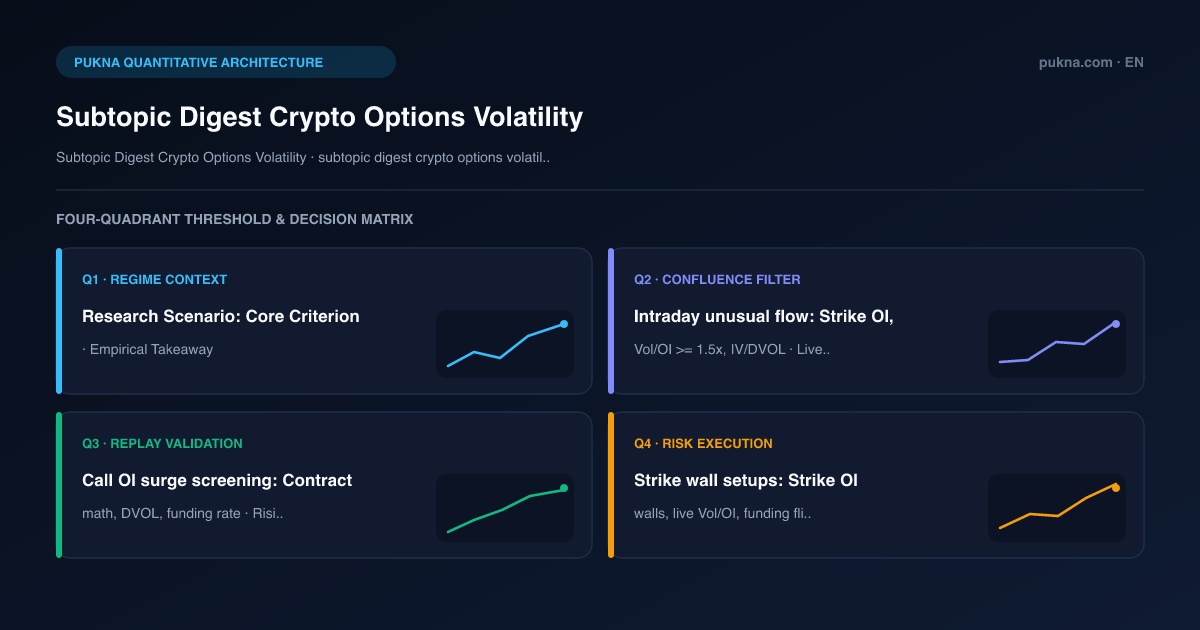
| Research Scenario | Core Criterion | Empirical Takeaway | Full Study |
|---|---|---|---|
| Selecting directional or hedged option payoffs | Payoff math, Vega exposure, expiry & max loss limits | Spot direction alone fails if DVOL crush and steep premiums erode returns. | Crypto Options Strategies: Payoffs, Implied Volatility, and Hedging → |
| Sizing 24/7 expected range & perp fragility | DVOL/BVIV daily implied move and IV-RV spread | Implied volatility prices move width, never direction; check IV-RV before sizing. | Crypto Implied Volatility: DVOL, BVIV & IV-RV Regime Risk → |
| Auditing coin-margined Greeks before entry | Net Delta, pre-priced weekend Theta & book liquidity | A 0.50 Delta is not a 50% win probability on 24/7 coin-margined desks. | Crypto Options Greeks: Raw Readings vs. Net Delta, 24/7 Theta & RV/IV → |
| Separating BTC call breakouts from macro panic | 365-day scaled DVOL vs VIX, IV percentile & term slope | High DVOL with call skew differs structurally from VIX-style macro backwardation. | Bitcoin Implied Volatility: DVOL vs VIX Regime Dashboard, 365d Scaling & VRP → |
| Choosing long vs short Vega structures | Rolling IV percentile, VRP spread & term structure | Raw IV alone misleads; filter defined-risk Vega trades by VRP and regime slope. | How to Trade Options Based on Implied Volatility: IV Percentile, VRP & Regime Filters → |
What Multi-Factor Workflow Controls Hedge Timing and Drawdown?
Disciplined risk control separates regime triage from trade execution. Rather than chasing single-day volatility spikes, systematic desks clear four sequential gates: macro environment framing, cross-venue surface checks, multi-timeframe spot confirmation, and leverage stress testing. Skipping one gate quickly invites chronic theta drag or gap-risk under-hedging.
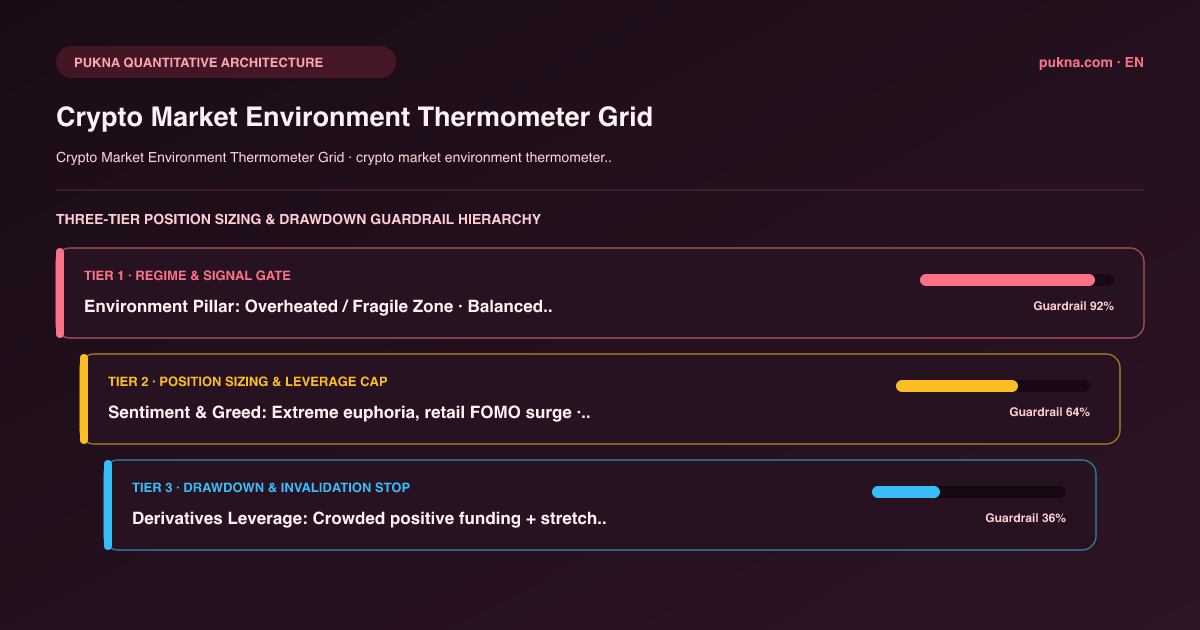
| Environment Pillar | Overheated / Fragile Zone | Balanced Constructive Zone | Capitulation / Value Zone |
|---|---|---|---|
| Sentiment & Greed | Extreme euphoria, retail FOMO surge | Neutral-to-constructive participation | Deep fear & forced de-risking |
| Derivatives Leverage | Crowded positive funding + stretched OI | Moderate basis, spot-led volume | Washed-out OI & negative funding |
| Volatility Structure | Inverted front-end IV spike | Contained term-structure contango | Post-liquidation volatility compression |

The Four-Stage Pre-Hedge Quantitative Verification Protocol
Every hedge deployment begins with a fixed pre-trade sequence. Treat the thermometer grid above as your top-level regime filter, then clear each quantitative gate below before committing option premium or futures margin. Whenever two stages disagree, cut notional size instead of forcing expensive carry bets.
- Stage 1 — Macro and Liquidity Regime Filter: Classify real-yield momentum, net dollar liquidity, derivatives leverage heat, and aggregate sentiment first. Reserve full long-gamma budgets for overheated or tightening regimes rather than constructive expansions where passive puts steadily bleed.
- Stage 2 — Cross-Venue Options Surface Audit: Compare DVOL against 7-day and 30-day realized volatility to locate the VRP percentile, read 7d-versus-30d term slope, and reconcile Deribit coin-margined 25-delta skew against CME and IBIT USD-settled books. Confirm positive or negative dealer GEX before choosing naked puts over spreads.
- Stage 3 — Multi-Timeframe Causal Spot Alignment: Downside hedges work best when structural weakness aligns across horizons instead of chasing intraday noise. Cross-check direction with Pukna 4-timeframe causal candlestick signals (15m/1h/4h/1d) and the P-score (0–100) relative return-quality ranking across
horizon_bars. Here, 50 marks neutral quality on par with surrounding ordinary candles—tracking combined best-return and terminal-return quality over the window, never win probability. - Stage 4 — Carry Budget and Monetization Triggers: Cap recurring option decay at a fixed monthly share of equity—typically 0.5% to 1.5% in calm regimes—and set exit rules ahead of entry. Pre-commit to monetizing or rolling long puts into spreads once front-end backwardation pushes VRP past the 90th percentile.
Auditing Leverage, Slippage, and Historical Drawdowns Before Execution
Running 5x to 10x directional leverage invites liquidation inside a sudden macro gap long before a 30-day out-of-the-money put builds enough delta to protect margin equity. Excess leverage breaks hedges faster than bad timing. Baking maker-taker fees, funding drift, and 5% to 10% jump slippage into sizing rules keeps options working as genuine tail cover.
Base exposure needs historical stress tests before live alerts. Running a Pukna AUTO 1–3x integer-leverage equity-curve simulation lets you audit strategy win rate and maximum drawdown across 1x, 2x, or 3x tiers. Reviewing that historical equity curve—strictly separate from the relative P quality score—confirms whether real-time push alerts fit your drawdown ceiling before subscribing.
Frequently Asked Questions
Why do front-end crypto protective puts often lose money after CPI or FOMC even when spot drops?
Before CPI or FOMC prints, market makers load explicit event variance into 1-day to 7-day expiries, pushing the IV-minus-RV spread past the 85th percentile. That event weight drops to zero immediately after release. Even on a 2% to 3% spot dip, rapid vega crush usually outweighs delta gains on out-of-the-money puts unless price clears the full implied move.
How do Deribit coin-margined skew readings differ from CME and IBIT USD-settled options?
Deribit inverse BTC puts pay out in falling BTC during drawdowns, creating negative convexity that forces hedgers to buy extra contracts while coin margin shrinks. CME and IBIT options settle in dollars instead. Institutional covered-call overwriting and collar flows keep those USD books flatter, so steeper negative Deribit 25-delta skew does not always signal stronger crash conviction.
When does a zero-cost collar outperform band-based dynamic delta hedging in crypto?
Zero-cost collars beat dynamic delta hedging during prolonged macro tightening or gap-prone ranges with elevated IV and firm call skew. Selling an upside call funds the downside put with minimal theta bleed. That static structure also eliminates jump slippage from discrete futures rebalancing, whereas dynamic delta wins only when gaps stay muted and positive perpetual funding pays carry.
What IV-RV spread and term-structure thresholds indicate overpriced versus cheap crypto options hedges?
Options protection screens cheap when the IV-minus-RV (VRP) spread holds below its 40th historical percentile and 7-day IV trades 5 to 12 points beneath 30-day pricing in steady contango. Overpriced territory starts past the 85th VRP percentile paired with backwardation, where 7-day IV exceeds 30-day pricing by 10 to 25 points. Spreads or put monetization beat fresh naked hedges there.
Put this into practice
Create a free account to browse live signals and test your own rules.