Contents6 sections
- What Are Ethereum Options, Settlement Specs, and Filtered Signals?
- Non-Linear Options Payoffs vs. Linear ETH Perpetuals
- Venue Settlement Specs and 08:00 UTC Expiry Mechanics
- How Do IV, 25-Delta Skew, and Dealer Gamma Shift Across Regimes?
- Positive-Gamma Ranges vs. Negative-Gamma Trend Expansion
- Reading Term-Structure Backwardation and 25-Delta Skew Kinks
- IV-RV Spread and Greeks Sensitivity on High-Beta ETH
- Why Do Raw Put/Call Ratios, Open Interest, and Max Pain Misfire?
- Why High Put/Call Ratios Often Signal Bullish Put-Selling or Spot Hedging
- ETH-Contract vs. USD-Notional Open Interest Distortion
- When Max Pain Breaks Down and Cross-Venue Tail Skew Diverges
- How Should Traders Match Ethereum Options Strategies to Volatility Regimes?
- Short-Volatility Yield Structures vs. Defined-Risk Convexity Buys
- Controlling Theta Decay, Vega Crush, and Tail Drawdowns
- Aligning Options Structure With Underlying ETH Regime Signals
- Multi-Factor Verification and Execution Risk Workflow Around Major Expiries
- Five-Step Pre-Trade Options Chain and Liquidity Audit
- Sizing, Margin Convexity, and Macro Regime Boundaries
- Benchmarking Directional ETH Timing Before Deploying Capital
- Frequently Asked Questions
Crypto-native Ethereum options are cash-settled, European-style derivative contracts that price forward volatility and non-linear ETH payoffs, structurally distinct from linear perpetual futures driven by funding rates. A raw Put/Call ratio above 1.0 or elevated 30-day implied volatility never proves directional conviction unless confirmed by 25-delta skew percentiles, the implied-versus-realized volatility spread, and signed taker premium flow. Before risking premium or margin, traders must cross-check dealer gamma regimes, contract settlement rules, and multi-timeframe spot liquidity across trading venues.
What Are Ethereum Options, Settlement Specs, and Filtered Signals?
Ethereum options price expected range, not simple direction. Treating them like linear perpetual swaps breaks position sizing on day one, so raw Put/Call ratios, USD open interest, and Max Pain strikes must pass through skew, realized-volatility, and settlement filters first.
| Options Metric | Raw Retail Reading | Regime-Filtered Quantitative Signal | Diagnostic Focus |
|---|---|---|---|
| Put/Call Ratio > 1.0 | Assumed bearish crash positioning | Separate aggressive put buying from bullish put-selling via signed taker flow | Aggressor intent audit |
| Rising USD Open Interest | Assumed fresh capital entering ETH | Normalize into native ETH contract units to strip out spot price inflation | Contract-unit OI filter |
| Elevated 30D ATM IV | Assumed directional trend signal | Measure against trailing realized volatility (IV-RV spread) and 25-delta skew | Volatility regime check |
| Max Pain Strike | Assumed Friday expiry price magnet | Applies only during positive dealer gamma ranges; fails in breakout trends | Dealer gamma boundary |
Non-Linear Options Payoffs vs. Linear ETH Perpetuals
Perpetual futures deliver symmetric, linear PnL. Every dollar move in ETH spot creates a fixed dollar gain or loss alongside recurring funding payments tied to the perpetual basis. Options break that linear symmetry completely.
Buying a European ETH call or put caps downside at upfront premium while convexity accelerates upside gains as spot trends. Two structural Greeks drive that shift: Gamma tracks how rapidly directional exposure builds with price, and Vega captures contract repricing whenever implied volatility expands or collapses.
That structural gap shows up fastest on 24/7 crypto order books. A thin weekend liquidation wick routinely stops out a leveraged ETH perpetual even when spot rebounds inside an hour. Defined-risk options ride out the wick without forced liquidation, trading liquidation risk for steady daily Theta decay.
Venue Settlement Specs and 08:00 UTC Expiry Mechanics
Settlement rules diverge sharply across exchanges and US equity venues. Offshore Ethereum options on Deribit, OKX, Bybit, and Binance use European-style cash settlement, meaning holders cannot exercise early and no physical ETH changes hands at expiry.
Daily, weekly (Friday), monthly (last Friday), and quarterly offshore contracts all settle simultaneously at 08:00 UTC (13:30 IST, 03:00 EST, or 04:00 EDT). Final settlement value equals a 30-minute time-weighted average price (TWAP) of a multi-exchange ETH spot index to curb last-second order-book manipulation.
Margin currency creates a hidden tail risk called inverse margin convexity. Unlike linear stablecoin margin, ETH-denominated collateral loses dollar value simultaneously during spot drawdowns, so writing puts on a coin-margined book inflates ETH losses right as your dollar buffer shrinks.
| Venue Tier | Margin & Settlement | Expiry & Index Rule | Primary Structural Constraint |
|---|---|---|---|
| Offshore Coin-Margined (Deribit) | Inverse ETH margin; cash-settled in ETH | 08:00 UTC; 30-min spot index TWAP | Collateral depreciates during selloffs, creating non-linear margin convexity. |
| Offshore Linear (OKX, Bybit, Binance) | Linear USDT/USDC margin; cash-settled | 08:00 UTC; exchange spot index TWAP | Removes coin-margin drag, though deep OTM liquidity stays thinner than Deribit. |
| US-Listed ETH ETF Options | USD margin; OCC ETF-share exercise | US equity close (16:00 ET); weekdays only | Weekend and overnight 24/7 ETH gaps create unhedgeable opening gap risk. |
How Do IV, 25-Delta Skew, and Dealer Gamma Shift Across Regimes?
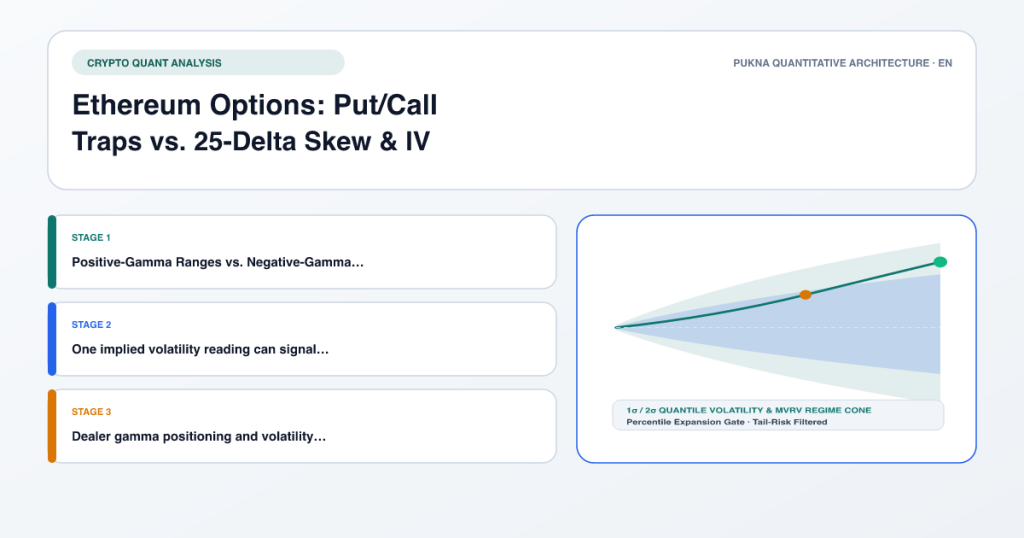
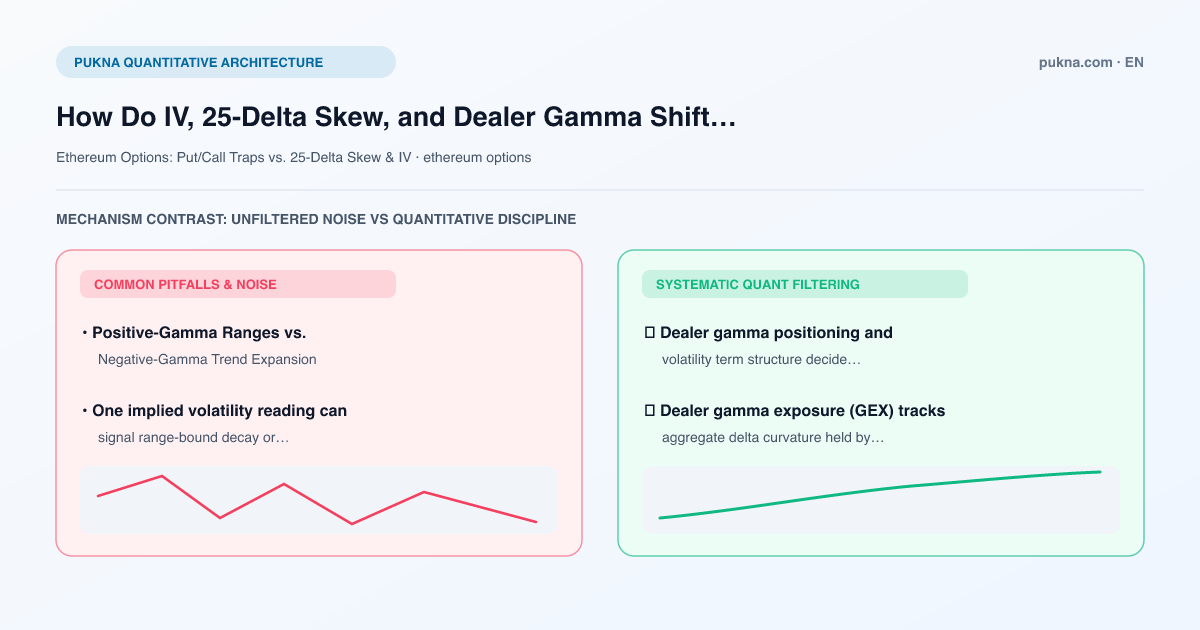
One implied volatility reading can signal range-bound decay or explosive breakout velocity. Dealer gamma positioning and volatility term structure decide which regime takes hold. Positive dealer gamma absorbs price shocks near major strikes, while negative dealer gamma forces market makers to hedge straight into momentum.
| Volatility & Flow Telemetry | Positive-Gamma Range | Negative-Gamma Breakout | Liquidation Backwardation |
|---|---|---|---|
| Dealer Gamma (GEX) | Net positive; dealers sell rallies and buy dips | Net negative; dealers chase spot to hedge delta | Deeply negative around breached downside puts |
| IV Term Structure | Upward contango (7D IV below 30D IV) | Flattening curve as front-end gamma bids rise | Inverted backwardation (7D IV spikes above 30D IV) |
| 25-Delta Skew | Balanced or mildly elevated call skew | Expands rapidly toward the active breakout side | Extreme put skew kink from crash protection bids |
| Resulting Spot Behavior | Mean reversion and strike pinning into 08:00 UTC | Directional expansion with stretched perp basis | Cascading liquidations, negative funding, wide spreads |
Positive-Gamma Ranges vs. Negative-Gamma Trend Expansion
Dealer gamma exposure (GEX) tracks aggregate delta curvature held by options market makers—distinct from directional trader bias—showing whether routine hedging damps or fuels spot volatility. When dealers sit net long gamma, their delta turns more positive as ETH falls and more negative as ETH rallies.
Long-gamma dealers stay neutral by buying dips and selling rallies mechanically, draining momentum from intraday breakouts. Spot then gravitates back toward heavy open-interest strikes as expiry nears.
Negative gamma flips that stabilizer into an accelerant. When directional desks aggressively buy upside calls or downside puts, dealers inherit short gamma and must hedge straight into price moves. On ETH, heavy weekly call buying often triggers a gamma-squeeze melt-up—a short-dated call chase that widens perpetual basis and slices cleanly through resistance.
Reading Term-Structure Backwardation and 25-Delta Skew Kinks
Raw implied volatility (DVOL) prices expected annualized turbulence across strikes, never directional fear. Directional tail pricing lives in 25-delta skew—the implied volatility gap between 25-delta calls and 25-delta puts, structurally separate from raw Put/Call volume ratios.
Maturity slope exposes when traders expect the shock. Calm markets trade in contango, keeping 30-day implied volatility above 7-day IV because longer windows carry greater event risk. Acute macro shocks or forced liquidations invert that slope, driving front-end 7-day IV above 30-day IV into backwardation.
Backwardation reflects urgent near-term panic, not permanent volatility repricing. Paying steep front-end premiums after an inversion prints often exposes buyers to rapid Vega crush once spot stabilizes. Benchmarking DVOL daily move ranges and IV-RV spreads clarifies whether fear pricing has already outrun actual spot turbulence.
IV-RV Spread and Greeks Sensitivity on High-Beta ETH
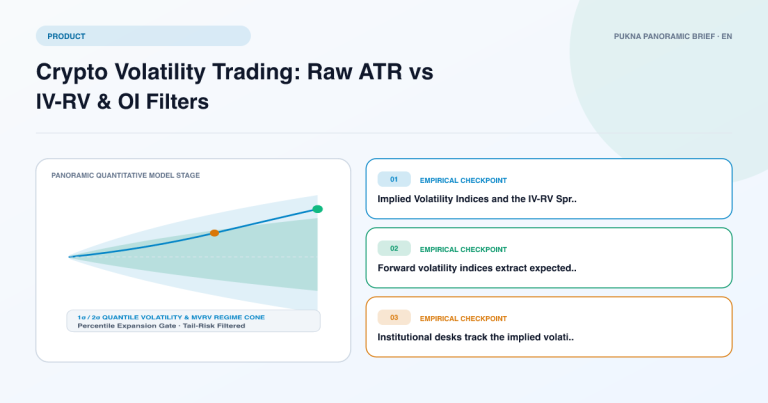
Implied volatility looks cheap or expensive only against realized movement. The implied volatility vs. realized volatility (VRP) spread subtracts trailing or forecasted realized volatility from forward ATM IV, separating raw volatility headlines from genuine pricing edge.
When 30-day ETH implied volatility sits 10 or more volatility points above realized volatility, option sellers collect a rich volatility risk premium. If IV slips below realized volatility during tight consolidations, directional buyers acquire underpriced convexity. High raw IV alone never justifies selling premium while realized swings are still accelerating.
ETH also swings harder than Bitcoin, carrying structurally higher realized volatility across market cycles. Wider daily ranges speed up near-the-money Gamma transitions and intensify Theta burn on short-dated out-of-the-money strikes. Auditing coin-margined Net Delta and 24/7 Theta decay keeps weekend decay and margin convexity from blindsiding live exposure.
Why Do Raw Put/Call Ratios, Open Interest, and Max Pain Misfire?
Options tape prints contract volume without tagging who crossed the spread. Strip out aggressor flow, ETH-unit scaling, and dealer gamma context, and three widely watched options ratios point traders in the wrong direction. Inspect the underlying microstructure before acting on any single headline.
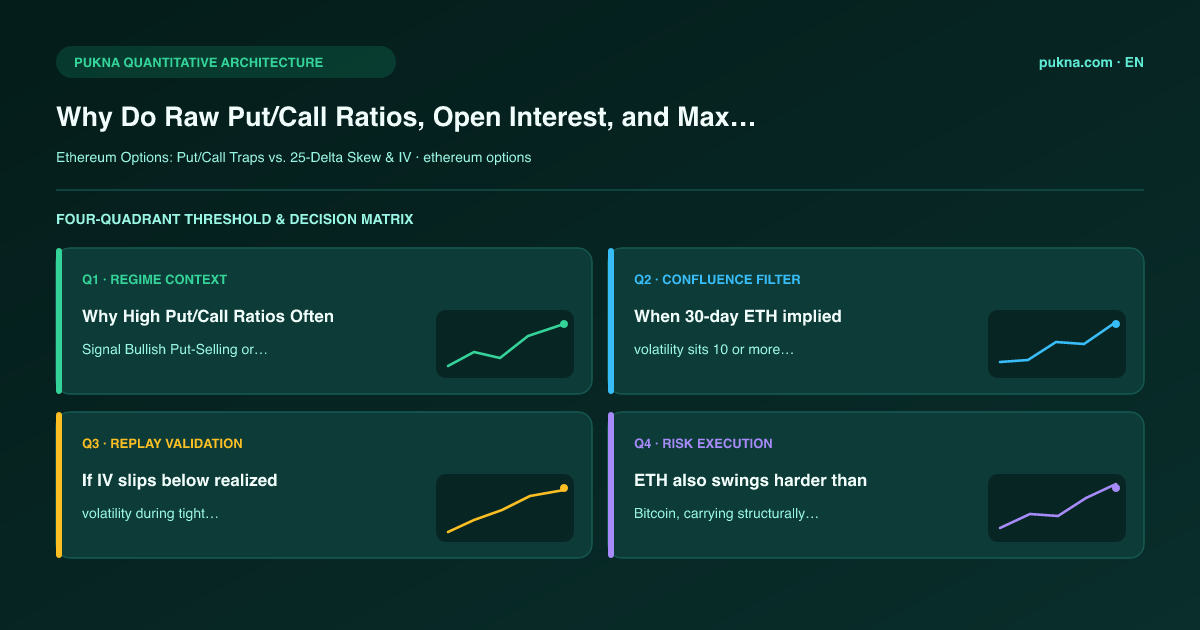
| Raw Metric Trap | Common Retail Assumption | Microstructure Counter-Example | Required Verification Filter |
|---|---|---|---|
| Put/Call Ratio > 1.0 | Traders are aggressively betting on a crash | Yield desks selling OTM puts or funds hedging spot ETH holdings | Signed taker premium flow & 25-delta skew shift |
| Rising USD Open Interest | Massive new options capital entered ETH | Flat ETH contract count inflated mechanically by rising spot prices | ETH-contract unit OI vs. spot and perp volume |
| Max Pain Strike Level | Spot ETH reliably pins to peak pain at expiry | Negative-gamma trend breakout accelerates straight past Max Pain | Dealer GEX sign & front-end IV slope |
| Single-Venue IV Spike | Global institutional panic across all ETH books | Isolated offshore weekend funding stress with muted ETF skew | Offshore-vs-ETF tail skew & macro vol check |
Why High Put/Call Ratios Often Signal Bullish Put-Selling or Spot Hedging
Every traded put has both a buyer and a seller. A Put/Call ratio above 1.0 divides total puts by calls without revealing who crossed the bid-ask spread.
During steady uptrends with rich VRP spreads, systematic yield desks actively sell out-of-the-money puts to collect volatility premium, lifting the Put/Call ratio despite a bullish or neutral-floor bias. Simultaneously, spot treasuries and validators buy protective puts against long ETH inventory without turning net short.
Separating crash hedges from yield harvesting requires signed taker premium flow, limit-orderbook (LOB) skew, and checks for taker-flow exhaustion. Genuine downside panic aligns across books simultaneously: buyers lift puts on the offer, 25-delta put skew widens, and funding deteriorates—signals verifiable via perpetual trader side concentration.
ETH-Contract vs. USD-Notional Open Interest Distortion
Headline trackers quote Open Interest in US dollars, creating severe nominal distortion during directional ETH swings. Suppose ETH rallies 35% over three weeks while active option contracts remain completely unchanged. USD Open Interest jumps 35% on paper with zero fresh positioning entering the book.
Multi-leg calendar and strike rolls compound that illusion. Traders regularly roll quarterly spreads across strikes, creating temporary headline turnover spikes that reflect portfolio maintenance rather than fresh directional conviction. Always normalize Open Interest into native ETH contract units and segment it by expiry bucket.
Pair contract-unit OI with spot volume and exchange netflow before inferring sell pressure. Rising ETH inflows alongside heavy upside call selling often reflect spot holders posting margin for covered call overwrites rather than immediate spot liquidation.
When Max Pain Breaks Down and Cross-Venue Tail Skew Diverges
Max Pain marks the strike where aggregate dollar payouts to option buyers hit their lowest value at expiry. Retail commentary turns that arithmetic into a Friday price magnet, yet the premise fails the moment volatility expands.
Strike pinning holds primarily when dealers carry large positive gamma and no external catalyst forces directional hedging. Once an inflation print, protocol event, or liquidation wave flips dealers into negative gamma, hedging flow drives ETH directly away from Max Pain.
Venue fragmentation adds another blind spot. Offshore 24/7 desks price continuous weekend jump risk and leveraged call chases, while regulated US ETH ETF options reflect institutional hedging confined to weekday equity hours. Treating an isolated offshore tail-skew kink as universal institutional consensus misreads split liquidity across crypto-native and ETF books.
How Should Traders Match Ethereum Options Strategies to Volatility Regimes?
Strategy selection begins with volatility pricing, not directional conviction. Buying naked calls or puts into stretched IV-RV spreads hands mathematical edge to Theta decay and post-event Vega crush. Selling uncapped strangles during compressed volatility invites severe negative-gamma drawdowns once quiet ranges snap.
| Options Structure | Target IV & IV-RV State | Primary Greek Profile | Max-Loss Boundary | Key Invalidation Trigger |
|---|---|---|---|---|
| Covered Call / Put Overwrite | Elevated IV rank (>65%); rich positive IV-RV | Short Vega, Positive Theta | Full ETH spot downside (upside capped) | Negative-gamma breakout through short strike |
| Vertical Credit Spread | High IV percentile; positive-gamma range | Short Vega, Positive Theta | Defined: strike width minus credit | 25-delta skew expands toward short strike |
| Vertical Debit Spread | Low-to-mid IV; clean directional catalyst | Reduced Vega/Theta drag, Net Delta | Defined: net debit paid upfront | Breakout stalls; LOB taker flow fades |
| Calendar / Diagonal Spread | Low front-end IV; normal contango curve | Long Vega, Front-End Theta Harvest | Defined: net debit paid upfront | Term structure flips into backwardation |
| Long Strangle / Straddle | Compressed IV rank (<25%); negative IV-RV | Long Gamma, Long Vega, Short Theta | Defined: total premium paid | Spot remains pinned past catalyst window |
Short-Volatility Yield Structures vs. Defined-Risk Convexity Buys
Options strategies split into two statistical engines: harvesting overpriced volatility or buying cheap convexity. Neither wins across every regime. Matching payoff geometry to the live IV-RV spread decides whether time decay pads returns or steadily bleeds the account.
Short-volatility structures—covered calls, vertical credit spreads, and iron condors—require a wide positive implied volatility vs. realized volatility (VRP) spread inside a positive-gamma range. Rich implied volatility pays sellers an upfront cushion while mean-reverting dealer hedging pins ETH inside short strikes, though accelerating realized turbulence erases that buffer fast.
Defined-risk convexity buys belong in compressed volatility regimes. When rolling 30-day IV percentiles sit near multi-month lows ahead of macro rate shifts or range breakouts, vertical debit spreads, calendars, and long strangles capture directional follow-through and Vega expansion together.
Controlling Theta Decay, Vega Crush, and Tail Drawdowns
Two execution mistakes drain options accounts faster than directional misreads. First, buyers chase weekly out-of-the-money contracts right ahead of CPI releases or central bank meetings. Even a 3% spot move in the right direction frequently finishes red when ETH misses a 6% implied move and post-event Vega crush meets final-week Theta.
The second error wipes out option sellers. Writing naked out-of-the-money puts or strangles without protective wings can look deceptively smooth during quiet weeks—until one 24/7 liquidation shock doubles implied volatility overnight and erases months of collected premium. Capping tail convexity through defined vertical spreads trades modest yield for survival during negative-gamma cascades.
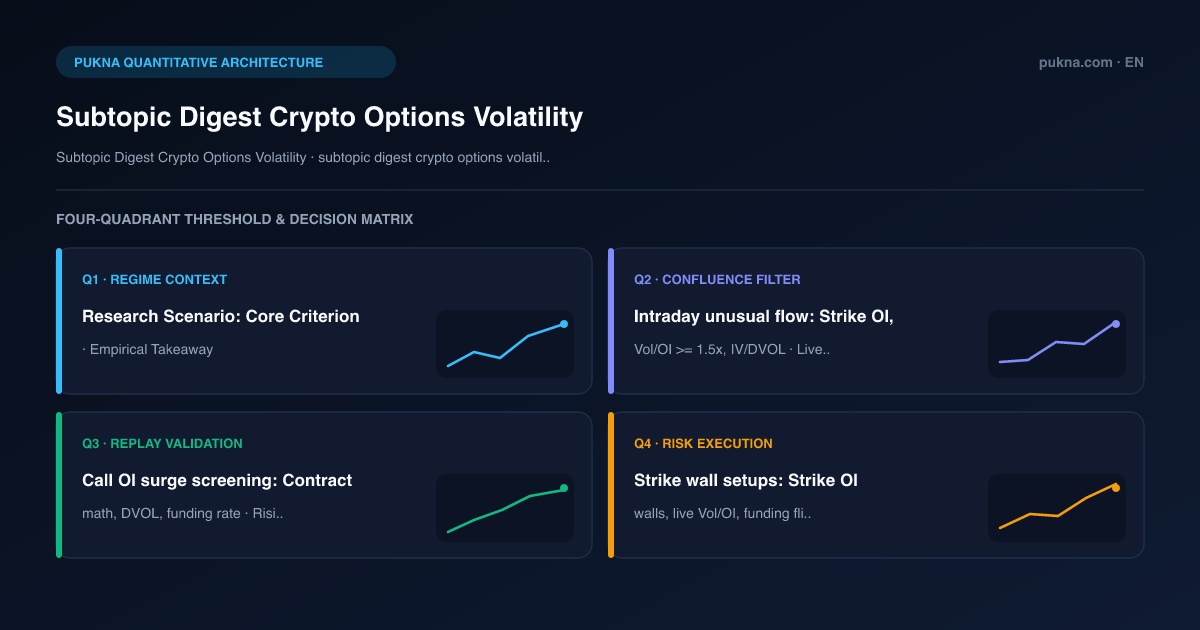
| Research Scenario | Core Criterion | Empirical Takeaway | Full Study |
|---|---|---|---|
| Selecting directional or hedged option payoffs | Payoff math, Vega exposure, expiry & max loss limits | Spot direction alone fails if DVOL crush and steep premiums erode returns. | Crypto Options Strategies: Payoffs, Implied Volatility, and Hedging → |
| Sizing 24/7 expected range & perp fragility | DVOL/BVIV daily implied move and IV-RV spread | Implied volatility prices move width, never direction; check IV-RV before sizing. | Crypto Implied Volatility: DVOL, BVIV & IV-RV Regime Risk → |
| Auditing coin-margined Greeks before entry | Net Delta, pre-priced weekend Theta & book liquidity | A 0.50 Delta is not a 50% win probability on 24/7 coin-margined desks. | Crypto Options Greeks: Raw Readings vs. Net Delta, 24/7 Theta & RV/IV → |
| Separating BTC call breakouts from macro panic | 365-day scaled DVOL vs VIX, IV percentile & term slope | High DVOL with call skew differs structurally from VIX-style macro backwardation. | Bitcoin Implied Volatility: DVOL vs VIX Regime Dashboard, 365d Scaling & VRP → |
| Choosing long vs short Vega structures | Rolling IV percentile, VRP spread & term structure | Raw IV alone misleads; filter defined-risk Vega trades by VRP and regime slope. | How to Trade Options Based on Implied Volatility: IV Percentile, VRP & Regime Filters → |
Aligning Options Structure With Underlying ETH Regime Signals
Skew prices fear, not trend durability. A clean 15m spot breakout frequently runs straight into 1d supply exhaustion, turning directional debit spreads into whipsaws and covered calls into capped upside. Options chains alone cannot resolve that timeframe conflict.
To close that verification gap across 42 major USDT pairs, cross-check underlying ETH structure via Pukna’s 15m-to-1d causal ETH signal scoring. Anchor every directional check to the P-score 50 neutral candle baseline—a 0–100 relative return-quality scale measuring composite peak and terminal return quality over horizon_bars against ordinary surrounding candles, never win probability.
Layering cross-asset macro and derivatives telemetry across 8 dimensions and 39 indicators alongside the 43-token research library completes the regime filter. Confirming macro liquidity and derivatives alignment keeps short-volatility trades from stepping directly into a structural trend reversal.
Multi-Factor Verification and Execution Risk Workflow Around Major Expiries
Expiry windows magnify every execution mistake. The final 24 hours before weekly, monthly, and quarterly 08:00 UTC expiries compress gamma rebalancing, funding swings, and thinning order-book depth into one fragile window. Running a repeatable five-step pre-trade audit filters out illiquid wing slippage and enforces strict capital boundaries.
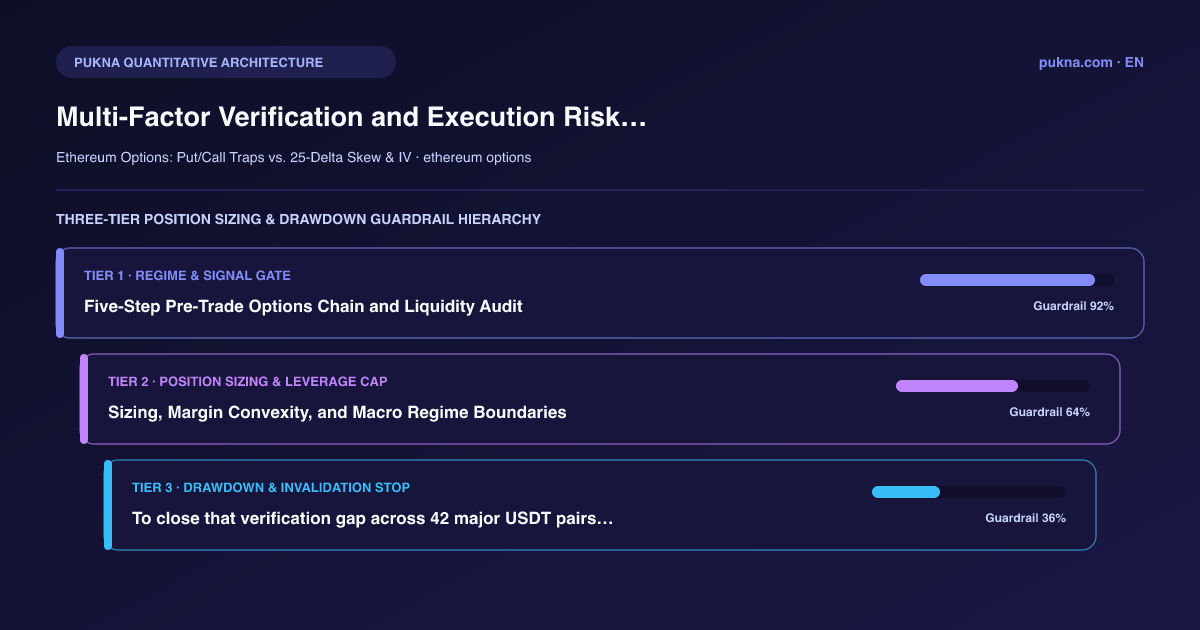
Five-Step Pre-Trade Options Chain and Liquidity Audit
- Classify Volatility State First: Benchmark 30-day ETH implied volatility percentiles against trailing realized volatility (IV-RV spread) to verify whether pricing rewards defined-risk short Vega or long convexity.
- Confirm Aggressor Flow and Skew: Cross-check 25-delta skew shifts against signed taker premium flow and LOB depth so bullish put-selling never poses as crash panic.
- Audit Wing Liquidity and Spread Cost: Measure bid-ask width as a share of option mid-price before submitting; a 5%–10% spread on thin OTM wings erodes expected edge before spot moves.
- Stress-Test Margin Convexity and 08:00 UTC Pin Risk: On coin-margined venues, model USD collateral shrinkage during drawdowns and cut naked short gamma within 24 hours of 08:00 UTC expiry.
- Check Macro and Sentiment Alignment: Ensure your payoff does not fight tightening macro liquidity or extreme daily crypto risk-appetite shifts, and set hard spot or IV invalidation levels pre-entry.
Sizing, Margin Convexity, and Macro Regime Boundaries
Macro regime shifts break isolated options metrics fast. Take a central bank rate cut paired with a 2s10s yield-curve steepener: identical policy headlines drive opposite DVOL curves, put/call skews, and funding flows depending on whether disinflation or credit stress leads.
Headline IV alone cannot separate those regimes. Selling puts into a correlation-one liquidation shock just because implied volatility looks optically high invites tail drawdowns. Inspect dollar strength, equity volatility, and perpetual funding stability alongside options skew before committing collateral.
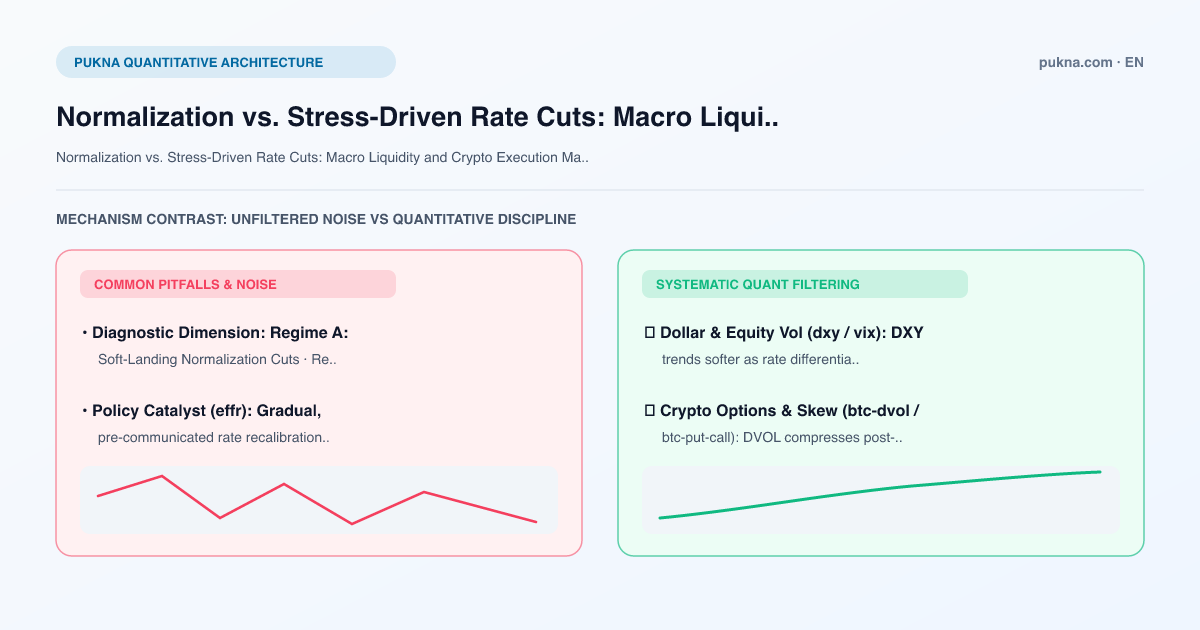
Two Rate-Cut Regimes: Benign Normalization vs. Stress-Driven Easing
| Diagnostic Dimension | Regime A: Soft-Landing Normalization Cuts | Regime B: Growth-Shock or Credit-Stress Cuts |
|---|---|---|
| Policy Catalyst (effr) | Gradual, pre-communicated rate recalibration as inflation cools without acute credit contraction. | Rapid or reactive easing triggered by labor deterioration, funding stress, or asset-market deleveraging. |
| Dollar & Equity Vol (dxy / vix) | DXY trends softer as rate differentials narrow; VIX remains contained or decays after policy clarity. | DXY spikes intermittently on safe-haven cash demand; VIX surges as cross-asset correlations rise toward one. |
| Crypto Options & Skew (btc-dvol / btc-put-call) | DVOL compresses post-meeting; put/call ratio normalizes toward balanced hedging demand. | DVOL stays elevated with upside convexity risk; put/call ratio skews defensive on downside protection. |
| Perp Positioning & Sentiment (btc-funding / fear-greed) | Funding stays moderately positive without extreme leverage; Fear & Greed recovers steadily from neutral. | Abrupt liquidations flip funding flat or negative while Fear & Greed drops into fear extremes before base formation. |
| Pukna Signal & AUTO Posture | Review 4h/1d causal signals with P scores comfortably above the 50 neutral baseline before scaling defined-risk upside or conservative 1x–2x AUTO exposure. | Wait for DVOL backwardation and negative funding spikes to stabilize before auditing 4h/1d causal entries or 1x–3x AUTO drawdown bounds. |
Benchmarking Directional ETH Timing Before Deploying Capital
Many quantitative desks pair defined-risk ETH options overlays with a directional spot or perpetual sleeve. Splitting both legs across disconnected exchange tabs invites conflicting entries and oversized drawdowns, whereas one unified regime workflow establishes stricter capital boundaries.
| Verification Stage | Fragmented Manual Screening | Multi-Factor Regime Workflow |
|---|---|---|
| Volatility & Macro Context | Reads isolated Put/Call ratios or Max Pain tables | Cross-checks IV-RV, 25-delta skew, and 39 macro/derivatives/on-chain indicators |
| Underlying ETH Timing | Chases 15m chart breakouts without higher-timeframe alignment | Filters 15m/1h/4h/1d causal signals against the P-score 50 neutral baseline |
| Leverage & Drawdown Control | Guesses position size without out-of-sample risk bounds | Audits historical equity curves, win rates, and max drawdown at 1–3x leverage |
Before pairing a directional ETH/USDT sleeve with options hedges, audit the AUTO strategy equity curve on app.pukna.com at 1–3x integer leverage. Reviewing historical win rates and max drawdown upfront locks in clear execution discipline before subscribing to real-time push alerts.
Frequently Asked Questions
What time do Ethereum options expire across major exchanges?
Major offshore crypto venues—Deribit, OKX, Bybit, and Binance—expire daily, Friday weekly, last-Friday monthly, and quarterly Ethereum options simultaneously at 08:00 UTC (13:30 IST, 03:00 EST, or 04:00 EDT). Contracts cash-settle automatically against a 30-minute time-weighted average price (TWAP) of a multi-exchange ETH spot index to curb last-second print manipulation. Watch perpetual-spot basis during that final 30-minute window, as large dealer delta unwinds often jolt short-term funding.
Does a high Ethereum Put/Call ratio mean ETH will drop?
No. A Put/Call ratio above 1.0 counts total contracts without showing who crossed the spread. Elevated put volume often reflects bullish desks selling out-of-the-money puts to harvest rich volatility risk premium, or spot treasuries hedging long ETH holdings. Verify genuine crash demand through signed taker premium flow, 25-delta put skew expansion, and weakening perpetual funding.
How do offshore crypto Ethereum options differ from ETH ETF options?
Offshore crypto options trade 24/7 and cash-settle in ETH—creating inverse margin convexity on Deribit—or linear USDT on OKX, Bybit, and Binance. Regulated US-listed ETH ETF options trade strictly during weekday equity hours and clear via the OCC with ETF-share exercise. Traders cross-hedging ETF options against offshore books must budget for Monday-open gap slippage whenever weekend liquidations move spot sharply.
When is selling Ethereum options preferable to buying calls or puts?
Selling defined-risk Ethereum options fits best when 30-day implied volatility percentiles sit elevated, the IV-RV spread prices rich volatility risk premium, and positive dealer gamma anchors range-bound trading. Skip naked short gamma when compressed IV precedes major macro catalysts. Because ETH carries wider realized drawdowns than BTC during risk-off shocks, cap tail exposure with vertical spreads and confirm higher-timeframe ETH alignment before deploying margin.
Put this into practice
Create a free account to browse live signals and test your own rules.