Contents6 sections
- How Is Bitcoin Options Max Pain Calculated Across Venues?
- Strike-Level Intrinsic Payout Formula vs. Peak Open Interest
- Why Deribit and Aggregated Options Dashboards Show Different Strikes
- How Does Dealer Delta Hedging Drive Pinning Across Market Regimes?
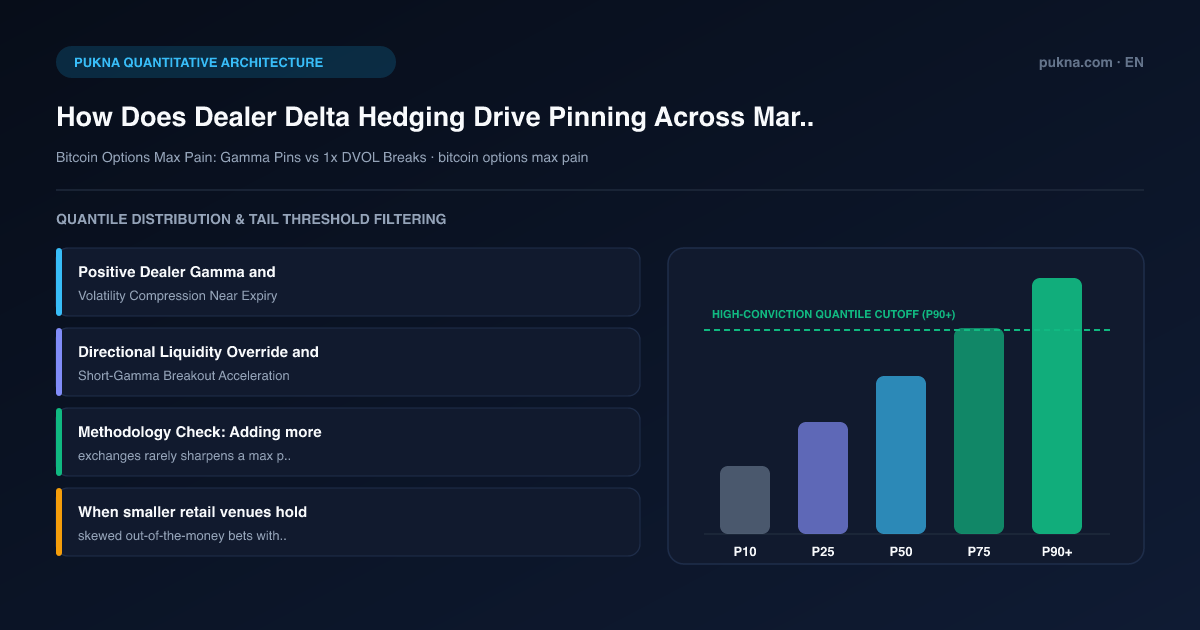
- Positive Dealer Gamma and Volatility Compression Near Expiry
- Directional Liquidity Override and Short-Gamma Breakout Acceleration
- Why Does Bitcoin Options Max Pain Fail Before Expiry?
- Weekly vs. Quarterly Notional Weight and Implied-Move Distance
- Intraday Open-Interest Rolls and Perpetual Liquidation Overrides
- How to Verify Max Pain With Multi-Factor Expiry Signals
- Four-Step Pre-Expiry Screening Protocol
- Aligning Options Expiry Structure With Multi-Timeframe Regime Signals
- Expiry Settlement Cliff vs. Post-Expiry Gamma Unwind Risk
- Handling the 08:00 UTC Settlement Cliff and Gamma Unclenching
- Drawdown Boundaries and Simulated Strategy Stress-Testing
- Frequently Asked Questions on Bitcoin Options Max Pain
Bitcoin options max pain is the expiry strike minimizing total buyer intrinsic payout—not peak open interest or a liquidation magnet. Raw multi-exchange prints misfire often: Deribit holds 70%–85% of crypto-native open interest, weekly chains carry thin notional depth, and spot breaks past 1.0x DVOL implied move quickly overwhelm passive dealer rebalancing. Before fading price toward an expiry strike, verify dealer gamma positioning, perpetual funding pressure, and broader spot liquidity across market regimes.
| Options Metric | Calculation Scope | Directional Signal Validity | Primary Analytical Blindspot |
|---|---|---|---|
| Bitcoin Options Max Pain | Strike minimizing total ITM call plus put dollar payout on one expiry | Conditional range anchor only in positive-gamma, low-DVOL windows | Ignores who holds long vs. short contracts and spot flow size |
| Peak Open-Interest Strike | Single strike carrying the highest nominal contract count | Flags dense hedging zones or psychological barriers | Skewed call/put tails often place peak OI away from the payout trough |
| Put/Call OI Ratio | Total open put contracts divided by open call contracts | Broad hedging skew and sentiment gauge across maturities | Cannot tell protective put buying apart from institutional call overwriting |
| Dealer Gamma Exposure (GEX) | Net market-maker Delta change per 1% spot move across strikes | Most direct mechanical read on volatility suppression vs. breakout speed | Depends on modeling dealer positioning accurately across venues |
How Is Bitcoin Options Max Pain Calculated Across Venues?
Max pain is an accounting exercise, not a flow indicator. For one expiry date, analysts total the in-the-money dollar payouts of every active call and put at each candidate settlement price, then pick the lowest sum. Because options liquidity splits sharply across venues, Deribit-only prints often diverge from aggregators pulling thinner retail order books.
Strike-Level Intrinsic Payout Formula vs. Peak Open Interest
High contract volume at one strike does not automatically make it max pain. At every possible settlement price, each in-the-money call or put earns its intrinsic gap—the dollar distance between settlement and strike—multiplied by open contract count. Summing those payouts across the whole chain isolates the single settlement price that leaves option buyers with the smallest combined payoff.
- Hypothetical three-strike chain: Picture a simplified expiry holding 1,400 calls at $50,000, 1,400 calls at $55,000, and 2,000 puts at $60,000.
- Peak open interest sits at $60,000: That level holds the most contracts, yet settling there pays $14.0 million to $50,000 calls and $7.0 million to $55,000 calls ($21.0 million total).
- True max pain prints at $55,000: Settling at $50,000 costs $20.0 million on puts, whereas $55,000 pays $7.0 million on calls plus $10.0 million on puts ($17.0 million total)—the payout floor despite holding fewer contracts.
Raw contract counts mislead fast. When call interest spreads across several upside strikes while protective puts cluster at one level, aggregate dollar payouts pull the trough toward an interior strike. Worse, an open-interest table never shows who is long versus short—which is why auditing coin-margined Delta and Gamma exposure mechanics comes before projecting expiry pull.
Why Deribit and Aggregated Options Dashboards Show Different Strikes
Why do two screens print different targets on Friday morning? Deribit holds roughly 70%–85% of crypto-native Bitcoin options open interest, settling coin-margined European contracts against a 08:00 UTC index average. Aggregators such as Coinglass merge Deribit with USDT-margined books on Binance, OKX, and Bybit, while regulated CME and U.S. spot ETF options settle separately during New York hours.
| Options Data Feed | Open Interest Scope | Margin & Settlement Spec | Impact on Max Pain Print |
|---|---|---|---|
| Deribit Single-Venue | Dominant 70%–85% crypto-native options liquidity share | Coin-margined BTC; 08:00 UTC Friday TWAP settlement | Cleanest proxy for offshore market-maker delta-hedging flows |
| Aggregated Crypto Trackers | Deribit merged with Binance, OKX, and Bybit chains | Mixed coin-margined and USDT-settled contract pools | Drifts 1–2 strikes when retail venues carry skewed OTM open interest |
| CME & Spot ETF Options | Regulated institutional futures and U.S. ETF option books | USD cash or ETF shares; New York afternoon expiry windows | Absent from offshore feeds yet drives heavy U.S.-session spot hedging |
Methodology Check: Adding more exchanges rarely sharpens a max pain print. When smaller retail venues hold skewed out-of-the-money bets without matching market-maker gamma depth, blending feeds drags the arithmetic strike away from where institutional desks actually hedge spot Bitcoin.
How Does Dealer Delta Hedging Drive Pinning Across Market Regimes?
Strike pinning comes from mechanical risk hedging, not backroom manipulation. The same distance to max pain behaves differently across volatility regimes: positive dealer gamma dampens swings inside range-bound tape, whereas sustained spot inflows or negative gamma turn the strike zone into a launchpad.
Positive Dealer Gamma and Volatility Compression Near Expiry
Options market makers run delta-neutral books rather than directional bets on Bitcoin’s settlement price. When dealers sit long positive dealer gamma exposure (GEX) near crowded strikes, rallying spot pushes their book net long Delta, forcing mechanical selling of spot or perpetuals into strength. Pullbacks push them short Delta, triggering automatic dip buying that creates volatility pinning.
That hedging drag peaks inside the final 24–48 hours before 08:00 UTC settlement. In this Regime A window, muted DVOL daily implied move and IV-RV spreads keep price within 1.0x expected range of a heavyweight monthly or quarterly strike. Spot turnover then stacks a tight point of control (POC)—the price band absorbing peak traded volume—locking in mean reversion as dealers lean against intraday breaks.
Directional Liquidity Override and Short-Gamma Breakout Acceleration
In Regime B, heavy spot ETF inflows, macro rate surprises, or aggressive futures buying dwarf the Delta hedges dealers need to rebalance. Market makers still hedge their books, yet larger directional orders absorb that counter-trend liquidity in minutes. Spot flow wins.
Now flip the dealer book. In Regime C, aggressive call chasing or panic put buying leaves market makers net short gamma across active strikes—meaning price moves force them to chase momentum instead of fading it. Dealers buy perpetuals into upside breaks and dump into sell-offs, fueling short-gamma squeezes that carry Bitcoin far past max pain.
| Market Regime | DVOL & Perpetual Basis | Dealer Gamma Sign | Spot vs. Options Flow | Pinning Reliability |
|---|---|---|---|---|
| Regime A: Range Compression | Contained DVOL; neutral perpetual funding and flat basis | Net Positive Gamma (Long GEX) | Options hedging rivals intraday spot turnover | Highest within 24–48h and 1.0x implied move |
| Regime B: Directional Trend | Rising DVOL; firm positive or negative basis trend | Neutral or overwhelmed positive GEX | Spot ETF and perpetual flow swamps options delta | Low; spot trends cleanly through expiry strikes |
| Regime C: Short-Gamma Squeeze | Spiking DVOL; stretched funding and inverted IV term slope | Net Negative Gamma (Short GEX) | Pro-cyclical dealer hedging amplifies spot breaks | Inverted; strike zone acts as breakout catalyst |
Why Does Bitcoin Options Max Pain Fail Before Expiry?
Bare max pain prints fail whenever four structural thresholds break: thin weekly notional weight, spot drift beyond 1.0x DVOL implied move, mid-week block rolls, or perpetual liquidation cascades. Trade the strike without checking those four failure modes, and mean-reversion fades turn expensive fast.
Weekly vs. Quarterly Notional Weight and Implied-Move Distance
Routine weekly Bitcoin expiries often carry just 10%–20% of the notional open interest stacked in quarter-end March, June, September, and December settlements. Expecting a light weekly chain to anchor billions in daily spot and perpetual turnover invites chronic false signals. Size matters first.
Distance matters only relative to implied volatility, never in raw percentage terms. Desks estimate remaining expiry range by scaling annualized DVOL by the square root of remaining days over 365. Once spot trades 1.0x–1.5x that implied move away from max pain, option gamma at the strike decays rapidly and dealer rebalancing loses its hold on price.
Intraday Open-Interest Rolls and Perpetual Liquidation Overrides
Monday screenshots go stale fast. Throughout expiry week, institutional desks roll near-dated exposure into next-month maturities or trade block calendar spreads, migrating open interest across strikes within hours. A strike marked down on Monday morning can shift two or three increments by Thursday afternoon, leaving traders defending an empty level.
Perpetual futures leverage breaks pinning even faster when crowded funding meets sudden 10-year TIPS real yield repricing—tightening global liquidity discount rates—or stretched perpetual trader directional leverage imbalance. Forced margin calls then fire cascading market orders. Those liquidations sweep resting book depth far faster than options dealers rebalance Delta, blowing clean through max pain.
| Invalidation Trigger | Observable Threshold Cue | Underlying Market Mechanism | Operational Adjustment |
|---|---|---|---|
| Weekly Expiry Dilution | Expiry holds <20% of quarterly Deribit open interest | Dealer delta rebalancing is too small relative to daily spot turnover | Downgrade max pain weight; prioritize spot trend structure |
| Implied-Move Breach | Spot sits >1.0x–1.5x remaining DVOL implied move from strike | Deep ITM/OTM options lose gamma sensitivity near expiry | Cancel pinning bias; evaluate directional continuation |
| Intraday OI Migration | Block rolls shift dominant strike >1 increment mid-week | Expiring gamma moves into next-month maturities before Friday | Recompute chain daily; discard early-week screenshots |
| Perp Liquidation Cascade | Funding extremes plus rising perp OI into macro rate release | Forced margin liquidations overpower passive option delta hedges | Step aside from fades; wait for the liquidation flush to clear |
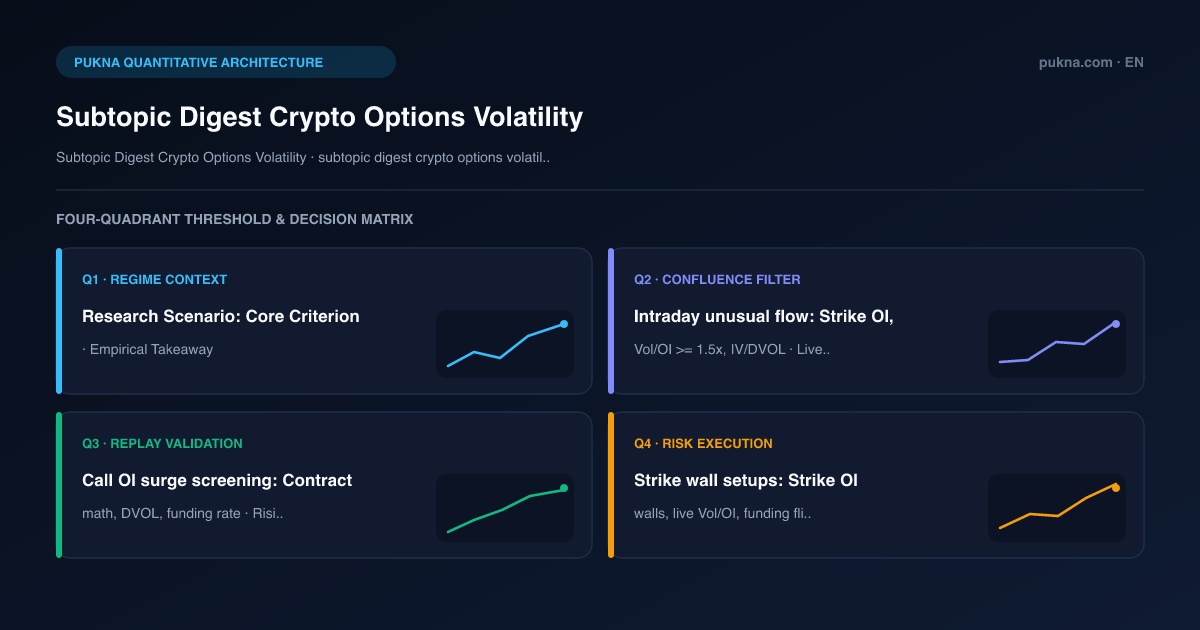
| Research Scenario | Core Criterion | Empirical Takeaway | Full Study |
|---|---|---|---|
| Selecting directional or hedged option payoffs | Payoff math, Vega exposure, expiry & max loss limits | Spot direction alone fails if DVOL crush and steep premiums erode returns. | Crypto Options Strategies: Payoffs, Implied Volatility, and Hedging → |
| Sizing 24/7 expected range & perp fragility | DVOL/BVIV daily implied move and IV-RV spread | Implied volatility prices move width, never direction; check IV-RV before sizing. | Crypto Implied Volatility: DVOL, BVIV & IV-RV Regime Risk → |
| Auditing coin-margined Greeks before entry | Net Delta, pre-priced weekend Theta & book liquidity | A 0.50 Delta is not a 50% win probability on 24/7 coin-margined desks. | Crypto Options Greeks: Raw Readings vs. Net Delta, 24/7 Theta & RV/IV → |
| Separating BTC call breakouts from macro panic | 365-day scaled DVOL vs VIX, IV percentile & term slope | High DVOL with call skew differs structurally from VIX-style macro backwardation. | Bitcoin Implied Volatility: DVOL vs VIX Regime Dashboard, 365d Scaling & VRP → |
| Choosing long vs short Vega structures | Rolling IV percentile, VRP spread & term structure | Raw IV alone misleads; filter defined-risk Vega trades by VRP and regime slope. | How to Trade Options Based on Implied Volatility: IV Percentile, VRP & Regime Filters → |
How to Verify Max Pain With Multi-Factor Expiry Signals
Turning max pain into a usable screen takes four gates in sequence: confirm Deribit expiry weight, measure distance against remaining DVOL range, audit macro and liquidity conditions, and check spot structure across timeframes. Skip one gate, and a clean-looking strike turns into a trap.
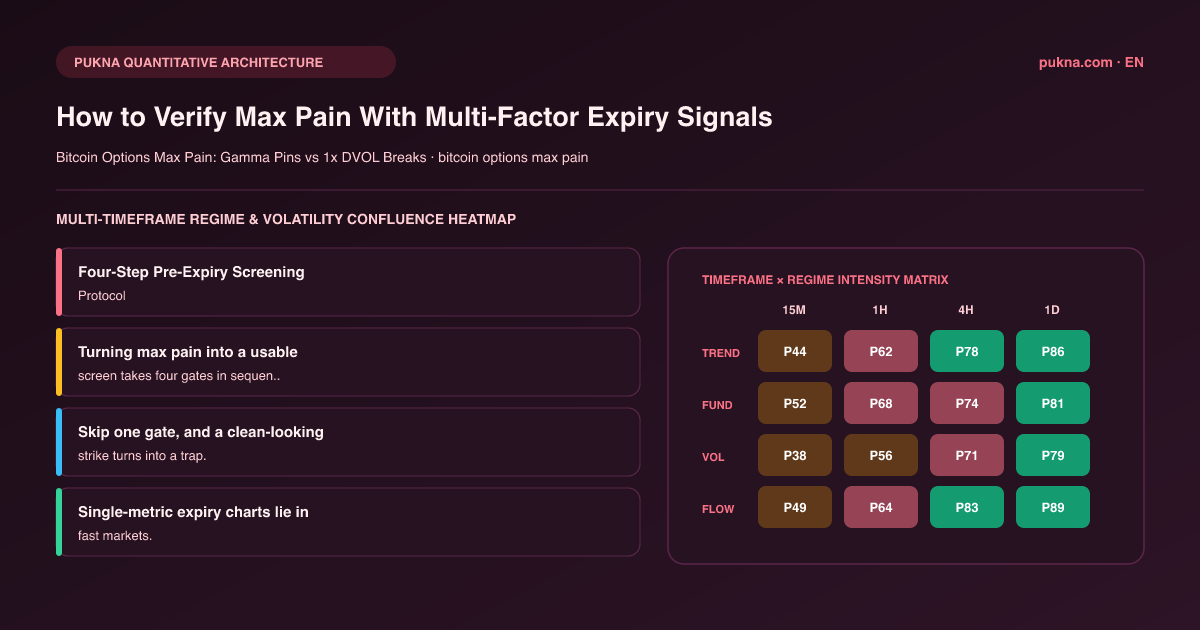
Four-Step Pre-Expiry Screening Protocol
Single-metric expiry charts lie in fast markets. A clean Deribit strike means little if Treasury yields jump or perpetual funding overheats on the same afternoon. Run these four filters in sequence before committing risk around settlement.
- Filter Venue Share and Expiry Tier: Check Deribit open-interest share first, then confirm that the upcoming 08:00 UTC Friday expiry is a heavyweight monthly or quarterly settlement rather than a thin weekly chain.
- Benchmark Distance Against DVOL and Basis: Compare current spot distance from max pain against remaining DVOL implied range, Put/Call open-interest skew, and perpetual basis slope to confirm positive gamma still anchors intraday swings.
- Cross-Check Macro, Liquidity, and Sentiment Regimes: Check 10-year TIPS real yield shifts alongside stablecoin supply ratio (SSR), which tracks sideline dry powder against spot market cap. Pair those flows with T+1 tokenized Treasury collateral and rate flows and daily crypto risk-appetite and panic readings before assuming range compression.
- Confirm Multi-Timeframe Spot Structure: Inspect candle closes across 15m, 1h, 4h, and 1d charts to see whether price rejects extremes back toward the strike or builds sustained acceptance away from it.
Aligning Options Expiry Structure With Multi-Timeframe Regime Signals
Juggling five browser tabs breaks down during live expiry swings. Manually reconciling options chains, perpetual basis, macro rates, and spot momentum adds lag right when a regime flips. To keep that audit in one view, some desks benchmark macro, liquidity, derivatives, and on-chain states across Pukna’s 8-dimension environment research library (39 indicators) and 43-token research library before trusting any expiry strike.
Pairing expiry structure with 4-timeframe causal candlestick signals (15m/1h/4h/1d) across 42 major USDT pairs checks whether BTC/USDT order flow confirms mean reversion or breakout follow-through. Each signal carries a P relative quality score (0–100) across horizon_bars, anchored at a 50 neutral baseline of ordinary surrounding candles to rank combined best-return and terminal-return quality. It is never a win-rate probability.
| Verification Stage | Single-Metric Expiry Watching | Multi-Factor Quantitative Workflow | Decision Discipline Impact |
|---|---|---|---|
| Venue & Expiry Weight | Reads raw aggregated headline number on any Friday | Prioritizes Deribit OI share and monthly/quarterly tiers | Filters out low-notional weekly noise |
| Volatility Distance | Assumes fixed percentage pull regardless of IV | Checks strike distance inside 1.0x remaining DVOL move | Stops traders from fading active breakouts |
| Cross-Market Regime | Ignores funding, basis, macro rates, and SSR liquidity | Audits 8-dimension environment indicators and BTC profile | Flags macro and perp liquidation overrides early |
| Entry Quality Filter | Enters blindly against intraday spot momentum | Screens 15m/1h/4h/1d causal signals via P-score > 50 baseline | Anchors entries in relative return quality |
Expiry Settlement Cliff vs. Post-Expiry Gamma Unwind Risk
At 08:00 UTC on settlement Friday, concentrated dealer gamma vanishes at once. Once that hedging drag lifts, spot often breaks into 6–24 hours of directional expansion. Controlling tail risk here requires capping leverage at 1x–3x integer tiers, honoring DVOL invalidation stops, and auditing historical drawdowns before deploying capital.
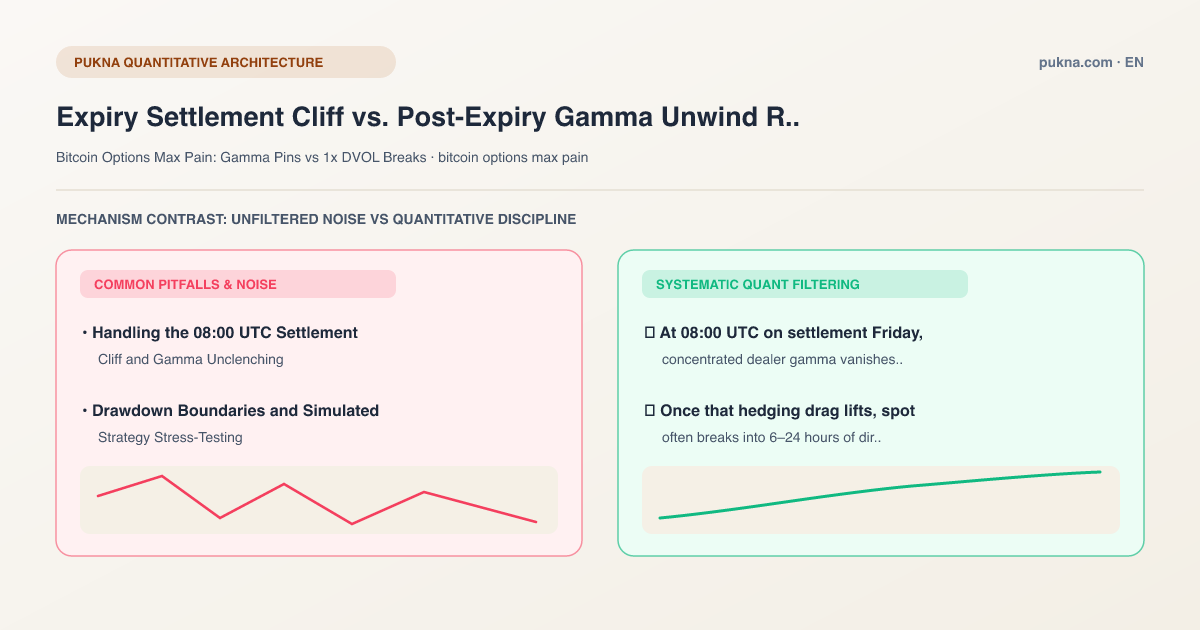
Handling the 08:00 UTC Settlement Cliff and Gamma Unclenching
Pinning does not fade gracefully—it snaps off at settlement. Deribit sets expiry settlement using a 30-minute time-weighted index average from 07:30 to 08:00 UTC. As expiring contracts clear, dealers unwind residual spot and perpetual hedges, triggering an opex-pin release and post-expiry delta-hedge unwind that drives sharp directional repricing.
Three quiet expiry Fridays can pay steady range scalps, only for one short-gamma squeeze or post-settlement unwind to wipe out a quarter’s gains before London lunch. That negative skew punishes blind fades. Checking IV percentile and volatility risk premium filters flags when cheap convexity favors breakout continuation over selling the range.
Drawdown Boundaries and Simulated Strategy Stress-Testing
Never size up simply because spot sits a few percent away from max pain ahead of a quarterly expiry. Anchor risk to worst-case volatility expansion and keep systematic exposure inside conservative 1x–3x integer leverage bounds. Strike distance is never a position-sizing rule.
- Settlement Cutoff Buffer: Trim or flatten pure pinning trades ahead of the 07:30–08:00 UTC TWAP window to sidestep opex-pin release whipsaws.
- DVOL Invalidation Stop: Drop the mean-reversion bias immediately if spot closes past 1.0x–1.25x remaining DVOL implied move on expanding perpetual volume.
- Drawdown-First Leverage Cap: Keep expiry-week exposure inside 1x–3x integer leverage sized to your worst acceptable historical drawdown.
Paper rules look tidy until a quarterly volatility spike hits. Before subscribing to live alerts, test how any expiry-week framework held up across past BTC/USDT stress cycles. Pukna’s AUTO 1–3x integer-leverage equity-curve simulation lets traders audit historical win rates and max drawdown first, then enable real-time push alerts only if the risk profile fits.
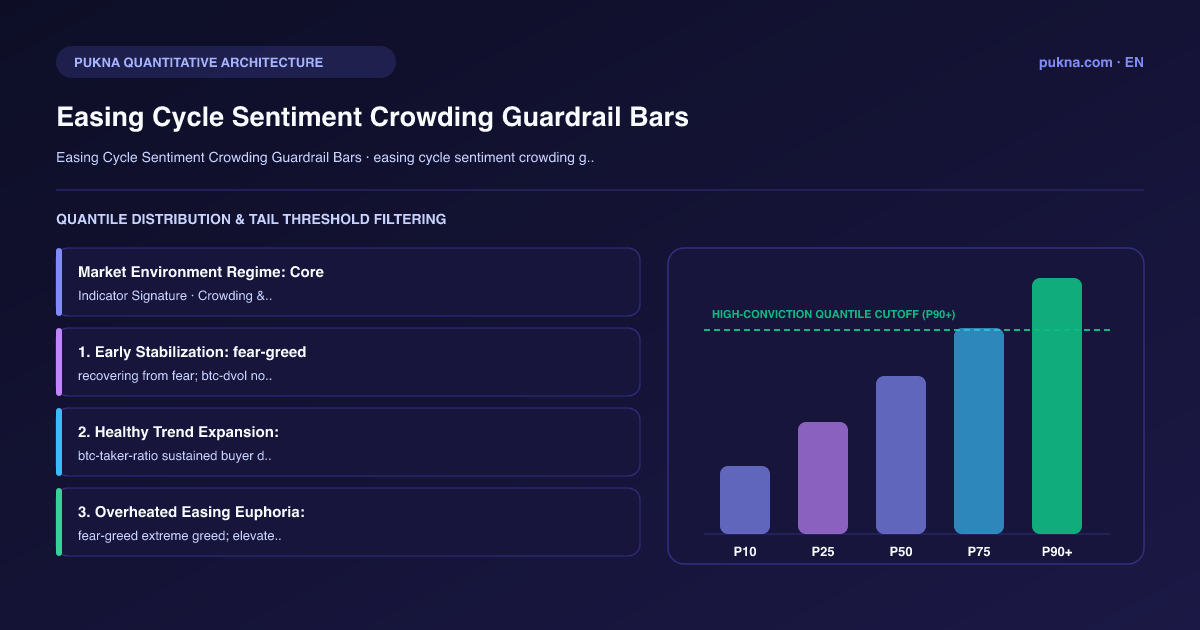
Easing Cycle Sentiment, Derivatives Crowding & Leverage Guardrails
| Market Environment Regime | Core Indicator Signature | Crowding & Tail-Risk Meter | Execution & AUTO Simulation Posture |
|---|---|---|---|
| 1. Early Stabilization | fear-greed recovering from fear; btc-dvol normalizing; btc-funding near neutral | Low Crowding | Evaluate 4h/1d causal buy signals with P-score > 50; test 2x–3x AUTO simulation only after reviewing historical max drawdown. |
| 2. Healthy Trend Expansion | btc-taker-ratio sustained buyer dominance; balanced btc-long-short; moderate btc-put-call | Moderate Load | Prioritize higher P-score quantile signals (relative return quality over horizon_bars); validate equity curve consistency in AUTO 1x–2x. |
| 3. Overheated Easing Euphoria | fear-greed extreme greed; elevated positive btc-funding; crowded btc-long-short | High Squeeze Risk | Tighten P-score threshold across 15m/1h/4h; cap AUTO simulation at 1x to prevent funding-driven shakeout drawdowns. |
| 4. Macro Shock / Vol Spike | btc-dvol surging; defensive btc-put-call skew; forced perpetual de-leveraging | Tail-Risk Alert | Suspend mechanical pinning fades; wait for post-expiry volatility compression and audit 1x AUTO max-drawdown limits first. |
Frequently Asked Questions on Bitcoin Options Max Pain
Why do Deribit and Coinglass show different Bitcoin options max pain prices?
Deribit computes max pain solely from its own coin-margined order book, which captures 70%–85% of crypto-native open interest. Aggregators like Coinglass blend Deribit with USDT-margined contracts from Binance, OKX, and Bybit. Differences in venue mix, margin specs, and update intervals often pull the composite strike 1–2 increments away from Deribit’s primary dealer-hedging hub.
Does Bitcoin price always move toward max pain before expiry?
No. Max pain is never a guaranteed price magnet. Pinning pressure shows up mainly during range-bound, positive-gamma regimes inside the final 24–48 hours before a heavyweight monthly or quarterly settlement. Strong ETF inflows, rate surprises, thin weekly notional weight, and short-gamma squeezes frequently drive Bitcoin straight through the strike.
When do Bitcoin options expire and why does volatility spike afterward?
Crypto-native Bitcoin options on Deribit and major offshore venues expire Fridays at 08:00 UTC, settled off a 07:30–08:00 UTC time-weighted index average. The moment contracts clear, concentrated dealer gamma disappears. Without counter-trend market-maker hedging dampening intraday swings, residual delta-hedge unwinds and fresh directional flow often trigger 6–24 hours of sharper volatility.
How is Bitcoin max pain different from Put/Call ratio and Gamma Exposure?
Max pain locates the single strike minimizing total buyer intrinsic payout, ignoring who sits long versus short. By contrast, the Put/Call ratio merely divides puts by calls with zero payout modeling. Dealer Gamma Exposure (GEX) tracks how aggressively market makers must rebalance spot hedges per 1% move—showing directly whether dealer flow pins price or fuels breakouts.
Put this into practice
Create a free account to browse live signals and test your own rules.