Contents6 sections
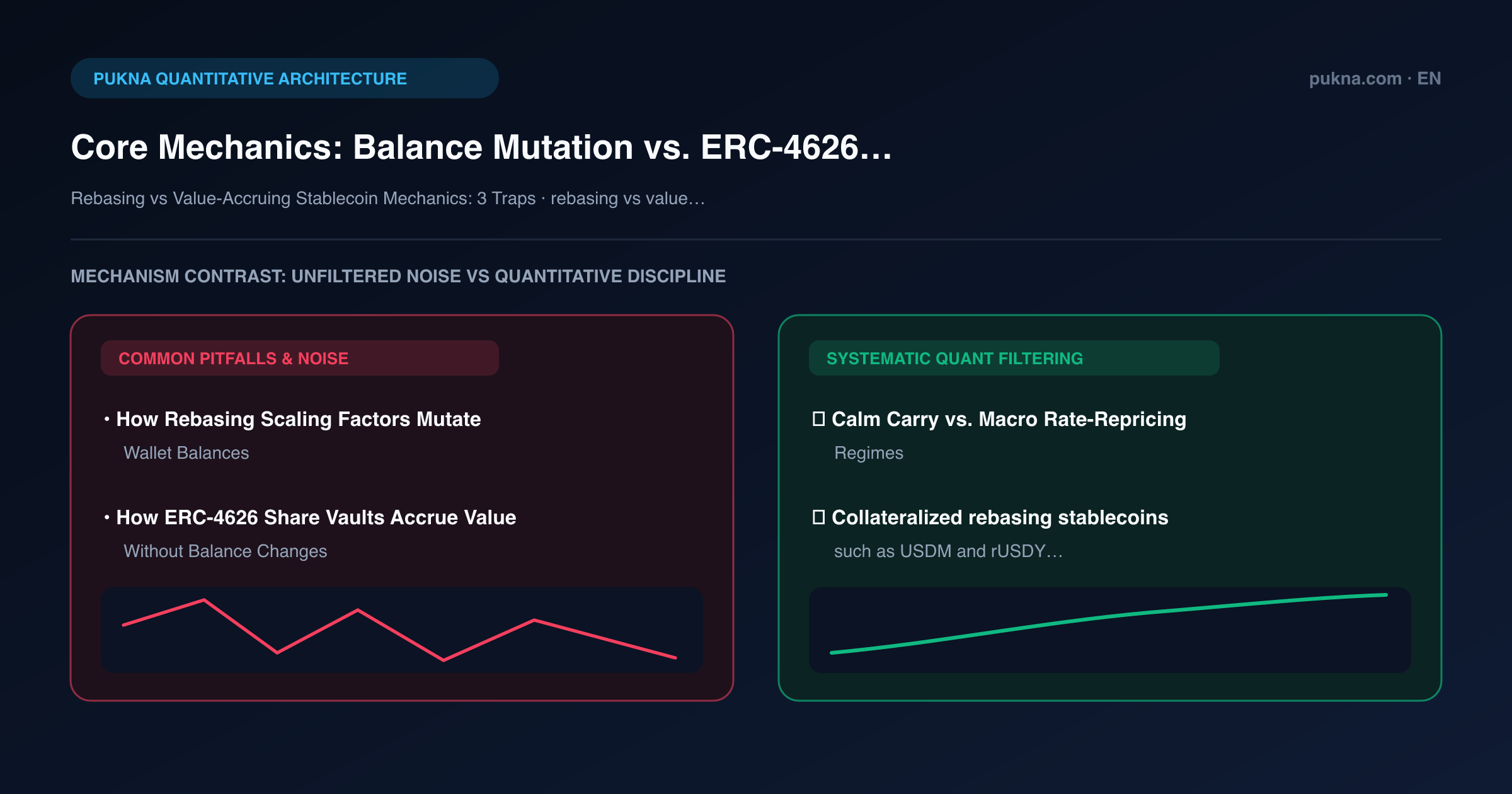
- Core Mechanics: Balance Mutation vs. ERC-4626 Exchange-Rate Accrual
- How Rebasing Scaling Factors Mutate Wallet Balances
- How ERC-4626 Share Vaults Accrue Value Without Balance Changes
- Multi-Regime Behavior: Calm Carry, Rate Shifts, and Liquidity Stress
- Calm Carry vs. Macro Rate-Repricing Regimes
- Redemption Queues and DEX Discount Dynamics Under Volatility Spikes
- DeFi Composability, Wrapper Trade-Offs, and Accounting Friction
- Why Non-Rebase-Aware AMMs and Lending Pools Leak Yield
- Non-Rebasing Wrappers (wUSDM, USDY) and Liquidity Fragmentation
- Cost-Basis Fragmentation and Stablecoin vs. Savings Valuation
- Raw-Metric Failure Cases: Backtest Distortions and Quant Blind Spots
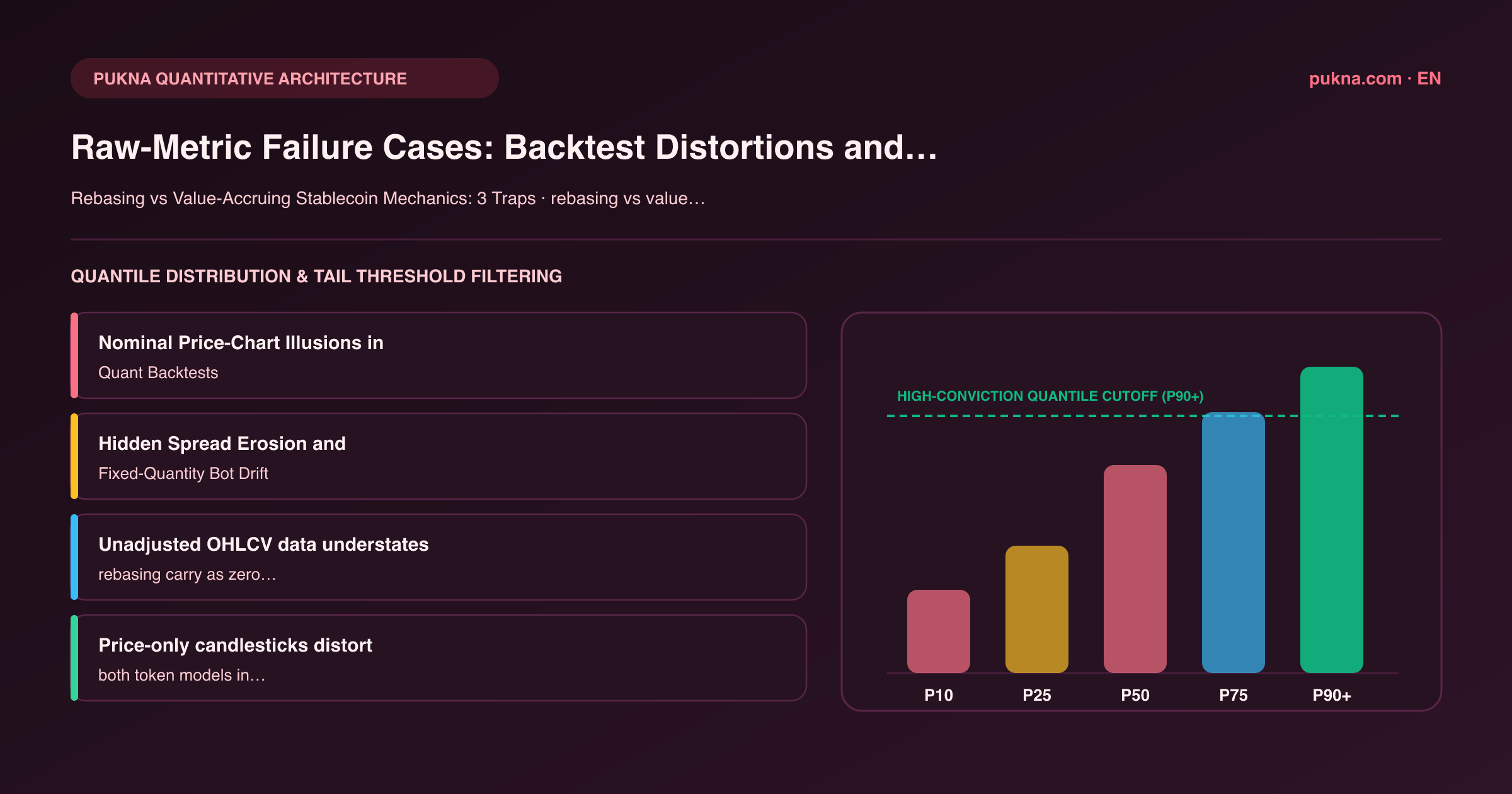
- Nominal Price-Chart Illusions in Quant Backtests
- Hidden Spread Erosion and Fixed-Quantity Bot Drift
- Policy Liquidity Regimes vs. Crypto Derivatives & Carry Posture
- Quantitative Selection and Capital Allocation Verification Workflow
- Architecture Selection Rules by Operational Mandate
- Benchmarking Active Strategy Drawdowns Against Passive Stablecoin Carry
- Frequently Asked Questions
Reserve-backed rebasing stablecoins (USDM, rUSDY) anchor near $1.00 by mutating wallet balances, whereas ERC-4626 vaults (sDAI, USDY) raise share NAV without AMPL-style supply contractions. An identical 5.00% headline APY therefore prints opposite nominal price charts, leaks yield in cached-balance AMM pools, and forfeits 15–50 bps whenever 24/7 selloffs force instant DEX exits. Allocators must verify smart-contract composability, live secondary DEX exit depth, and macro liquidity regimes before sizing stablecoin carry.
Core Mechanics: Balance Mutation vs. ERC-4626 Exchange-Rate Accrual
Both models can pass through identical reserve yield, yet balance mutation and NAV accrual separate every downstream workflow.
| Mechanism | Rebasing Stablecoins | Value-Accruing ERC-4626 |
|---|---|---|
| Wallet Balance | Grows periodically via scaling | Fixed until swap or redemption |
| Unit Price | Anchors near $1.00 parity | Rises above $1.00 with NAV |
| Token Standard | Custom ERC-20 scalingFactor | ERC-4626 tokenized vault shares |
| DeFi Fit | Breaks cached-balance pools | Native AMM and lender support |
| Tracking Lots | Frequent micro-increments | Single lot until disposal |
| Examples | USDM, rUSDY (unlike AMPL) | sDAI, USDY, wUSDM |
How Rebasing Scaling Factors Mutate Wallet Balances
Collateralized rebasing stablecoins such as USDM and rUSDY store fixed internal shares inside the contract and multiply them by a rising global scalingFactor at each distribution tick. Calling balanceOf updates balances without on-chain transfers. Unlike unbacked elastic-supply tokens such as AMPL, reserve-backed designs do not run negative rebases to cut wallet balances during market selloffs. Positive Treasury and repo income expands token supply daily while spot pricing anchors near $1.00.
How ERC-4626 Share Vaults Accrue Value Without Balance Changes
ERC-4626 value-accruing vaults leave your wallet share balance unchanged after minting instead of multiplying units. As T-bill or money-market interest compounds inside the vault, calling convertToAssets quotes an ever-higher redemption price above the original $1.00 par value. A $1.05 market quote signals accrued carry, not depegging. Allocating $10,000 at 5.00% APY for 365 days yields either 10,500 rebasing tokens priced near $1.00 or 10,000 fixed ERC-4626 shares redeemable at $1.05 via convertToAssets. Gross value matches at $10,500 until liquidity cracks.
Multi-Regime Behavior: Calm Carry, Rate Shifts, and Liquidity Stress
Headline APY parity breaks once macro rates shift or forced liquidations drain DEX depth, turning carry into basis risk.
| Market Regime | Rebasing (USDM / rUSDY) | ERC-4626 (sDAI / USDY) | Execution Impact |
|---|---|---|---|
| Calm Carry | Daily balance steps near $1.00 | Smooth convertToAssets growth | 1–5 bps DEX spreads |
| Rate Repricing | Daily rebase increment adjusts | NAV accrual slope bends | 5–15 bps reset basis |
| Liquidity Crunch | Breaks visual $1.00 peg | Trades below on-chain NAV | 15–50+ bps exit loss |
Calm Carry vs. Macro Rate-Repricing Regimes
Quiet carry regimes reward operational fit over headline APY. Corporate treasuries favor $1.00 rebasing units for dollar invoicing, whereas DeFi desks hold ERC-4626 shares that compound untouched inside collateral vaults. Macro rate shifts break that calm. Reserve yields reset unevenly during term premium repricing or a jump in the DeFi lending utilization rate, shifting daily rebase increments faster than ERC-4626 vaults bend their accrual slopes. Secondary DEX spot quotes often lag those resets by 5–15 bps, echoing primary NAV tracking error mechanics.
Redemption Queues and DEX Discount Dynamics Under Volatility Spikes
Liquidity stress turns gross yield parity into an exit-cost race. Desks dump yield-bearing stablecoins into secondary DEX pools during a sharp funding-carry unwind instead of waiting through T+1 issuer redemption queues. Rebasing coins break $1.00 visually, while ERC-4626 shares trade below on-chain convertToAssets NAV. Taking a 35 bps secondary exit discount ($350 per $100,000 clip) erases 25 days of 5.00% gross carry, mirroring order-book depth during liquidity crunches across thin pools. Even in calm pools, can legacy DeFi contracts hold mutating balances safely?
DeFi Composability, Wrapper Trade-Offs, and Accounting Friction
Smart contracts that cache deposit balances silently leak rebasing yield, forcing issuers to wrap ERC-4626 shares and fragment liquidity.
| Dimension | Native Rebasing | Wrapped ERC-4626 | Cash Savings |
|---|---|---|---|
| Pool Support | Needs custom hooks | Native ERC-20 fit | Off-chain only |
| Liquidity Depth | Split by wrappers | Deepest DeFi routing | Bank transfer limits |
| Friction Cost | Zero wallet wrap gas | Wrap gas or spread | Wire or ACH lag |
| Lot Profile | Frequent micro-lots | One lot until exit | Periodic interest |
Why Non-Rebase-Aware AMMs and Lending Pools Leak Yield
Legacy AMMs, money markets, and perpetual margin engines record your deposited token quantity inside internal storage variables at entry and never poll subsequent balanceOf expansions automatically. Overnight positive rebases expand pool reserves without crediting you. Searchers can skim that unallocated surplus through permissionless skim or sync calls unless the protocol ships custom rebase accounting hooks. Static ERC-4626 share counts close that leak.
Non-Rebasing Wrappers (wUSDM, USDY) and Liquidity Fragmentation
Issuers restore standard ERC-20 composability by locking native rebasing supply inside ERC-4626 wrappers like wUSDM or USDY to mint fixed vault shares. Two tickers inevitably split secondary pool depth. Fragmented liquidity widens impact on six-figure clips, forcing desks to price wrap gas against live DEX slippage by measuring real bid-ask spread depth. Thin secondary order books quickly erase several weeks of marginal wrapper yield during exits.
Cost-Basis Fragmentation and Stablecoin vs. Savings Valuation
Accounting friction splits sharply across the two token standards. Daily rebases append 365 non-trade micro-lots each year, whereas ERC-4626 shares keep one cost-basis lot until disposal, though local tax rules require professional counsel. Pricing either token against bank cash savings means weighing 24/7 on-chain settlement against smart-contract bugs, custodian queues, and DEX exit spreads. Do raw OHLCV price charts capture any of these frictions?
Raw-Metric Failure Cases: Backtest Distortions and Quant Blind Spots
Unadjusted OHLCV data understates rebasing carry as zero return while tricking trend models into chasing passive ERC-4626 exchange-rate drift.
Nominal Price-Chart Illusions in Quant Backtests
Price-only candlesticks distort both token models in opposite directions. A rebasing stablecoin prints a flat line near $1.00 all year, forcing unadjusted engines to log 0.00% return without multiplying by cumulative scalingFactor. ERC-4626 vaults trigger the exact opposite bug. Naive momentum scripts mistake steady convertToAssets climb for directional alpha, repeating classic moving-average trend filter pitfalls on pure reserve carry. Normalize both stablecoin models into total-return indices before testing any directional strategy rule.
Hidden Spread Erosion and Fixed-Quantity Bot Drift
Live execution friction compounds those historical chart distortions the moment automated strategies deploy capital. Models backtested on primary issuer NAV ignore the 15–50+ bps secondary DEX discounts that open whenever forced liquidations hit thin stablecoin pools. Static-size basis bots also drift silently on rebasing collateral. Fixed-quantity order loops accumulate unintended net-long inventory as balanceOf expands overnight, so every bot leg must poll live balances before sizing.
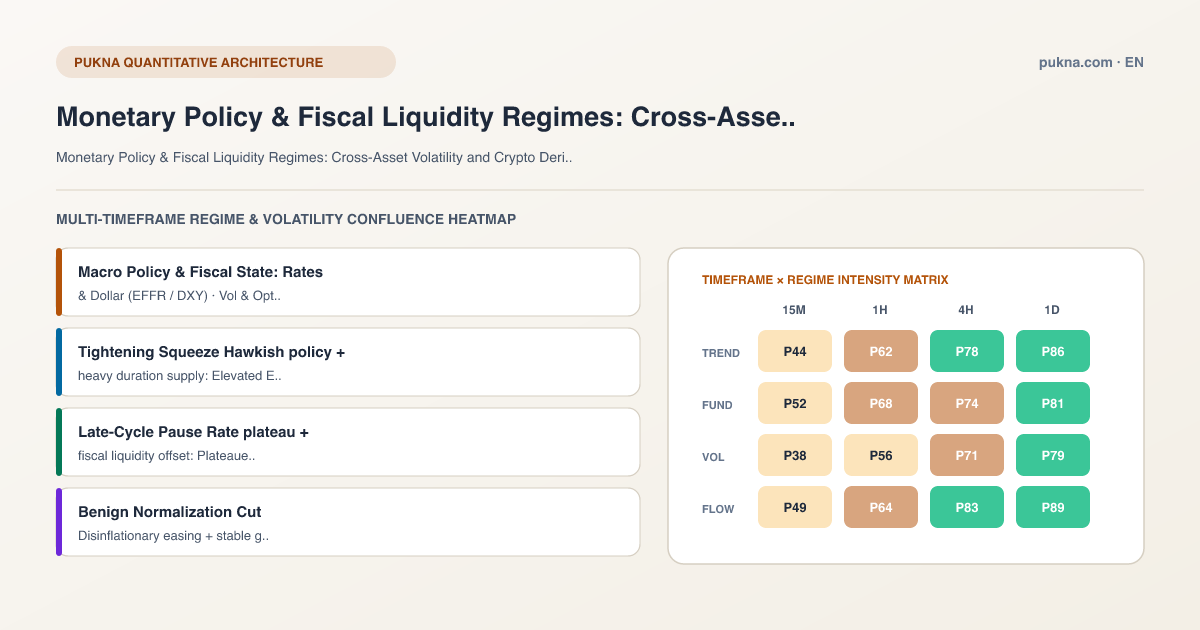
Shifting idle stablecoin carry into active crypto exposure demands live market regime verification first. Perpetual basis, funding crowding, implied volatility DVOL, and the ATM straddle implied move around macro releases reveal whether expected directional price range can clear your net passive carry hurdle. Headline APY alone never times that switch. Pukna’s 8-dimension, 39-indicator Environment Research Library unifies macro policy, rates, liquidity, sentiment, derivatives, and on-chain feeds so desks audit market regimes without maintaining fragile spreadsheet tabs.
Policy Liquidity Regimes vs. Crypto Derivatives & Carry Posture
| Macro Policy State | Rates & Dollar | Vol & Skew | Perp Crowding | Carry vs. Active Posture |
|---|---|---|---|---|
| Tightening Squeeze Hawkish rates + heavy duration |
Elevated EFFR; rising DXY | High VIX & DVOL; put skew | Flat/negative funding; weak bids | Prioritize ERC-4626 carry; 1x cap |
| Late-Cycle Pause Rate plateau + fiscal offset |
Plateaued EFFR; range DXY | Moderating DVOL; balanced skew | Mean-reverting funding; two-way OI | Split carry & filtered setups; 1x–2x |
| Easing Expansion Rate cuts + rising liquidity |
Falling EFFR; softer DXY | Compressed DVOL; call skew | Positive funding; spot-led OI | Rotate above net hurdle; audit 2x–3x |
When leveraged BTC trader positioning balance crowds on one side while system-wide digital asset capitalization stalls, does active beta still clear your net carry hurdle?
Quantitative Selection and Capital Allocation Verification Workflow
Choose token architecture by smart-contract mandate first, then require active setups to clear your net stablecoin hurdle in causal simulation.
Architecture Selection Rules by Operational Mandate
Operational venue mandates pick the right stablecoin standard faster than a 20 bps yield gap. Keep native rebasing tokens in custodial treasuries that need $1.00 invoicing, and require ERC-4626 shares or wUSDM wrappers for DeFi pools and bots. Never benchmark active trades against gross headline stablecoin yields. Subtract mint or redeem fees, 15–50 bps stress DEX exit spreads, and custody buffers before setting your net hurdle rate for risk capital. A 5.00% headline rate commonly nets 3.80%–4.30% once realistic trading and settlement frictions clear.
Benchmarking Active Strategy Drawdowns Against Passive Stablecoin Carry
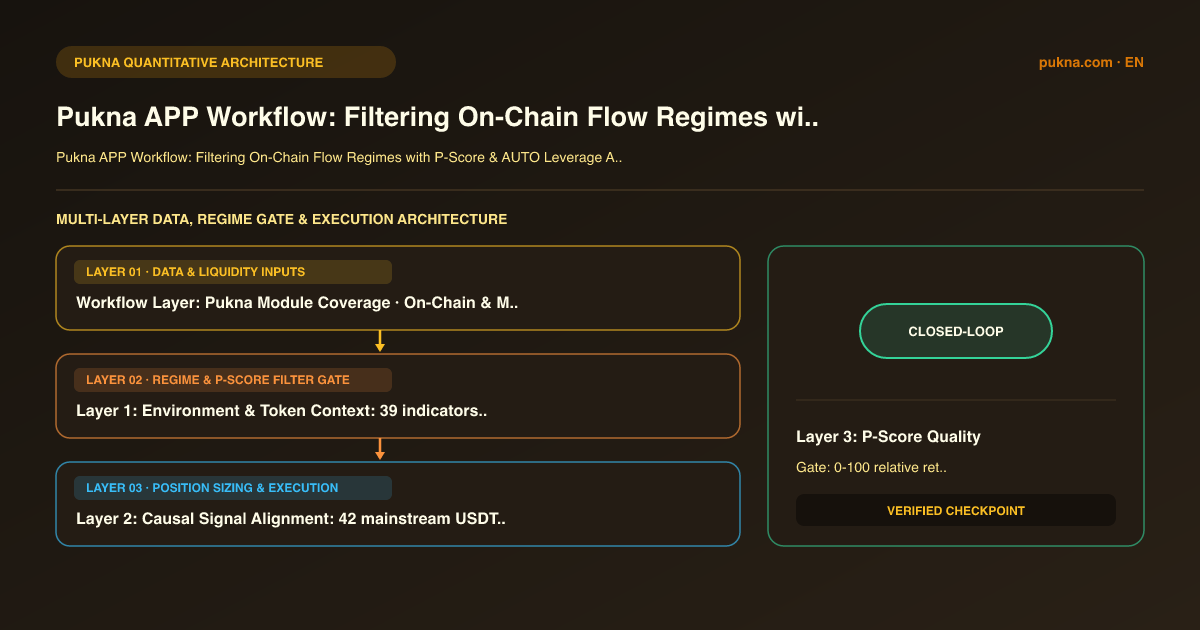
Clean chart triggers never guarantee smooth equity curves. Analysts can screen Pukna 42-pair USDT signal coverage across 15m, 1h, 4h, and 1d charts through the closed-candle signal quality framework. Signals settle strictly on closed bars without post-close repainting. Every trigger carries a 0–100 P score anchored to the P-score 50-point neutral baseline, where 50 marks return-quality parity with ordinary surrounding candles on that chart. Higher scores measure stronger combined peak gain and final return over horizon_bars, never win probability.
Pukna APP Four-Layer Regime to Execution Audit Stack
Aligning macro liquidity, closed-bar signals, and simulated drawdown limits before rotating reserves
| Layer | Module Coverage | Filter Logic | Audit Output |
|---|---|---|---|
| 1. Regime Context | 39 indicators (8 dimensions) + 43 token profiles | Verify rates, DeFi TVL, and derivatives crowding | Carry vs. active regime tag |
| 2. Causal Signals | 42 USDT pairs (15m / 1h / 4h / 1d) | Check closed-bar triggers without repainting | Multi-timeframe setup list |
| 3. P-Score Gate | 0–100 relative quality (50 = neutral bar) | Rank peak and terminal return over horizon_bars | High-quality signal shortlist |
| 4. AUTO Audit | 1x–3x integer-leverage simulation | Review equity curve, win rate, and max drawdown | Alert subscription decision |
Run this four-step verification audit before shifting passive stablecoin carry into active risk:
- Match architecture to venue: Hold native rebasing units for $1.00 treasury accounting; require ERC-4626 or wrapped shares for DeFi pools and bots.
- Calculate net passive carry: Subtract settlement fees, 15–50 bps stress DEX discounts, and smart-contract buffers from gross APY.
- Verify macro and derivatives regime: Cross-check rates, perpetual basis, DVOL, and on-chain liquidity before taking directional exposure.
- Audit drawdowns in simulation: Run a 1x–3x integer-leverage AUTO personal simulated strategy on Pukna to inspect historical equity curves, win rates, and max drawdown before subscribing to live alerts.
Keep reserves parked whenever simulated net returns trail passive carry.
| Research Scenario | Core Criterion | Empirical Takeaway | Full Study |
|---|---|---|---|
| Comparing ETH vs. BTC allocation and relative risk | ETH/BTC ratio trend plus 15m–1d volatility and drawdown | Compare ETH and BTC via 15m–1d risk-adjusted backtests, not raw return alone. | Ethereum vs. Bitcoin: Network Design, Risk & Backtests → |
| Screening 4H BTCUSDT quantitative buy and sell setups | Bar-close causal rules, fee drag, and 8-dimension regimes | Eliminate repainting and model trading fees before trusting 4H BTCUSDT equity curves. | BTCUSDT 4H Quantitative Buy and Sell Signals: Bar-Close Causal Rules, Fee Drag, and Regime Filters → |
| Evaluating DeFi lending yields and borrowing risk | 80%–92% utilization kink math and regime Health Factor | Headline APY hides rate-curve spikes; size Health Factor buffers for regime shifts. | Crypto Lending Protocols: High APY vs 80%+ Kink Risk → |
| Selecting and validating automated crypto trading bots | Regime fit, post-cost causal backtests, and drawdown replay | Bots fail from regime mismatch and biased backtests, not execution speed. | Crypto Trading Bots: Regime-Fit Strategies, Causal Backtesting, and Risk Controls → |
| Structuring 24/7 crypto technical analysis workflows | Multi-timeframe 15m–1d alignment with funding and macro filters | Pair textbook indicators with funding filters and causal backtests under leverage. | Crypto Technical Analysis: Indicators, 15m–1d Workflows, and Regime-Filtered Backtests → |
Frequently Asked Questions
What is the core mechanical difference between rebasing and value-accruing stablecoins?
Rebasing stablecoins pay reserve yield by raising your wallet balanceOf count through a global scalingFactor while anchoring each unit near $1.00. Value-accruing stablecoins follow the ERC-4626 vault standard instead. They keep your share count static while lifting the on-chain convertToAssets redemption rate above $1.00 as reserve interest compounds.
Can yield-bearing rebasing stablecoins experience negative rebases like AMPL?
Collateralized rebasing stablecoins like USDM and rUSDY pass through positive Treasury or reserve income rather than running AMPL-style algorithmic supply contractions. Negative balance cuts are not part of standard accruals. Secondary DEX prices can still slip below $1.00 during liquidity crunches, redemption queue bottlenecks, or impairment of the underlying reserve collateral.
Why do most DeFi protocols prefer ERC-4626 value-accruing stablecoins or wrapped versions like wUSDM?
Most AMMs, lending pools, and perp margin engines cache user deposits inside internal storage at entry. Overnight rebases expand the contract’s token balance without updating individual accounts, letting arbitrageurs skim unallocated interest through sync calls unless custom hooks exist. ERC-4626 shares and wUSDM wrappers keep balances fixed instead. That static share accounting plugs cleanly into standard ERC-20 liquidity pools, lenders, and margin vaults.
How do yield-bearing stablecoin mechanics compare to a traditional savings account on valuation and liquidity risk?
Both vehicles can track short-term money-market rates, yet their liquidity and risk mechanics diverge sharply. Bank savings accounts rely on wire hours and statutory deposit insurance caps, whereas yield-bearing stablecoins settle 24/7 on public blockchains without banking delays. Always-on liquidity comes with distinct on-chain trade-offs. Token holders trade deposit insurance for smart-contract, custodian, and secondary DEX discount risk whenever instant exits bypass T+1 issuer redemption queues.
Put this into practice
Create a free account to browse live signals and test your own rules.