Contents7 sections
- How Crypto Trading Bots Actually Work: Execution Architecture & Signal Flow
- From Market Feed to Order Fill: The Four-Stage Bot Pipeline
- Exchange-Native vs. Cloud SaaS vs. Open-Source vs. Quant Research Stacks
- Core Crypto Trading Bot Strategies and Market Regime Fit
- Grid and DCA Bots: Mean Reversion Edge vs. Breakout & Drawdown Traps
- Trend-Following, Causal Signal, and Arbitrage Bots Across Timeframes
- Backtesting and Signal Validation: Why Live Bots Underperform Historical Tests
- Five Backtest Distortions That Break Live Crypto Bots
- Auditing Causal Signals, Relative Quality Scores, and Simulation Drawdowns
- Build vs. Buy: Exchange Bots, Cloud Platforms, TradingView Webhooks, or Python
- No-Code Options: Exchange-Native Templates vs. Cloud Platforms and TradingView Alerts
- Coding Your Own Bot in Python: Freqtrade, GitHub Frameworks, and Hidden Maintenance Costs
- Market Environment Filtering and Live Risk Controls Before Going Live
- API Key Hardening, Sub-Account Isolation, and Leverage Caps
- Using Macro, Liquidity, and Derivatives Regime Filters as Automated Kill-Switches
- Step-by-Step Deployment Workflow: From Causal Validation to Monitored Execution
- Five-Stage Validation and Launch Checklist
- Weekly Live-vs-Simulated Drift Monitoring Routine
- Frequently Asked Questions About Crypto Trading Bots
A crypto trading bot is rule-based software that executes spot or perpetual orders 24/7 through restricted exchange APIs or webhook alerts. Speed rarely separates winning bots from blown accounts. On 15m to 1d charts, strategy-regime fit, non-repainting causal signals, and round-trip execution friction dictate net expectancy far more than millisecond latency. Below, we compare exchange-native templates, cloud tools, and Python stacks so you can audit regime failure modes, backtest biases, and live risk guardrails before deploying capital.
- Regime beats speed: Mean-reversion grids bleed during breakouts, while trend systems churn inside tight chop.
- Friction erases paper alpha: An 18 bps round-trip cost in taker fees and slippage wipes out thin 15m setups.
- Causal proof comes first: Lock logic to confirmed candle closes, cap leverage at 1x–3x, and replay drawdowns before going live.
How Crypto Trading Bots Actually Work: Execution Architecture & Signal Flow
Every automated crypto strategy runs a four-stage loop from market feed to order fill, where causal logic, fee drag, and API isolation outweigh raw speed.
From Market Feed to Order Fill: The Four-Stage Bot Pipeline
Whether a bot runs inside an exchange dashboard or a self-hosted Python daemon, every live cycle executes four stages. One weak link erodes live expectancy, even when the core thesis holds.
- Market Data Ingestion: The engine streams live order books over WebSocket or polls 15m, 1h, 4h, and 1d candle feeds alongside funding rates and open interest (OI, total active futures contracts).
- Signal Evaluation: After a candle closes, deterministic rules decide whether to enter, scale, or exit. Intrabar checks invite repainting.
- Sizing & Risk Checks: Pre-trade code enforces position size, 1x–3x integer leverage caps, free margin headroom, active pair limits, and daily loss halts.
- Order Routing: Signed API requests send post-only limits or protected market orders to the matching engine, then log actual fills and fees.
Vendor marketing oversells server speed as a universal edge. Sub-20 millisecond routing matters for cross-exchange arbitrage and high-frequency market making. On 15m to 1d candles, speed is secondary. Net returns depend on signal quality, bid-ask spread, slippage, and fee tiers—typically 2–6 basis points (bps, 0.01% each) for maker fills versus 4–10 bps for taker fills.
Security begins at the exchange API layer, before any strategy places its first order. Restrict keys to read and spot or futures trading only, with withdrawals and transfers permanently off. Bind those credentials to a static IP allowlist. Then isolate bot equity inside a dedicated sub-account so one buggy loop can never touch core holdings.
Exchange-Native vs. Cloud SaaS vs. Open-Source vs. Quant Research Stacks
Automated setups fall into four core architectures. Each trades off key custody, customization freedom, and backtest depth differently.
| Bot Architecture | API Custody & Trust Model | Latency Profile | Backtesting Depth | Customization Ceiling / Recurring Fee Overhead |
|---|---|---|---|---|
| Exchange-Native Bots | Internal exchange execution; zero external API keys | Lowest (co-located matching engine) | Minimal (simplified parameter previews) | Customization Ceiling: Low (fixed Grid, DCA, TWAP templates) · Recurring Fee Overhead: $0 subscription; standard exchange trading fees |
| Third-Party Cloud SaaS | Hosted vendor servers hold trade-only API keys | Moderate (500 ms–3 s webhook/API hops) | Basic to moderate; often lacks order-book depth | Customization Ceiling: Moderate (preset indicators and webhook triggers) · Recurring Fee Overhead: $30–$120+/month subscription plus exchange fees |
| Open-Source Python Stacks | Self-hosted local server or private VPS controls keys | Low to moderate (50–300 ms via VPS WebSocket) | High (custom event-driven or vectorized code) | Customization Ceiling: Unlimited (custom ML, multi-venue, risk engines) · Recurring Fee Overhead: $10–$60/month VPS & data feeds plus engineering time |
| Quant Signal & Simulation Platforms | Non-custodial research & paper replay; alert-driven execution | Candle-close cadence (15m–1d structural horizon) | High (causal multi-timeframe & drawdown replay) | Customization Ceiling: Structured parameter & leverage filtering · Recurring Fee Overhead: Research tier cost; zero live API custody risk |
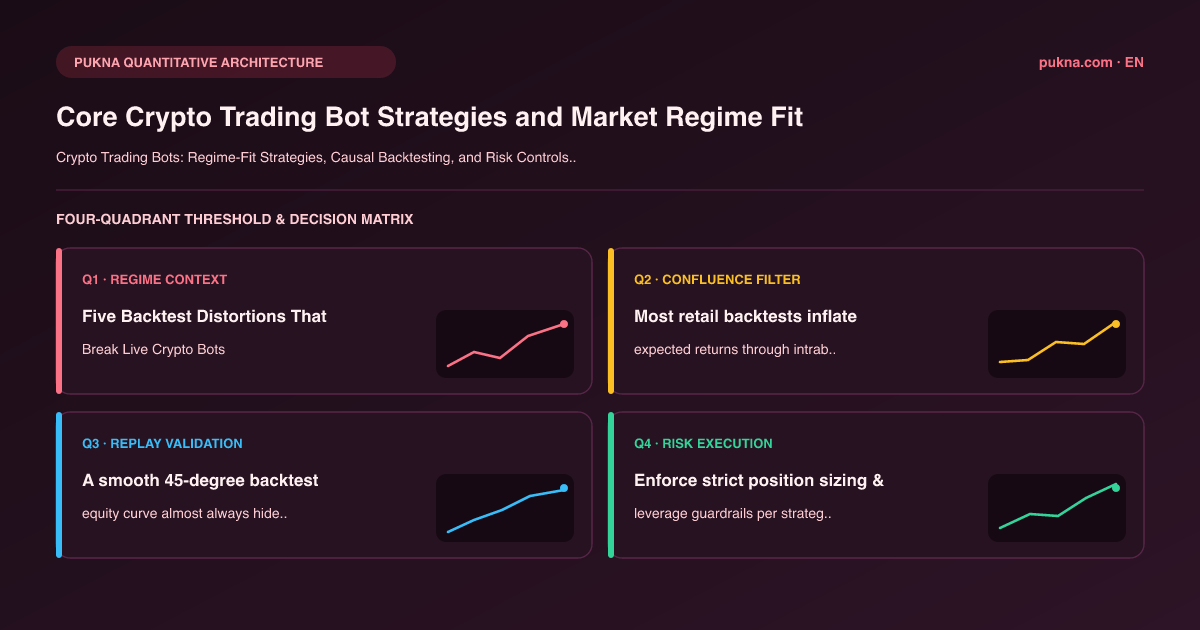
Core Crypto Trading Bot Strategies and Market Regime Fit
Most automated crypto bots fail from regime mismatch: mean-reversion grids hoard losing inventory during breakouts, while trend systems bleed to whipsaws in tight chop.
Grid and DCA Bots: Mean Reversion Edge vs. Breakout & Drawdown Traps
Grid bots slice a price range into spaced buy limits below spot and sell limits above it. They thrive in sideways markets where implied volatility (IV, the market's priced-in swing range tracked by DVOL) stays calm. In those periods, price bounces repeatedly between liquidity zones and stop-hunt fakeouts without breaking away.
Breakouts expose the structural trap of a grid: your losses accelerate faster than your gains. When a major USDT (US-dollar stablecoin) pair drops below the floor, a long grid fills every bid on the way down and carries peak inventory into a sell-off. Rip higher, and the bot dumps spot early—leaving you holding idle quote cash behind simple buy-and-hold.
Dollar-Cost Averaging (DCA) bots split entries into scheduled or dip-triggered tranches. Unleveraged spot DCA on deep assets works reliably for multi-quarter accumulation. Leveraged Martingale DCA is a different beast. Doubling safety orders into a falling market produces an impressive win rate during shallow dips—until one 35%–50% drawdown triggers cascading liquidations.
Trend-Following, Causal Signal, and Arbitrage Bots Across Timeframes
Trend and causal signal bots target directional moves across 15m, 1h, 4h, and 1d bars. Their cleanest runs appear when broad crypto market liquidity breadth expands on genuine spot volume. Another high-conviction window opens right after an open interest (OI) flush and leverage reset clears crowded longs or shorts from perpetual books.
Run those same bots unfiltered in tight sideways chop, and false breakouts eat the account alive. Ten straight whipsaws at 10–14 bps round-trip in taker fees and slippage add up fast. Without volatility or regime filters to suppress weak entries, small cuts compound into double-digit drawdowns.
Arbitrage and funding-rate bots trade structural price gaps rather than direction. A cash-and-carry bot buys spot and shorts perpetual futures to collect positive funding payments and the futures-to-spot price gap (basis). That trade breaks when funding flips negative for weeks. Persistent cash-and-carry bleed erodes yield, while extreme squeezes introduce ADL-queue risk—where exchange auto-deleveraging forcibly closes your profitable short hedge and leaves spot exposure naked.
| Strategy Type | Optimal Market Regime | Primary Failure Mode | Fee & Slippage Sensitivity | Risk Profile |
|---|---|---|---|---|
| Spot / Futures Grid | Bounded sideways chop with moderate DVOL | Directional breakout inventory trap (adverse selection) | High (frequent small fills erode net spread) | Moderate (spot) to High (leveraged) |
| Spot DCA / Martingale DCA | Mean-reverting pullbacks within secular uptrends | Uninterrupted multi-week bear drawdown & liquidation | Low (spot) to Moderate (safety-order loops) | Low (unleveraged spot) to Extreme (Martingale) |
| Trend / Causal Signal (15m–1d) | Directional expansion after OI leverage resets | Whipsaw fee bleed inside compressed ranges | Moderate (sensitive to taker fills on 15m) | Controlled with 1x–3x caps & hard stops |
| Funding-Rate / Basis Arbitrage | Bullish leverage demand with positive perpetual basis | Negative funding bleed, transfer delays & ADL-queue risk | Very High (edge often 5–25 bps per leg) | Low directional beta; high operational risk |
Backtesting and Signal Validation: Why Live Bots Underperform Historical Tests
Most retail backtests inflate expected returns through intrabar repainting, ignored fee friction, and single-regime curve-fitting rather than real out-of-sample edge.
Five Backtest Distortions That Break Live Crypto Bots
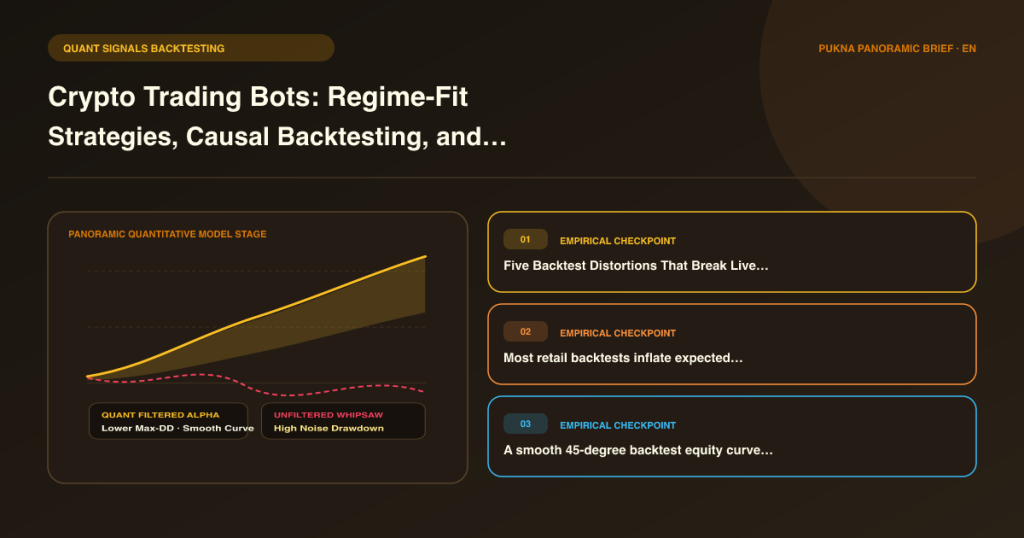
A smooth 45-degree backtest equity curve almost always hides look-ahead leaks or missing friction. In live order books, regime-conditional Sharpe decay and execution slippage turn paper winners into slow bleeds. Take a 15m bot averaging 0.22% gross gain per trade. Deduct 8 bps in round-trip taker fees and 10 bps of slippage, and over 80% of that edge vanishes before funding costs even hit.
| Distortion Type | How It Appears in Retail Backtests | Live Execution Impact | Verification Fix |
|---|---|---|---|
| Look-Ahead & Intrabar Repainting | Signals evaluate unclosed candle highs/lows or higher-timeframe bars before close | Historical entries shift retroactively; live bot fires late or misses fills | Lock all calculations strictly to confirmed bar close and next-bar open fills |
| Fee, Funding & Slippage Omission | Zero-commission mid-price fills ignore spread, taker tiers, and 8-hour funding | High-turnover strategies bleed steadily despite positive paper PnL | Deduct realistic taker bps, depth-based slippage, and historical funding schedules |
| Single-Regime Curve-Fitting | Grid-searching dozens of parameters until one bull sample peaks | Severe live drawdown as soon as volatility structure or trend slope shifts | Enforce walk-forward out-of-sample splits across trending and choppy periods |
| Pair Survivorship Bias | Testing exclusively on today's top-20 winners while excluding delisted tokens | Overstates altcoin trend persistence and underestimates tail collapse | Audit fixed liquid universes and evaluate point-in-time delisted histories |
| Raw Win-Rate Myopia | Optimizing for 75%+ winning trades via wide stops or averaging down | One tail event erases months of small gains (negative profit factor) | Judge systems by max drawdown, profit factor, and expectancy per unit risk |
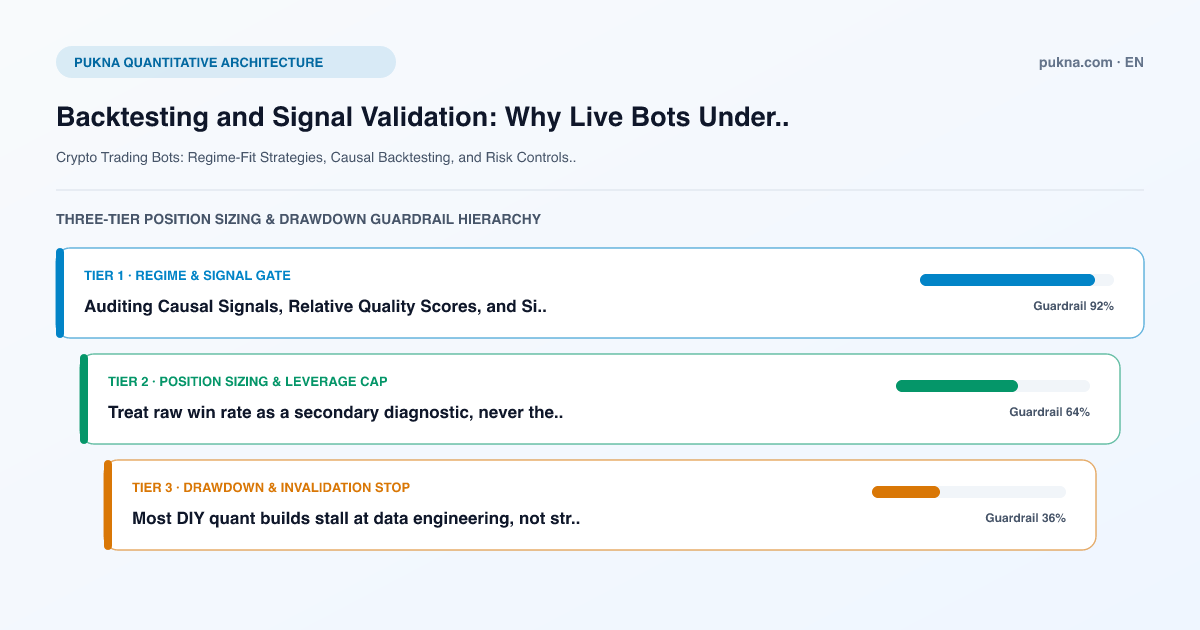
Treat raw win rate as a secondary diagnostic, never the headline goal. A trend bot winning 42% of trades at a 2.4 reward-to-risk ratio compounds reliably. By contrast, a 78% win-rate Martingale loop with uncapped tail risk eventually blows up. Walk-forward validation—tuning rules on past data, then scoring untouched forward windows across calm and chaotic regimes—exposes fragile setups before real money touches an exchange.
Auditing Causal Signals, Relative Quality Scores, and Simulation Drawdowns
Most DIY quant builds stall at data engineering, not strategy ideation. Aligning 15m, 1h, 4h, and 1d bars across dozens of liquid pairs without timestamp drift is tedious. Filtering genuine structural inflections from noisy oscillators strictly on bar close takes even stricter causal code.
To avoid rebuilding that pipeline from scratch, you can benchmark signals against Pukna's candle-level causal signal framework. It tracks 42 major USDT pairs across 15m, 1h, 4h, and 1d timeframes, logging entries strictly on bar close. That eliminates intrabar repainting across every pair and horizon.
Each signal carries a relative P-score from 0 to 100, where 50 marks neutral parity with ordinary surrounding candles. Higher scores measure stronger best excursion and final return over the forward horizon_bars window. That score gauges relative payoff quality, never win probability. From there, simulate the rule with AUTO at 1x–3x integer leverage. Inspect its historical equity curve, win rate, and max drawdown before subscribing to real-time alerts.
- Raw Bar Signal Capture: Detect multi-timeframe structural inflection across 15m, 1h, 4h, and 1d bars strictly on candle close.
- Relative Quality Gate (P-Score): Filter out sub-50 ordinary noise bars; prioritize higher relative forward payoff quality across
horizon_bars. - Out-of-Sample Replay: Simulate conservative 1x–3x integer leverage rules to inspect net return, win rate stability, and maximum drawdown.
- Disciplined Execution: Subscribe to validated live alerts with predefined invalidation stops and portfolio drawdown caps.
Build vs. Buy: Exchange Bots, Cloud Platforms, TradingView Webhooks, or Python
Choosing a bot stack comes down to real operating drag: rigid exchange templates, monthly SaaS hurdle rates, or nonstop Python maintenance.
No-Code Options: Exchange-Native Templates vs. Cloud Platforms and TradingView Alerts
Built-in bots on Binance, OKX, Bybit, and Pionex eliminate third-party API custody and software fees. On smaller accounts running spot rebalancing, scheduled DCA, or tight range grids, they carry the lowest friction. Their limits show up fast. You cannot wire custom multi-timeframe rules, portfolio-wide drawdown halts, or macro regime filters into fixed venue templates.
Cloud platforms like 3Commas and Bitsgap—often connected via TradingView webhooks—bridge that gap without Python code. Two hidden drains still bite. A $50–$90 monthly plan creates a 6%–10% annual hurdle on a $10,000 account before a single trade fills. Worse, TradingView alerts missing strict bar-close confirmation fire mid-candle and later vanish on historical charts, breaking live-to-backtest parity.
Coding Your Own Bot in Python: Freqtrade, GitHub Frameworks, and Hidden Maintenance Costs
Open-source Python frameworks grant full code ownership with zero SaaS fees. Freqtrade excels at directional candle systems and local backtesting, while Hummingbot targets market making and cross-venue arbitrage. Writing your own code lets you model order-book depth, custom slippage, and walk-forward validation directly.
The catch is nonstop operational upkeep. Exchange APIs change schemas without mercy, rate limits tighten during volatility spikes, and local candle histories quietly drop bars. VPS servers also demand security patches, failover alerts, and crash recovery. If your edge sits in market research rather than DevOps, decoupling signal validation from execution spares weeks of brittle plumbing.
| Bot Stack | Setup Time | Coding Required | Backtest & Data Rigor | Direct Fee Drag / Ongoing Maintenance |
|---|---|---|---|---|
| Exchange-Native Bots (Binance, OKX, Bybit, Pionex) | 10–20 minutes | None | Low (limited historical depth) | Direct Fee Drag: $0 software fee; standard venue commissions · Ongoing Maintenance: Minimal (manual regime start/stop) |
| Cloud SaaS Platforms (3Commas, Bitsgap) | 1–3 hours | None | Moderate (template-level replays) | Direct Fee Drag: $30–$120+/month + exchange fees · Ongoing Maintenance: Low (API key rotation & parameter tuning) |
| TradingView Webhook Bridges | 2–6 hours | Pine Script basics | Prone to intrabar repainting if misconfigured | Direct Fee Drag: TradingView plan + relay/SaaS cost · Ongoing Maintenance: Moderate (webhook retries & bar-close audits) |
| Open-Source Python (Freqtrade, Hummingbot) | 1–3 weeks | Intermediate to advanced Python | Very High (full local OHLCV & custom fees) | Direct Fee Drag: $10–$60/month VPS + exchange fees · Ongoing Maintenance: High (API breaks, data cleaning, 24/7 uptime) |
| Quant Signal & Simulation Workspaces | Under 1 hour | None | High (causal multi-timeframe & drawdown replay) | Direct Fee Drag: Research subscription; zero live custody risk · Ongoing Maintenance: Low (periodic strategy & regime audit) |
Market Environment Filtering and Live Risk Controls Before Going Live
Locked-down exchange API permissions, 1x–3x integer leverage caps, and cross-market regime filters stop one liquidity shock from wiping out months of automated gains.
API Key Hardening, Sub-Account Isolation, and Leverage Caps
Sound bot risk architecture assumes every script will eventually hit a software bug or flash crash. Dedicated sub-accounts cap total loss regardless of code faults. Lock trade-only API keys to a static VPS IP to block unauthorized transfers. Where venues allow symbol whitelists, restrict keys to liquid USDT pairs so a compromised key cannot wash-trade illiquid altcoins.
Position sizing matters just as much as key hygiene. Even major USDT pairs print 10%–20% intraday swings during forced deleveraging. Capping directional bots at 1x–3x integer leverage pushes liquidation levels well beyond routine noise. Run automated loops at 10x–20x, and a single stop-hunt ends the account.
| Control Layer | Concrete Quantitative Threshold | Automated Action / Guardrail |
|---|---|---|
| API Permission Scope | Read + Spot/Futures Trade only; zero withdrawal or transfer rights | Static IP allowlist, symbol whitelist, and 90-day key rotation |
| Leverage Cap | Strict 1x–3x integer leverage maximum per directional strategy | Reject order sizing exceeding target margin ceiling before routing |
| Max Drawdown Kill-Switch | 2%–3% daily realized loss limit; 10%–15% rolling equity drawdown cap | Flatten open risk and suspend new entries pending manual review |
| Slippage & Spread Guard | Bid-ask spread > 8 bps or execution slippage > 15 bps above trigger | Convert to post-only limit or abort fill during thin book spikes |
| Pair Liquidity Floor | Top-tier liquid USDT pairs with deep 2% order-book depth | Exclude micro-cap altcoins susceptible to single-candle wicks |
| Regime Filter Gate | Cross-pillar alignment across macro, derivatives, volatility & sentiment | Cut position size by 50% or pause automated entries in fragile zones |
Using Macro, Liquidity, and Derivatives Regime Filters as Automated Kill-Switches
Price-only signals react too late when dollar liquidity turns. A widening SOFR-OIS spread and repo market plumbing stress signal tightening bank funding, often sparking risk-off deleveraging before moving averages roll over. On-chain flows confirm the shift. Stablecoin mint-burn netflow and dry powder velocity show whether fresh spot buying power is entering liquid USDT books or leaving exchanges.
Derivatives positioning forms the second half of a reliable kill-switch. Watch what happens when elevated positive funding and stretched open interest collide with euphoric market sentiment and fear gauges. Add crowded BTC long-short positioning and an inverted near-dated DVOL curve, and breakout bots walk straight into a liquidation snapback.
Watching disconnected dashboards slows down every regime call. Instead, group macro rates, dollar liquidity, sentiment, derivatives leverage, volatility structure, and on-chain flows inside a 39-indicator market environment library spanning eight dimensions. Check those pillars before enabling entries—they tell you immediately whether trend or grid bots hold the structural tailwind.
| Environment Pillar | Overheated / Fragile Zone | Balanced Constructive Zone | Capitulation / Value Zone |
|---|---|---|---|
| Sentiment & Greed | Extreme euphoria, retail FOMO surge | Neutral-to-constructive participation | Deep fear and forced de-risking |
| Derivatives Leverage | Crowded positive funding rate & stretched open interest | Moderate perpetual basis, spot-led volume | Washed-out open interest & negative funding rate |
| Volatility Structure | Inverted front-end implied volatility (DVOL) spike | Contained term-structure contango | Post-liquidation volatility compression |
| Market Breadth & Liquidity | Narrow speculative rotation, thinning spot bids | Expanding stablecoin netflow across major USDT pairs | Broad capitulation volume near structural support |
Step-by-Step Deployment Workflow: From Causal Validation to Monitored Execution
Treat every trading bot like production financial software, using strict go/no-go validation gates from pair selection through weekly live-drift audits.
Five-Stage Validation and Launch Checklist
Jumping straight from a clean backtest to live leverage is the fastest way to blow up an account. Run this five-stage pre-live checklist, and halt immediately if any gate fails.
- Stage 1 — Define Regime Thesis & Liquid Universe: Write down the exact trend or range regime your bot targets, and restrict orders to liquid USDT pairs. Check tokenomics and cliff unlock audits to weed out heavy supply overhangs. Pass Gate: tight median bid-ask spreads and deep top-of-book liquidity; abort any pair showing thin order books or imminent major unlocks.
- Stage 2 — Causal Backtest & Cost Audit: Test candle-close rules across 15m, 1h, 4h, or 1d bars with realistic maker/taker fees, funding rates, and unseen walk-forward windows. Pass Gate: positive fee-adjusted profit factor across at least two volatility regimes; reject rules that break when parameters nudge by 10%.
- Stage 3 — Paper Simulation Before Capital Allocation: Verify strategy drawdowns before risking live margin. If you do not maintain custom replay infrastructure, cross-check fundamentals inside Pukna's 43-token research library alongside its 39 environment indicators across eight dimensions. Then simulate the rule via AUTO at 1x–3x integer leverage inside the web app. Audit the historical equity curve, win rate, and max drawdown before subscribing to live alerts. Pass Gate: simulated max drawdown stays inside your loss limit; pause if leverage above 1x turns drawdown unacceptable.
- Stage 4 — Isolated Pilot or Alert Execution: Allocate just 10%–15% of target size to a withdrawal-locked sub-account—or execute manually from live signal pushes—to measure real fill quality. Pass Gate: zero unhandled API errors and realized slippage inside modeled bps bounds; halt if fills lag trigger candles materially.
- Stage 5 — Controlled Scaling With Circuit Breakers: Scale size in fixed steps only after live trades match paper expectancy over a meaningful sample. Keep daily loss limits and rolling drawdown kill-switches armed at all times. Pass Gate: live-to-simulated expectancy drift stays below 20%; cut size back to pilot weight if drift widens.
Weekly Live-vs-Simulated Drift Monitoring Routine
Automation removes screen fatigue, not risk oversight. Set aside 20 minutes each week to reconcile live fills against simulated assumptions before silent decay snowballs.
- Execution Slippage Drift: Track the bps gap between signal candle closes and actual exchange fills across limit and market orders.
- Fee & Funding Drag: Compare cumulative maker/taker fees and perpetual funding payments against gross PnL to confirm turnover still clears costs.
- Regime Shift Check: Re-read funding skew, open interest build-up, DVOL term structure, and dollar liquidity gauges to verify your active bot archetype still fits current conditions.
- Infrastructure & API Health: Audit webhook latency logs, WebSocket disconnects, order rejection codes, and sub-account key scopes.
Frequently Asked Questions About Crypto Trading Bots
Do crypto trading bots actually work in volatile markets?
Crypto trading bots work only when their rules match the live regime and beat transaction costs. Grid bots harvest bounded chop, while causal trend bots capture directional breakouts. Automation itself rarely fails. Losses pile up when static parameters stay armed through a regime flip—accumulating underwater inventory, slippage, and taker fees. Checking cross-pillar leverage and volatility shifts in the 39-indicator market environment library helps flag when to pause entries.
How do you stop a crypto trading bot backtest from repainting or overfitting?
Lock every indicator and entry rule to confirmed candle closes, never intrabar highs, lows, or unclosed higher-timeframe bars. To fight overfitting, run walk-forward tests on unseen windows spanning both strong trends and choppy drawdowns. Deduct realistic taker fees, funding costs, and slippage. Drop any setup whose edge collapses after a small parameter shift, or benchmark your logic against a strict bar-close causal signal feed.
Is it better to use a free exchange bot, a cloud platform, or build one in Python?
Match the stack to your balance, strategy complexity, and DevOps time. Free exchange bots fit smaller accounts running spot DCA or tight grids where monthly SaaS fees eat net yield. Cloud tools simplify multi-venue routing, while Python frameworks like Freqtrade unlock custom execution if you maintain VPS uptime and API updates. Whichever stack you pick, filter thin pairs using broad market liquidity breadth before allocating size.
Are exchange API keys safe to connect to a crypto trading bot?
Exchange API keys stay safe only under strict least-privilege rules. Disable withdrawals and internal transfers permanently, lock keys to a static IP allowlist, and ring-fence capital in a dedicated sub-account. Trade-only keys still carry tail risk. A leaked key can drain equity through wash trading on thin altcoins, so rotate keys every 90 days and whitelist liquid pairs vetted through tokenomics and unlock audits.
Put this into practice
Create a free account to browse live signals and test your own rules.