Contents6 sections
- What Separates Live Solana Institutional Adoption From Press-Release Pilots?
- The Four Verifiable Institutional Channels on Solana
- How Solana Compares to Ethereum and XRP on Institutional Rails
- How Do Solana Institutional Catalysts Behave Across Market Regimes?
- Range-Bound Chop vs. Risk-On Trend Transmission
- Why Bullish Institutional Headlines Fail During Liquidity Contraction
- Why Do Raw Institutional Metrics and ETF Prints Mislead Traders?
- Parent Balance-Sheet Halos vs. Deployed On-Chain Capital
- Hedged ETF Basis, Validator Diversity, and Treasury Overhangs
- How to Build a Multi-Factor Quantitative Framework for Solana Adoption
- Four-Layer Verification Scorecard: From Narrative to Measurable Edge
- Token Cross-Venue Liquidity Accessibility Pipeline
- Aligning Environment Regimes With Causal Multi-Timeframe Signals
- Execution Guardrails: Invalidation Rules vs. Catalyst Horizon Lag
- Pre-Trade Invalidation Triggers and Horizon Alignment
- Stress-Testing SOL Catalyst Assumptions Through Historical Simulation
- Frequently Asked Questions
Solana institutional adoption measures regulated capital deployment, live settlement rails, and audited corporate treasuries, not non-binding pilot press releases or retail turnover. Unfiltered bank headlines and gross spot ETF inflows trigger opposite return paths, extending trends during unhedged spot absorption yet fading quickly when futures arbitrage meets tightening dollar liquidity. Separating durable institutional demand from fleeting exit liquidity requires testing every milestone against stablecoin settlement velocity, validator client diversity, derivatives basis, and prevailing market regimes.
What Separates Live Solana Institutional Adoption From Press-Release Pilots?
A memorandum of understanding moves zero capital onto a blockchain. Genuine Solana institutional adoption clears through four measurable channels: regulated spot ETFs, live stablecoin payment corridors, post-trade tokenization workflows, and audited corporate SOL staking treasuries. Each rail operates on its own compliance timeline and feeds spot SOL demand at a different pace. Treat them as one bucket and your read breaks.
| Adoption Pillar | Capital & Rail Structure | Auditable Proof | SOL Price-Transmission Trap |
|---|---|---|---|
| Spot ETFs & ETPs | Regulated brokerage share creations and redemptions | Multi-week net creation persistence and custody vault inflows | Cash-and-carry futures hedges neutralize immediate spot lift |
| Stablecoin & Payment Rails | Live fiat-to-stablecoin payout corridors (B2C2, MoneyGram, SBI Solana Global) | Institutional-size USDC/PYUSD velocity and non-bot transfer share | Payment volume grows network fees without requiring SOL balance-sheet inventory |
| Post-Trade & RWA Clearing | Regulated fund registries and settlement stacks (DTCC, Project Harmonia / Allfunds) | Production smart-contract mint volume and audited custodian filings | Technical sandboxes often precede live asset migration by several quarters |
| Corporate SOL Staking Treasuries | Public equity vehicles accumulating and staking SOL (e.g., Nasdaq-listed HSDT) | Audited treasury filings, validator stake accounts, and share logs | Equity-to-NAV premiums and capital raises create dilution overhangs |
The Four Verifiable Institutional Channels on Solana
Real institutional commitment leaves an audit trail inside regulated custody, listed balance sheets, or active payout corridors. Production rails such as B2C2 liquidity routing and MoneyGram stablecoin settlement move verifiable volume across public ledgers every session. By contrast, exploratory memorandums and banking joint ventures like SBI Solana Global must clear multi-stage compliance gates before real settlement flows arrive. Until those gates clear, treat the deal as an option.
Headline wallet counts rarely confirm enterprise onboarding on their own. Traders often misread rising active addresses as institutional adoption, even though automated market-making bots and retail wallet churn inflate address counts without representing unique regulated accounts. Look instead for sustained institutional-ticket stablecoin velocity, expanding custodian vault balances, and repeatable fiat-to-chain settlement flows.
Capital-market wrappers also price differently from payment infrastructure. Spot ETFs let authorized participants create shares directly against custodial SOL, whereas post-trade pilots—such as DTCC clearing tests or Project Harmonia with Allfunds—validate programmable fund registries first. Meanwhile, public SOL staking treasuries like Nasdaq-listed HSDT link stock-market equity premiums and share-issuance cycles straight to on-chain validator yield.
How Solana Compares to Ethereum and XRP on Institutional Rails
Institutional desks pick settlement networks by matching latency, compliance, and collateral depth to a mandate. Solana runs a single shared global state with sub-second finality and predictable fees, removing bridge friction for high-frequency stablecoin payouts and live liquidity routing. Speed counts most when desks settle cash across borders.
Competitors own different lanes of institutional finance. Ethereum still commands the deepest regulated DeFi collateral and tokenized-asset custody base, even though activity splits across competing Layer-2 rollups and bridges. XRP focuses on bank messaging and pre-funded cross-border corridors, sacrificing general-purpose smart-contract flexibility for narrower compliance workflows.
Superior rail architecture raises Solana’s long-term ceiling, yet tech advantages never control short-term price paths alone. Even when regulated desks deploy fresh capital onto Solana over rival chains, identical adoption catalysts resolve in opposite directions across changing volatility and dollar-liquidity backdrops. Market regime mechanics explain that split.
How Do Solana Institutional Catalysts Behave Across Market Regimes?
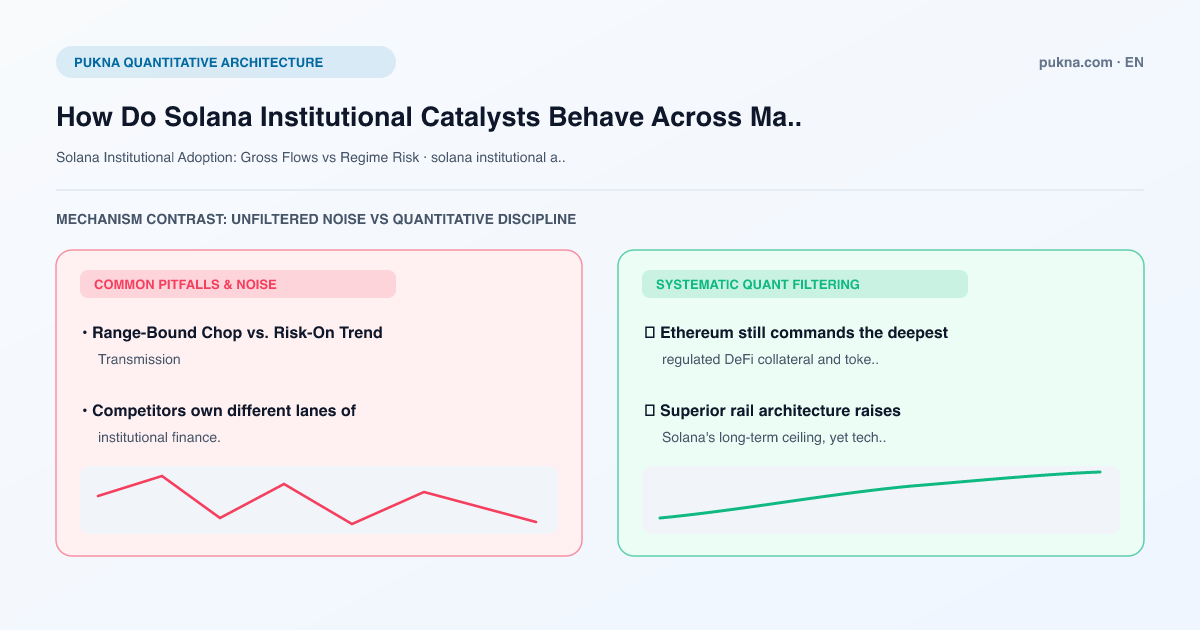
An identical ETF inflow print can launch a multi-week trend during loose dollar conditions or mark an immediate local top during a liquidity squeeze. Inside range-bound chop, institutional headlines sweep resting stops and fade quickly. Risk-on expansions turn steady creations into shallow pullbacks, whereas macro contractions turn credible bank deals into exit liquidity for leveraged longs.
| Market Regime | Liquidity & Volatility State | Catalyst Resolution Path | Required Confirmation Filter |
|---|---|---|---|
| Range-Bound Chop | Compressed realized volatility, flat funding rate, balanced open interest | Headline spike sweeps stops, then fades back inside range | Multi-session spot absorption and rising stablecoin settlement velocity |
| Risk-On Expansion | Rising market breadth, contango implied volatility (DVOL), firm spot basis | Sustained ETF inflows and Firedancer progress reinforce trend continuity | Consecutive positive creation weeks without overheated perpetual funding |
| Macro Risk-Off Contraction | Widening cross-currency basis, elevated VRP spread, shrinking risk budgets | Credible bank or treasury headlines fuel sharp rallies sold by de-risking funds | Stabilizing dollar funding conditions and full open interest flush |
Range-Bound Chop vs. Risk-On Trend Transmission
During quiet range-bound sessions, a single corporate treasury filing or one-day ETF print spikes perpetual open interest while spot orderbooks stay thin. Tape readers track orderbook ask-wall absorption and CVD divergence to check whether passive institutional buyers actually lift offers or short-term leverage chases thin air. Without spot follow-through, headline pops fade fast.
Everything changes once broad crypto market capitalization expansion unlocks fresh portfolio risk budgets. Inside a risk-on trend, stacking tangible catalysts—multi-week spot ETF creations, rising non-bot USDC settlement, and growing Firedancer validator participation—creates a spot-led bid vs. perp-driven froth. Unleveraged buyers absorb routine profit-taking before perpetual funding overheats, keeping pullbacks shallow.
Options term structure confirms that regime shift cleanly. Inside choppy ranges, news flashes briefly bid up front-end volatility while longer-dated institutional positioning stays flat. During durable expansions, implied volatility (DVOL) holds an orderly contango curve because options desks price steady upside demand rather than panic short covering.
Why Bullish Institutional Headlines Fail During Liquidity Contraction
Dollar funding conditions override single-network headlines every time. When rate expectations tighten and the global cross-currency basis widens, multi-strategy funds cut gross exposure across high-beta crypto regardless of Solana fundamentals. No banking joint venture or post-trade clearing pilot can offset forced portfolio deleveraging. Liquidity wins the tape.
Derivatives desks expose this trap within minutes of a bullish headline. When retail traders chase institutional news while crowded perpetual account skew already leans heavily long, larger funds sell directly into the liquidity burst. The implied volatility vs. realized volatility (VRP) spread widens as desks buy downside puts into bounces instead of adding unhedged spot.
Macro tightening explains only half of the false breakouts. Even inside supportive liquidity regimes, popular adoption trackers regularly point traders the wrong way because hedging mechanics and accounting conventions distort headline numbers. Four specific measurement traps account for most misreads.
Why Do Raw Institutional Metrics and ETF Prints Mislead Traders?
A massive single-day Solana ETF creation print can hide zero directional conviction underneath. Four recurring distortions turn bullish institutional updates into losing entries: parent-company AUM halos, hedged ETF basis trades, peak TPS claims, and corporate treasury equity dilution. Reading headline figures at face value ignores how regulated desks hedge risk and pace deployment.
| Headline Institutional Signal | Hidden Measurement Trap | Verification Counter-Metric | Empirical Invalidation Trigger |
|---|---|---|---|
| Parent-Consortium AUM | Attributes multi-trillion-dollar parent bank assets to small initial pilots | Live on-chain custody balances and settled institutional transfer share | Multi-quarter stagnation in non-bot stablecoin settlement volume |
| Gross Spot ETF Inflows | Masks cash-and-carry desks buying spot ETFs while shorting futures | Net CME/perp open interest delta and perpetual basis slope | Basis compresses toward zero while inflows fail to lift spot price |
| Headline Peak TPS | Ignores validator client concentration, custody SLAs, and fault tolerance | Firedancer mainnet validator stake share and Nakamoto Coefficient | Single-client consensus fault stalls finality or custodian onboarding |
| Corporate Treasury Filings | Conflates stock-market issuance hype with unencumbered spot demand | Equity-to-SOL NAV premium and scheduled share issuance overhang | NAV premium collapses, halting accretive equity raises for SOL purchases |
Parent Balance-Sheet Halos vs. Deployed On-Chain Capital
Whenever banking consortiums behind initiatives like SBI Solana Global or clearing utilities like DTCC announce Solana work, headlines cite their multi-trillion-dollar parent balance sheets. Almost none of that legacy pool sits on-chain. Production institutional sleeves start with tight capital caps and expand only after multi-quarter compliance audits. Parent AUM is never deployed liquidity.
Public block explorers trigger a similar head fake when large wallets move coins between custody tiers. Automated whale alerts flag those transfers as urgent buying or dumping waves. Applying entity-filtered exchange inflow diagnostics separates routine cold-to-hot custody sweeps, margin top-ups, and private OTC legs from real directional orders hitting spot books.
Hedged ETF Basis, Validator Diversity, and Treasury Overhangs
Market-neutral quant funds often buy spot Solana ETFs while shorting CME futures or offshore perpetuals to harvest elevated basis. That package logs as bullish ETF demand without adding net buying pressure to spot books. Pairing creations with spot versus futures ETF flow filters isolates unhedged accumulation from basis arbitrage.
Peak lab throughput rarely moves an institutional risk committee. Custodians prioritize uptime SLAs, clean audit trails, and multi-client fault tolerance. Firedancer tackles Solana’s historic single-client bottleneck by adding an independent validator stack alongside Agave. Still, enterprise approval hinges on live Firedancer stake share and Nakamoto Coefficient resilience rather than test-net TPS claims.
Corporate SOL staking treasuries add equity-market reflexivity to on-chain supply. Public vehicles such as HSDT issue shares or convertible debt to buy and stake SOL while their stock trades above net asset value. Once risk appetite cools and that NAV premium disappears, accretive buying halts and pending share unlocks become overhead supply. Comparing supply overhang against entity-level flows below clarifies these recurring distortions.
| Research Scenario | Core Criterion | Empirical Takeaway | Full Study |
|---|---|---|---|
| Exchange Whale Ratio spike | 7d EMA 0.55-0.85 regime & venue split | Raw spikes often reflect low total inflow denominators; verify sustained 7d EMA regimes and spot venue routing. | Exchange Whale Ratio: Raw Spikes vs 0.55-0.85 Regimes → |
| Scheduled token unlock impact | >5% float cliff, >2x 30d ADV, cohort | Unlocks rarely dump on day one; pre-unlock perp hedging and VC vs. ecosystem cohorts drive actual supply pressure. | How Token Unlocks Affect Price: 5% Float, 2x ADV & Cohorts → |
| Large on-chain exchange inflow | 30d Z-score >2.0 & spot vs. deriv split | Raw inflows frequently mark custody sweeps or margin top-ups rather than imminent spot sell orders. | On-Chain Exchange Flow: Raw Spikes vs Z>2.0 Filters → |
| Whale wallet transfer alert | ±1.5σ entity-adjusted netflow & regime | Cross-check entity-adjusted netflows with Whale Ratio and market regime to filter internal sweeps and OTC noise. | Onchain Whales: Raw Alerts vs. ±1.5σ Entity Netflows → |
| Headline USD unlock valuation | 3%-5% insider cliff, 1x-2x ADV, CEX flow | Nominal dollar size misleads without circulating float, daily volume depth, and net CEX deposit confirmation. | Crypto Token Unlock Meaning: USD Size vs. 5%+ Cliff → |
Spotting distorted prints keeps you out of crowded bull traps, yet skepticism alone never times an entry. Turning those diagnostics into repeatable execution requires a four-layer framework linking macro liquidity, on-chain settlement, derivatives positioning, and causal chart structure. A disciplined checklist replaces headline guesswork.
How to Build a Multi-Factor Quantitative Framework for Solana Adoption
Reacting to breaking news alerts guarantees late fills and noisy drawdown risk. Replacing ad-hoc news tracking with a four-layer scorecard filters out crowded headline spikes before capital gets trapped. An institutional catalyst earns directional sizing only when macro liquidity expands, two independent on-chain metrics confirm usage, derivatives basis stays balanced, and multi-timeframe price structure aligns.

| Verification Layer | Ad-Hoc News Tracking | Structured Quant Workflow | Analytical Error Prevented |
|---|---|---|---|
| 1. Macro & Liquidity Filter | Ignores rates and funding conditions during bullish headlines | Audits dollar liquidity, rate pressure, and sentiment regimes first | Buying real news into forced systemic deleveraging |
| 2. On-Chain Settlement Proof | Accepts parent AUM or single-day inflow prints linearly | Requires dual convergence across ETFs, stablecoins, and Firedancer stake | Confusing exploratory pilots with live deployed capital |
| 3. Derivatives Basis Filter | Treats every ETF creation print as unhedged spot buying | Cross-checks open interest delta, funding rate, and basis slope | Chasing market-neutral cash-and-carry arbitrage noise |
| 4. Causal Timeframe Alignment | Reacts to intraday spikes right after social-media alerts | Aligns 4h/1d regime direction with causal 15m/1h entries | Entering against higher-timeframe supply or lookahead bias |
Four-Layer Verification Scorecard: From Narrative to Measurable Edge
Start with macro context before reading a single Solana press release. Layer one screens dollar funding conditions, rate expectations, and composite market sentiment regime readings to set your portfolio risk ceiling. When liquidity drains or sentiment hits fragile euphoria, institutional announcements stop acting as breakout catalysts and start functioning as distribution windows.
Layers two and three force empirical confirmation across spot and derivatives venues. Demand convergence from at least two auditable streams—multi-week net ETF creations, rising non-bot stablecoin velocity, or expanding Firedancer validator stake—before calling a milestone structural. Cross-check those trends against entity-adjusted whale netflow thresholds and perpetual open interest so custody sweeps never masquerade as fresh inflows.
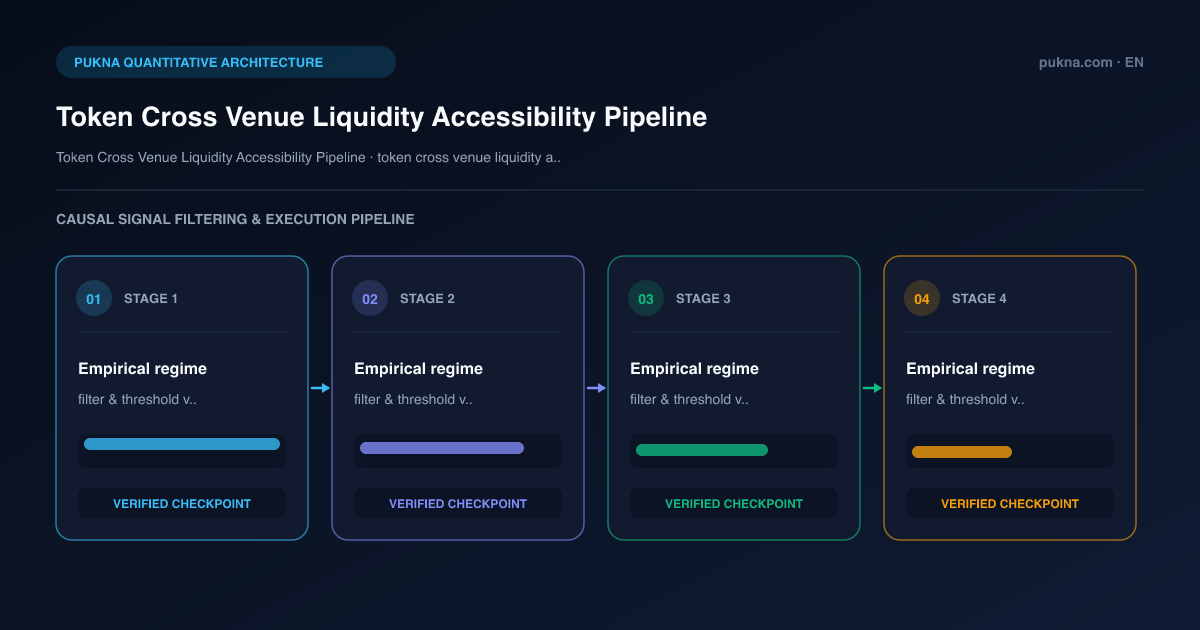
Execution depth sits between a sound thesis and a clean fill. Institutional capital clears unevenly across brokerage wrappers, primary USDT spot orderbooks, and offshore perpetual venues. Walking through the three-stage liquidity pipeline below confirms real spot depth backs the narrative before you commit size.
Token Cross-Venue Liquidity Accessibility Pipeline
| Pipeline Phase | Microstructure Checkpoint | Execution Guardrail |
|---|---|---|
| Phase 01 · Fragmentation Audit | Compare spot orderbook depth across major USDT books and regulated institutional venues | Reject headline breakouts when depth concentrates purely in leveraged perpetual venues |
| Phase 02 · Cross-Venue Liquidity | Track sustained spot net absorption against CME futures and offshore open interest shifts | Confirm spot volume leads derivatives expansion before classifying inflows as unhedged |
| Phase 03 · Microstructure Filter | Inspect ask-wall absorption, perpetual basis elasticity, and realized slippage buffers | Stand aside when bid-ask depth thins or funding spikes ahead of spot confirmation |
Aligning Environment Regimes With Causal Multi-Timeframe Signals
Hindsight ruins most headline trading rules. Layer four aligns 4h and 1d directional structure with strictly causal 15m and 1h candle triggers computed solely from closed-bar data. Sticking to closed-bar causality eliminates the lookahead bias that makes back-of-the-envelope catalyst rules look clean on historical charts yet collapse in live orderflow.
Juggling macro dashboards, stablecoin trackers, rival chain metrics, and four chart timeframes across browser tabs slows execution during fast catalyst sessions. The Pukna 8-dimension environment research library (39 indicators spanning macro, rates, liquidity, sentiment, derivatives, and on-chain data) pulls that backdrop into one view. From there, comparing SOL directly against ETH and XRP inside the 43-token research library takes seconds.
For timing entries, pairing 4-timeframe causal candlestick signals (15m/1h/4h/1d across 42 USDT pairs) with the P relative quality score (0–100) across horizon_bars removes guesswork. A reading of 50 marks neutral performance comparable to ordinary surrounding candles; higher scores rank combined best-return and terminal-return quality, never win-rate probability. Even clean setups fail without hard invalidation rules.
Execution Guardrails: Invalidation Rules vs. Catalyst Horizon Lag
Timing mismatch kills more institutional theses than flawed research. Payment corridors, post-trade clearing rails, and RWA fund migrations compound over quarters rather than fifteen-minute candles. Protecting capital means writing pre-trade invalidation triggers, capping exposure at spot or 1–3x integer leverage, and auditing historical drawdown behavior before trading live headlines.
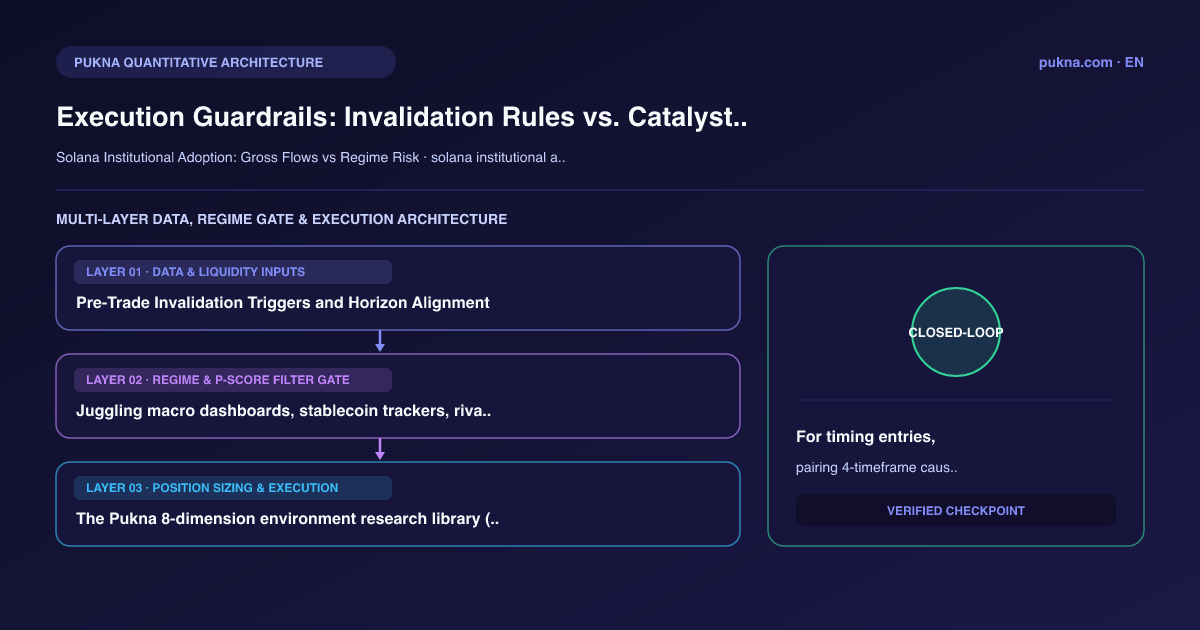
Pre-Trade Invalidation Triggers and Horizon Alignment
Match your leverage ceiling to institutional settlement speed. Regulated ETF creations shape multi-week capital flows, whereas banking corridors and clearing sandboxes scale across multi-quarter compliance cycles. Running heavy intraday leverage behind slow infrastructure milestones lets normal crypto volatility liquidate your position long before the adoption thesis matures.
Define your exit before clicking buy. Stand aside immediately whenever positive ETF inflow prints collide with collapsing perpetual basis, thinning spot depth, or a higher-timeframe shift toward tight dollar liquidity. Never justify holding a broken chart by citing a multi-year institutional roadmap.
- Clear the macro liquidity gate: Confirm dollar funding conditions, interest-rate expectations, and broad market breadth permit risk expansion before sizing catalyst trades.
- Verify dual on-chain convergence: Require alignment across at least two measurable streams—multi-week net ETF inflows, non-bot stablecoin settlement, or Firedancer validator stake share.
- Filter derivatives hedging distortion: Flag inflows paired with surging open interest and stagnant spot absorption as probable market-neutral basis arbitrage.
- Enforce objective tape invalidation: Cut or skip breakout entries when spot depth thins, funding stretches abruptly, or 4h/1d causal structure loses directional alignment.
- Cap leverage to catalyst lag: Restrict directional sizing to spot exposure or 1–3x integer leverage ceilings so multi-quarter adoption theses survive routine volatility sweeps.
Stress-Testing SOL Catalyst Assumptions Through Historical Simulation
One memorable partnership rally never validates an untested trading rule. Before sizing capital around Solana institutional milestones, audit past volatility cycles with downside-focused Sortino and drawdown metrics to measure how fast tail losses accelerate when macro regimes flip. Good theses still break under bad sizing.
You do not need custom backtesting code to pressure-test SOL/USDT catalyst rules. Running an AUTO 1–3x integer-leverage equity-curve simulation on Pukna lets you review historical return paths across changing regimes first. Complete that simulated win-rate and max-drawdown audit before deciding whether to subscribe to real-time push alerts.
Keeping simulated historical win rate separate from the relative return-quality P score prevents overconfidence whenever headline volatility spikes. Institutions deploy onto Solana through audited custody, multi-client validator resilience, and hard risk budgets. Evaluating their on-chain footprint demands that exact same discipline.
Frequently Asked Questions
Which institutions are deploying live capital on Solana versus running exploratory pilots?
Live capital sits inside regulated spot Solana ETF creations, active payout rails like B2C2 and MoneyGram, and audited corporate SOL staking treasuries such as Nasdaq-listed HSDT. By contrast, most banking consortiums and post-trade clearing projects start as phased compliance sandboxes. Genuine balance-sheet exposure scales over quarters, not on press-release day.
How do spot Solana ETFs, corporate treasuries, and stablecoin payment rails affect SOL differently?
Spot ETFs add regulated SOL custody demand directly, though cash-and-carry futures hedging can mute immediate spot repricing. Corporate SOL staking treasuries tie buying power to equity NAV premiums and share-issuance cycles, introducing dilution risk when premiums fade. Regulated stablecoin rails expand network fee volume and real utility, yet settle in dollar-pegged tokens without requiring large institutional SOL inventory.
Does Firedancer resolve institutional reliability and decentralization concerns on Solana?
Firedancer targets Solana’s biggest institutional reliability risk by adding an independent validator client alongside Agave, reducing the chance that one software bug halts block production. Enterprise risk committees still judge mainnet track records over lab benchmarks. Lasting institutional clearance requires sustained Firedancer stake share, a resilient Nakamoto Coefficient, and clean uptime through violent volatility cycles.
Put this into practice
Create a free account to browse live signals and test your own rules.