Contents6 sections
- What Does a Crypto Token Unlock Mean in Practice?
- Vesting Schedule vs. Token Unlock vs. TGE
- Cliff, Linear, and Milestone Release Structures
- What a Token Unlock Is Not: Minting, Hacks, and Wallet Locks
- Why Do Nominal USD Unlock Headlines Mislead Traders?
- Float Dilution Percentage vs. Headline Dollar Value
- Recipient Cohort Incentives: VCs, Core Teams, and Treasuries
- Order-Book Absorption: 30-Day ADV, 2% Depth, and Venue Fragmentation
- Token Cross Venue Liquidity Accessibility Pipeline
- How Do Token Unlocks Move Price Across Market Regimes?
- Bullish High-Liquidity Expansion and Overhang Relief
- Range-Bound Low-Volume Markets and Persistent Supply Bleed
- High-Volatility Deleveraging and the Buy-the-Unlock Short Squeeze
- Why Do Raw Unlock Calendar Alerts Frequently Fail?
- Smart-Contract Release vs. Actual Exchange Deposit Flow
- OTC Deals, Pre-Unlock Hedging, and Market-Maker Loans
- Why Public Unlock Trackers Report Conflicting Float Numbers
- How to Build a 4-Stage Token Unlock Verification Workflow
- Pre-Unlock Screening: Float Dilution, ADV Ratio, and Cohort Audit
- Tracking Vesting Contracts and On-Chain Exchange Inflows
- Regime Confirmation, Multi-Timeframe Validation, and Drawdown Controls
- Frequently Asked Questions on Crypto Token Unlocks
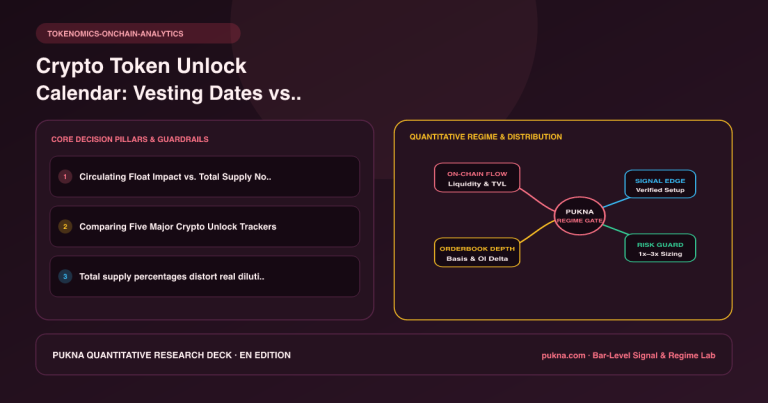
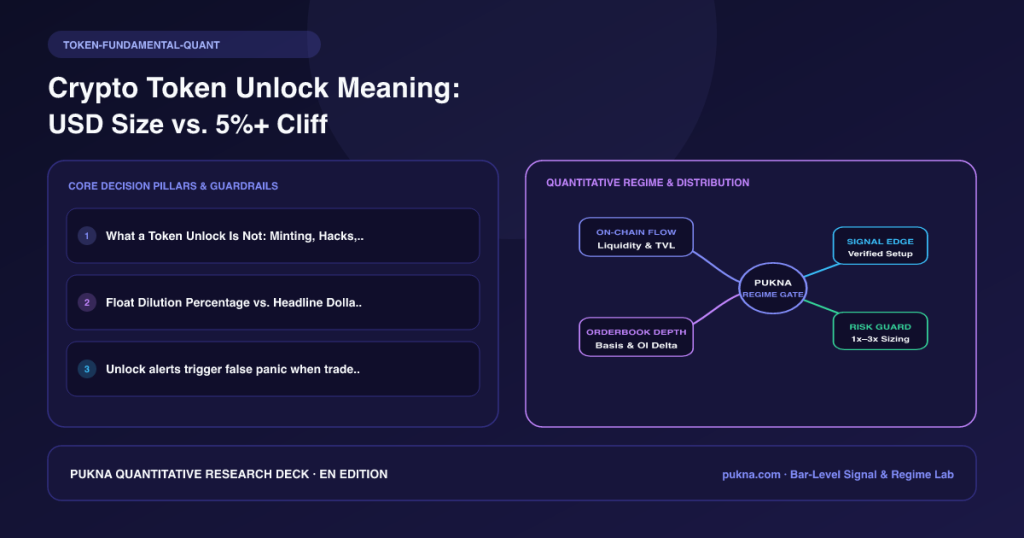
A crypto token unlock is the scheduled smart-contract release of restricted supply into transferable circulation, distinct from minting new coins, protocol exploits, or unfreezing an exchange account. Dollar headlines hide scale: an insider cliff above 3%–5% of circulating float and 1x–2x 30-day Average Daily Volume (ADV) signals real overhang, yet crowded pre-unlock shorts can trigger a squeeze. Comparing vesting schedules, recipient cohorts, net CEX inflows, and market regimes below verifies whether unlocked tokens actually turn into sell pressure.
What Does a Crypto Token Unlock Mean in Practice?
A token unlock lifts transfer restrictions without minting new coins.
Vesting Schedule vs. Token Unlock vs. TGE
At a Token Generation Event (TGE), smart contracts lock allocations reserved for seed backers, core engineers, advisors, and protocol treasuries. Timelocks stop day-one insider dumping onto public spot buyers. Multi-year schedules align early contributor payouts with protocol delivery instead of launch-week exit liquidity.
Traders routinely blur two distinct milestones: vesting accrual and token unlocks. Vesting tracks when a recipient legally earns ownership over time. An unlock is the exact block timestamp when smart-contract transfer limits expire and those coins move freely on-chain.
Structural overhang comes from the gap between circulating supply and Fully Diluted Valuation (FDV). Suppose a token debuts at a $150M market cap with just 15% circulating float. Its FDV sits at $1.0B, leaving 85% of supply behind future unlock gates. Reviewing low-float FDV overhang benchmarks shows how MC/FDV ratios below 0.25 expose spot holders to multi-year dilution.
Cliff, Linear, and Milestone Release Structures
Release cadence drives order-book shock far more than total locked supply. Lump-sum cliffs compress months of accrued allocation into one tradable block. Linear streams and programmatic emissions dilute float slowly, testing organic spot demand over quarters instead of one violent session.
| Unlock Type & Cadence | Circulating Float Shock | Typical Recipient Cohort | Liquidity Absorption Behavior |
|---|---|---|---|
| Cliff Unlock Zero release for 6–12+ months, then one lump-sum drop |
Acute, concentrated step-jump in transferable supply | Seed/private VCs, early advisors, core founders | High event volatility; often pre-priced 14–30 days early via perp positioning |
| Linear Vesting Unlock Continuous per-block, daily, or monthly stream |
Gradual, persistent float expansion over 1–4 years | Post-cliff team, investors, ecosystem contributors | Rarely spikes volatility alone; causes steady bleed in thin sideways books |
| Milestone / Performance Unlock Event-triggered by TVL, shipping, or governance vote |
Irregular, hard to schedule on fixed calendar dates | Protocol builders, strategic partners, DAO grantees | Price impact hinges on whether the achieved catalyst draws fresh spot inflows |
| Staking & Ecosystem Emissions Programmatic inflation released every epoch or block |
Predictable baseline dilution tied to staking APR | Validators, liquidity providers, farming participants | Steady sell pressure when mercenary farmers harvest rewards into thin bids |

What a Token Unlock Is Not: Minting, Hacks, and Wallet Locks
Unlock alerts trigger false panic when traders confuse scheduled releases with supply bugs or exploits. Standard unlocks release pre-allocated coins already counted inside total supply and FDV. No new maximum supply is minted, and no contract was breached.
Protocol unlocks also have nothing to do with personal wallet administration. A token unlock never means unfreezing a restricted exchange balance, resetting a hardware wallet PIN, or clearing a personal validator unstaking queue. Yet even after isolating a real cliff event, raw dollar headlines still distort its market impact.
Why Do Nominal USD Unlock Headlines Mislead Traders?
Dollar headlines lie; float dilution and 30-day ADV determine absorption.
Float Dilution Percentage vs. Headline Dollar Value
Raw dollar headlines chase clicks while hiding relative scale. A $50M release against a $10B circulating market cap adds just 0.5% to tradable float. By contrast, a $20M unlock on a $200M circulating cap expands active float by 10.0%, delivering twenty times heavier dilution from less than half the dollar figure.
Two simple ratios kill the guesswork. Divide newly unlocked tokens by circulating supply to measure real float dilution. Then divide unlock dollar value by 30-day Average Daily Volume (ADV) to see how many full trading sessions of turnover are needed to absorb potential liquidation.
Run both ratios on two identical $30M calendar alerts. Token A carries a $3B circulating cap (1.0% float dilution) and $300M in 30-day ADV (0.10x daily volume), so routine market-making clears the batch smoothly. Token B sits at a $375M float (8.0% dilution) with $15M in 30-day ADV (2.0x daily volume), creating heavy overhang if holders sell spot.
Recipient Cohort Incentives: VCs, Core Teams, and Treasuries
Identical float percentages produce opposite sell rates depending on who controls the unlocked wallets. Seed and private VC funds sitting on 10x–30x paper multiples answer to LP distribution clocks and strict fund mandates. Core teams and foundation treasuries face public wallet tracking, governance limits, and multi-year operating budgets.
| Recipient Cohort | Typical Cost-Basis Advantage | Sell / Hedge Propensity | Float-Dilution Alert | CEX Deposit Likelihood |
|---|---|---|---|---|
| Seed & Private VC Rounds | 10x–30x+ discount to public spot | High; fund mandates drive OTC sales or perp pre-hedges | > 2.0% of circulating float | High via prime brokers or market-maker desks |
| Core Team & Advisors | Genesis or early equity allocation | Moderate; sensitive to public governance reputation | > 3.0% of circulating float | Moderate; often staggered over months or routed OTC |
| Ecosystem & Community Grants | Variable reward or incentive basis | Moderate-to-high among short-term yield farmers | > 4.0% of circulating float | High for immediate claimers; fragmented across retail wallets |
| Foundation & DAO Treasuries | Genesis protocol reserve | Low; rarely liquidated straight onto spot books | > 5.0% if paired with live spend | Low; unlocked balances typically rest in multisigs |
Order-Book Absorption: 30-Day ADV, 2% Depth, and Venue Fragmentation
Reported volume still overstates exit capacity whenever rebate churn or wash trading pads turnover. Comparing unlock size against consolidated 2% spot bid depth shows how much selling hits resting bids before price gaps down. Checking headline valuation versus executable bid depth explains why last-trade market cap consistently exaggerates real liquidity in thin books.
Liquidity split across centralized exchanges (CEXs), decentralized exchanges (DEXs), and separate chains cannot be summed blindly. Research in BIS Bulletin No. 56 on crypto market fragmentation details how isolated venues and settlement delays block seamless pooling. Only reachable venues, transferable assets, synchronized timestamps, and deduplicated quotes belong in an executable 2% bid-depth estimate.
Market stress compresses real capacity even faster. Wide spreads, pulled market-maker quotes, and congested bridges shrink reachable CEX depth right as large holders seek exits, while intent-based orderflow and MEV toxic flow erode DEX execution quality. That fragility explains why the same 5% float cliff produces opposite price paths across shifting macro regimes.
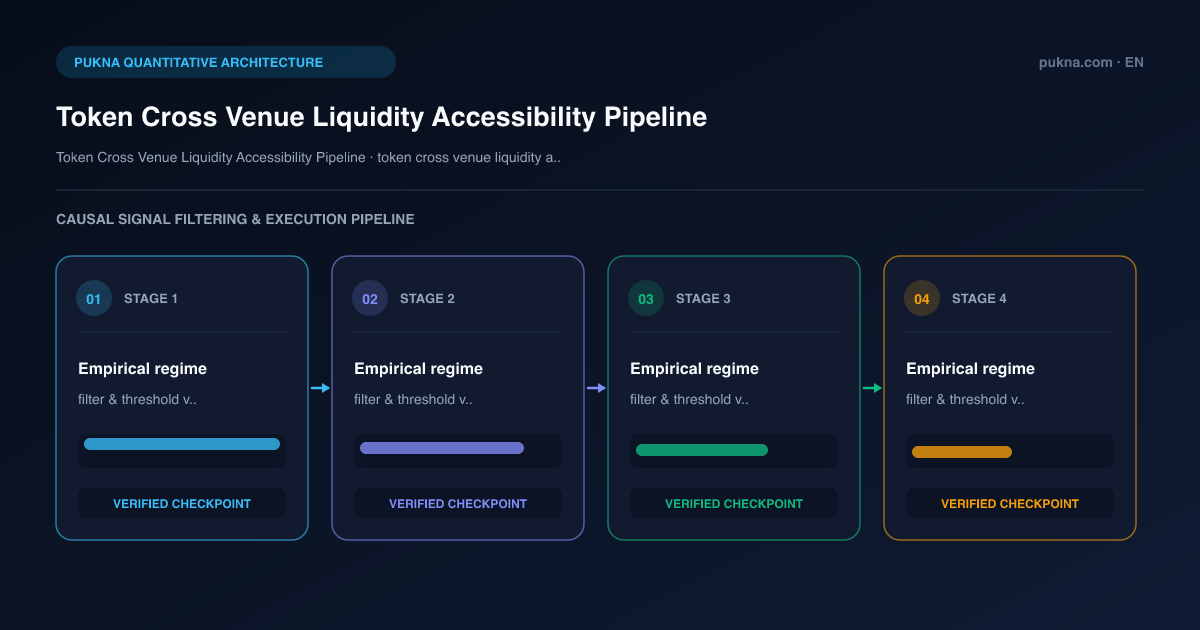
Token Cross Venue Liquidity Accessibility Pipeline
| Checkpoint | Empirical Criterion & Execution Guardrail |
|---|---|
| Phase 01 | Venue Accessibility & Deduplication: Verify CEX and DEX pools are reachable, assets can bridge freely, and shared market-maker liquidity is not double-counted across order books. |
| Phase 02 | Unified 2% Bid-Depth Snapshot: Measure executable buy depth within a fixed 2% price band using one synchronized timestamp, quote currency, and reference mid-price. |
| Phase 03 | Stress-Regime Slippage Guardrail: Discount static depth when spreads widen, quotes pull back, or transfer congestion raises execution friction during catalyst windows. |
How Do Token Unlocks Move Price Across Market Regimes?
The same 5% float unlock triggers opposite moves across regimes.
Markets rarely wait for the unlock block to reprice new supply. Desk positioning builds across a T-30d to T+14d window around publicized cliffs. Front-runners open perpetual shorts weeks early, lifting open interest and compressing perpetual basis before a single coin moves. Post-unlock direction then hinges on whether actual spot selling validates those crowded bets.
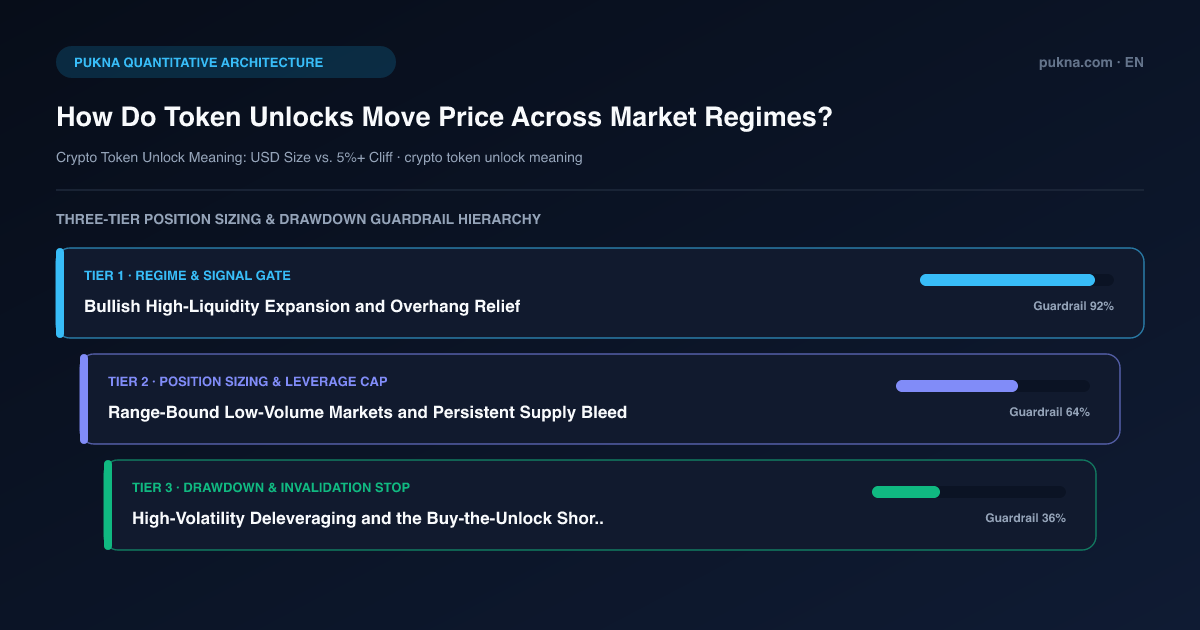
Bullish High-Liquidity Expansion and Overhang Relief
Deep spot demand clears mid-sized cliffs much faster than raw supply math assumes. During macro liquidity expansion regimes, market-maker bids routinely digest 2%–5% float unlocks through brief intraday dips. Once feared overhang clears without snapping support, spot-TWAP absorption drives perpetual-basis normalization and fuels a relief rally as event uncertainty lifts.
Range-Bound Low-Volume Markets and Persistent Supply Bleed
Low-volume sideways chop turns the same dilution profile into a slow grind lower. Shallow resting bids struggle to clear even a 1.5%–3% monthly linear stream or mid-sized cliff. Rebounds stall against ask-heavy limit-orderbook (LOB) skew while taker-flow exhaustion sets in, creating a multi-week bleed rather than one clean flush.
High-Volatility Deleveraging and the Buy-the-Unlock Short Squeeze
High-volatility stress splits into two violent tails. When cross-asset shocks spike equity volatility stress via VIX, crypto implied volatility (DVOL) jumps above trailing realized volatility, widening the implied volatility vs. realized volatility (VRP) spread. Market makers pull defensive quotes fast, amplifying downside slippage whenever real spot selling hits thin books.
Widely telegraphed cliffs frequently spring the opposite trap: a buy-the-unlock short squeeze. Speculators pile into pre-unlock perpetual shorts, inflating open interest and driving funding rates deeply negative. Checking crowded directional account positioning flags lopsided bearish bets early. If unlock-day spot selling underwhelms, forced short covering ignites a violent upside liquidation cascade.
| Market Regime | Liquidity & Derivatives Backdrop | Typical Path (T-14d to T+14d) | Signal Polarity & Trader Trap |
|---|---|---|---|
| Bullish High-Liquidity Expansion | Deep 2% spot bids, expanding inflows, healthy perpetual basis | Brief pre-unlock dip; rapid absorption into post-unlock relief rally | Shorting the cliff gets steamrolled by spot-TWAP absorption |
| Range-Bound Low-Volume Chop | Thin resting books, stagnant ADV, ask-heavy LOB skew | Persistent multi-week supply bleed; failed rebounds below resistance | Buying early dips underestimates continuous linear distribution |
| High-Volatility / Crowded Short | Surging open interest, negative funding rate, elevated DVOL & VRP spread | Sharp pre-unlock drop, then violent short squeeze if spot selling stalls | Treating calendar alerts as automatic shorts invites liquidation |
Regime shifts explain half of why naive unlock shorts blow up. Flawed calendar feeds and invisible off-chain deals explain the rest.
Why Do Raw Unlock Calendar Alerts Frequently Fail?
Calendar timestamps mark contract eligibility, not forced spot selling.
Smart-Contract Release vs. Actual Exchange Deposit Flow
Smart-contract expiration grants transferability, never a mandate to hit spot bids. Large insider tranches regularly sit idle inside vesting multisigs for months, rotate straight into staking pools, or move across internal custody wallets. Using wallet custody versus CEX inflow filters separates routine treasury reshuffles from verifiable deposits onto liquid spot venues.
OTC Deals, Pre-Unlock Hedging, and Market-Maker Loans
Institutional holders rarely dump millions straight into thin retail books on unlock morning. Funds often transfer discounted blocks through private over-the-counter (OTC) desks with fresh secondary lockups, keeping coins off public exchanges altogether. Others lock in paper gains weeks early via perpetual short hedges or borrowed-inventory loans arranged with market makers.
When the vesting block finally unlocks, those pre-hedged desks simply deliver spot coins to flatten shorts or repay borrowed inventory. Zero net fresh selling touches the live order book. Late traders shorting the exact calendar timestamp become exit liquidity.
Why Public Unlock Trackers Report Conflicting Float Numbers
Public unlock calendars routinely disagree by 20%–40% on the exact same cliff percentage. One tracker excludes foundation reserves, bridge escrows, and unclaimed DAO grants from circulating float; another counts every non-timelocked wallet. That accounting gap swings a reported release from 3.5% to over 6% overnight, warping ADV multiples and firing false alarms.
| Naive Calendar Alert | Underlying On-Chain / Market Reality | Required Multi-Factor Verification |
|---|---|---|
| Large cliff timestamp triggers immediate dump call | Tokens stay idle in vesting multisigs or re-stake on-chain | Confirm net transfers from vesting contracts to labeled CEX deposit wallets |
| VC unlock implies day-of spot liquidation | Fund pre-hedged via perp shorts or sold OTC weeks beforehand | Track pre-unlock open interest spikes, perpetual basis compression, and negative funding |
| Headline release exceeds $50M, flagged as high risk | Equals < 1% of float and < 0.25x 30-day ADV in a deep liquid pair | Normalize by circulating float %, 30-day ADV ratio, and 2% consolidated bid depth |
| Single dashboard reports 8% circulating dilution | Conflicting tracker rules omit or include treasury and DAO balances | Reconcile smart-contract schedules directly against primary docs and on-chain balances |
| Manual single-calendar tracking in isolation | Ignores macro liquidity shifts, volatility stress, and positioning skew | Cross-check asset-level unlock schedules against macro liquidity, derivatives positioning, and on-chain regime indicators |
Tracking unlock calendars in isolation fails because supply releases never trade outside broader liquidity regimes. Pairing asset-level unlock profiles in the Pukna 43-token research library with macro, derivatives, and on-chain readings from its 8-dimension 39-indicator environment library closes that blind spot. That single cross-check replaces reactive calendar alerts with verifiable supply and regime context.
How to Build a 4-Stage Token Unlock Verification Workflow
Disciplined desks filter dilution first, then confirm flows and structure.
A repeatable four-stage screen cuts noisy calendar feeds down to high-conviction risk windows. Every stage demands numerical confirmation before you adjust spot inventory or place hedges.

Pre-Unlock Screening: Float Dilution, ADV Ratio, and Cohort Audit
Eliminate 80% of low-impact unlocks before opening a price chart. Flag an upcoming cliff only when circulating float dilution tops 2%–3%, dollar value exceeds 1.0x 30-day ADV, and consolidated 2% bid depth runs thin. Prioritize seed VC and private tranches over foundation treasuries. Clearing this gate earns watchlist priority, never an automatic trade.
Tracking Vesting Contracts and On-Chain Exchange Inflows
Once the vesting timestamp fires, monitor whether released tokens reach liquid exit venues across the first 72 hours. Track labeled transfers from vesting contracts into spot exchange deposit addresses alongside stablecoin inflows. Contrast net CEX deposits against open interest, funding rates, perpetual basis, and DVOL: muted inflows paired with deeply negative funding warn of short-squeeze risk.
Regime Confirmation, Multi-Timeframe Validation, and Drawdown Controls
Skip guessing directional turns on the exact unlock minute. Wait for objective structure confirmation across 15m, 1h, 4h, and 1d charts instead. Pairing volume-confirmed price structure rules with intraday taker-flow exhaustion separates durable post-unlock spot absorption from fragile bounces trapped under lingering overhang.
Across major liquid pairs, Pukna tracks 15m/1h/4h/1d bar-level causal buy and sell signals on 42 USDT pairs at app.pukna.com. Each trigger displays a P relative quality score (0–100), where 50 marks the neutral baseline matching surrounding ordinary candles. Higher readings reflect stronger combined peak return and final return over the forecast window (horizon_bars). That score measures relative return quality, never win-rate probability.
Event-window leverage punishes mistakes through simple loss asymmetry: a 50% drawdown demands a +100% gain just to recover breakeven, and one buy-the-unlock squeeze liquidates crowded shorts. Cap risk with explicit invalidation stops rather than oversized margin. Before subscribing to real-time push alerts, simulate the strategy in AUTO at 1x–3x integer leverage to audit its historical equity curve, win rate, and max drawdown across prior volatility spikes.
- Stage 1 — Supply & Liquidity Gate: Keep events on watch only when float dilution tops 2%–3%, unlock value exceeds 1.0x 30-day ADV, 2% consolidated bid depth runs thin, and VC cohorts dominate.
- Stage 2 — On-Chain & Derivatives Audit: Confirm vesting releases convert into net CEX spot inflows rather than idle multisigs. Cross-check funding rates, open interest, and perpetual basis for crowded pre-shorting.
- Stage 3 — Multi-Timeframe Causal Confirmation: Wait for 15m/1h/4h/1d structure validation and volume follow-through instead of front-running T0. Benchmark causal triggers against the P = 50 neutral baseline without confusing quality scores for win probability.
- Stage 4 — Drawdown & Leverage Discipline: Restrict exposure to 1x–3x integer leverage around catalyst windows, verify historical max drawdown first, and cut shorts immediately if spot-TWAP absorption reclaims broken support.
Supply unlocks interact directly with FDV ratios, stablecoin demand, and whale transfer filters; compare core verification rules across related studies below.
| Research Scenario | Core Criterion | Empirical Takeaway | Full Study |
|---|---|---|---|
| Evaluating stablecoin supply expansion | Mint-burn netflows, issuer share, bid depth, derivatives positioning | Rising stablecoin market cap only confirms spot demand when paired with bid depth and net inflows. | Stablecoin Market Cap: Supply Growth vs. Real Spot Demand → |
| Screening token dilution and vesting risk | MC/FDV tiers (<0.25), cliff unlock size, 30-day volume, liquidity | Low MC/FDV tokens carry acute overhang unless 30-day spot liquidity can absorb cliff unlocks. | FDV vs Market Cap Crypto: MC/FDV <0.25 Dilution & Spot Depth → |
| Filtering whale alert noise on BTC, ETH, XRP | Internal vs. external wallet flows, 24h spot volume, order-book depth | Large transfers often reflect internal custody moves rather than trades; verify against spot depth. | Crypto Whale Tracker: Compare Tools & Filter False Alerts → |
| Sizing risk behind headline market cap | Circulating last-trade pricing vs. order-book depth and FDV unlocks | Market cap multiplies circulating coins by the last trade, overstating exit liquidity in thin books. | Crypto Market Cap: Formula, FDV Traps, Liquidity, and Quant Screening → |
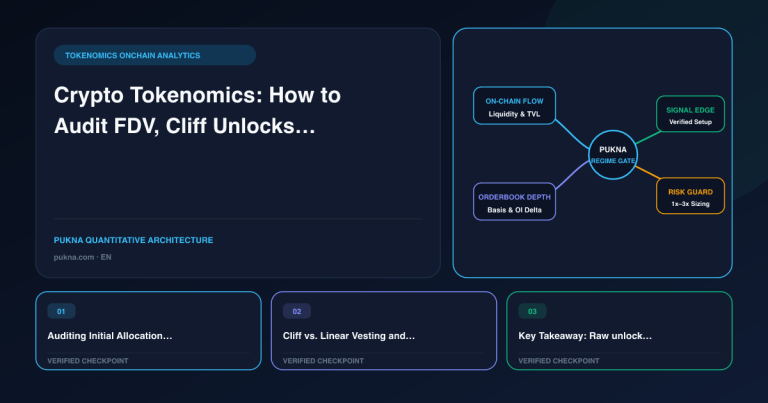
| Auditing tokenomics before holding | MC/FDV ratios, cliff unlocks, illiquid absorption, BTC/ETH/XRP benchmarks | A 6-step audit pairing unlock cliffs with real demand sinks exposes dilution hidden by headline valuation. | Crypto Tokenomics: How to Audit FDV, Cliff Unlocks, and Demand Sinks → |
Frequently Asked Questions on Crypto Token Unlocks
Does a crypto token unlock always cause the price to drop?
No. Price impact depends on circulating float dilution, 30-day ADV depth, and derivatives positioning rather than headline dollar value. Releases under 1% of float are routinely absorbed during bullish liquidity expansions. When traders crowd into pre-unlock perpetual shorts ahead of a publicized cliff, muted spot selling often triggers a sharp short squeeze instead.
What is the difference between a cliff unlock and linear vesting?
A cliff unlock freezes 100% of an allocation for a fixed lockup, typically six to twelve months, then releases one lump sum on a single date. Linear vesting streams tokens continuously every block, day, or month after that cliff passes. Cliffs drive acute event volatility, while linear emissions create steadier supply drag across thin books.
How do you evaluate an upcoming crypto token unlock list?
Ignore raw dollar totals first and divide unlocked tokens by circulating supply to gauge real float dilution. Next, benchmark unlock value against 30-day Average Daily Volume and consolidated 2% spot bid depth. Audit recipient cohorts too, since seed VCs sell far faster than ecosystem treasuries. Always verify tracker float figures against vesting contracts and net CEX inflows.
Is a protocol token unlock the same as unlocking a personal wallet?
No. A crypto token unlock is a protocol-level supply event governed by smart-contract vesting code that makes investor, team, or treasury allocations transferable on-chain. It never refers to unfreezing a restricted exchange account, resetting a hardware wallet PIN, or finishing a personal staking unbonding queue, which are account-level or validator-level user actions.
Put this into practice
Create a free account to browse live signals and test your own rules.