Trailing Stop Loss in Crypto: Fixed-Percentage vs. ATR Distance and Fill Risk
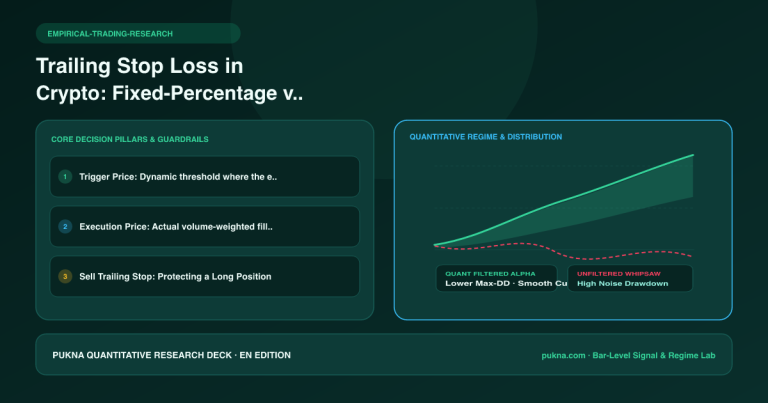
A trailing stop tracks favorable crypto swings, yet never guarantees a fill. Screen fixed % vs. ATR distances against realized volatility, book depth, and drawdown risk.
This archive establishes the core architectural framework for empirical crypto strategy design and multi-timeframe execution. Coverage spans causal candlestick modeling across 42 USDT pairs (15m, 1h, 4h, and 1d), P relative return quality evaluation (scaled 0–100, where 50 marks neutral candle parity rather than win probability), and cross-validation against 39 market environment indicators across 8 dimensions. Explore full-lifecycle research on historical equity curves, AUTO simulation workflows, and systematic signal execution.
A trailing stop tracks favorable crypto swings, yet never guarantees a fill. Screen fixed % vs. ATR distances against realized volatility, book depth, and drawdown risk.
Isolated bid-ask walls mislead traders during thin-book sweeps. Use L1-L3 feed comparisons, persistence-weighted OBI rules, and a regime-filtered execution checklist.
A 1:1 crypto hedge trades spot downside for funding drag and basis risk. Screen perps, dated futures, and protective puts by beta ratio, carry cost, and…
Isolated crypto candlestick shapes whipsaw in thin 24/7 books. Screen UTC closes with >=2.0x wick-to-body ratios, volume Z-scores >1.5, and ATR(14) volatility regimes.
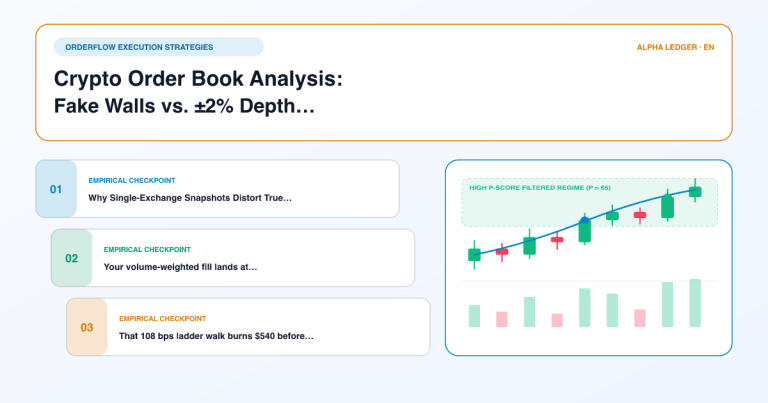
Isolated exchange bid walls rarely equal real support. Screen crypto order book viewers using aggregated ±2% depth, spread bps, spoof filters, and slippage bounds.
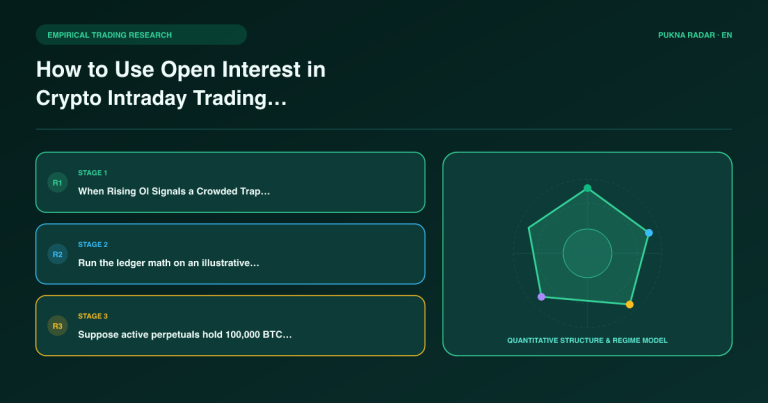
USD open interest can climb with zero new contracts. Filter 15m/1h coin OI delta with +0.03% funding, spot CVD, and 2% depth to avoid intraday liquidation…
Market makers pull big crypto buy walls in milliseconds. Filter spoofs with ±2% depth, 10× clip checks, spot CVD absorption, and regime context to cut slippage.
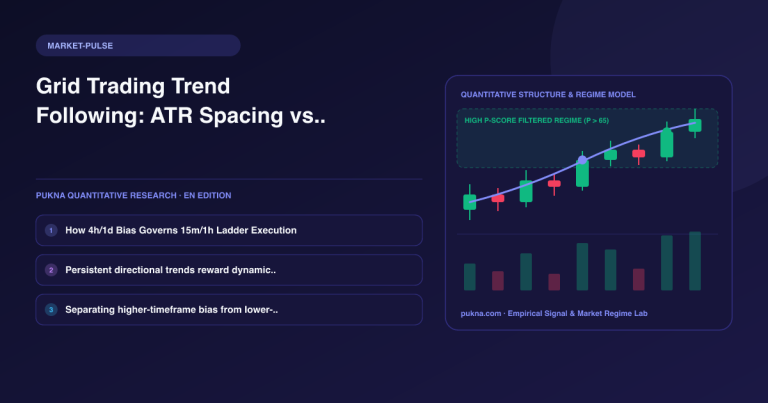
Static trend grids bleed in chop and miss breakouts. Pair dynamic re-anchoring and fee-adjusted ATR spacing with 4h/1d regime and DVOL filters to curb drawdown.
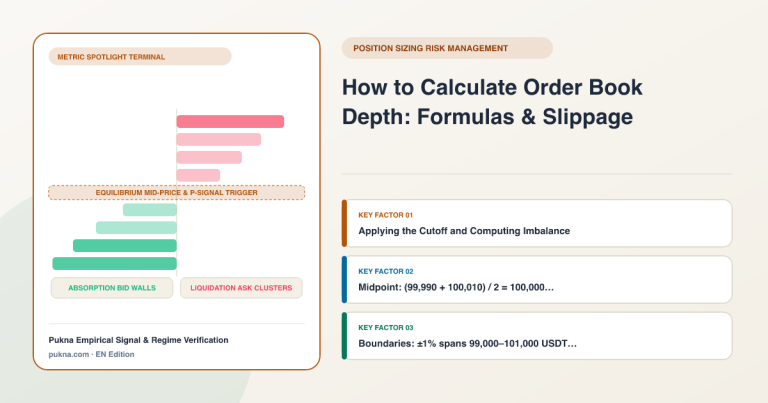
Sum price times quantity on each side within mid-price bands. Then walk the book to estimate slippage and check quote persistence before sizing orders.
Full Kelly is highly sensitive to estimation errors. Compare Quarter- and Half-Kelly sizing using worked examples, leverage caps, correlation adjustments, and drawdown stress tests.
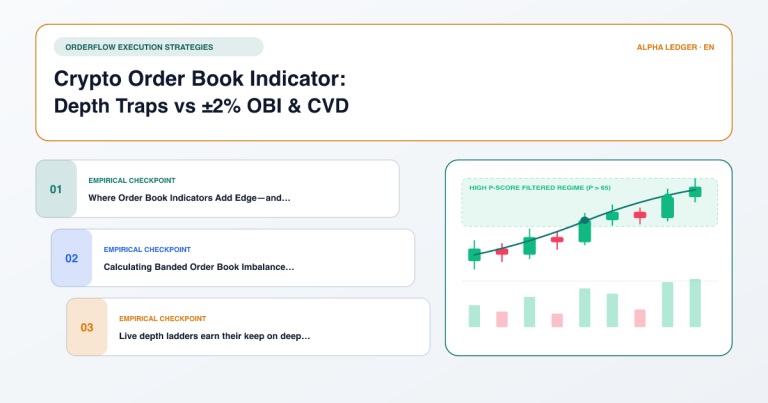
Static order walls cancel in milliseconds and never guarantee reversals. Benchmark ±0.5%–±2% OBI past ±0.25 against CVD flow, merged venue depth, and higher-timeframe regimes.
Fixed 5% stops can sit inside liquidation wicks. Compare 1.5x–3.5x ATR exits, DVOL, order-book depth, stop-limit buffers, and 1x–3x position sizing to manage drawdown.