Crypto Market Cycles: Halving Clock vs. 4-Phase Regimes
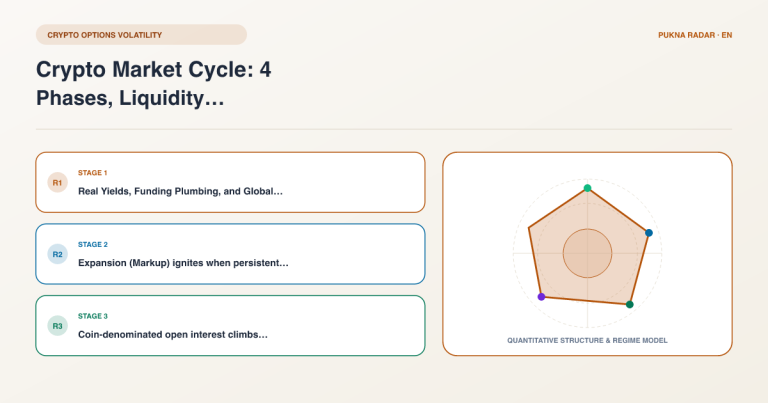
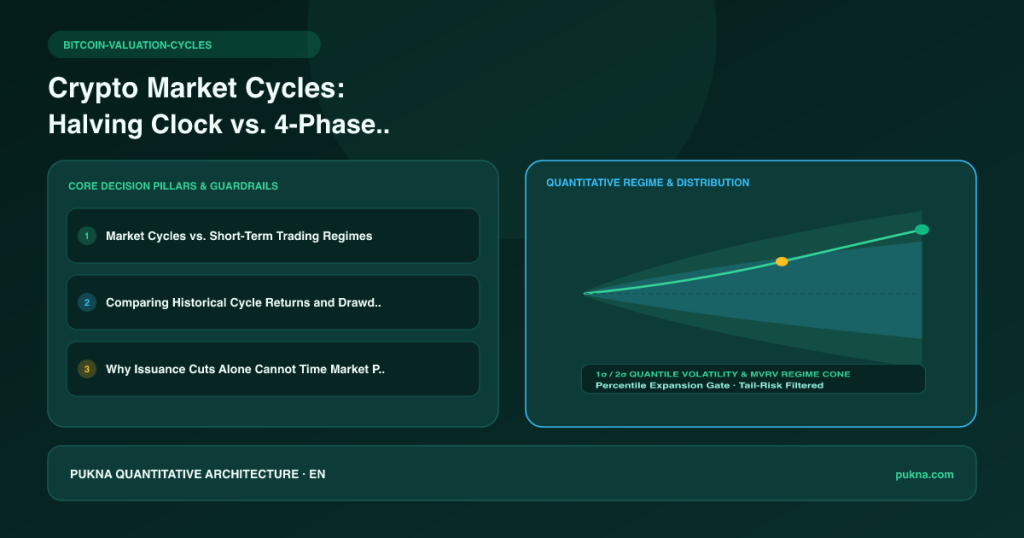
Crypto market cycles do not run on a halving clock. Screen four phases with trend, valuation, and liquidity, then validate strategy drawdowns via point-in-time backtests.
This hub focuses on tactical parameterization and operational hygiene across shifting market cycles: setting concrete threshold cutoffs across Pukna's 39 macro, liquidity, sentiment, derivatives, and on-chain indicators; filtering extreme volatility spikes, funding-rate squeezes, and liquidity air-pockets on 15m/1h/4h/1d K-lines so microstructure noise is not mistaken for a cycle inflection; calibrating P-score cutoffs (0-100, where 50 marks neutral relative quality over horizon_bars, never a win probability); and running a pre-deployment checklist on AUTO (1-3x integer leverage) historical equity curves, win rate, and maximum drawdown before subscribing to live alerts. For the overarching structural framework, explore our complete guide in Bitcoin Halving & Market Cycle Models (https://pukna.com/category/blog/macro-market-regime/bitcoin-valuation-cycles/).
Crypto market cycles do not run on a halving clock. Screen four phases with trend, valuation, and liquidity, then validate strategy drawdowns via point-in-time backtests.
Bitcoin's 4-year cycle tracks 210,000-block halvings, not a fixed calendar. Pair verified halving dates with dollar liquidity, ETF flows, and leverage to screen cycle regimes.
Issuance cuts follow code, yet BTC price paths diverge. Audit fixed-window returns and 27%–70% drawdowns to screen halving regimes by liquidity, spot demand, and leverage.
Halvings cut issuance, yet observed peak multiples fell from 92.1x to 1.9x across four cycles. Assess entry risk using spot demand, liquidity and leverage.
A 25% rally can leave a bear trend intact. Check weekly support, spot demand and dollar liquidity, then test 1x–3x strategies against historical drawdowns.
A 20–35% pullback can occur within a Bitcoin bull market. Use weekly support, macro liquidity, spot ETF flows and derivatives leverage to assess reversal risk.
Single indicators invert polarity across volatility shifts. Filter all four crypto cycle phases using dollar liquidity, funding, coin OI, DVOL, and 1x–3x drawdown caps.