Contents6 sections
- How Do the Cboe VIX and Crypto Fear & Greed Index Differ Structurally?
- Forward Implied Volatility vs. Lagging Realized-Volatility Drag
- Why VIX Has No Greed Mirror and How DVOL Bridges the Gap
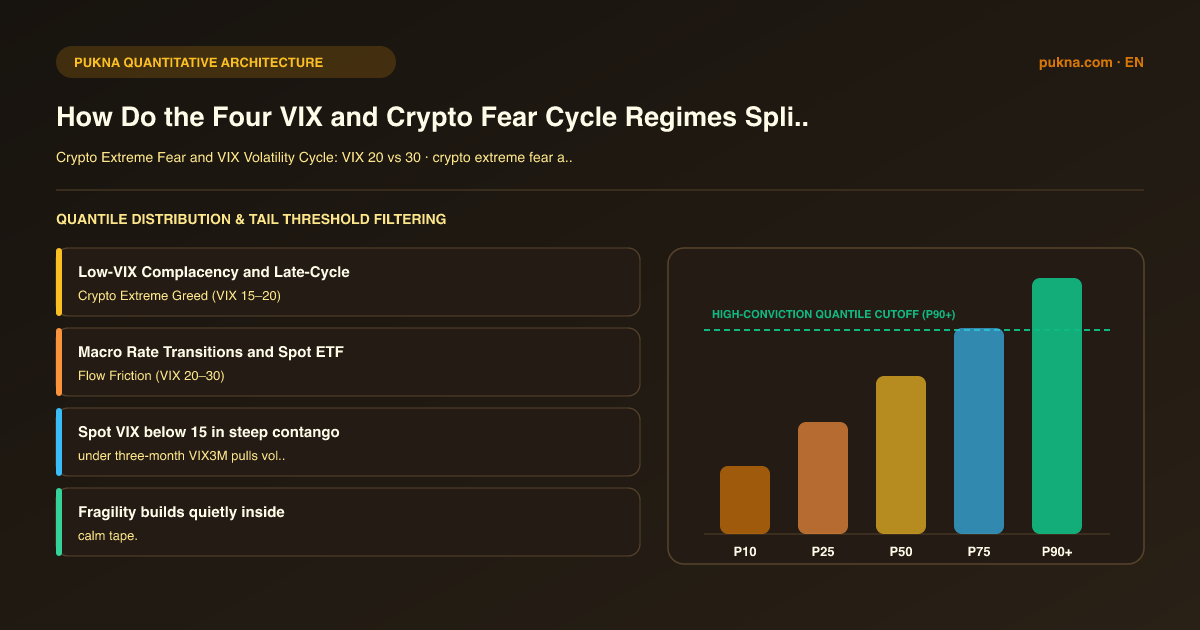
- How Do the Four VIX and Crypto Fear Cycle Regimes Split Market Outcomes?
- Low-VIX Complacency and Late-Cycle Crypto Extreme Greed (VIX <15–20)
- Macro Rate Transitions and Spot ETF Flow Friction (VIX 20–30)
- Systemic Liquidation Contagion in VIX Backwardation (VIX >30 + F&G <25)
- Crypto-Native Idiosyncratic Panic Under Muted Equity Volatility
- Why Did March 2020 and FTX React Oppositely Under Extreme Fear?
- Macro Contagion Episodes: Why First-Print Extreme Fear Under VIX >30 Fails
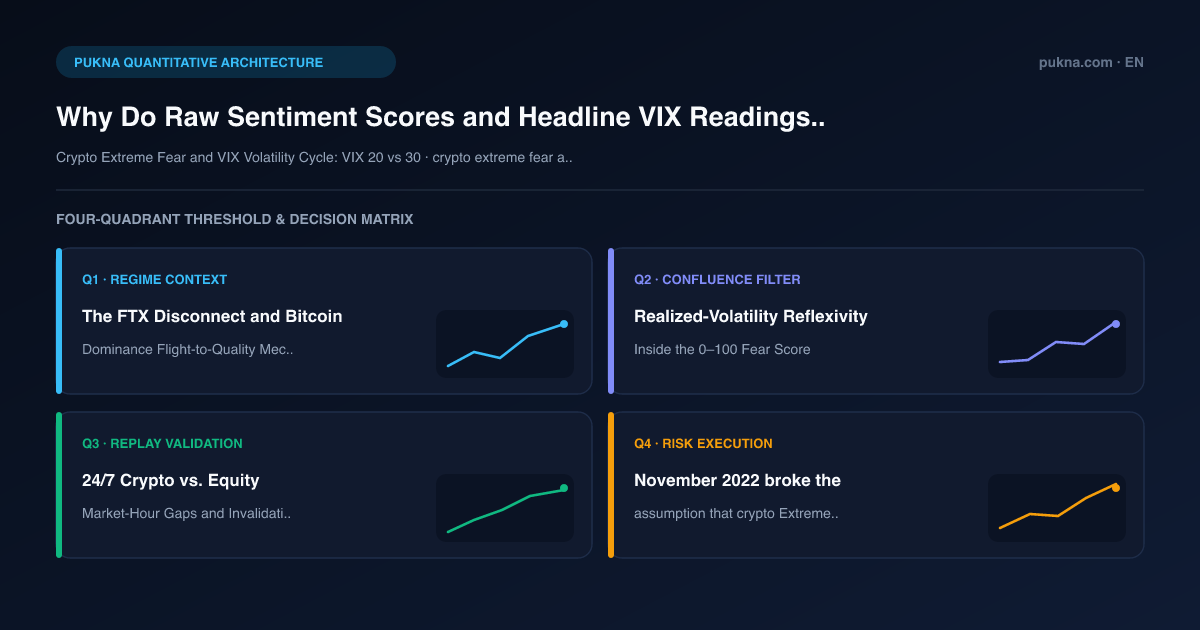
- The FTX Disconnect and Bitcoin Dominance Flight-to-Quality Mechanics
- Why Do Raw Sentiment Scores and Headline VIX Readings Mislead Traders?
- Realized-Volatility Reflexivity Inside the 0–100 Fear Score
- 24/7 Crypto vs. Equity Market-Hour Gaps and Invalidation Thresholds
- How to Build a Four-Gate Crypto Volatility Trading and Risk Workflow
- Macro Pre-Filters: VIX Term Structure Normalization and Liquidity Alignment
- Multi-Timeframe Causal Confirmation and 1x–3x Drawdown Guardrails
- Frequently Asked Questions
Crypto Extreme Fear scores lagging 0–25 spot sentiment, whereas the Cboe VIX prices 30-day forward S&P 500 crash protection, not crypto volatility. Extreme Fear below 25 flags forced cross-asset liquidation whenever spot VIX breaks above 30 in backwardation, while VIX below 20 isolates localized crypto washouts that clear much faster. Before sizing directional exposure around any headline fear print, traders must cross-check global dollar liquidity, implied-versus-realized volatility spreads, perpetual leverage resets, and higher-timeframe market structure.
How Do the Cboe VIX and Crypto Fear & Greed Index Differ Structurally?
The Cboe VIX prices 30-day forward equity option demand for crash protection, while Crypto Fear & Greed measures trailing market stress on a symmetric 0–100 scale. Because roughly 25% of the crypto index tracks backward-looking realized volatility and max drawdowns, lining up raw readings directly introduces timing errors.
Forward Implied Volatility vs. Lagging Realized-Volatility Drag
The Cboe VIX aggregates out-of-the-money S&P 500 option prices to gauge expected 30-day annualized equity variance. It prices future risk, not past pain. When institutional desks bid up put protection ahead of macro stress, VIX jumps before spot equities finish repricing, flagging live collateral strain across dollar-funded risk assets.
Crypto Fear & Greed relies on a backward-looking composite rather than live option pricing. Roughly 25% of its 0–100 score measures current realized volatility and max drawdowns against trailing 30-day and 90-day baselines, blended with momentum, volume, social chatter, and Bitcoin dominance. That trailing weight builds in structural lag. Once a sharp liquidation candle prints, the score stays pinned low long after spot buyers begin absorbing supply.
| Structural Dimension | Cboe VIX | Crypto Fear & Greed | Crypto IV (DVOL / BVIV) |
|---|---|---|---|
| Underlying Asset | S&P 500 index options | Spot crypto & BTC metrics | BTC & ETH 30-day options |
| Time Horizon | 30-day forward implied | Backward-looking composite | 30-day forward implied |
| Volatility Weight | 100% option-implied variance | ~25% realized vol & drawdown | 100% option-implied variance |
| Symmetry | One-sided fear index | Symmetric 0–100 (Fear–Greed) | Two-sided variance gauge |
| Trading Hours | US equity & futures sessions | 24/7 continuous spot feeds | 24/7 continuous option venues |
| Primary Blind Spot | Misses weekend crypto shocks | Trailing vol drag pins extremes | Thinner altcoin option depth |
Why VIX Has No Greed Mirror and How DVOL Bridges the Gap
Equity volatility benchmarks have no symmetric “Extreme Greed” mirror. Asset managers pay far steeper premiums for left-tail crash puts than for upside calls, skewing the index toward downside fear. Equity complacency surfaces as compressed VIX readings around 12–15, never as a euphoric spike. Crypto Extreme Greed above 75 works differently, flagging stretched momentum right before variance expands.
Mapping equity implied volatility straight onto lagging crypto sentiment mixes two incompatible clocks. Crypto options indices like Deribit DVOL and Volmex BVIV close that mismatch by pricing 30-day forward variance directly from live crypto books. Tracking the implied volatility vs. realized volatility (VRP) spread inside a DVOL-to-VIX volatility scaling framework reveals whether option desks expect macro spillover. Above VIX 20 or 30, identical fear readings invert.
How Do the Four VIX and Crypto Fear Cycle Regimes Split Market Outcomes?
An identical Crypto Extreme Fear reading below 25 produces opposite forward return paths depending on whether the VIX sits in calm contango or panicked backwardation. Cross-referencing VIX bands and term-structure slope against crypto sentiment separates systemic dollar de-grossing from localized crypto washouts.
| Volatility Regime | VIX & Curve Slope | Crypto F&G Zone | BTC–Equity & Liquidity Driver | False-Signal Trap & Posture |
|---|---|---|---|---|
| Calm Contango Complacency | VIX <15–20 (VIX < VIX3M) | Extreme Greed (>75) | Low equity beta; steady spot ETF inflows | Chasing late longs into vol compression; tighten risk |
| Macro Rate Transition | VIX 20–30 (Flattening curve) | Fear to Neutral (20–45) | Rising beta; sticky yields & mixed ETF flows | Whipsaw entries on oscillating fear; trim size |
| Systemic Contagion Shock | VIX >30 (VIX > VIX3M) | Extreme Fear (<25) | High positive beta; cross-asset margin calls | Buying first F&G <25 print; wait for curve reset |
| Idiosyncratic Crypto Panic | VIX <22 (Orderly contango) | Extreme Fear (<20) | Decoupled beta; BTC dominance flight | Treating local panic as macro recession; track base |
Low-VIX Complacency and Late-Cycle Crypto Extreme Greed (VIX <15–20)
Spot VIX below 15 in steep contango under three-month VIX3M pulls vol-targeting funds back into risk assets. Capital slides fast down the risk curve. Steady spot ETF creations bid up Bitcoin while perpetual basis widens and open interest builds across major venues. Separating genuine spot accumulation from hedged basis carry requires spot ETF flow and basis arbitrage filters before trusting trend strength.
Fragility builds quietly inside calm tape. Once Crypto Fear & Greed clears 75 with VIX pinned at 12–15, crowded longs drive perpetual rates toward each venue’s funding cap. One unexpected macro print then squeezes equity vol shorts and crypto leverage together, snapping prices sharply off quiet highs.
Macro Rate Transitions and Spot ETF Flow Friction (VIX 20–30)
Equity volatility curves flatten between VIX 20 and 30 as Treasury markets reprice policy rates and inflation risk. Neither bulls nor bears hold control. Bitcoin chops around its multi-week point of control (POC) while erratic spot ETF outflows offset dip buying. Swinging Fear prints between 20 and 40 produce serial fakeouts on both sides.
Linear dip buying bleeds capital inside these choppy ranges. Dollar liquidity direction dictates whether VIX 20–30 cools into trend resumption or snaps above 30 into forced selling. Auditing global dollar liquidity cycle regimes distinguishes routine rate repricing from systemic contagion risk.
Systemic Liquidation Contagion in VIX Backwardation (VIX >30 + F&G <25)
Spot VIX above 30 and higher than VIX3M flips equity volatility into backwardation. That inversion proves institutions are paying steep premiums for near-term crash protection. Cross-asset funds slash gross books indiscriminately, pulling Bitcoin’s short-term correlation with the Nasdaq 100 sharply higher. During a USD/JPY carry-trade unwind and cross-asset risk-off deleveraging wave, 24/7 crypto venues turn Bitcoin into instant collateral for global margin calls.
First-print Extreme Fear below 25 signals active liquidation under backwardation, not a value floor. Early dip buyers get run over. Cascading perpetual stop-runs push implied volatility vertically across equity options and crypto DVOL alike. Asymmetric risk-reward returns only once spot VIX stops setting higher highs and front-end inversion begins to unwind.
Crypto-Native Idiosyncratic Panic Under Muted Equity Volatility
Crypto needs no equity shock to hit deep Extreme Fear. Exchange failures, stablecoin depegs, or protocol exploits can drive Crypto Fear & Greed below 20 while VIX sits quietly below 22 in contango. Broad dollar funding channels stay intact. On-chain spent output profit ratio (SOPR) slips below 1.0 as short-term holders lock in losses, while capital flees thin altcoins into Bitcoin.
Traditional desks face zero cross-asset margin strain here. Once crypto open interest flushes clean, forced selling exhausts fast. Historical stress tests prove how widely post-signal drawdowns diverge when VIX breaks above 30 versus when equity volatility holds below 22 in contango.
Why Did March 2020 and FTX React Oppositely Under Extreme Fear?
Historical cycle shocks confirm that Extreme Fear below 25 marks rapid base-building only when equity VIX stays in contango, never during dollar-funding backwardation. Comparing macro contagion episodes against crypto-native collapses shows why blind dip buying absorbs steep second-leg drawdowns.
| Historical Episode | Peak VIX & Curve | Crypto F&G Trough | BTC Dominance Shift | Post-Signal Drawdown Path |
|---|---|---|---|---|
| March 2020 Liquidity Shock | VIX >80 (Steep backwardation) | Extreme Fear (<15) | Sharp flight into BTC & USD | Steep flush after first <25 print; bottomed post-backstop |
| 2022 Fed Tightening Cycle | VIX 30–36 (Repeated inversions) | Extreme Fear (<15, weeks) | Steady exit from high-beta alts | Multi-month grind lower as rates drained liquidity |
| Yen Carry Unwind Spike | VIX >38–65 intraday (Inverted) | Rapid drop (<25) | Sharp BTC outperformance | Fast 48-hour deleveraging; bounced once curve eased |
| Nov 2022 FTX Collapse | VIX low-to-mid 20s (Orderly) | Extreme Fear (~20) | Altcoin flush lifted BTC share | Decoupled local washout; multi-week structural base |
Macro Contagion Episodes: Why First-Print Extreme Fear Under VIX >30 Fails
March 2020 offers the cleanest case study of cross-asset volatility contagion. Global dollar funding froze and VIX spiked past 80 in steep backwardation, driving Crypto Fear & Greed below 25 well before peak forced selling hit. Early buyers took a severe second-leg flush. Spot markets formed a durable floor only after emergency central-bank liquidity eased funding stress and VIX rolled off peak inversion.
The 2022 Fed tightening cycle and sudden yen carry-trade unwinds obeyed the exact same boundary. Above VIX 30, crypto traded like levered equity beta. Standalone Extreme Fear entries failed repeatedly until front-end yield repricing stalled and VIX backwardation unwound back toward contango.
The FTX Disconnect and Bitcoin Dominance Flight-to-Quality Mechanics
November 2022 broke the assumption that crypto Extreme Fear always tracks equity stress. As FTX failed, crypto sentiment sank into Extreme Fear while the Cboe VIX drifted calmly through the low-to-mid 20s. US equity volatility desks barely reacted. Without external equity margin calls compounding crypto insolvencies, Bitcoin absorbed forced spot liquidation and built a multi-week base regardless of S&P 500 direction.
Both shock types spark one shared rotation: liquidity abandons illiquid altcoins for Bitcoin and stablecoins. Altcoin order books hollow out first. That flight lifts Bitcoin dominance and drags headline sentiment lower even before Bitcoin’s own spot bid breaks. Still, index formula lag and weekend equity closures distort raw readings even when VIX aligns.
Why Do Raw Sentiment Scores and Headline VIX Readings Mislead Traders?
Headline Extreme Fear and VIX readings embed backward-looking volatility feedback loops and equity calendar gaps that skew timing around real turning points. Acting on unfiltered prints invites early entries into trailing volatility drag and weekend liquidity blind spots.
Realized-Volatility Reflexivity Inside the 0–100 Fear Score
Roughly one quarter of the daily crypto fear composite gauge weighs current realized volatility and maximum drawdown against 30-day and 90-day baselines. That weighting locks in reflexive score drag. One sharp liquidation week keeps trailing variance elevated for a full month, pinning the print under 25 long after forced sellers finish exiting. Traders watching only the headline score mistake post-crash consolidation for fresh capitulation.
A mirrored trap builds when perpetual leverage returns too early inside low sentiment. Checking retail directional tilt in BTC perpetuals alongside open interest often exposes crowded dip-buying longs while fear still sits near 20. Early longs turn straight into liquidation fuel. When open interest rebuilds and perpetual basis jumps too soon, a secondary stop-run usually sweeps weak hands before real accumulation starts.
24/7 Crypto vs. Equity Market-Hour Gaps and Invalidation Thresholds
Calendar asymmetry creates a second blind spot. Cboe VIX closes Friday afternoon and pauses over weekends and US holidays, while Bitcoin and perpetuals trade nonstop 24/7. Shocks hitting Saturday night reprice crypto immediately across thin Sunday order books while headline VIX sits frozen at Friday’s close. Monday’s equity open then delivers a delayed volatility catch-up wave that whipsaws weekend positioning.
Options microstructure adds a subtler distortion beyond weekend gaps. Heavy zero-days-to-expiration (0DTE) index option volume concentrates crash hedging inside intraday sessions outside the VIX’s 30-day strip, muting headline VIX surges during fast single-day selloffs. Hard invalidation rules block both traps. Never act on standalone Fear below 25 while spot VIX stays inverted in backwardation or net USD liquidity keeps shrinking.
| Raw Signal Trap | Hidden Distortion Mechanism | Quantitative Invalidation Check | Cross-Market Verification |
|---|---|---|---|
| Sticky Extreme Fear (<25) | ~25% trailing 30d/90d vol & drawdown drag | Realized vol cooling; SOPR stabilizing near 1.0 | Compare fear against forward DVOL & VRP spread |
| Calm Weekend VIX Print | Equity options closed during 24/7 crypto moves | Wait for Monday equity open & VIX repricing | Track 24/7 DVOL, perpetual basis & OI resets |
| Muted Intraday VIX Spike | 0DTE hedging bypasses 30-day VIX strip | 2Y yield jump or VIX/VIX3M curve flattening | Check credit spreads & intraday Nasdaq beta |
| Fragmented 5-Feed Polling | Manual lag reconciling VIX, rates, flows & OI | Single-timestamp multi-dimension alignment | Unified 8-dimension monitoring vs. ad-hoc tabs |
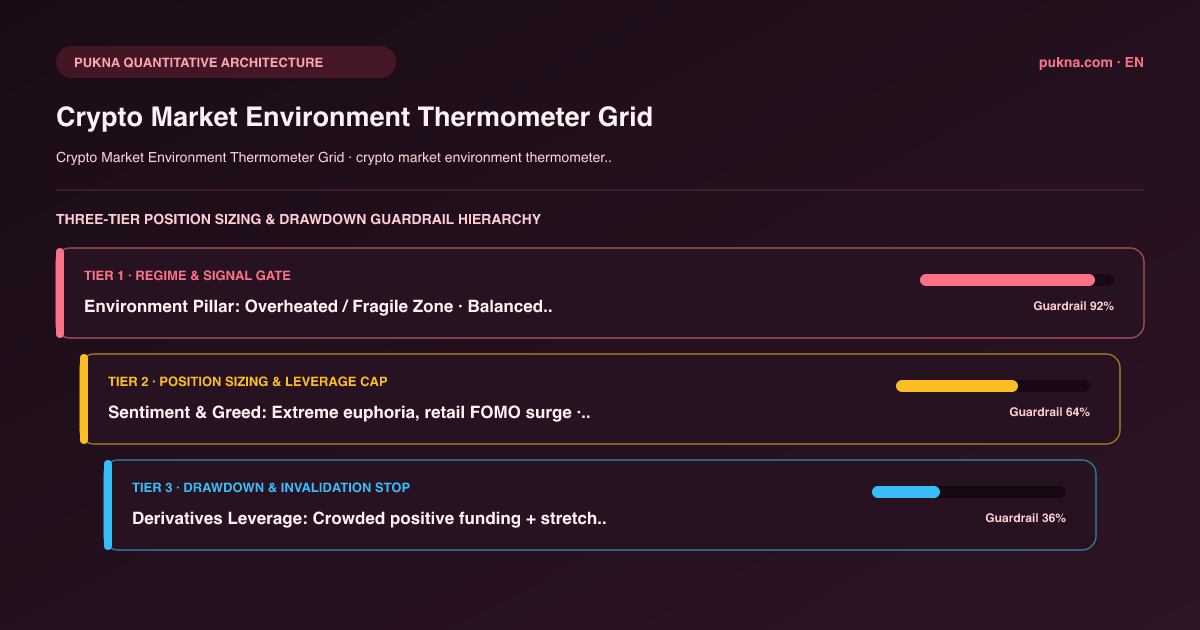
| Environment Pillar | Overheated / Fragile Zone | Balanced Constructive Zone | Capitulation / Value Zone |
|---|---|---|---|
| Sentiment & Greed | Extreme euphoria, retail FOMO surge | Neutral-to-constructive participation | Deep fear & forced de-risking |
| Derivatives Leverage | Crowded positive funding + stretched OI | Moderate basis, spot-led volume | Washed-out OI & negative funding |
| Volatility Structure | Inverted front-end IV spike | Contained term-structure contango | Post-liquidation volatility compression |
Polling VIX term structure, policy yields, ETF flows, and perpetual funding across separate browser tabs breaks down right when volatility spikes. Manual tab switching lags fast tape. Reviewing aligned macro, liquidity, derivatives, and on-chain context inside the Pukna 8-dimension environment research library (39 indicators) alongside its 43-token research pages cuts cross-feed blind spots on a single timestamp. Once macro gates clear, execution still demands strict timeframe sequencing and hard leverage ceilings.
How to Build a Four-Gate Crypto Volatility Trading and Risk Workflow
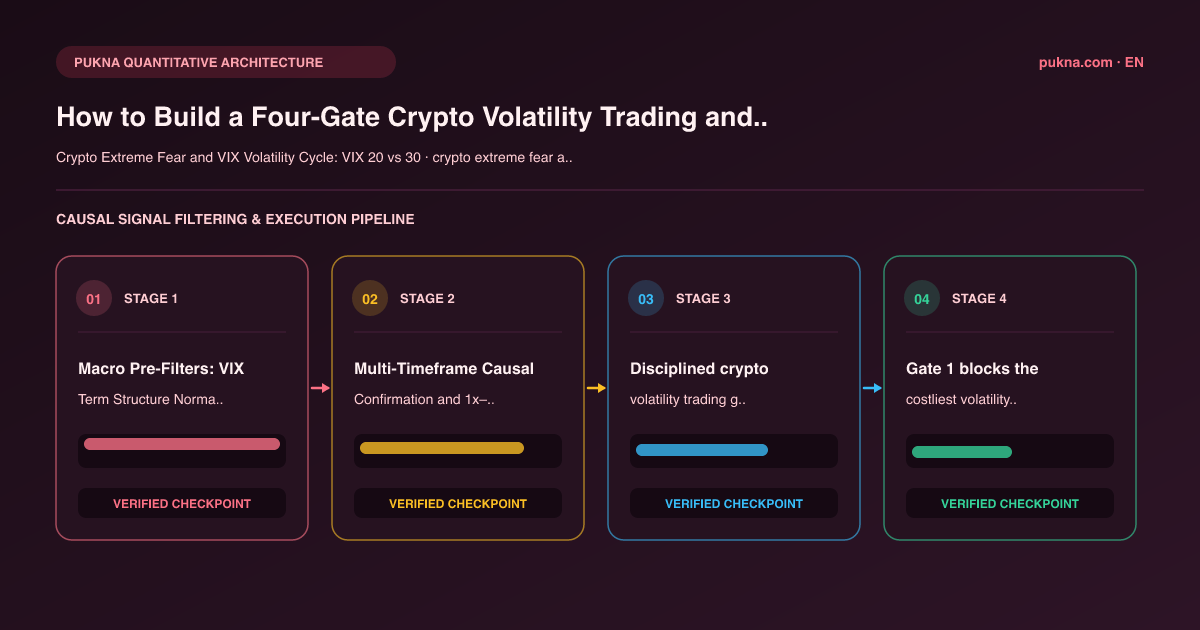
Disciplined crypto volatility trading gates every Extreme Fear setup behind four sequential filters: VIX curve normalization, dollar liquidity stabilization, multi-timeframe causal alignment, and strict 1x–3x leverage limits. Skipping any upstream check exposes portfolios to cascading second-leg drawdowns during systemic equity stress.
| Workflow Gate | Primary Metric & Band | Pass Condition | Risk-Control Action |
|---|---|---|---|
| Gate 1: VIX & Curve | Spot VIX vs. VIX3M slope | VIX peaking off >30 or returning to contango (<22) | Stand aside during steep backwardation |
| Gate 2: Macro & Flows | 2Y yields, net liquidity, ETF flows | Yield spikes cooling; ETF outflows & SOPR easing | Cut size 50% if liquidity contracts |
| Gate 3: Timeframe Alignment | 4h/1d structure + 15m/1h trigger | Higher-timeframe floor & P-score >50 (above neutral) | Skip isolated lower-timeframe bounces |
| Gate 4: Leverage & Drawdown | 1x–3x integer leverage & drawdown | Simulated max drawdown fits risk limit | Cap at 1x–2x whenever VIX >25 |
Macro Pre-Filters: VIX Term Structure Normalization and Liquidity Alignment
Gate 1 blocks the costliest volatility mistake: stepping into forced cross-asset liquidation during active VIX backwardation. Wait until spot VIX stops setting higher highs and front-end inversion begins tightening toward contango. Patience protects dry powder during macro de-grossing. When equity volatility stays muted below 22 in contango, Gate 1 clears immediately and focus shifts straight to crypto-native resets.
Gate 2 verifies that dollar liquidity and spot flows confirm decelerating forced sales. An easing VIX curve alone is not enough. Check whether two-year Treasury yield spikes have cooled, net USD liquidity has stopped shrinking, and perpetual open interest has flushed crowded longs before taking directional risk.
Multi-Timeframe Causal Confirmation and 1x–3x Drawdown Guardrails
Gate 3 translates macro clearance into candle-level execution without lookahead bias. Anchor structural basing on 4h and 1d charts before reading 15m or 1h triggers so intraday chop never forces early counter-trend sizing. Screening entries via four-timeframe causal signal quality scoring filters out fragile dead-cat bounces.
Across 42 mainstream USDT pairs, Pukna 4-timeframe causal candlestick signals (15m/1h/4h/1d) pair with the P-score (0–100) relative return-quality ranking across horizon_bars. A score of 50 marks neutral parity with surrounding ordinary candles. Higher readings reflect stronger combined best-return and terminal-return quality over the forecast window, never a win-rate probability.
Gate 4 caps exposure at 1x–3x integer leverage so secondary volatility aftershocks cannot force liquidation. Stress-test risk bounds before going live. Run an AUTO 1–3x integer-leverage equity-curve simulation inside the personal strategy simulator to audit historical win rate and maximum drawdown prior to subscribing to real-time alerts. Historical equity curves expose tail risk clearly, yet past simulations never predict future returns.
- Verify VIX term structure first: Confirm spot VIX is rolling off peaks above 30 or trading beneath VIX3M in contango before treating Extreme Fear (<25) as potential value.
- Audit macro liquidity and flows: Check two-year yields, net USD liquidity direction, and spot ETF flows to rule out ongoing cross-asset de-grossing.
- Separate leverage washouts from score drag: Confirm open interest has reset, perpetual funding sits flat or negative, and DVOL-versus-realized volatility spreads are compressing.
- Enforce timeframe alignment and 1x–3x caps: Require 4h/1d structural stabilization before acting on 15m/1h triggers, and audit historical maximum drawdown at 1x–3x integer leverage before scaling live size.
Volatility triggers break down quickly when policy rates, dollar liquidity, or ETF arbitrage flows point the opposite way. Cross-check your macro backdrop across the related regime studies below.

| Research Scenario | Core Criterion | Empirical Takeaway | Full Study |
|---|---|---|---|
| Comparing spot vs. futures crypto ETFs | CME basis >10%, contango drag, real yields & OI | Verify net spot demand instead of basis-arb inflows. | Crypto ETF: Spot vs Futures, Roll Drag & Flow Filters → |
| Timing Bitcoin with Global M2 growth | Global M2 Z>+0.5, Net Liquidity & 45-120d drift | Replace fixed 10-week clocks with regime Z-scores. | M2 Money Supply and Bitcoin: Lag Myth vs Z>+0.5 Filter → |
| Trading BTC around US CPI releases | +0.1pp core surprise, ±0.05pp band & 2Y yields | 2-year yield repricing dictates post-CPI direction. | CPI Inflation and Bitcoin: How Core Surprises and Rate Repricing Move BTC → |
| Evaluating Solana staking ETF inflows | 150-350 bps drag, perp basis, DVOL & NAV spread | Hedged flows and fee drag erode headline gross APY. | Solana Staking ETF: 150-350 bps Drag & Hedged Flows → |
| Navigating Bitcoin liquidity cycles | FX-adjusted Z>+0.5, DXY, real yields & Fed Net Liq | Fixed 70-108d M2 lags fail during DXY and rate spikes. | Bitcoin Liquidity Cycle: Raw M2 Traps vs Z>+0.5 Regimes → |
Frequently Asked Questions
Is Crypto Extreme Fear Below 25 a Buy Signal When VIX Spikes Above 30?
No. When spot VIX breaks above 30 in backwardation, cross-asset funds liquidate liquid holdings indiscriminately to cover dollar margin calls. Early contrarian buyers absorb the steepest cascading flush, as March 2020 proved. Extreme Fear clears quickly only when VIX stays muted below 20–22 in orderly contango.
Why Does VIX Have No Extreme Greed Equivalent Like the Crypto Fear and Greed Index?
The Cboe VIX aggregates out-of-the-money S&P 500 option prices, where institutional hedging clusters in downside puts rather than upside calls. That skew makes VIX a one-sided fear gauge. Equity complacency surfaces as compressed readings near 12–15, whereas Crypto Fear & Greed runs a symmetric 0–100 scale where prints above 75 flag stretched bullish momentum.
What Is the Closest Crypto Equivalent to the Cboe VIX for Volatility Trading?
Deribit DVOL and Volmex BVIV are the closest structural peers to the Cboe VIX. Both price 30-day forward crypto implied volatility straight from live 24/7 options books, unlike the lagging Crypto Fear & Greed score. Desks compare DVOL against trailing realized volatility to judge whether directional hedges are overpriced.
Put this into practice
Create a free account to browse live signals and test your own rules.