Contents8 sections
- What Are Real-World Assets (RWA) in Crypto—and What They Are Not?
- Crypto Real-World Assets vs. Banking Risk-Weighted Assets
- Tokenized Underlying Assets vs. Protocol Governance Tokens
- How Does RWA Tokenization Connect Off-Chain SPVs to On-Chain Settlement?
- Off-Chain Structuring, SPVs, and Regulated Custody
- Smart-Contract Minting, Compliance Gates, and Proof-of-Reserve Oracles
- How Do Core RWA Asset Classes Differ Across Yield, Access, and Liquidity?
- Tokenized U.S. Treasuries and Money Market Instruments
- Private Credit, Gold-Backed Commodities, and Tokenized Equities
- How Do Macro Interest Rates and Liquidity Regimes Drive RWA Sector Rotation?
- The Yield-vs-Beta Paradox Across Interest-Rate Cycles
- Tracking RWA Capital Rotation Relative to AI, DePIN, and Broad Altcoin Regimes
- Crypto Market Breadth Implied Volatility Regime Matrix
- RWA Asset Issuers vs. Oracle Middleware: Auditing Value Capture
- Asset Issuers vs. Oracle and Settlement Middleware
- Auditing Fee Capture, Unlock Schedules, and Secondary Liquidity
- Why Do Legal Wrappers, Custody Concentration, and Weekend Liquidity Gaps Break RWA Pegs?
- Off-Chain Legal Enforceability and Custody Concentration
- 24/7 Market Liquidity Gaps and Regulatory Freeze Controls
- How to Screen and Size RWA Crypto Exposure Quantitatively
- Pre-Allocation Checklist for Tokenized Assets vs. Ecosystem Tokens
- Aligning Multi-Timeframe Signal Quality and Drawdown Limits
- Frequently Asked Questions
Real-World Assets (RWAs) in crypto represent off-chain U.S. Treasuries, private credit, gold, or property wrapped into blockchain tokens—unrelated to Basel III banking Risk-Weighted Assets. Direct collateralized tokens track benchmark sovereign cash flows with minimal variance, whereas protocol governance coins hold zero bond title and suffer 50% to 75% drawdowns during liquidity contractions. Separating steady off-chain carry from speculative crypto beta requires auditing legal enforceability, macro interest-rate regimes, and resting 2% spot order-book depth together.
Executive Research Summary
- Collateral vs. Ticker: Asset-backed tokens carry legally enforceable redemption claims; RWA governance coins trade like high-beta crypto software equities.
- Macro Rate Paradox: High Treasury yields pull defensive cash into tokenized T-bills while tight dollar liquidity compresses governance-token multiples.
- Operational Fault Lines: Special Purpose Vehicle (SPV) enforceability, custodian concentration, and business-day T+1 settlement versus 24/7 markets drive weekend de-peg risk.
What Are Real-World Assets (RWA) in Crypto—and What They Are Not?
Most RWA tickers carry zero claim on collateral. True tokenization binds an enforceable off-chain ownership right or cash-flow claim onto programmable blockchain settlement rails through regulated legal entities. Buying a protocol governance token instead gives you secondary-market voting exposure, leaving your principal tied to standard altcoin drawdown cycles.
Crypto Real-World Assets vs. Banking Risk-Weighted Assets
Under Basel III banking rules, Risk-Weighted Assets weight balance-sheet loans and securities by credit risk to determine how much equity capital a bank must hold. Crypto Real-World Assets mean something entirely different: off-chain sovereign debt, private loans, bullion, or equities digitized for round-the-clock collateral transfer. Those two metrics share only three letters.
Confusing them breaks institutional flow analysis. A bank growing Risk-Weighted Assets adds balance-sheet credit exposure under regulatory capital ratios, whereas an on-chain fund issuing Real-World Assets wraps ring-fenced external collateral into transferable digital claims. Never conflate bank capital ratios with tokenized collateral.
Tokenized Underlying Assets vs. Protocol Governance Tokens
Start by tracing who pays the yield. In a tokenized Treasury fund, U.S. government coupon payments land in a regulated custody account, clear a fixed management fee, and accrue straight to verified holders. Holders of governance coins such as ONDO or CFG own voting tokens with no legal title to those underlying bonds.
That legal boundary dictates how each asset trades under stress: short-duration Treasury tokens hug par value plus accrued interest with negligible daily variance. Governance coins trade on open spot and perpetual books, absorb scheduled unlock supply, and reprice sharply whenever altcoin bids thin out.
| Dimension | Asset-Backed RWA Tokens (T-Bills, PAXG/XAUT) | Governance & Middleware Tokens (ONDO, CFG, LINK) |
|---|---|---|
| Legal Claim | Direct claim on ring-fenced collateral via SPV or trust | No direct title to underlying bonds or bullion |
| Yield Origin | Sovereign coupons, loan interest, or 1:1 gold spot | Price appreciation, staking emissions, or indirect protocol fees |
| KYC Gate | Know-Your-Customer (KYC) allowlists for funds; retail gold access | Permissionless trading on global spot and perpetual exchanges |
| Volatility | Low variance matching short-term bonds or spot gold | High crypto beta; 50%–75% drawdowns in tight liquidity |
Common RWA Investor Misconceptions
- Governance Is Not Custody: Buying an issuer’s governance coin never provides sovereign fixed-income downside protection.
- Off-Chain Enforcement Still Governs Title: Smart contracts automate transfers, yet qualified custodians and local courts still enforce underlying property rights.
- Acronym Collision: Crypto Real-World Assets represent tokenized collateral, completely separate from Basel III Risk-Weighted Assets in bank capital math.
A token balance on a public ledger protects principal only when bankruptcy courts recognize the off-chain entity holding the assets. Otherwise, an operator insolvency turns tokenized bond holders into general unsecured creditors overnight.
How Does RWA Tokenization Connect Off-Chain SPVs to On-Chain Settlement?
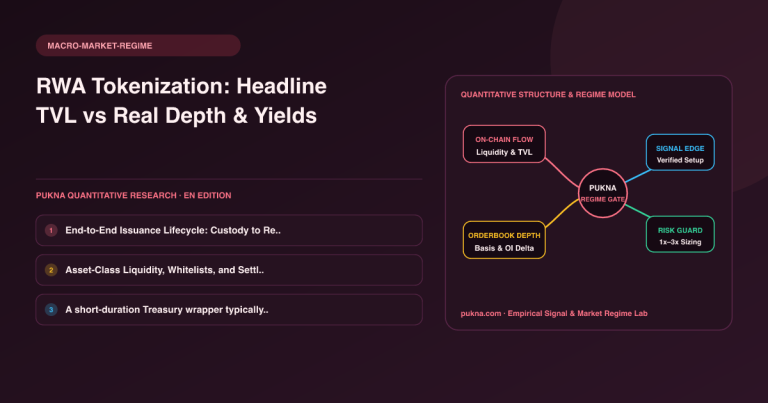
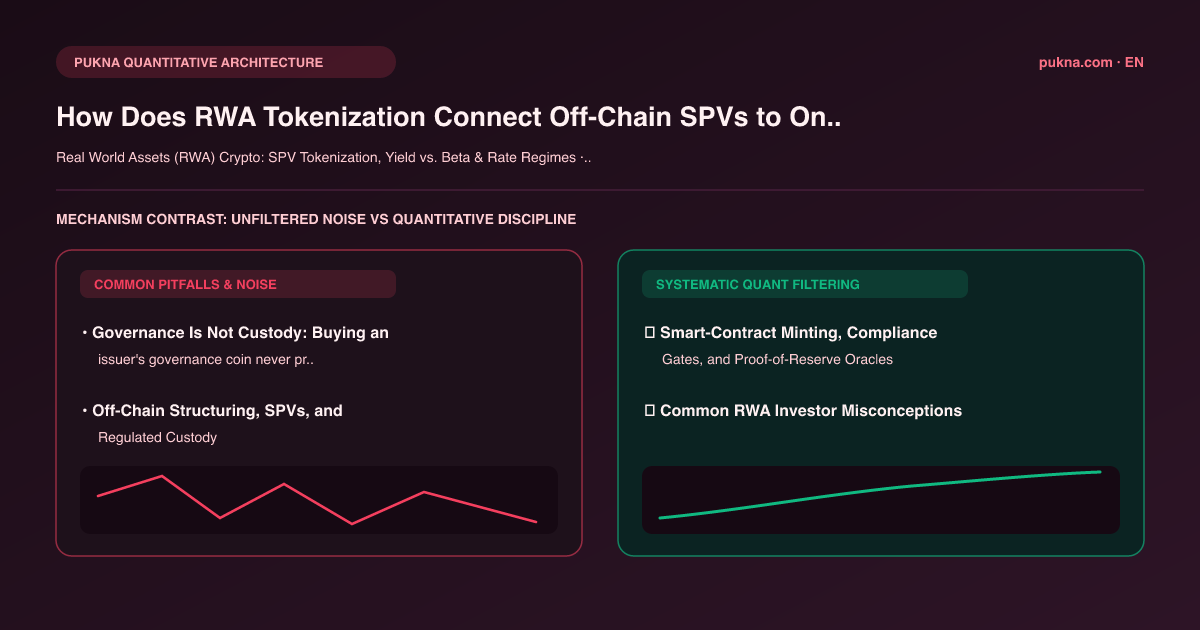
Code alone cannot enforce off-chain property claims. Credible RWA issuers rely on a four-stage bridge covering off-chain origination, bankruptcy-remote custody, independent reserve verification, and permissioned on-chain issuance. Blockchains handle settlement composability, while traditional trust and securities statutes still anchor legal ownership.
Off-Chain Structuring, SPVs, and Regulated Custody
Issuers begin by forming a Special Purpose Vehicle (SPV)—a standalone legal entity ring-fencing collateral from operating liabilities—so corporate creditors cannot seize client Treasury bills during an operator bankruptcy. A regulated qualified custodian holds those securities off-chain while offering documents define redemption priority, management fees, and governing court jurisdiction.
Sloppy structuring breaks that firewall fast. Whenever an issuer commingles client collateral inside general operating accounts, public on-chain visibility delivers zero protection during bankruptcy proceedings. Verify the SPV counsel opinion before trusting any dashboard reserve proof.
Smart-Contract Minting, Compliance Gates, and Proof-of-Reserve Oracles
Once off-chain custody clears, institutional issuers typically use ERC-3643—an Ethereum security-token standard with embedded identity allowlists—to restrict transfers strictly to KYC-verified wallets. Permissionless secondary wrappers can still trade on decentralized exchanges, yet primary minting and redemption remain gated behind verified onboarding. Primary issuance never turns fully permissionless.
Independent auditors and Proof-of-Reserve oracles then synchronize off-chain accounting with on-chain token supply, publishing Net Asset Value (NAV—total collateral minus liabilities per share) alongside custody balances. Cleared bank wires trigger minting, and burned tokens initiate fiat wire or stablecoin redemptions. Still, settling a 90-day Treasury bill takes one business day, whereas liquidating private credit loans or fractional property can freeze exits for months.
How Do Core RWA Asset Classes Differ Across Yield, Access, and Liquidity?
Tokenized Treasuries and fractional real estate share almost nothing. Sovereign debt dominates institutional adoption through daily NAV pricing and T+1 redemption, while private credit and property enforce steep lockups, wide spreads, and off-chain default risk.
| RWA Vertical | Yield Origin | Investor Access | Secondary Liquidity | Primary Risk |
|---|---|---|---|---|
| Tokenized Treasuries | Short-term bill coupons & repo | Accredited or non-U.S. KYC allowlists | High T+1 redemption; growing DEX pools | Weekend settlement gap; rate cuts |
| Private Credit Pools | Corporate & fintech borrower interest | Institutional KYC; tranche lockups | Low; locked until repayment windows | Borrower default; slow workouts |
| Gold Tokens (PAXG / XAUT) | Zero coupon; 1:1 bullion spot | Open retail exchange access | Deep 24/7 spot and perp books | Custodian concentration; minimums |
| Tokenized Equities | Stock price & pass-through dividends | Strictly geo-fenced securities rules | Thin outside market hours | Delisting risk; tracking lag |
| Fractional Real Estate | Net rental income & appreciation | KYC required; local property law | Very low; wide bid-ask spreads | Illiquidity; valuation lag |
Tokenized U.S. Treasuries and Money Market Instruments
Short-duration sovereign bills anchor institutional RWA Total Value Locked (TVL—collateral deposited inside protocol contracts) because crypto treasuries and market makers need liquid dollar carry. Daily NAV reporting lets idle stablecoins earn benchmark government interest without governance-token volatility and qualifies select tokens as prime-broker margin collateral.
That sovereign yield floor directly squeezes native DeFi leverage. When short-term Treasury bills yield above 4% while on-chain borrowing slows, liquid staking token (LST) recursive looping hits DeFi borrow-yield compression until net leveraged spreads vanish. Traders weighing sovereign cash flows against protocol emissions can consult this on-chain staking and yield-farming risk comparison.
Private Credit, Gold-Backed Commodities, and Tokenized Equities
Private credit pools lend stablecoins to off-chain emerging-market lenders, invoice discounters, and market-neutral funds at yields frequently running 300 to 600 basis points above Treasury bills. That spread buys illiquidity, not safety. Once capital locks into fixed tranches, a single uncollateralized borrower default can stall recovery across multiple quarters.
Gold tokens like Pax Gold (PAXG) and Tether Gold (XAUT) pay zero coupon yet deliver 1:1 allocated bullion claims with liquid 24/7 order books. Tokenized equities and fractional real estate remain boxed in by regional securities rules and thin secondary depth. Yet tokenized Treasury TVL often surges during tightening cycles while RWA governance coins drop 40% or more, breaking any linear TVL signal.
How Do Macro Interest Rates and Liquidity Regimes Drive RWA Sector Rotation?
Rising Treasury yields do not automatically lift RWA coins. Higher policy rates attract defensive stablecoins into tokenized T-bills, yet tight dollar liquidity compresses valuation multiples across volatile RWA governance tokens. Reading nominal T-bill TVL growth as a linear altcoin buy signal fails repeatedly.
The Yield-vs-Beta Paradox Across Interest-Rate Cycles
When terminal-rate repricing triggers real-rate curve bear-flattening, front-end real yields climb faster than inflation expectations and pull defensive cash into tokenized bills. At the same time, real yield headwinds and a tightening dollar liquidity impulse drain speculative bids from long-duration governance coins. One macro print splits the sector in two.
Identical TVL prints carry opposite meanings across regimes. Under tight liquidity and spikes on the U.S. equity implied volatility benchmark, surging T-bill balances reflect defensive hoarding rather than risk appetite. At a rate peak, bill inflows plateau while altcoin breakouts fade; only monetary easing pushes capital outward into RWA middleware, DeFi, AI, and DePIN.
| Macro Liquidity Regime | Tokenized T-Bill TVL | RWA Governance Beta | AI / DePIN / DeFi Rotation |
|---|---|---|---|
| High Rates & Tight Liquidity | Strong defensive inflows for benchmark yield | Multiple compression; steep drawdowns | Capital exits speculative themes to cash/BTC |
| Rate Peak & Range-Bound | Plateau supported by high sovereign carry | Choppy range; selective leader strength | Rotational rallies fade without liquidity growth |
| Monetary Easing & Expansion | Slower growth as sovereign yields decline | Risk-on tailwind; expanding multiples | Broad outward rotation across DeFi, AI, DePIN |
| Acute Liquidation Cascade | Safety inflows; brief weekend DEX discounts | Correlation jumps toward 1.0 in sell-offs | Forced deleveraging; 1x defensive caps dominate |
Tracking RWA Capital Rotation Relative to AI, DePIN, and Broad Altcoin Regimes
Market-cap indexes mask where new capital is actually flowing. A benchmark can climb purely on Bitcoin strength while RWA, AI, and DePIN—decentralized physical infrastructure—tokens bleed against dollar liquidity. Pairing research-layer net advancing breadth with options implied volatility surfaces that divergence before narratives catch up.
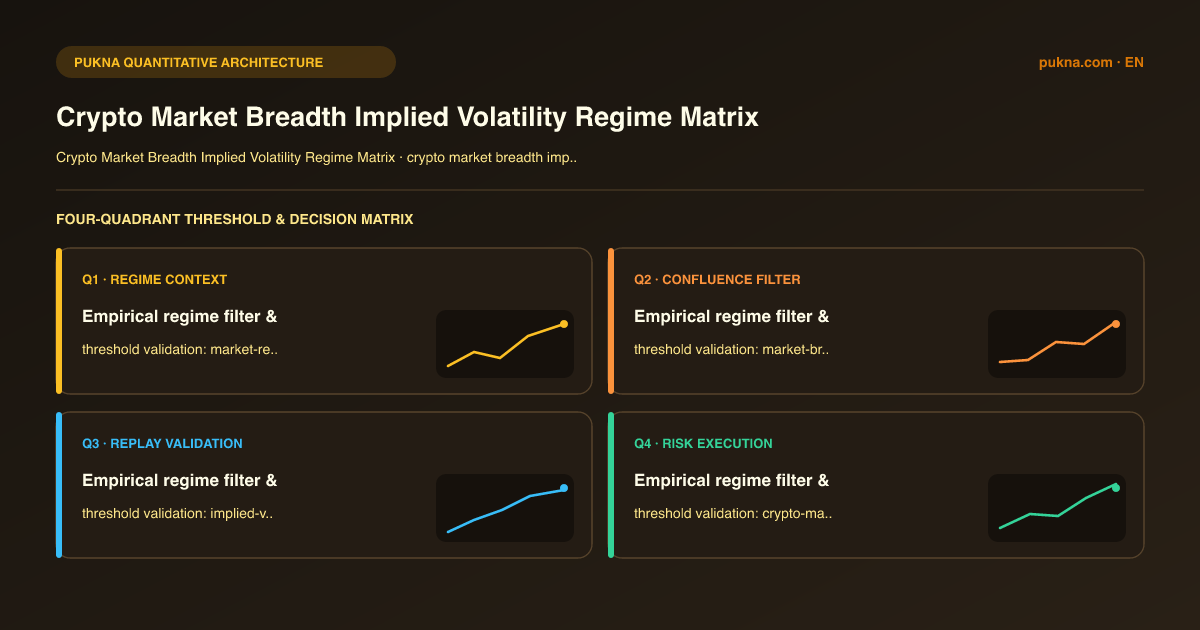
Crypto Market Breadth Implied Volatility Regime Matrix
| Matrix Dimension | Empirical Criterion & Guardrail |
|---|---|
| Net Advancing Breadth | Research-layer metric: (Advancing − Declining) / Valid Sample over a fixed universe and uniform return window; unclassified at zero or incomplete data. |
| BTC DVOL Relative State | Compares 30-day annualized implied volatility from Deribit DVOL methodology against its rolling historical median, aligned with S&P Digital Assets index conventions. |
| Usage Boundary | Separates broad uptrends, sharp rebounds, low-vol grinds, and wide liquidations; classifies regime context only, never standalone trade signals. |
BTC DVOL measures expected turbulence, not price direction. Comparing the implied volatility vs. realized volatility (VRP) spread through crypto options IV-to-RV pricing mechanics separates panic short-covering squeezes from durable multi-week sector rotation. Positive perpetual funding confirms leverage demand, yet never proves fresh spot inflows on its own.
Monitoring Treasury yields, dollar liquidity, BTC DVOL, and perpetual funding across scattered browser tabs creates slow regime reads. Instead of stitching spreadsheets by hand, researchers can cross-check Pukna’s 8-dimension 39-indicator environment library alongside its 43-token research library inside one unified cross-domain environment workspace. Even under expanding liquidity, doubling tokenized bond TVL fails to lift a governance coin when fee revenue stays trapped inside off-chain corporate equity.
RWA Asset Issuers vs. Oracle Middleware: Auditing Value Capture
Growing protocol TVL rarely translates into governance-token cash flow. Across RWA crypto, annual management fees usually accrue to licensed off-chain corporate subsidiaries rather than on-chain token treasuries. Auditing investable RWA exposure requires separating issuers from middleware, sizing unlock dilution, and stripping basis arbitrage out of futures volume.
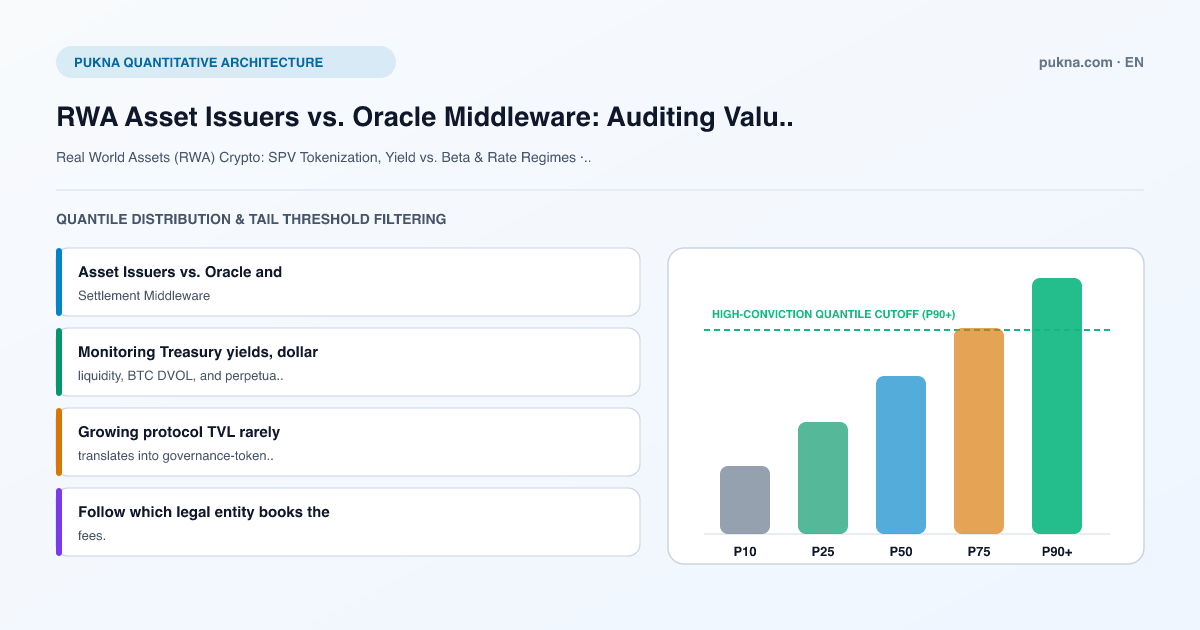
Asset Issuers vs. Oracle and Settlement Middleware
Follow which legal entity books the fees. Regulated issuers usually collect 15 to 50 basis points annually inside off-chain corporate subsidiaries to cover custody overhead, leaving governance coins without binding cash-flow claims. Middleware networks such as Chainlink charge for Proof-of-Reserve updates and cross-chain messaging across multiple issuers, capturing broader sector activity.
| Ecosystem Layer | Revenue Model | Token Value Capture | Supply & Liquidity Audit |
|---|---|---|---|
| Asset Issuers (Ondo, Paxos, Tether Gold) | Management fees (15–50 bps) & mint spreads | Often stays in off-chain equity; indirect link | Check circulating-to-FDV ratio & cliff unlocks |
| Private Credit (Centrifuge, Maple) | Origination, servicing, & spread fees | Governance, staking, & selective routing | Thinner spot books; high drawdown slippage |
| Collateral Vaults (Maker / Sky) | Net interest margin on Treasury reserves | Surplus buffers, buybacks, or savings yields | Direct protocol revenue; watch concentration |
| Oracle Middleware (Chainlink) | Cross-chain messaging & reserve-proof fees | Network usage fees & multi-issuer demand | Deep USDT spot/perp depth; audit emissions |
Auditing Fee Capture, Unlock Schedules, and Secondary Liquidity
Partnership headlines move charts for hours; unlock schedules govern quarters. Measure protocol TVL against Fully Diluted Valuation (FDV—token price multiplied by maximum supply, including locked tranches) before assuming growth is cheap. Whenever circulating float sits below 25% of FDV, quarterly cliff unlocks regularly overwhelm thin spot bids even while Treasury TVL climbs.
Perpetual futures metrics misfire fast. An 8-hour funding rate sitting at +0.01% usually reflects a baseline exchange interest-rate clamp rather than crowded directional longs. During manic rallies, an exchange funding cap clips payout rates even while perpetual premiums blow out above spot.
Rising open interest paired with wide futures spreads frequently reflects delta-neutral cash-and-carry arbitrage—long spot against short perpetuals—rather than directional conviction. Audit 2% spot order-book depth (resting liquidity within 2% of spot) alongside negative perpetual funding and open-interest squeeze math when shorts crowd thin books. Pair that with composite crypto risk-appetite readings, keeping in mind that clean tokenomics cannot stop off-chain legal freezes or weekend settlement breaks.
Why Do Legal Wrappers, Custody Concentration, and Weekend Liquidity Gaps Break RWA Pegs?
On-chain transparency does not remove off-chain counterparty risk. Tokenized assets inherit every legal statute, banking rail, and settlement cutoff buried inside the traditional plumbing beneath them. When weekend crypto liquidations hit while sovereign bond desks sit closed, secondary RWA prices regularly trade below NAV until Monday settlement reopens.
Off-Chain Legal Enforceability and Custody Concentration
Whenever SPV formation documents fail to secure bankruptcy-remote title, insolvency courts override smart contracts and reclassify on-chain token holders as unsecured creditors. In private credit pools, borrower defaults trigger protracted workouts that freeze redemption queues long before reported NAV reflects true loss. Ledger balances never outrank court jurisdiction.
Custody concentration introduces correlated tail risk across issuers that appear diversified on-chain. Competing Treasury funds routinely share identical prime brokers, custodial banks, or attestation vendors, letting one banking freeze stall redemptions across multiple protocols at once.
24/7 Market Liquidity Gaps and Regulatory Freeze Controls
Traditional bond rails still close on Friday. Bank wires settle on business-day T+1 cycles while crypto venues run nonstop. During Saturday sell-offs, thin decentralized pools absorb panic redemptions at 1% to 5% discounts—mirroring how the CME-spot basis premium widens into Sunday’s weekend gap-fill auction.
Compliance keys create a separate structural constraint. Regulated RWA smart contracts embed administrative pause, address-freeze, and clawback controls to satisfy securities and sanctions mandates, making freeze authority a permanent operational risk.
| Failure Mode | Warning Sign | Audit Check | Worst-Case Impact |
|---|---|---|---|
| SPV Enforceability | Missing bankruptcy-remote legal opinion | Verify counsel memo & SPV jurisdiction | Holders treated as unsecured creditors |
| Custody Concentration | Single custodian or opaque bank partner | Confirm segregated custody & reserve audits | Frozen redemptions during bank stress |
| T+1 vs. 24/7 Gap | Shallow DEX pools; no weekend buffer | Check stablecoin buffers & 2% depth | 1%–5% weekend secondary market discounts |
| Compliance Freeze Keys | Broad admin keys without legal scope | Review freeze rules & KYC transfer gates | Blocked transfers or forced liquidation |
Identifying a 3% weekend de-peg or a looming unlock cliff fails to protect capital if governance beta gets sized like cash. Turning legal and macro audits into repeatable risk control requires explicit sizing rules.
How to Screen and Size RWA Crypto Exposure Quantitatively
Treat Treasury yield and governance beta as separate books. Passive tokenized bill holdings rely on legal and custody audits, whereas active RWA governance and middleware positions require macro regime filters and hard drawdown caps. Never let defensive dollar reserves absorb the same leverage shocks as speculative altcoin exposure.
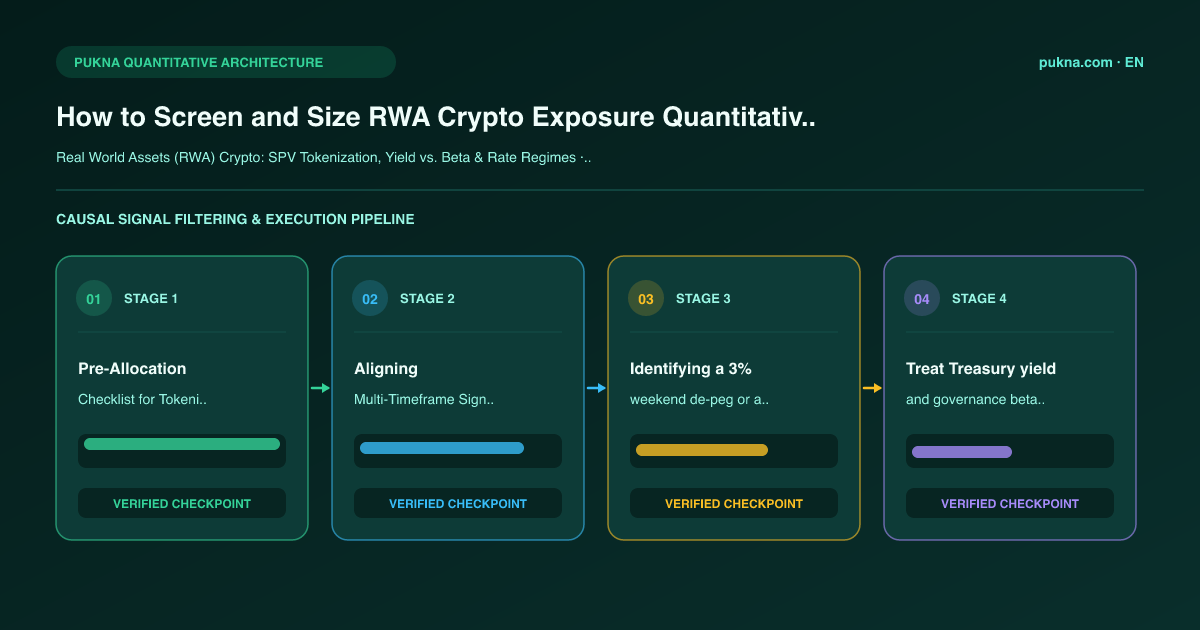
Pre-Allocation Checklist for Tokenized Assets vs. Ecosystem Tokens
Run five auditable checks before allocating capital to any RWA instrument:
- Classify the Instrument: Separate direct SPV yield claims (passive carry track) from governance or middleware tokens (active beta track), verifying KYC and regional eligibility upfront.
- Filter Macro & Volatility Regimes: Check real Treasury yields, dollar liquidity, BTC DVOL against its rolling median, and net advancing breadth; hold defensive bills under tight liquidity and scale beta only when breadth expands.
- Audit Value Capture & Slippage: Verify fee routing, compare 6-to-12-month unlock cliffs against daily spot volume, and check 2% book depth—thin altcoin spreads and slippage routinely shave 1.5% to 3% off annual returns.
- Stress-Test Custody & Weekend Buffers: Confirm bankruptcy-remote SPV opinions, segregated tier-one custody, Proof-of-Reserve cadence, and instant stablecoin liquidity buffers for weekend redemptions.
- Enforce Drawdown Arithmetic: Losses compound asymmetrically—a 50% drawdown requires a +100% rally to break even, and an 80% drop needs +400%—so cap active exposure strictly within 1x to 3x integer leverage limits.
Aligning Multi-Timeframe Signal Quality and Drawdown Limits
Social partnership headlines make terrible entry triggers. Syncing lower-timeframe entries with higher-timeframe structure filters out one-day news spikes, while measuring historical max drawdown before entry prevents volatility expansions from blowing through risk limits.
For liquid infrastructure pairs in the Pukna 42-pair USDT universe, traders can review 15m/1h/4h/1d causal candlestick triggers through this multi-timeframe causal signal and P-score methodology. Each trigger carries a P relative quality score (0–100), with 50 marking the neutral baseline of ordinary surrounding candles across horizon_bars. Higher scores track better combined peak and final return quality. Treat P as relative return quality, never win probability.
Before risking capital, cross-check asset fundamentals in the 43-token research library and run a pre-subscription AUTO backtest audit reviewing the historical equity curve, win rate, and max drawdown. Comparing AUTO strategy leverage across 1x, 2x, and 3x integer tiers shows how fast drawdowns compound—and keeps historical win rate distinct from P score. Subscribe to AUTO real-time strategy alerts only after the simulated drawdown fits your loss ceiling.
| Research Scenario | Core Criterion | Empirical Takeaway | Full Study |
|---|---|---|---|
| Evaluating tokenized US Treasury AUM inflows vs. DeFi and perp carry | Net yield after 15-50 bps fee drag, wrapper overlap, and perp basis spread | Rising Treasury AUM reflects opposite regimes depending on net yield vs. on-chain basis. | Tokenized US Treasuries: Raw AUM vs Net Yield & Rails → |
| Timing altcoin rotation when BTC.D falls alongside shifting stablecoins | USDT.D direction, 50-day TOTAL3/BTC trend, and 60%+ equal-weighted breadth | Falling BTC.D traps traders if USDT.D rises; confirm rotation with 60%+ breadth. | Crypto Sector Rotation Strategy: BTC.D vs 60%+ Breadth → |
| Separating organic DePIN network demand from subsidy-driven node growth | >0.50 revenue-to-emissions ratio, burn-to-mint coverage, and unlock float | Subsidies inflate node counts; durable DePIN setups require >0.50 paid revenue coverage. | DePIN Crypto: Node Counts vs Paid Revenue & Regimes → |
| Screening RWA tokens for genuine underlying claims vs. narrative exposure | Enforceable holder rights, net token issuance, and order-book depth | Not every RWA coin carries asset backing; screen holder rights and liquidity depth. | RWA Crypto Coins: Asset Backing, Value Capture and How to Compare 9 Tokens → |
| Using Altcoin Season Index readings for late-cycle vs. early rotation checks | 90-day 75% outperformance lag, CMC vs. BlockchainCenter scope, and dominance | A 75 reading confirms altcoin strength late over 90 days; filter entries with dominance. | Altcoin Season Index: 90-Day Lag, CMC vs. BlockchainCenter, and Rotation Signals → |
Frequently Asked Questions
What are real-world assets (RWAs) in crypto, and how do they differ from banking Risk-Weighted Assets?
Crypto Real-World Assets (RWAs) are blockchain tokens backed by off-chain collateral—such as U.S. Treasuries, private credit, gold, or real estate—through regulated legal wrappers. Basel III banking Risk-Weighted Assets are unrelated accounting metrics. Banks weight balance-sheet loans and securities by credit risk to calculate mandatory equity buffers, not to tokenize investments.
Does buying an RWA crypto token give me direct legal ownership or yield from the underlying asset?
Only direct asset-backed tokens—such as KYC-verified tokenized Treasury funds or allocated bullion tokens like PAXG and XAUT—grant legal redemption claims or pass-through yield. Protocol governance and middleware coins rarely carry title to underlying bonds. They trade with high-beta altcoin volatility and unlock-driven supply cycles instead.
How do smart contracts and legal SPVs connect off-chain bonds, gold, or real estate to a blockchain?
Issuers ring-fence off-chain collateral inside a bankruptcy-remote Special Purpose Vehicle (SPV) held by a qualified custodian. Standards such as ERC-3643 enforce on-chain KYC allowlists, while Proof-of-Reserve and Net Asset Value (NAV) oracles synchronize custody balances with token supply. Cleared bank wires trigger minting; burned tokens initiate fiat or stablecoin redemption.
Why do tokenized Treasury inflows sometimes rise while RWA governance tokens fall?
High short-term Treasury yields and tight liquidity pull RWA assets in opposite directions. Crypto treasuries park idle stablecoins in tokenized T-bills for defensive sovereign carry, lifting protocol TVL. At the same time, elevated real yields and tighter dollar liquidity drain speculative risk appetite, compressing valuation multiples across volatile RWA governance coins.
Put this into practice
Create a free account to browse live signals and test your own rules.