Contents7 sections
- ZK Rollups vs Optimistic Rollups: Architecture and Finality Matrix
- Side-by-Side Architectural and Settlement Comparison
- Rollups vs Sidechains and Validiums: The L1 Security Boundary
- How Do Validity Proofs and Fault Proofs Verify Off-Chain State?
- Optimistic Rollups: Batching, Interactive Fault Proofs, and Challengers
- ZK Rollups: SNARK/STARK Circuits, Prover Latency, and State Diffs
- Why Do Rollup Costs and Finality Flip Across Network Regimes?
- Quiet Regimes: Fixed Prover Overhead vs Cheap Blob Space
- Congestion Surges: Batch Amortization and EIP-4844 Blob Fees
- Volatility Stress: Fast-Bridge Spreads vs Canonical Exit Finality
- Why Do Headline TVL, TPS, and Soft Finality Mislead Traders?
- Canonical vs Externally Bridged TVL and Incentive Distortion
- Token Cross-Venue Liquidity Accessibility Pipeline
- Sequencer Soft Finality vs L1 Hard Finality and Token Divergence
- How Should Researchers Evaluate L2 Venues and Ecosystem Tokens?
- Selecting an Execution Venue by Use Case and L2BEAT Stage
- Combining L2 Fundamentals with Multi-Factor Market Timing
- How Do You Audit Rollup Risk and Size L2 Positions Safely?
- Four-Point On-Chain Venue and Bridge-Exit Audit
- Drawdown-Bounded Strategy Validation for L2 Ecosystem Assets
- Frequently Asked Questions
ZK Rollups verify Ethereum Layer 2 state upfront through L1 cryptographic proofs, whereas Optimistic Rollups enforce a ~7-day fault-proof dispute window; unlike sidechains or validiums, both post transaction data on Ethereum L1. Relying on headline TVL or ~250ms–2s sequencer receipts breaks down under stress, when post-EIP-4844 blob fees, prover queues, and fast-bridge spreads invert across market regimes. Sound venue selection and L2 token sizing require cross-checking proof finality, exit depth, decentralization maturity, and macro liquidity.
ZK Rollups vs Optimistic Rollups: Architecture and Finality Matrix
Key Takeaway: Both rollup families inherit Ethereum L1 consensus and data availability, yet their default trust models create opposite trade-offs across canonical exit speed, compute overhead, and EVM compatibility.
Side-by-Side Architectural and Settlement Comparison
Wallet responsiveness tells you almost nothing about Ethereum settlement finality. Most fee comparisons capture a quiet afternoon snapshot and ignore how state disputes clear when gas spikes or liquidity thins. Below are the structural boundaries separating ZK and Optimistic rollups across normal and stressed markets.
| Evaluation Dimension | ZK Rollups | Optimistic Rollups |
|---|---|---|
| Verification Method | Default-untrusted cryptographic validity proofs (ZK-SNARK or ZK-STARK) verified on Ethereum L1 | Default-trusted state posting backed by an interactive fault-proof challenge game |
| Soft vs Hard L1 Finality | ~250ms–2s sequencer soft receipt; minutes-to-hours hard finality upon L1 proof verification | ~250ms–2s sequencer soft receipt; ~7-day hard canonical finality after dispute expiry |
| Canonical Withdrawal Window | Minutes to a few hours once batch proof clears the L1 verifier contract | Approximately 7 days via canonical bridge; minutes only through third-party liquidity bridges |
| Cost Structure (DA vs Compute) | Higher fixed off-chain prover compute; lower L1 blob bytes when state-diff compression applies | Minimal proving compute; posts full compressed transaction inputs to L1 blobs for replay |
| EVM Equivalence | High via modern zkEVMs, though custom opcodes and circuit constraints add audit surface | Near-native bytecode equivalence with battle-tested tooling and mature DeFi composability |
| Decentralization Stage (L2BEAT) | Varies by prover permissioning, verifier audits, and Security Council multisig overrides | Varies by live permissionless fault-proof status, proposer whitelists, and upgrade timelocks |
| Stress-Regime Failure Mode | Prover queue latency spikes, rising proving cost, or circuit bug exposure | Third-party fast-bridge inventory depletion forcing ~7-day exit lockups and basis spreads |
Rollups vs Sidechains and Validiums: The L1 Security Boundary
True Ethereum rollups execute off-chain while anchoring both state verification and transaction data on Ethereum L1. Because compressed batches land on L1 via EIP-4844 blobs or calldata, any independent node can rebuild the full Layer 2 state without trusting the sequencer. Lose L1 data availability, and forced self-custody exits break.
Sidechains and validiums cross outside that boundary in different ways. Sidechains rely on an independent validator set, leaving bridged funds exposed if a majority colludes or halts consensus. Validiums verify cryptographic proofs on Ethereum L1 but store transaction data off-chain with a Data Availability Committee, so withheld data can still freeze user withdrawals even when state math remains valid.
How Do Validity Proofs and Fault Proofs Verify Off-Chain State?
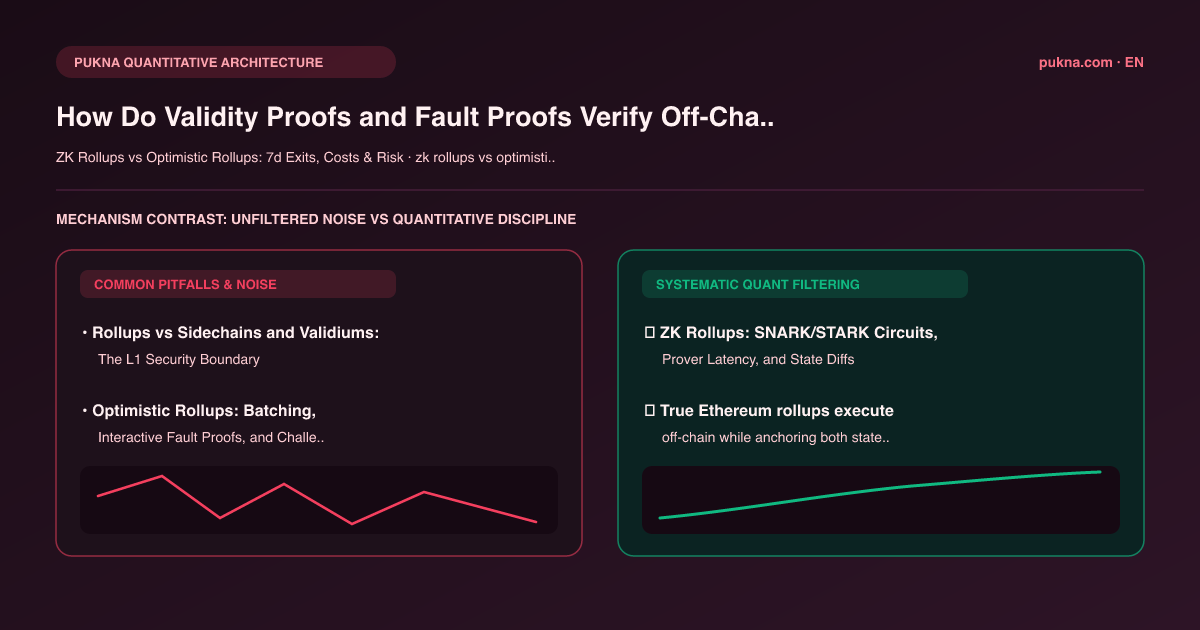
Key Takeaway: Optimistic rollups rely on bonded economic incentives and a live honest challenger to revert invalid state, whereas ZK rollups enforce mathematical soundness upfront before Ethereum L1 accepts a batch.
Optimistic Rollups: Batching, Interactive Fault Proofs, and Challengers
An Optimistic sequencer orders transactions, issues a ~250ms–2s soft receipt, and posts compressed raw inputs to Ethereum L1 blobs without proving the new state root upfront. Until L1 settlement clears, that instant receipt remains revocable.
Real enforcement runs across the ~7-day dispute window. Independent verifiers re-execute the L1 blob inputs, post a bond when a root diverges, and trigger an interactive bisection game that isolates one disputed opcode directly on Ethereum L1 to slash the dishonest party. In practice, that guarantee holds only when fault proofs are permissionless and live rather than gated behind whitelisted proposers or multisig overrides.
ZK Rollups: SNARK/STARK Circuits, Prover Latency, and State Diffs
ZK rollups compile off-chain execution traces into arithmetic circuits and run GPU or FPGA provers to generate a succinct validity proof. Ethereum L1 accepts the updated state root only after an on-chain verifier contract validates that proof in constant or polylogarithmic time. Invalid transitions simply fail verification on arrival.
Proving systems carry concrete engineering trade-offs. ZK-SNARKs keep proof sizes compact and L1 verification gas low, though some designs require trusted setup ceremonies. ZK-STARKs drop trusted setups in favor of collision-resistant hashes, yet produce heavier proofs unless recursively wrapped in a final SNARK before L1 settlement. Custom zkEVM opcodes also widen the circuit audit surface.
L1 data footprints diverge just as sharply. Optimistic rollups must post full compressed transaction inputs so any challenger can replay every step from scratch. Many ZK rollups instead publish state diffs that record only net storage-slot changes after repeated writes collapse into one final update, cutting blob bytes heavily during active market sessions.
Why Do Rollup Costs and Finality Flip Across Network Regimes?
Key Takeaway: Neither architecture stays cheapest or safest across every cycle; per-transaction economics and bridge exit spreads flip sharply between quiet ranges, congestion bursts, and forced deleveraging.
| Operating Regime | ZK Rollup Behavior | Optimistic Rollup Behavior | Dominant Risk Boundary |
|---|---|---|---|
| Quiet / Low-Activity Ranging | Fixed prover overhead amortizes poorly over sparse batches, raising unit cost or delaying batch sealing | Posts lean compressed batches onto near-floor EIP-4844 blob space with minimal compute overhead | Prover amortization floor vs slow batch finality |
| High-Throughput / L1 Congestion | Dense batches amortize prover compute across thousands of operations; state diffs blunt blob fee spikes | Full compressed input posting transmits L1 blob base-fee spikes directly into per-transaction costs | Sequencer priority-fee bidding and L1 blob repricing |
| Extreme Volatility / Bridge Stress | Canonical L1 exit stays in minutes-to-hours range unless prover queues saturate under load spikes | Fast-bridge providers widen fees, hit inventory caps, or pause rebalancing, exposing the ~7-day exit lockup | Exit latency converting into collateral insolvency risk |
Quiet Regimes: Fixed Prover Overhead vs Cheap Blob Space
Quiet regimes favor Optimistic unit economics. During low-volume consolidation, Ethereum EIP-4844 blob base fees frequently sit near protocol floors, letting Optimistic rollups post lean batches for fractions of a cent without heavy proving hardware. ZK operators still absorb fixed GPU or FPGA compute overhead to prove and verify every sealed batch.
When auditing fee benchmarks on quiet weekends, that fixed overhead often hides behind delayed batch sealing. Rather than subsidizing sparse blocks, ZK sequencers stretch batch intervals to accumulate enough transactions before running the prover. Gas looks cheap, while L1 hard finality quietly stretches.
Congestion Surges: Batch Amortization and EIP-4844 Blob Fees
Sustained throughput bursts flip that cost curve. Once thousands of swaps, oracle updates, and liquidations pack into one batch, fixed ZK proving overhead spreads thinly across high transaction density. State-diff compression discards intermediate overwrites to the same storage slots, dampening unit-cost spikes when L1 blob base fees jump.
Optimistic rollups absorb heavier L1 data repricing during those bursts because full compressed inputs must reach blobs for fault-proof replay. Even with cheap blobs, neither architecture eliminates local block-space contention. During sharp price dislocations, arbitrage bots still bid up sequencer priority fees for top-of-block execution, adding real execution friction independent of L1 posting costs.
Volatility Stress: Fast-Bridge Spreads vs Canonical Exit Finality
In calm sessions, third-party liquidity bridges hide the ~7-day Optimistic exit window by fronting L1 capital for a few basis points. That convenience vanishes during sharp drawdowns. When flows surge one-way back toward L1 exchanges, bridge market makers run out of L1 inventory and widen exit spreads aggressively.
When auditing canonical bridge liquidity during L1 fee spikes, stress escalates once borrowed relayer inventory pushes lending pools past the 80%–92% threshold in DeFi utilization kink dynamics. Fast bridges hit inventory caps, leaving Optimistic exiters with steep discounts or the full ~7-day canonical queue. Borrowers defending a falling health factor cannot wait a week for collateral, whereas ZK rollups maintain minutes-to-hours canonical exits unless prover queues back up.
Why Do Headline TVL, TPS, and Soft Finality Mislead Traders?
Key Takeaway: Standalone TVL, peak TPS, and sub-second wallet receipts distort both protocol safety and token value because liquidity fragmentation, multisig custody, and unlock overhang decouple engineering from market returns.
| Raw Headline Metric | Methodological Distortion | Verified Multi-Factor Benchmark |
|---|---|---|
| Headline TVL | Combines canonically bridged ETH, externally wrapped assets, and native governance tokens inflated by incentive farming | Canonical L1 bridge balance, native stablecoin depth, and post-incentive retention |
| Sub-Second Confirmation | Measures sequencer soft receipts (~250ms–2s) vulnerable to centralized reorgs or inclusion delays before L1 commitment | Time to L1 blob posting plus hard finality (ZK verification or ~7-day dispute closure) |
| Peak Advertised TPS | Counts minimal transfers, ignores multi-hop swap gas complexity, and omits prover subsidies or L1 blob spikes | Median complex-swap cost across quiet and congested regimes plus net sequencer margin |
| Tech Lead → Token Price | Assumes superior proofs produce linear token gains while ignoring unlock schedules, fee capture, and macro liquidity | Circulating supply dilution, sequencer revenue accrual, and macro/derivatives regime state |
Canonical vs Externally Bridged TVL and Incentive Distortion
Headline Total Value Locked lumps three incompatible risk buckets together: canonically bridged L1 assets, externally wrapped tokens carrying third-party bridge custody, and native governance tokens minted on the rollup itself. Raw deposits hide real unit economics. Even with sticky EVM liquidity, net sequencer margins depend on L1 blob bills and token incentive burn.
Liquidity across fragmented venues never adds up linearly. As shown in BIS research on blockchain scalability and market fragmentation, siloed order books across CEXs, DEXs, and isolated rollups incur steep slippage once bridge transfer rails slow down. Always benchmark single-rollup TVL inflows against aggregate crypto market capitalization before treating nominal growth as durable capital demand.
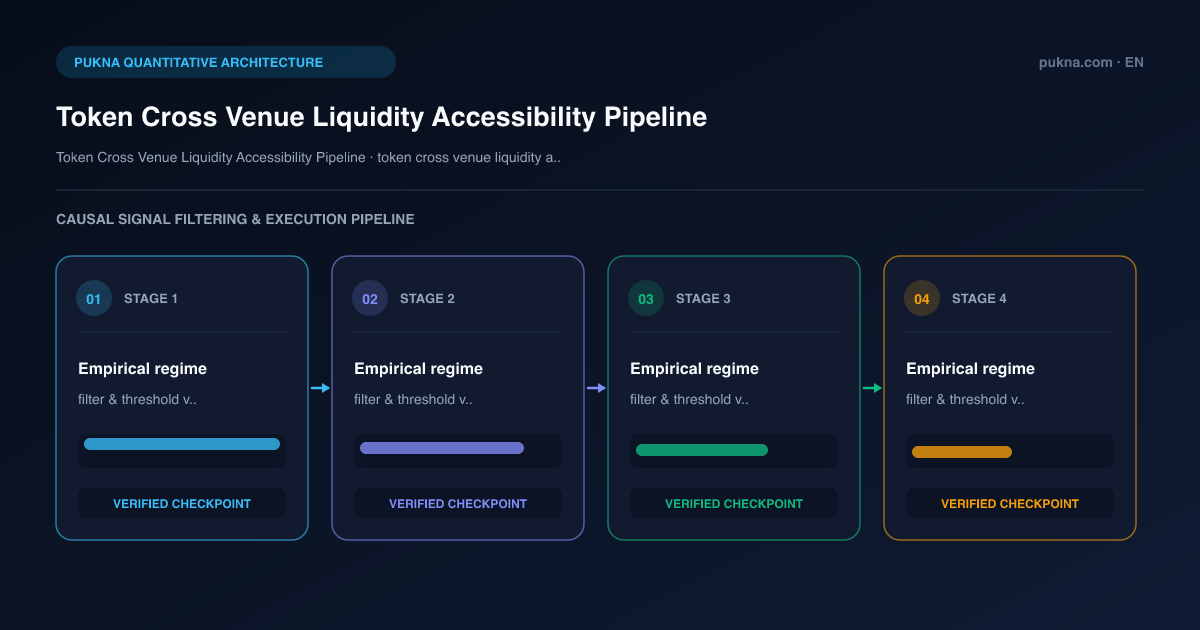
Token Cross-Venue Liquidity Accessibility Pipeline
| Checkpoint | Empirical Criterion & Execution Guardrail |
|---|---|
| Phase 01 · Venue Access & Transferability | Confirm that target CEX, DEX, and rollup pools remain directly reachable without paused bridges, canonical lockups, or withdrawal caps before aggregating depth. |
| Phase 02 · Unified Depth Accounting | Measure executable bid depth within fixed price-deviation bands at one shared timestamp and quote currency, stripping out wrapped or double-counted liquidity. |
| Phase 03 · Stress Slippage Audit | Re-price realizable exit value under a widening bid-ask spread, quote pullbacks, and transfer friction rather than relying on marginal price or FDV. |
Sequencer Soft Finality vs L1 Hard Finality and Token Divergence
Identical ~250ms–2s wallet confirmations blur real settlement differences. A sequencer pre-confirmation remains a revocable receipt until transaction batches post to Ethereum L1 blobs and clear validity or fault-proof verification. Until L1 commitment, a centralized sequencer can still reorder flow, stall inclusion, or go offline.
Better cryptography rarely drives linear token appreciation. Rapid ZK proving gains and rising active addresses routinely coincide with multi-quarter drawdowns whenever unlock schedules flood circulating float or sequencer fees bypass token holders. When ETH/BTC relative rotation structure rolls over, even premier scaling stacks compress alongside broader beta.
How Should Researchers Evaluate L2 Venues and Ecosystem Tokens?
Key Takeaway: Disciplined Layer 2 research separates on-chain execution venue selection from directional token timing, pairing L2BEAT decentralization audits with macro, liquidity, and derivatives regime filters.
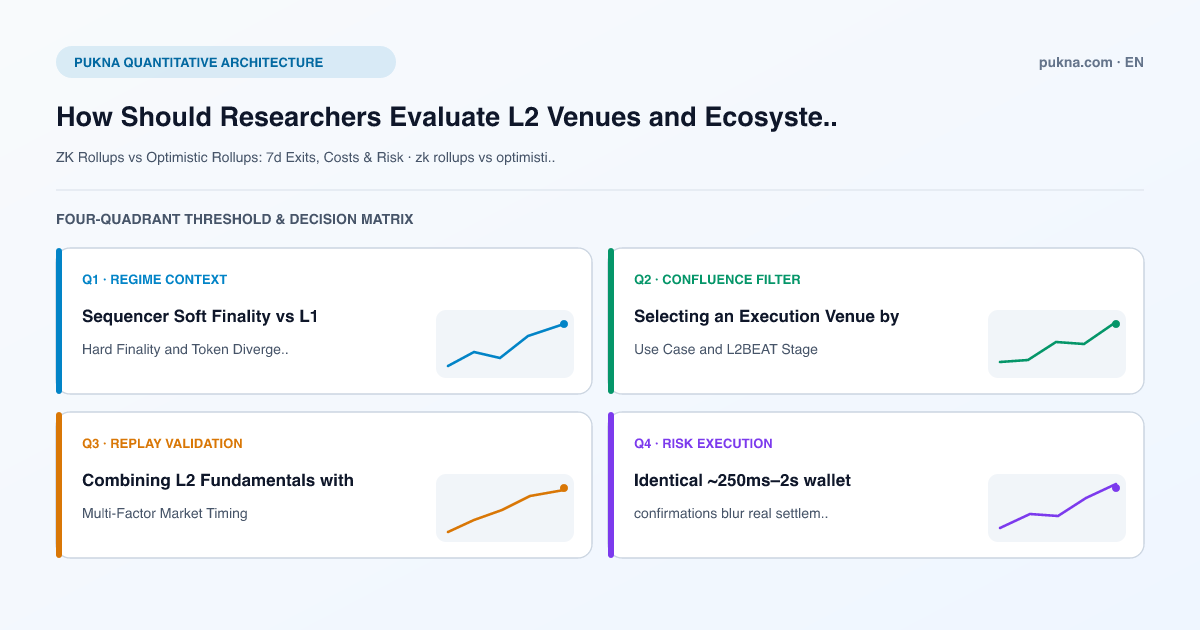
Selecting an Execution Venue by Use Case and L2BEAT Stage
Match rollup architecture directly to operational exit urgency. Mature Optimistic rollups suit desks and DeFi allocators that prioritize deep battle-tested EVM liquidity, broad contract composability, and minimal bytecode friction. ZK rollups win where fast canonical L1 exits, aggressive state-diff compression, or programmable proof aggregation sit on the critical path.
Before routing capital to either stack, check L2BEAT’s three-stage decentralization milestones. Stage 0 rollups still depend on centralized operators or multisig committees to settle disputes. Stage 1 activates working proof systems with bounded Security Council safeguards, whereas Stage 2 restricts council overrides strictly to provable on-chain bugs. Confirm that forced L1 transaction inclusion actually executes if the sequencer stalls.
Combining L2 Fundamentals with Multi-Factor Market Timing
Protocol engineering rarely dictates near-term token returns. Turning architectural conviction into directional ETH or L2 exposure means filtering for real rates, USD liquidity, implied volatility (DVOL), perpetual basis, and funding positioning. Even top-tier rollups suffer synchronized liquidations during a USD/JPY carry-trade unwind and cross-asset risk-off deleveraging.
Crowded perpetual positioning routinely overwhelms solid on-chain catalysts. Climbing open interest paired with sticky positive funding introduces persistent funding drag that bleeds spot-equivalent returns across multi-week ranges. Reviewing BTC derivatives account positioning alongside unlock schedules and structural yield drag and hedged flows keeps entries anchored in net expectancy rather than protocol hype.
Reconciling L2 governance stages, unlock overhang, derivatives crowding, and multi-timeframe structure across scattered dashboards breaks down during fast selloffs. Combining L2 fundamental audits with Pukna’s 8-dimension 39-indicator environment library and 43-token research library aligns macro context with 15m/1h/4h/1d bar-level causal signals across 42 major USDT pairs. Each signal carries a P-score (0–100) ranking relative optimal and final return quality across horizon_bars, centered on a P=50 neutral baseline comparable to ordinary surrounding bars, not a win-rate probability.
| Research Workflow | Fundamental & Regime Verification | Execution & Drawdown Discipline |
|---|---|---|
| Manual L2 Narrative Tracking | Isolated TVL dashboards, ad-hoc unlock spreadsheets, and qualitative macro impressions | Discretionary entries with unmeasured slippage, funding drag, and untracked max drawdown |
| Unified Multi-Factor Workflow | L2BEAT stage audit paired with 8-dimension 39-indicator environment library & 43-token research context | 15m/1h/4h/1d bar-level causal signals, P=50 neutral baseline, and 1x–3x leverage drawdown checks |
How Do You Audit Rollup Risk and Size L2 Positions Safely?
Key Takeaway: Preserving capital across Layer 2 protocols requires auditing four on-chain settlement invariants before bridging funds and capping directional L2 token leverage before opening positions.
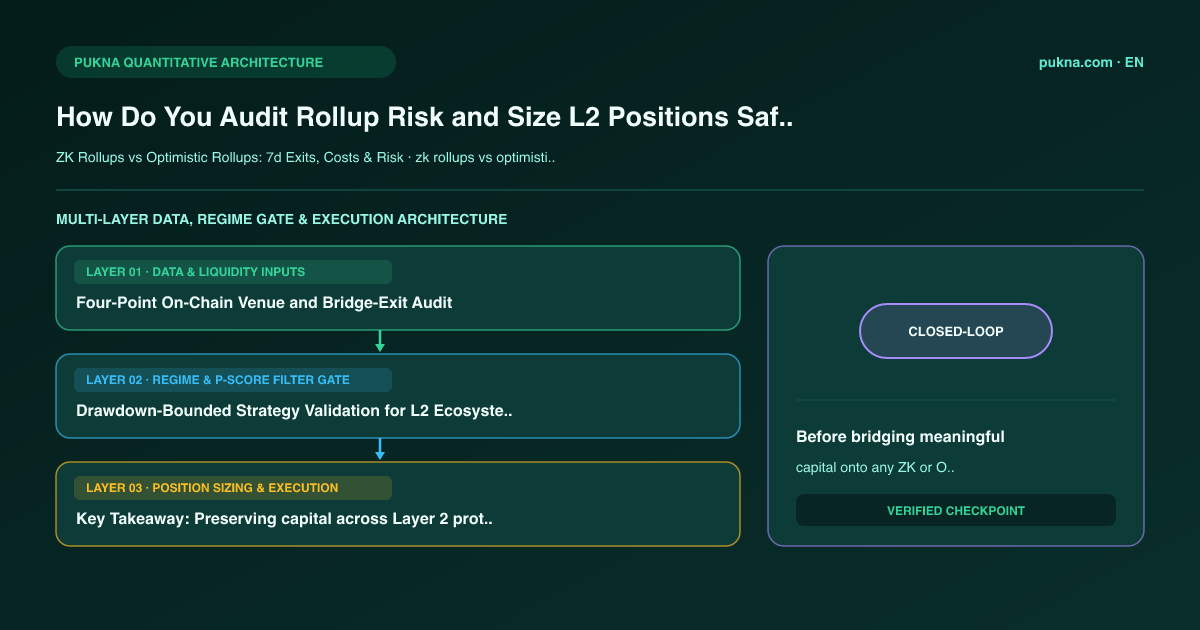
Four-Point On-Chain Venue and Bridge-Exit Audit
Before bridging meaningful capital onto any ZK or Optimistic rollup, audit four on-chain operational invariants instead of headline marketing benchmarks:
- Proof Status and Stage Maturity: Confirm whether fault proofs run permissionlessly or ZK prover circuits carry independent audits, then verify the rollup’s current L2BEAT Stage 0, 1, or 2 milestone.
- Upgrade Keys and Escape Hatches: Inspect Security Council multisig thresholds, upgrade timelocks, and whether users can force transactions directly through Ethereum L1 if the sequencer stalls.
- Stress-Tested Exit Liquidity: Size capital against third-party fast-bridge inventory caps and real executable depth under a widening bid-ask spread, not calm-market quotes.
- Blob-Spike Cost Resilience: Review historical fee behavior during Ethereum L1 congestion episodes so sudden gas repricing cannot interrupt automated collateral top-ups or liquidation defense.
Drawdown-Bounded Strategy Validation for L2 Ecosystem Assets
Position sizing in ETH and L2 ecosystem tokens should manage tail-risk drawdown asymmetry, capping downside excursion while preserving room for right-tail trend winners. Size inversely to volatility and cap isolated leverage at 1x–3x. Validate entry rules through friction-adjusted strategy backtesting incorporating exchange fees, 8-hour funding drag, and real slippage so unmodeled costs do not erase thin edge.
Before enabling live alerts on L2-linked USDT pairs, run an AUTO historical equity curve and 1x–3x integer-leverage review inside the Pukna AUTO simulation workspace across the 42-pair USDT universe. Audit simulated win rate and maximum drawdown across both quiet ranges and high-volatility flushes before subscribing to real-time push alerts. Historical curves never guarantee future returns, so treat observed max drawdown as a hard capital boundary.
For related empirical studies covering crash bottoms, ETH/BTC rotation filters, friction-adjusted backtesting, and DeFi liquidity kinks, review the research digest below.
| Research Scenario | Core Criterion | Empirical Takeaway | Full Study |
|---|---|---|---|
| Drawdowns exceeding 25% & crash bottoms | Spot inflows, OI flushes, and 1x–3x leverage caps | Extreme Fear and negative funding fail in liquidity drains; wait for deleveraging confirmation. | Crypto Market Crash: >25% Threshold vs False Bottoms → |
| ETH/BTC relative rotation & cross-pair traps | 90-day ±2σ Z-scores, USDT legs, and perp funding | A falling ratio does not equal USD loss; raw Golden Crosses invert without regime filters. | ETH/BTC Ratio: Raw Signal Traps vs ±2σ Regime Filters → |
| Strategy validation & real-friction testing | Bar-close causality, 8h funding carry, walk-forward | Zero-cost OHLCV backtests surrender 30–70% of paper PnL once fees, funding, and slippage hit. | Crypto Trading Strategy Backtesting: Bias vs. Net Edge → |
| 24/7 chart breakouts & wick sweep filtering | Full-body closes, 1.5x 20-bar volume, regime filters | Visual breakouts fail on crypto wick sweeps unless confirmed by close structure and invalidation. | Crypto Chart Patterns: Fakeouts vs 1.5x Volume & Regime Rules → |
| DeFi lending yield & liquidation buffer sizing | 80%–92% kink curves and regime Health Factor | Headline APY and gross TVL mask utilization kinks that spike borrow rates and liquidation risk. | Crypto Lending Protocols: High APY vs 80%+ Kink Risk → |
Frequently Asked Questions
What is the core difference between ZK validity proofs and Optimistic fault proofs?
ZK rollups attach a cryptographic validity proof, such as a SNARK or STARK, so Ethereum L1 verifies batch math upfront before accepting a new state root. Optimistic rollups instead assume posted batches are valid by default. They submit compressed inputs to L1 and rely on bonded verifiers to challenge fraudulent roots through an interactive fault proof.
Why do canonical withdrawals take about seven days on Optimistic Rollups?
The ~7-day canonical window gives independent challengers enough time to download L1 batch data, spot an invalid state root, and finish an interactive dispute game on Ethereum. Third-party liquidity bridges usually compress exits to minutes during orderly markets. When volatility surges, however, bridge inventory can drain and push late exiters back onto the full ~7-day canonical queue.
How do rollups differ from sidechains and validiums in Ethereum security?
True rollups execute off-chain while anchoring both state verification and transaction data directly to Ethereum L1, letting users reconstruct state and force exits independently. Sidechains run separate validator sets and consensus, creating independent bridge custody risk. Validiums verify ZK proofs on L1 but store transaction data off-chain, exposing funds to data-withholding freezes despite intact state math.
Put this into practice
Create a free account to browse live signals and test your own rules.