Contents6 sections
- TWAP vs. VWAP Execution: Core Mechanics and Slicing Thresholds
- Execution Algorithm vs. VWAP Chart Indicator
- When Order Size Actually Requires Algorithmic Slicing
- How Crypto Market Regimes Shift TWAP and VWAP Slippage Outcomes
- Liquid Range-Bound Sessions: Where VWAP Blends Into Depth
- Directional Trends and Drift: Why Slow Slicing Bleeds Arrival Price
- Thin Weekend Books and Liquidation Spikes: When Volume Curves Break
- Why Naive TWAP and VWAP Execution Fails: Counterexamples and Hidden Costs
- Volume-Forecast Errors and Non-Organic Altcoin Volume Skew
- Deterministic TWAP Footprints and Randomization Jitter
- Guaranteed VWAP vs. Best-Efforts Algorithmic VWAP
- Why Execution Pacing Needs Pre-Trade Regime and Multi-Timeframe Verification
- Screening Liquidity, Derivatives Stress, and Volatility Before Slicing
- Aligning Execution Windows With Multi-Timeframe Causal Signals
- How to Configure Execution Risk Controls: POV Caps, Collars, and Audits
- Parameterizing Participation Caps, Jitter, and Limit Collars
- Auditing Fills With Implementation Shortfall Instead of Vanity Benchmarks
- Frequently Asked Questions
TWAP splits parent orders across equal time intervals, while VWAP weights slices by volume; neither is the VWAP chart indicator. VWAP cuts market impact by 4–12 bps in deep books holding 1–3 bps spreads and 5%–10% participation, whereas randomized TWAP wins in thin altcoin books where bad volume curves inflate slippage. Because slicing only manages order footprint, live desks pair schedule pacing with pre-trade volatility regime screens and multi-timeframe signal checks to cap arrival-price shortfall.
TWAP vs. VWAP Execution: Core Mechanics and Slicing Thresholds
Key Takeaway: Algorithmic slicing earns its spread once a parent ticket exceeds 15%–25% of visible top-5 book depth or pushes hourly participation past 0.5%–1.0% of venue turnover.
| Execution Tool | Scheduling Rule | Forecast & Footprint | Ideal Liquidity Tier | Primary Failure Mode |
|---|---|---|---|---|
| TWAP Execution | Equal time slices over fixed window | Zero volume forecast; deterministic if unjittered | Thin altcoins, weekends, erratic volatility | HFT interval fingerprinting and trend drift |
| Best-Efforts VWAP | Child orders weighted to UTC volume buckets | High forecast reliance; blends into natural flow | Deep BTC/ETH books (1–3 bps spreads) | Volume-curve skew during crashes or wash spikes |
| Guaranteed VWAP | Principal dealer locks exact interval VWAP | Zero schedule management; explicit dealer markup | Large institutional blocks needing fill certainty | Embedded spread markup exceeds best-efforts cost |
| VWAP Chart Indicator | Cumulative price-volume line on price charts | Technical reference only; routes zero orders | Liquid pairs for intraday bias checks | Mistaking a chart support line for an execution algo |
Execution Algorithm vs. VWAP Chart Indicator
A VWAP execution engine is an order-routing scheduler that parcels a parent ticket across intraday volume buckets to track the session’s volume-weighted fill price. It is not the anchored VWAP line plotted on charts for mean-reversion setups or volume-weighted moving average crossovers. Mixing the two creates an immediate post-trade blind spot. Execution pacing lowers book footprint, whereas chart indicators only frame directional entry bias.
When Order Size Actually Requires Algorithmic Slicing
Tickets under 5% of top-5 depth rarely justify multi-hour slicing. Resting passive limits or crossing a 1–2 bps spread clears cheaper than absorbing prolonged directional drift. The math flips once notional crosses 15%–25% of top-5 depth inside a thin order book, where single market orders sweep multiple price tiers. At that threshold, book-walk slippage compounds nonlinearly.
Crypto venues trade 24/7 with zero closing auctions. Uniform TWAP assumes flat liquidity across every hour, while VWAP extrapolates historical UTC turnover curves forward—assumptions that hold only when depth stays stable and spreads remain compressed. Once weekend depth drops past 40% or spreads top 8 bps, slippage leadership flips abruptly.
How Crypto Market Regimes Shift TWAP and VWAP Slippage Outcomes
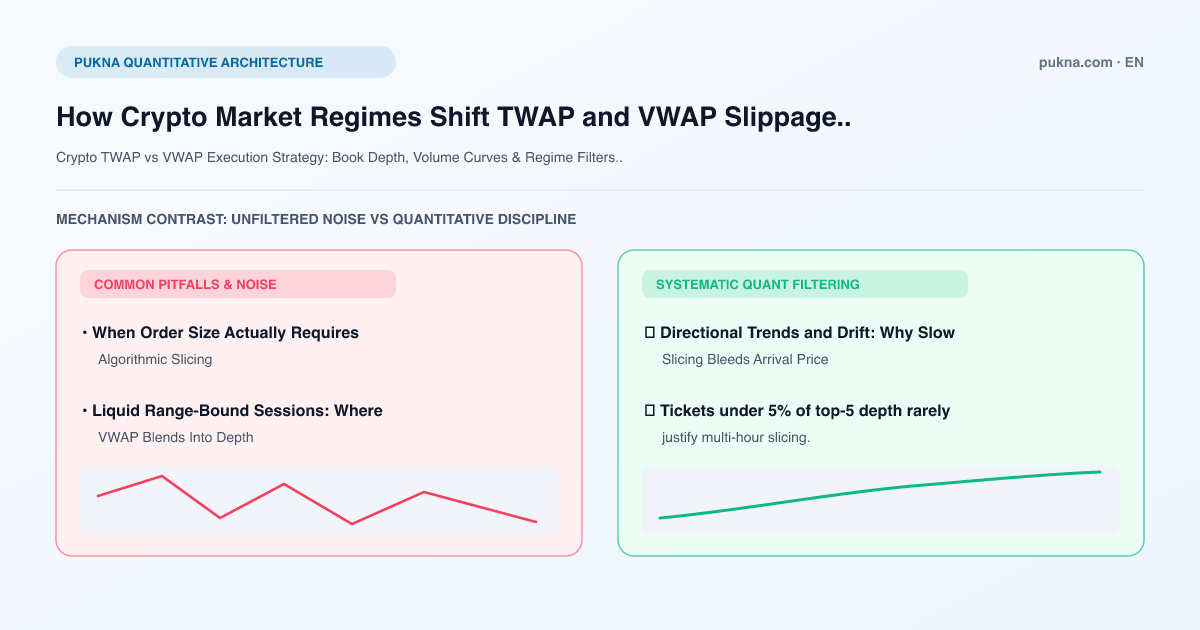
Key Takeaway: The same VWAP schedule that saves 4–12 bps during US/EU session overlaps can bleed 20–60 bps of adverse slippage during thin weekend books or liquidation cascades.
| Crypto Market Regime | Spread & Book Depth | Preferred Schedule | POV Cap & Jitter | Dominant Cost Driver |
|---|---|---|---|---|
| Liquid Range (US/EU Overlap) | 1–3 bps; rapid top-5 refill | Best-Efforts VWAP | 5%–10% POV; 10% jitter | Queue wait and passive book impact |
| Directional Breakout / Trend | 3–8 bps; one-sided book refill | Front-Loaded TWAP / Aggressive Limit | 8%–12% POV; 15% jitter | Adverse arrival-price drift |
| Thin Weekend / Liquidation Flush | 10–35+ bps; 40%–60% depth drop | Randomized TWAP + Limit Collar | 2%–5% POV; 20%–25% jitter | Volume-forecast error and spread blowouts |
Liquid Range-Bound Sessions: Where VWAP Blends Into Depth
Spot and perpetual majors cluster genuine two-way turnover across European and US cash-market overlaps, roughly 13:00–17:00 UTC. Spreads compress to 1–3 bps while market makers refill top-of-book queues rapidly. Best-efforts VWAP routes heavier clips into those peak buckets and dials back size during quiet Asian-to-London troughs, keeping participation inside 5%–10%. Uniform TWAP over-trades thin hours and leaves basis points behind.
Directional Trends and Drift: Why Slow Slicing Bleeds Arrival Price
One-sided breakouts invert execution math on contact. Stretching a buy order across four passive hours while perpetual basis expands and open interest climbs turns both TWAP and VWAP into slow-motion opportunity-cost traps as spot escapes. Saving 3 bps of book impact fails completely when arrival price runs 120 bps higher. In fast trends, timing drift swamps passive savings.
Thin Weekend Books and Liquidation Spikes: When Volume Curves Break
Weekend depth routinely drops 40%–60% below weekday baselines, hitting mid-caps inside overall digital-asset liquidity breadth hardest. Liquidation cascades then spike realized volume 3x–8x right as market makers widen quotes and Bitcoin DVOL implied-volatility regime shifts jump sharply. VWAP misreads forced liquidations as deep liquidity. It fires oversized slices into hollow books, whereas jittered TWAP behind strict limit collars survives until hidden venue distortions break naive execution rules.
Why Naive TWAP and VWAP Execution Fails: Counterexamples and Hidden Costs
Key Takeaway: Out-of-the-box exchange bots telegraph repeatable footprints, misprice non-organic altcoin volume, and mask heavy arrival-price drag behind flattering interval benchmarks.
| Naive Execution Assumption | Microstructure Breakdown | Observed Slippage Symptom | Parameterization Fix |
|---|---|---|---|
| 24h volume equals live depth | Cross-venue wash prints inflate mid-cap VWAP buckets | 15–50 bps sudden book-walk per slice | Cap child clips to 2%–5% of single-venue depth |
| Fixed 5-minute TWAP hides size | HFT desks fingerprint intervals and step ahead of fills | 3–10 bps recurring pre-slice adverse ticks | Apply 15%–25% size/time jitter and maker offsets |
| Guaranteed VWAP removes cost risk | Principal dealers bake volatility buffers into quotes | 8–25 bps markup over best-efforts slicing | Compare dealer quotes against live POV benchmarks |
| Beating interval VWAP proves quality | Passive pacing ignores multi-hour structural trend shifts | +3 bps vs. VWAP but -180 bps vs. arrival price | Audit implementation shortfall and pre-screen regimes |
Volume-Forecast Errors and Non-Organic Altcoin Volume Skew
Aggregated 24-hour turnover routinely exaggerates single-venue altcoin depth. Zero-fee promotions, fragmented books, and maker-rebate loops inflate trailing volume curves that vanish once real inventory arrives, unlike US flow clusters verified through spot-versus-futures ETF institutional flow filters. Thin mid-cap venues buckle above 5% participation and punish blind VWAP buckets. Every oversized clip walks empty price tiers.
Deterministic TWAP Footprints and Randomization Jitter
Rigid TWAP bots broadcast flow like a metronome. Firing identical clips every 300 seconds lets high-frequency desks front-run each slice, while predictable on-chain intervals invite intent-based orderflow and MEV toxic flow extraction. Adding 15%–25% randomization jitter across both clip size and spacing breaks mechanical fingerprinting. Pairing jittered clips with passive maker offsets captures spread rather than paying taker fees repeatedly.
Guaranteed VWAP vs. Best-Efforts Algorithmic VWAP
Institutional desks sometimes request Guaranteed VWAP, shifting execution variance to a principal dealer who commits to the exact interval VWAP print. That pricing certainty never comes free. Dealers bake inventory and volatility risk into an 8–25 bps markup that routinely exceeds disciplined best-efforts costs in deep BTC/ETH books. Both VWAP variants still share one fatal blind spot: beating interval VWAP by 3 bps hurts badly when execution starts before a 200 bps breakdown.
Why Execution Pacing Needs Pre-Trade Regime and Multi-Timeframe Verification
Key Takeaway: Separating impact control from entry timing keeps passive TWAP and VWAP schedules from accumulating inventory straight into volatility spikes or failed breakouts.
Screening Liquidity, Derivatives Stress, and Volatility Before Slicing
Execution schedules manage book footprint, not four-hour directional timing. Before committing a multi-hour slice horizon, audit DVOL implied-volatility slope, rising open interest, and the cross-exchange funding rate differential alongside leveraged BTC account crowding ratios and extreme panic-and-euphoria positioning shifts. Crowded positioning turns passive VWAP into adverse selection. Accumulating steadily inside a fragile liquidation zone saves pennies in spread while risking dollars in forced downside.
Aligning Execution Windows With Multi-Timeframe Causal Signals
Aligning 15m and 1h slicing windows with 4h and 1d structure stops passive schedules from fighting dominant flow. Switching across disconnected dashboards slows pre-trade validation and feeds regime-conditional Sharpe decay and execution slippage. Inside Pukna, researchers audit 39 environment indicators across 8 macro, rates, liquidity, sentiment, derivatives, and on-chain dimensions alongside 43 token research profiles before setting slice horizons. That single check filters hostile macro regimes before order release.
Across 42 USDT pairs on 15m, 1h, 4h, and 1d charts, its bar-level causal signals pair with a 0–100 P-score across horizon_bars. That score is never a win probability. Measured from the P-score 50 neutral candle baseline, higher values reflect stronger combined best-return and final-return quality versus ordinary surrounding candles, separating spot-led impulses from upper-wick sweeps.
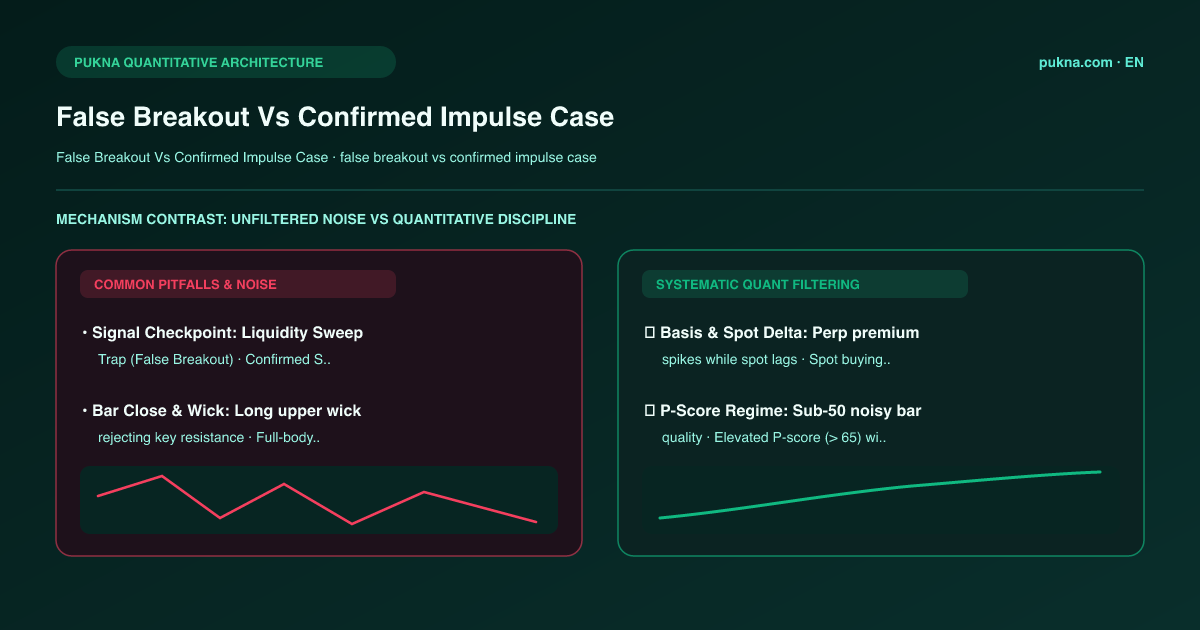
| Signal Checkpoint | Liquidity Sweep Trap (False Breakout) | Confirmed Structural Impulse |
|---|---|---|
| Bar Close & Wick | Long upper wick rejecting key resistance | Full-body bar close above range high |
| Basis & Spot Delta | Perp premium spikes while spot lags | Spot buying leads perpetual basis |
| P-Score Regime | Sub-50 neutral-or-below bar quality | Elevated P-score (> 65) relative return quality |
| Pre-Trade Dimension | Blind Single-Algo Slicing | Regime-and-Signal-Filtered Workflow | Execution Risk Impact |
|---|---|---|---|
| Liquidity & Vol State | Assumes 7-day volume curve holds | Audits DVOL, depth drop, and 39 environment indicators | Avoids hollow weekend and cascade books |
| Derivatives Crowding | Ignores funding and open interest skew | Flags stretched perpetual basis and crowded accounts | Stops buying into liquidation squeezes |
| Timeframe Alignment | Slices on an arbitrary clock window | Checks 15m/1h horizon against 4h/1d causal signals & P-score | Reduces adverse arrival-price drift |
| Schedule Selection | Static VWAP or fixed-interval TWAP | Dynamic POV cap, jittered TWAP, or collar pause | Balances impact against timing risk |
| Research Scenario | Core Criterion | Empirical Takeaway | Full Study |
|---|---|---|---|
| Range mean-reversion vs. band-walk breakouts | %B>1, BandWidth expansion, spot volume, and regime checks | Band touches measure volatility dispersion, not overbought ceilings; separate range fades from %B>1 band-walks using BandWidth and spot volume. | What Are Bollinger Bands in Trading: %B>1 Trend vs Fade → |
| SMA, EMA, and VWMA crossover entries across regimes | ADX>20 threshold, spot-led volume, and multi-timeframe alignment | Naked 9/21 and 50/200 crossovers bleed capital to whipsaws below ADX 20; filter setups with ADX>20, spot-led volume, and regime checks. | Crypto Moving Average Strategy: Chop vs. ADX>20 Filters → |
| MACD momentum crossovers and divergence screening | 12/26/9 vs. fast settings, 4h/1d trend, funding, and divergence limits | Unfiltered MACD crossovers whipsaw in choppy ranges; screen trades with 4h/1d regime alignment, funding context, and divergence caps. | Crypto MACD Strategy: Raw Crossovers vs. 4h/1d Filters → |
| 24/7 crypto candlestick reversal and rejection setups | UTC closed candles, >=2.0x wick-to-body ratio, volume Z>1.5, ATR(14) | Isolated candlestick shapes fail in thin 24/7 order books; require UTC closes, >=2.0x wick-to-body ratios, volume Z>1.5, and ATR(14) filters. | Candlestick Patterns Crypto: 24/7 Noise vs Z>1.5 & ATR → |
| Overbought/oversold fades vs. trend continuation (15m-1d) | 70/30 vs. 80/20 trend bands, closed candles, and liquidity filters | Static 70/30 RSI rules fail in strong trends; adapt with 80/20 trend bands, divergence rules, closed candles, and liquidity filters. | Crypto RSI Strategy: 70/30 vs. 80/20 and Trend Bands → |
Regime alignment still fails if an unguarded engine pushes participation past 10% or chases spreads wider than 15–35 bps without automatic collars.
How to Configure Execution Risk Controls: POV Caps, Collars, and Audits
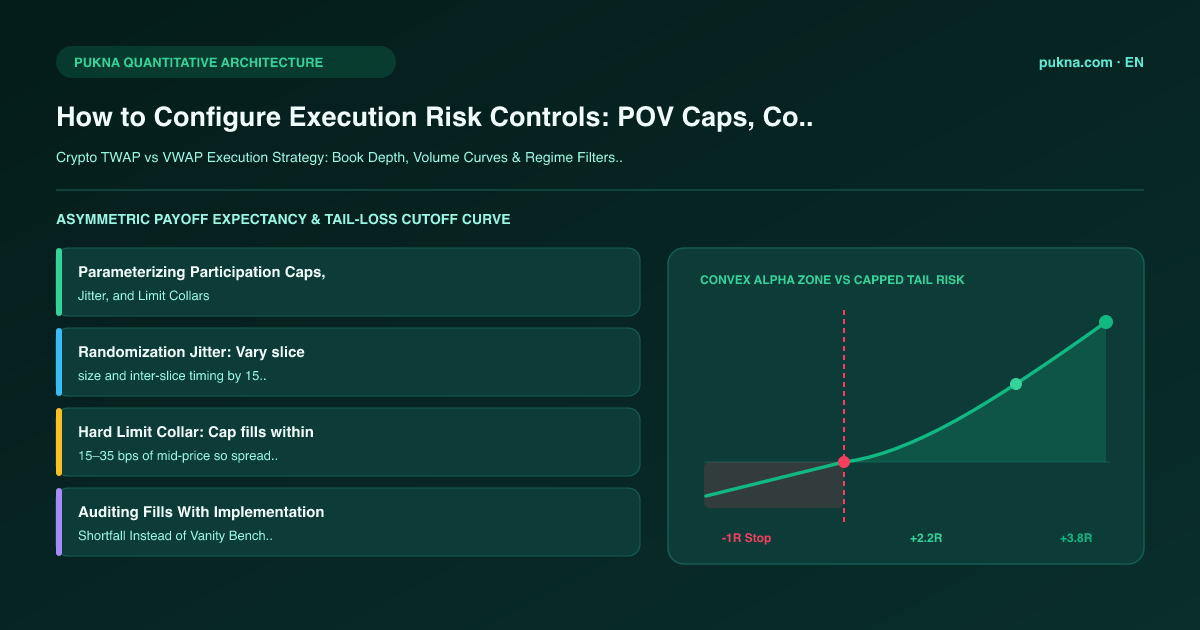
Key Takeaway: Disciplined crypto execution pairs strict Participation of Volume caps, 15%–25% randomization jitter, and hard limit collars with post-trade Implementation Shortfall auditing.
Parameterizing Participation Caps, Jitter, and Limit Collars
Never let an execution engine chase widening spreads unchecked. Explicit guardrails convert textbook schedules into controllable desk rules, especially when Bollinger volatility band-walk breakouts accelerate intraday range velocity. Lock five mechanical controls before releasing any sliced parent ticket:
- Depth-to-Size Gate: Trigger TWAP or VWAP only once parent notional exceeds 15%–25% of visible top-5 depth or 0.5% of hourly venue turnover.
- Participation of Volume (POV) Cap: Restrict participation to 5%–10% on deep BTC/ETH books and 2%–5% on mid-cap USDT pairs to contain market footprint.
- Randomization Jitter: Vary slice size and inter-slice timing by 15%–25% so HFT desks cannot fingerprint repeating prints.
- Hard Limit Collar: Cap fills within 15–35 bps of mid-price so spread blowouts pause routing instead of sweeping a thin order book.
- Regime Horizon Switch: Shorten slice windows during spot-led impulses, and pause passive VWAP whenever weekend book depth drops past 40%.
Auditing Fills With Implementation Shortfall Instead of Vanity Benchmarks
Post-trade reviews belong on Implementation Shortfall: the basis-point gap between your average executed fill price and arrival mid-price at order release, split cleanly into market impact and timing drift. Interval VWAP alone is a flattering vanity benchmark. It rises right alongside the market during rallies, making slow passive slicing look skillful while your arrival price escapes. Decomposing shortfall separates bad clip sizing from bad timing.
When timing drift swamps book impact, refining entry rules beats tweaking slice intervals. Before allocating live capital, review the AUTO strategy equity curve on Pukna across 1x–3x integer leverage, checking historical win rate alongside AUTO strategy maximum drawdown under realistic slippage. Past simulations never ensure live future returns. Subscribe to AUTO real-time strategy alerts only once that simulated drawdown profile fits your personal capital limits.
Frequently Asked Questions
When is VWAP execution an optimal strategy in crypto?
VWAP works best on high-liquidity majors like BTC and ETH during US/EU session overlaps when spreads hold 1–3 bps and participation stays under 5%–10%. Inside balanced ranges, matching child clips to organic turnover curves cuts market impact and tracking error below uniform TWAP. It breaks down in thin weekend books or liquidation cascades.
What is the difference between Guaranteed VWAP and best-efforts VWAP?
Best-efforts VWAP runs an algorithmic schedule targeting the interval volume-weighted average price while leaving price-drift and slippage risk on your book, whereas Guaranteed VWAP transfers that variance. A principal dealer guarantees the exact interval VWAP print in exchange for an explicit 8–25 bps risk-transfer markup. In deep BTC/ETH books, disciplined best-efforts slicing typically costs less.
When does a retail or mid-size crypto order actually need TWAP or VWAP slicing?
Algorithmic slicing earns its keep once one ticket exceeds roughly 15%–25% of visible top-5 order-book depth or 0.5%–1.0% of hourly venue turnover. Smaller orders clear cheaper with passive limit postings or a quick spread cross. Stretching tiny tickets across hours adds timing drift without saving impact.
Which performs better during thin weekend books or sudden liquidation spikes: TWAP or VWAP?
Randomized TWAP behind hard limit collars beats standard VWAP easily. Weekend depth routinely drops 40%–60%, while forced liquidations spike turnover 3x–8x and shatter historical UTC volume curves. Standard VWAP dumps oversized clips into hollow books, whereas jittered TWAP with a 2%–5% POV ceiling and 15–35 bps collar caps book-walk slippage.
Put this into practice
Create a free account to browse live signals and test your own rules.