Contents6 sections
- Which Crypto Whale Wallets Actually Signal Smart Money?
- Directional Smart Money vs. Passive Custodial and Exchange Wallets
- Why Nominal Transfer Size Fails Without Entity Attribution
- How Do You Find and Track Crypto Whale Wallets Step by Step?
- Finding High-Signal Wallets via Holder Distributions, Early DEX Buyers, and Unlock Multisigs
- Clustering Linked Addresses and Setting Liquidity-Adjusted Alerts
- Comparing Free Explorers, Entity Intelligence Platforms, and Alert Feeds
- Why Do Identical Whale Inflows Flip Meaning Across Market Regimes?
- Range-Bound Consolidation: Exchange Outflows vs. Silent OTC Absorption
- Trending Breakouts and Late-Stage Distribution: Inflow Z-Scores and Token Unlocks
- High-Volatility Liquidation Cascades: Margin Collateral Top-Ups vs. Capitulation Dumps
- Token Cross-Venue Liquidity Accessibility Pipeline
- Why Do Raw Whale Transfer Alerts Produce False Trading Signals?
- Internal Exchange Shuffles, Custody Sweeps, and Delta-Neutral Perp Hedges
- Token Unlock Routing, Bridge Hops, and Copy-Trade Decoy Wallets
- How Should Traders Verify Whale Flows Before Sizing Risk?
- Layering On-Chain Whale Flows with Macro, Liquidity, and Derivatives Context
- Validating Multi-Timeframe Structure, Relative Signal Quality, and Drawdown Bounds
- Frequently Asked Questions on Tracking Crypto Whale Wallets
- 4-Gate Whale Wallet Verification Checklist
Tracking crypto whale wallets means monitoring labeled non-custodial entity clusters via block explorers and attribution tools, separating active directional funds from exchange cold storage, bridges, and market-maker vaults. Over 60% of raw nominal alerts flag routine custody sweeps rather than selling; actionable exchange netflow requires a 30-day Z-score above 2.0 sigma or flow exceeding 2% of 24-hour spot volume. Because identical deposits flip meaning between quiet ranges and liquidation cascades, cross-checking unlock cliffs, perpetual funding, and ±2% book depth stays mandatory before risking capital.
Which Crypto Whale Wallets Actually Signal Smart Money?
Key takeaway: Most top-ranked blockchain addresses hold passive exchange reserves or bridge collateral, so directional tracking starts by isolating attributed smart-money entity clusters.
| Address Archetype | On-Chain Labeling Clues | Typical Transfer Cadence | Directional Signal Value | False-Positive Risk |
|---|---|---|---|---|
| Active Smart-Money Fund | Recurring DEX routing, early accumulation timing, linked sub-wallets | Irregular; clusters around catalysts or volatility troughs | High when entity netflow exceeds a 30d 1.5σ–2.0σ threshold | Low–Moderate (invalidated if hedged via perps) |
| Centralized Exchange Cold/Hot Wallet | High fan-in retail sweeps, verified venue cluster tags | Continuous hot sweeps; periodic cold consolidation | None individually; track aggregate exchange netflow only | Very High (internal sweeps trigger raw bots) |
| Market-Maker Inventory | Two-way transfers across three or more CEX and DEX pools | High-frequency daily inventory rebalancing | Low; reflects inventory quoting, not directional bets | High (misread as spot dumping or accumulation) |
| Protocol Treasury / Unlock Multisig | Multisig signers, vesting contracts, governance timelocks | Scheduled monthly or quarterly cliff releases | Medium–High only when routed to CEX deposit wallets | Moderate (custody transfers rarely hit spot books) |
| Custody / Bridge Vault | Prime-brokerage vaults, wrapped-asset lock contracts | Batch institutional settlements or cross-chain mint/burns | Neutral to indirect; mirrors ETF or bridge demand | High (vault consolidations mimic whale dumps) |
Directional Smart Money vs. Passive Custodial and Exchange Wallets
Raw rich lists mislead. Public ledgers expose every balance openly, yet top-50 holder tables rarely belong to directional traders. Exchange cold storage, institutional custodians, staking contracts, and bridge vaults dominate raw supply concentration. Treating pooled custody reserves as conviction trades guarantees noise before you even size a position.
Active funds reveal themselves through execution timing and routing, not wallet size alone. Desk-grade wallets accumulate steadily during low-volatility drawdowns, split orders across decentralized exchange (DEX) routers, and scale out into retail volume spikes. Public chains remain pseudonymous, never identity-verified. Attribution holds only after analysts corroborate cluster ownership via shared deposit addresses, ENS records, or audited disclosures.
Why Nominal Transfer Size Fails Without Entity Attribution
Dollar size alone tells you almost nothing. A $25 million Bitcoin transfer accounts for under 0.5% of deep 24-hour spot turnover, whereas the same print in a mid-cap altcoin can exceed 20% of daily volume. Reliable flow analysis pairs clustered entity labels with multi-metric on-chain screening across ±2% order-book depth and realized cost basis. If a transfer sits below 1% of daily spot turnover, ignore the headline alert.
How Do You Find and Track Crypto Whale Wallets Step by Step?
Key takeaway: Building a low-noise whale tracker requires no custom code: source wallets from early liquidity events, cluster linked addresses, and scale alerts to spot turnover.
Finding High-Signal Wallets via Holder Distributions, Early DEX Buyers, and Unlock Multisigs
Public whale feeds drown your screen in unlabeled noise. Start instead with token holder tables on free block explorers like Etherscan or Solscan, stripping out tagged exchanges, bridges, and burn contracts. Focus on non-contract wallets ranked roughly 15th through 150th that accumulated steadily during flat ranges ahead of prior breakouts. That middle tier catches nimble funds before supply becomes obvious.
Two extra checks tighten your watchlist fast. First, audit historical DEX swap logs around prior cycle troughs to isolate wallets that bought early and scaled out into strength across multiple assets. Second, bookmark official protocol treasury and investor vesting multisigs from governance docs so scheduled cliff releases never blindside your book. Drop any wallet whose profitable history stems from a single lucky meme trade.
Clustering Linked Addresses and Setting Liquidity-Adjusted Alerts
Watching one address misses how institutional desks split size. Active funds rotate balances across fresh sub-wallets to hide execution footprints and starve automated copy-bots. Grouping sibling wallets that share gas-funding sources, multisig signers, or identical exchange deposit addresses restores true entity-level exposure. Without clustering, one fund splitting five wallets looks like five unrelated prints.
Large deposits matter only when they crowd normal venue traffic and break recent variance. Desks gauge flow concentration via the Exchange Whale Ratio: the top 10 exchange inflows divided by total exchange inflows. They also normalize daily entity exchange netflow into a 30-day Z-score by subtracting the 30-day mean and dividing by the 30-day standard deviation. Readings past 2.0 sigma flag genuine structural flow rather than background churn.
- Step 1: Filter Holder Discovery. Pull top non-contract holders on a block explorer, verify entry timing across prior swings, and strip out labeled exchanges, bridges, and staking contracts.
- Step 2: Cluster Linked Sub-Wallets. Group sibling addresses sharing gas funders, CEX deposit tags, or multisig signers inside an attribution watchlist so balance splits cannot mask aggregate entity flow.
- Step 3: Calibrate Liquidity-Adjusted Alerts. Mute routine churn by triggering alerts only when cluster flow tops 1%–2% of 24-hour spot volume or breaches entity-adjusted whale netflow benchmarks of ±1.5σ to ±2.0σ.
- Step 4: Run Biweekly Watchlist Hygiene. Prune dormant addresses, retired market-maker wallets, and copy-trade bait accounts every two weeks so alert fatigue never erodes execution discipline.
Comparing Free Explorers, Entity Intelligence Platforms, and Alert Feeds
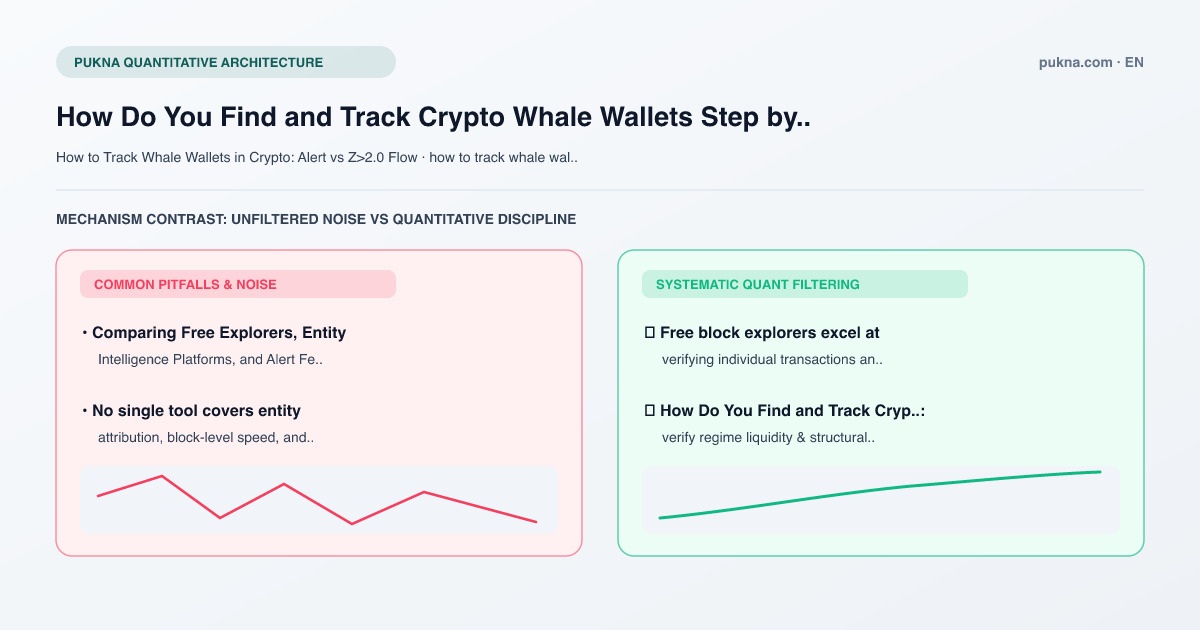
No single tool covers entity attribution, block-level speed, and derivatives context equally well. Free block explorers excel at verifying individual transactions and smart-contract calls, while attribution platforms handle multi-wallet clustering. Pair one attribution layer with liquidity-filtered alerts and derivatives data instead of paying for overlapping dashboards.
| Tool Layer | Attribution Depth | Alert Latency | Noise-to-Signal Ratio | Free-Tier Usability |
|---|---|---|---|---|
| Block Explorers (Etherscan, Solscan, Mempool) | Low–Medium (public labels only) | Real-time (block confirmation) | High when addresses remain unclustered | Excellent; free watchlists and basic email triggers |
| Entity Attribution Platforms (Arkham, Nansen, Glassnode) | High (clustered funds, desks, treasuries) | Near real-time to 10-minute lag | Low–Moderate with entity and venue filters | Useful for manual lookups; custom cluster alerts often paid |
| Macro Transfer Bots (Public whale alert feeds) | Low (single-tx tags, misses wallet splits) | Instant (sub-minute broadcast) | Very High (over 60% routine sweeps and shuffles) | Free public stream, but unreliable without manual filtering |
| Derivatives & Orderflow Dashboards (Coinglass, Hyblock) | Venue-level positioning (no wallet IDs) | Real-time (tick to 1-minute) | Moderate; exposes hedging intent cleanly | Strong free access to open interest, funding rate, and liquidations |
Why Do Identical Whale Inflows Flip Meaning Across Market Regimes?
Key takeaway: An identical 2.0-sigma exchange inflow signals supply overhang near late-trend unlocks, yet often marks defensive margin collateral during liquidation cascades.
Linear whale watching breaks because large desks adapt directly to volatility and order-book depth. Retail traders often treat every exchange inflow as spot selling and every outflow as bullish accumulation. That shortcut fails during deleveraging spikes, when whales wire spot onto exchanges purely to defend collateral ratios. The regime matrix below separates identical flow thresholds across three volatility states.
| Market Regime | Whale CEX Inflow (>2.0σ) | Whale CEX Outflow (>1.5σ) | Dominant Counterparty Intent | Directional Reliability |
|---|---|---|---|---|
| Range-Bound Consolidation (Low Volatility) | Often neutral market-maker rebalancing or OTC settlement routing | Constructive spot accumulation into self-custody if open interest stays flat | Patient inventory absorption or two-way spread quoting | Moderate–High for sustained multi-day outflows; Low for one-off inflows |
| Directional Trend (Markup & Late Distribution) | High-risk supply overhang, especially near insider unlock cliffs | Supply tightening during early breakouts; supports spot-led rallies | Early breakout absorption vs. late-stage distribution into retail bids | High when confirmed by spot turnover and perpetual basis divergence |
| Extreme Volatility & Liquidation Cascades | Frequently urgent margin collateral top-ups defending leveraged books | Panic self-custody flight or forced cross-venue arbitrage withdrawal | Defensive collateral preservation rather than voluntary spot selling | Inverted for naive shorts; verify open-interest washouts before fading |
Range-Bound Consolidation: Exchange Outflows vs. Silent OTC Absorption
Quiet ranges produce the cleanest accumulation footprints when entity outflows persist across three or more consecutive sessions. When non-custodial funds withdraw supply while perpetual funding hovers near neutral and open interest stays flat, the tape reflects a spot-led bid rather than perp-driven froth. Cross-checking those withdrawals against stablecoin supply and bid-depth checks separates real spot demand from passive vault rotation. If open interest climbs faster than spot volume, the accumulation thesis invalidates immediately.
Trending Breakouts and Late-Stage Distribution: Inflow Z-Scores and Token Unlocks
Mature uptrends split whale behavior cleanly between early sponsorship and late-cycle exits. Early in a breakout, shrinking exchange inventories tighten liquid float and reinforce momentum, particularly when an expanding CME-spot basis premium confirms institutional demand. Once price stretches far above cohort cost basis, clustered exchange netflow past a 30-day 2.0-sigma Z-score alongside scheduled insider cliff unlocks signals systematic distribution into retail bids. Absorption invalidates that bearish read only if spot books clear the deposit without losing ±2% bid depth.
High-Volatility Liquidation Cascades: Margin Collateral Top-Ups vs. Capitulation Dumps
Liquidation cascades flip the textbook inflow rule upside down. When options implied volatility (DVOL) spikes and leveraged books approach maintenance margin, whales rush spot balances onto exchanges purely to defend collateral ratios. Shorting those defensive deposits sells straight into exhaustion bottoms. Order-book depth governs actual price impact: a $5 million deposit barely dents deep Bitcoin books, yet the same transfer exceeding 15% of daily mid-cap turnover can slice through thin bids.
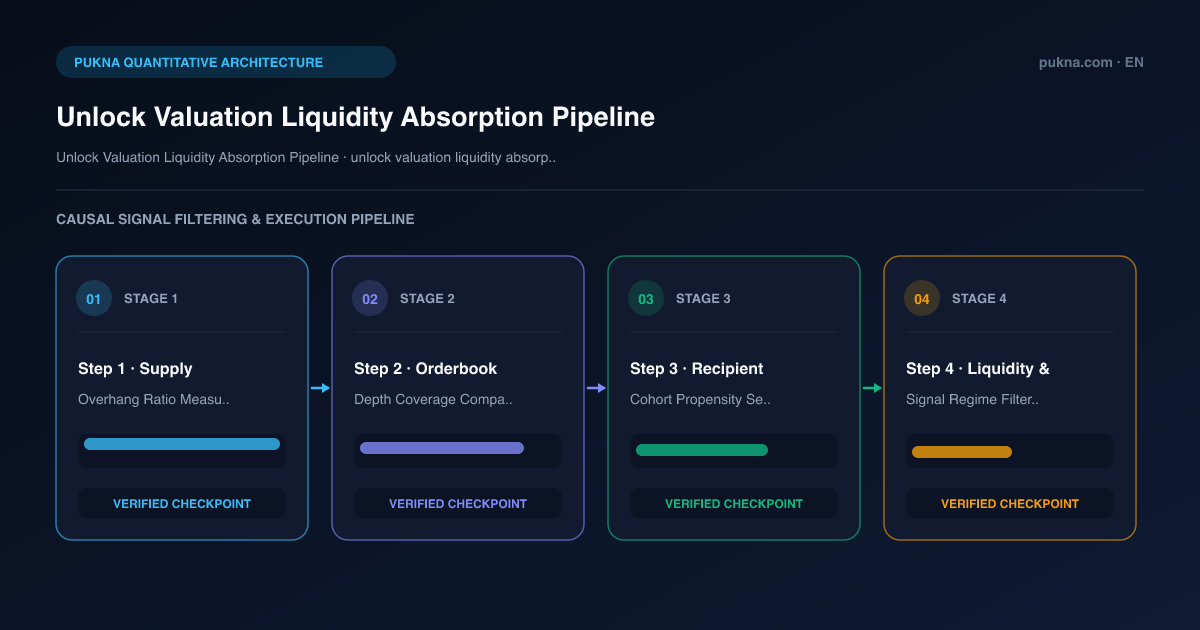
Token Unlock Valuation & Liquidity Absorption Pipeline
- Step 1 · Supply Overhang RatioMeasure single-event unlock size against active circulating float and cumulative 12-month emission velocity rather than headline FDV alone.
- Step 2 · Orderbook Depth CoverageCompare USD value of newly unlocked tokens against spot 2% bid-side depth and 30-day median daily turnover to estimate slippage impact.
- Step 3 · Recipient Cohort PropensitySegment unlocks by recipient class (ecosystem grants, team cliff, early venture tranches) to separate passive staking from active exchange inflows.
- Step 4 · Liquidity & Signal Regime FilterCross-check macro liquidity (EFFR, DXY), total crypto market cap, BTC DVOL, and Pukna 15m/1h/4h/1d P relative quality scores (0–100; 50 = neutral return quality baseline, not win probability) before sizing exposure.
Token Cross-Venue Liquidity Accessibility Pipeline
| Checkpoint | Empirical Criterion & Execution Guardrail |
|---|---|
| Phase 01 · Liquidity Fragmentation Audit | Measure spot order-book depth within ±2% of mid-price across primary venues; discount raw whale alerts if the receiving venue holds under 25% of global liquidity. |
| Phase 02 · Cross-Venue Turnover Scaling | Normalize entity exchange netflow against 24-hour spot turnover; prioritize transfers exceeding 2% of daily volume or a 30-day 2.0-sigma Z-score. |
| Phase 03 · Microstructure Confirmation | Verify whether perpetual basis, open interest shifts, and top-of-book bid depth absorb or amplify the deposit before committing directional risk. |
Why Do Raw Whale Transfer Alerts Produce False Trading Signals?
Key takeaway: Raw transfer bots routinely misread internal exchange shuffles, delta-neutral basis hedges, market-maker unlock loans, and copy-trade decoys as directional spot orders.
Internal Exchange Shuffles, Custody Sweeps, and Delta-Neutral Perp Hedges
Public transfer bots flood social feeds, yet most viral alerts carry zero market impact. Exchanges routinely sweep funds between hot and cold wallets or consolidate addresses for proof-of-reserve audits. Tradable supply does not budge by one token. Labeling gaps also lump prime-brokerage custody sweeps together with offshore retail exchange deposits, inflating naive inflow counts.
Delta-neutral basis desks set an even subtler trap. When annualized perpetual basis widens and positive funding pays short sellers reliably, funds deposit spot collateral and short equal notional size in perpetual contracts. That trade carries zero directional conviction. Reading spot inflows without checking open-interest expansion and funding rates mistakes carry yield for bearish dumping.
Token Unlock Routing, Bridge Hops, and Copy-Trade Decoy Wallets
Three recurring on-chain patterns punish blind copy-trading. First, unlocked treasury allocations often move into qualified custody or market-maker loan accounts under option agreements rather than hitting spot books immediately. Second, withdrawals into bridges or staking contract lockup mechanics register as bullish outflows despite representing pure yield migration. Third, opportunistic whales fire visible buys from public decoy wallets in thin pools while unloading larger sibling clusters quietly.
| Raw On-Chain Alert | Common Linear Misread | Actual Cross-Market Mechanism | Disqualifying Verification Filter |
|---|---|---|---|
| Exchange-to-Exchange or Cold-to-Hot Sweep | Imminent spot dump by a major whale | Internal venue wallet consolidation or proof-of-reserve audit | Check entity-level exchange netflow; zero net change across venue cluster disqualifies alert |
| Large Spot Deposit During Elevated Funding | Directional selling into upward momentum | Delta-neutral cash-and-carry trade (long spot collateral plus short perpetual futures) | Confirm simultaneous open-interest surge paired with positive funding rate expansion |
| Protocol Treasury Move on Unlock Date | Immediate market-order supply shock | Staged transfer to institutional custody or market-maker liquidity loan | Track secondary hops into labeled CEX deposit wallets before flagging sell overhang |
| Large Outflow to Smart Contract | Aggressive spot accumulation into cold storage | Cross-chain bridge transfer or validator staking yield migration | Inspect destination contract bytecode and exclude bridge or liquid-staking routers |
| High-Profile Wallet Buying Thin DEX Pool | High-conviction smart-money entry to mirror | Decoy bait purchase using automated copy-bots as exit liquidity | Audit linked cluster outflows and require at least ±2% order-book depth confirmation |
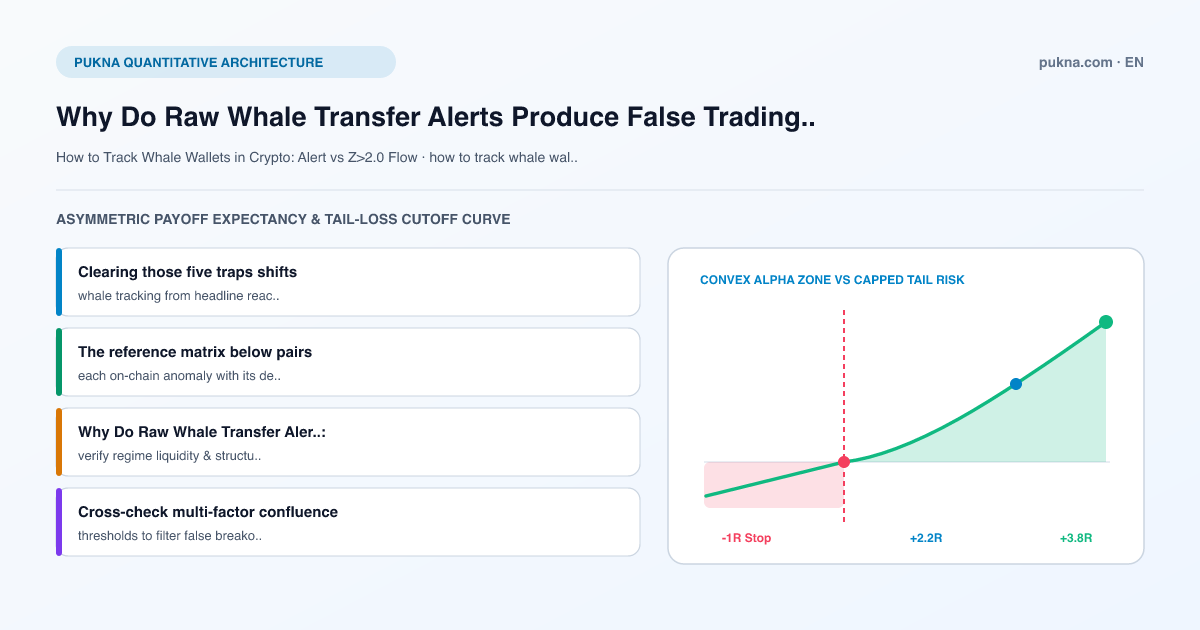
Clearing those five traps shifts whale tracking from headline reactions to structured flow attribution. The reference matrix below pairs each on-chain anomaly with its dedicated exchange-netflow, token-unlock, and bid-depth methodology so you can benchmark live readings against historical thresholds.
| Research Scenario | Core Criterion | Empirical Takeaway | Full Study |
|---|---|---|---|
| Exchange inflow spikes | 30-day Z-score > 2.0, venue split, liquidity regime | Raw inflows often reflect custody sweeps or margin top-ups rather than spot selling. | On-Chain Exchange Flow: Raw Spikes vs Z>2.0 Filters → |
| Large whale transfer alerts | ±1.5σ entity-adjusted netflows, Whale Ratio, regime checks | Raw whale alerts misfire on internal sweeps or OTC transfers without entity filtering. | Onchain Whales: Raw Alerts vs. ±1.5σ Entity Netflows → |
| Scheduled token unlock events | 3%–5% insider cliff, 1x–2x 30d ADV, recipient CEX inflows | Nominal USD unlock figures mislead unless weighed against float, ADV, and CEX flows. | Crypto Token Unlock Meaning: USD Size vs. 5%+ Cliff → |
| Multi-metric on-chain screening | Entity percentiles, cost basis, orderbook depth, derivatives | Active addresses and inflows rarely show direction until paired with depth and basis. | On-Chain Analysis in Crypto: Flows, Cost Basis, and Depth Checks → |
| Stablecoin market cap expansion | Mint-burn netflows, issuer share, bid depth, perp positioning | Rising stablecoin supply signals real spot demand only when bid depth confirms it. | Stablecoin Market Cap: Supply Growth vs. Real Spot Demand → |
How Should Traders Verify Whale Flows Before Sizing Risk?
Key takeaway: Disciplined whale tracking treats entity netflow as one input inside a four-gate workflow covering macro liquidity, derivatives crowding, bar-level structure, and integer-leverage drawdown limits.
Layering On-Chain Whale Flows with Macro, Liquidity, and Derivatives Context
Block explorers solve wallet lookup, never regime confirmation. On-chain data stops at the exchange door, missing off-chain funding stress like elevated Standing Repo Facility (SRF) take-up during a quarter-end funding squeeze. A wide implied volatility vs. realized volatility (VRP) spread sends the same warning: dealers are hedging macro catalysts rather than chasing spot. Upstream USD liquidity overrides isolated spot transfers every time.
Instead of stitching together five separate tabs, traders can cross-check whale anomalies directly inside Pukna’s 8-dimension, 39-indicator environment library and 43-token research context before risking capital. Comparing a 2.0-sigma exchange netflow reading against BTC long-short account positioning, a composite crypto sentiment index, and token-specific unlock schedules exposes opposing headwinds fast. Stand aside whenever crowded perpetual longs or 3%–5% insider cliff unlocks contradict a spot outflow.
Validating Multi-Timeframe Structure, Relative Signal Quality, and Drawdown Bounds
Slow multi-day wallet flows tell you directional bias, never your exact entry bar or stop level. To bridge that execution gap, traders inspect 15m/1h/4h/1d bar-level causal signals across 42 major USDT pairs on Pukna’s live research workspace. Its P-score (0–100) ranks a candle’s combined peak and final return across the forward horizon_bars window against ordinary peer candles anchored at a P=50 neutral baseline. P measures relative return quality, never win-rate probability.
Clear invalidation rules protect capital far better than chasing late whale wicks. Model 1.5%–3% slippage drag on thin mid-cap books, cap single-idea exposure, and exit immediately if entity exchange netflow flips while open interest climbs. Before enabling AUTO real-time strategy alerts, run an AUTO 1–3x integer-leverage equity-curve simulation to audit historical win rate and max drawdown across prior regimes. Strict integer leverage keeps tail drawdowns bounded when whale narratives fail.
| Workflow Gate | Manual Raw-Alert Watching | Multi-Factor Quantitative Verification | Risk & Invalidation Guardrail |
|---|---|---|---|
| Gate 1 · On-Chain Flow Filter | Chases single raw transfer pings from social feeds | Isolates attributed entity clusters exceeding ±1.5σ–2.0σ 30d netflow Z-score and 2% of daily spot turnover | Reject internal venue sweeps, bridge locks, and receiving venues holding under 25% of global depth |
| Gate 2 · Macro & Supply Regime | Ignores funding rates, unlocks, and USD liquidity | Cross-checks 8-dimension, 39-indicator environment metrics and 43-token supply profiles | Stand aside when 3%–5% insider cliff unlocks, wide VRP hedging, or perp crowding oppose spot flow |
| Gate 3 · Multi-Timeframe Structure | Enters at market after delayed transfer alerts | Validates 15m/1h/4h/1d bar-level causal signals across 42 USDT pairs using the P relative quality score (50 neutral, not win rate) | Require higher-timeframe structure alignment; filter out sub-50 relative quality readings |
| Gate 4 · Sizing & Drawdown Audit | Applies arbitrary leverage without drawdown bounds | Runs AUTO personal simulation at 1–3x integer leverage to audit equity curve, win rate, and max drawdown before live push | Enforce hard max-drawdown limits and cap leverage strictly within 1–3x integer bounds |
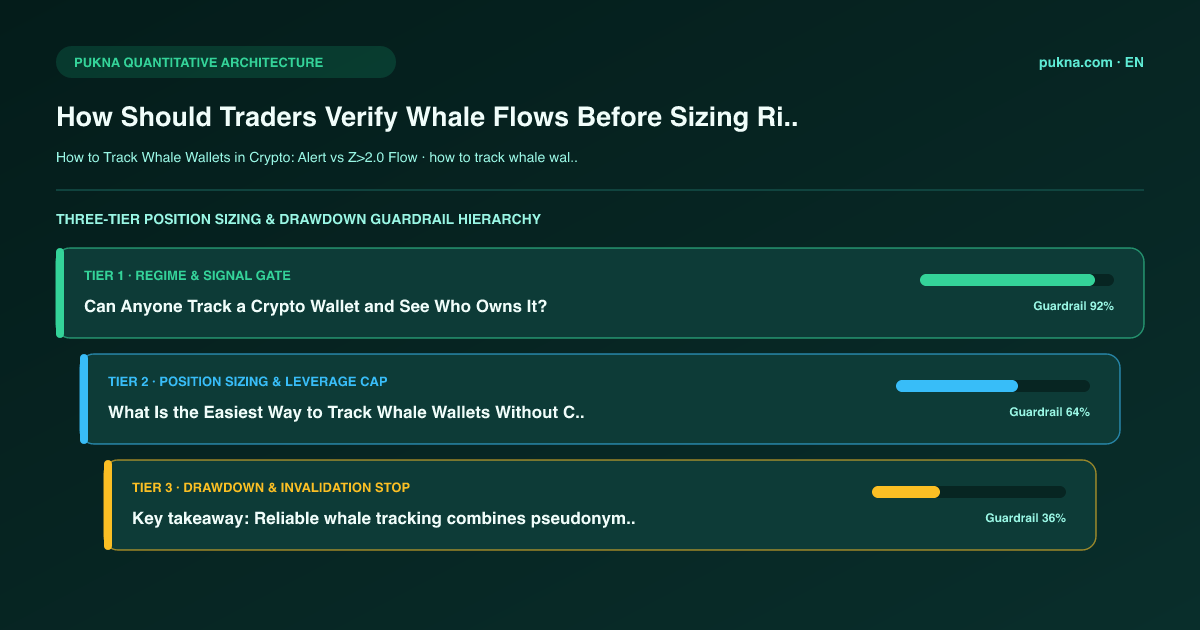
Frequently Asked Questions on Tracking Crypto Whale Wallets
Key takeaway: Reliable whale tracking combines pseudonymous entity attribution with turnover thresholds, derivatives cross-checks, and audited drawdown limits before committing capital.
Can Anyone Track a Crypto Wallet and See Who Owns It?
Anyone can inspect balances and transfer histories on public blockchains like Bitcoin, Ethereum, or Solana using free explorers. Public ledgers stay pseudonymous, not identity-verified. Real-world ownership surfaces only when entities disclose addresses publicly or attribution platforms cluster linked wallets through recurring deposit addresses, gas funders, and multisig patterns.
What Is the Easiest Way to Track Whale Wallets Without Coding?
Pull top non-contract token holders on a free block explorer and exclude tagged exchanges, bridges, and staking pools. Group related sub-wallets inside an entity-attribution watchlist rather than following isolated addresses. Then set alert floors at 1%–2% of 24-hour spot volume or a 1.5-sigma entity exchange netflow shift to mute routine churn.
Does a Large Whale Transfer to an Exchange Always Trigger a Price Drop?
No. Large exchange inflows frequently stem from internal wallet sweeps, proof-of-reserve audits, or delta-neutral basis trades paired with equal perpetual shorts. During violent liquidation cascades, whales also deposit spot urgently to defend leveraged margin ratios. Credible sell pressure emerges only when entity-adjusted inflows hit thin ±2% bid depth alongside fading derivatives demand.
How Should Traders Combine Whale Wallet Alerts with Quantitative Risk Controls?
Treat filtered whale exchange netflow as an upstream hypothesis, never a standalone entry trigger. Cross-check macro liquidity, derivatives crowding, and unlock overhang across multi-dimension environment and token research libraries first. Next, confirm 15m–1d bar-level causal structure and above-50 P relative return-quality scores rather than guessing entries. Before activating AUTO real-time strategy alerts, audit historical equity curves, win rate, and max drawdown at 1–3x integer leverage.
Put this into practice
Create a free account to browse live signals and test your own rules.