Contents7 sections
- Why Does Crypto Staking Carry Risks Beyond Spot Holding?
- Where Staking Rewards Originate vs. Other Yield Sources
- Market Risk vs. Incremental Staking Risk
- How Can Crypto Staking Lose Money Across Seven Risk Channels?
- Token Price Drawdowns vs. Issuance Dilution
- Lockups, Unbonding Queues, and Exit Illiquidity
- Validator Inactivity Penalties vs. Slashing
- Custody Failures, Smart Contract Bugs, and Policy Shifts
- Native vs. Exchange vs. Liquid Staking: How Do Risk Profiles Differ?
- Solo Native vs. Delegated Staking
- Custodial Exchange and Pooled Staking
- Liquid Staking and Restaking Risk Layers
- Token Cross Venue Liquidity Accessibility Pipeline
- Why Do Positive Staking Rewards Fail to Offset Capital Losses?
- Total Dollar Return vs. Headline APY
- Break-Even Price Boundaries and Dilution Math
- What Quantitative Market Research Can and Cannot Verify
- How Do Ethereum Staking Risks Differ From Bitcoin Yield Products?
- What Can Go Wrong When Staking ETH?
- Why Native Bitcoin Staking Does Not Exist on Base Consensus
- How Should You Assess Staking Risks Across Shifting Market Regimes?
- Range-Bound Markets vs. Spot Trends vs. Liquidation Cascades
- Five-Step Verification Checklist Before Locking Tokens
- Separating Market-Regime Research From Protocol Due Diligence
- Frequently Asked Questions
Crypto staking risks are the ways proof-of-stake participation, unlike simple spot holding or crypto lending, can reduce capital, delay withdrawals, or expose funds to third-party failures. In a hypothetical twelve-month scenario, a 5% net token reward fails to offset a 20% price drop, leaving a 16% dollar loss before trading fees or exit slippage. Because headline APY ignores spot drawdowns and exit friction, reliable evaluation requires cross-checking lockup queues, validator penalties, custody terms, and cross-venue liquidity.
Why Does Crypto Staking Carry Risks Beyond Spot Holding?
Staking layers operational, liquidity, and counterparty exposures directly onto full underlying token volatility. Locking coins never removes market risk. Because spot beta dominates most staking outcomes, broad market regimes dictate whether modest yield acts as a cushion or vanishes during sell-offs. The four regime states below show how volatility, market breadth, and leverage reshape downside exposure before you lock capital.
Before comparing individual protocols or platforms, map every potential loss channel to its actual trigger. Headline reward rates reflect token-denominated issuance assumptions rather than capital preservation. Treating nominal yield as a safety cushion systematically misprices tail risk.
| Risk Category | Triggering Condition & Mechanism | Financial Consequence | Affected Methods | Primary Verification Check |
|---|---|---|---|---|
| Market Price Drawdown | Underlying spot token falls faster than reward accrual | Negative fiat return despite positive token balance growth | All staking methods | Compare historical token drawdowns against net break-even yield |
| Withdrawal & Liquidity | Unbonding locks, validator exit queues, or thin secondary bids | Inability to sell during crashes or forced exit at a discount | Native, delegated, pooled, liquid | Verify protocol exit queues and live executable order-book depth |
| Validator Penalties | Node downtime, missed attestations, or slashable double-signing | Reduced yield or permanent confiscation of staked principal | Solo, delegated, pooled, liquid | Audit validator uptime, client diversity, and slashing history |
| Custody & Counterparty | Exchange insolvency, withdrawal freeze, or compromised signing keys | Frozen balances or unsecured creditor losses | Custodial exchange, custodial pools | Inspect legal ownership terms, segregation, and withdrawal rights |
| Smart Contract & Peg | Contract bug, governance exploit, or receipt-token sell pressure | Direct exploit loss or market discount below redemption value | Smart-contract pools, liquid, restaking | Check independent audits, upgrade keys, and redemption mechanics |
| Dilution & Fee Drag | High token issuance, validator commissions, or shifting reward rates | Flat relative network ownership and lower realized net yield | All staking methods | Subtract provider fees and compare rewards against supply issuance |
| Regulatory & Access | Jurisdictional restrictions or platform staking product suspension | Forced unstaking, service loss, or unexpected tax treatment | Custodial and third-party services | Review current local rules and provider service-termination clauses |
Where Staking Rewards Originate vs. Other Yield Sources
Native staking locks a proof-of-stake token directly or via validator delegation so the network can propose and verify blocks. Realized rewards come from newly minted protocol issuance and transaction priority fees.
Many retail platforms still market unrelated yield products under a generic staking label. Lending interest stems from borrower demand, while decentralized exchange rewards come from swap fees and token emissions. Centralized yield accounts typically depend on institutional lending or collateral re-pledging, whereas restaking layers external validation duties onto staked collateral under separate penalty rules. Mixing these engines obscures where losses originate.
Market Risk vs. Incremental Staking Risk
An unstaked spot holder faces price volatility and wallet security risk. Moving those same tokens into a staking contract preserves 100% of that spot exposure while adding exit delays and technical dependencies.
Advertised APR or APY figures only reflect nominal token accrual under current network participation rates. They never indicate the probability of preserving purchasing power. Normalizing compounding yield and fee drag is only step one; separating spot drawdowns from protocol mechanics reveals why positive payouts still produce real losses.
How Can Crypto Staking Lose Money Across Seven Risk Channels?
Positive token payouts mask real losses whenever market declines, lockup friction, protocol penalties, or intermediary failures erode realizable cash value. Every channel operates on a different balance-sheet mechanism.
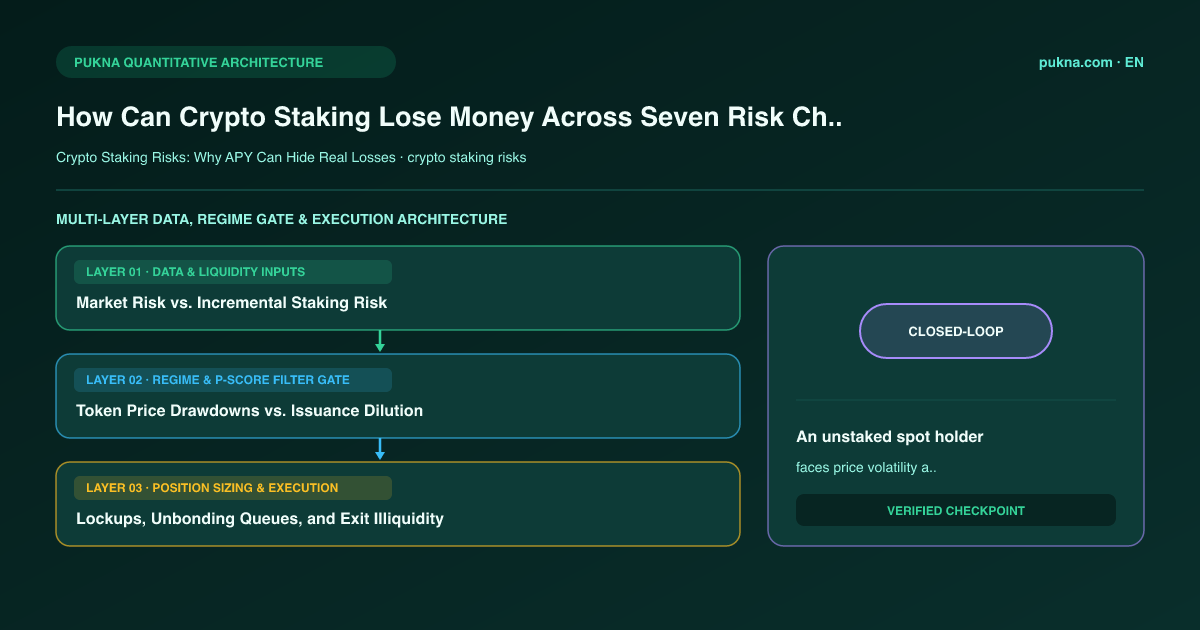
Token Price Drawdowns vs. Issuance Dilution
Underlying token depreciation is the most frequent driver of capital loss in staking. In an illustrative week, a volatile token can fall 15% while a 6% annual reward accrues roughly 0.12%.
Counting newly credited coins without revaluing principal creates an accounting blind spot. Risk desks instead track mark-to-market P&L (MTM P&L), which revalues open positions at live tradable spot prices rather than nominal token inflows.
Issuance dilution compounds that blind spot when protocol inflation expands circulating supply near the staking yield rate. Your wallet holds more tokens, yet your proportional share of network value barely moves.
Lockups, Unbonding Queues, and Exit Illiquidity
Unbonding is a mandatory protocol waiting period after a withdrawal request, during which staked tokens remain locked and often stop accruing rewards. On networks with dynamic validator exit queues, simultaneous withdrawal surges can stretch settlement times far beyond calm-market norms.
Platform-imposed lockups add a second layer of friction. A centralized exchange may enforce fixed notice windows or pause redemptions during volatility spikes even when base-layer exits remain open. Liquidity disappears fastest when exits crowd together. Locked capital cannot be rebalanced, hedged cheaply, or rotated into cash during a sharp drawdown.
Validator Inactivity Penalties vs. Slashing
Validator risk splits into two distinct ledger outcomes that investors routinely conflate. Ordinary downtime or missed block attestations typically cause missed rewards or modest inactivity leaks. Slashing is far more severe: it is a protocol-enforced confiscation of staked principal triggered by verifiable misconduct such as signing conflicting blocks.
Hardware faults, broken client upgrades, or correlated cloud outages can penalize many validators simultaneously. Delegators and pool users absorb those losses whenever an operator lacks strict key-management redundancy or minority client diversity. A clean record during calm months never proves operational immunity.
Custody Failures, Smart Contract Bugs, and Policy Shifts
Custodial staking transfers private-key control to a third party. If that custodian turns insolvent, suffers a key compromise, or faces regulatory freezes, depositors may lose access or rank as unsecured creditors under local law.
On-chain alternatives trade custodian solvency risk for code and market-structure exposure. Smart contract bugs, faulty price oracles, or compromised upgrade keys can drain pooled funds directly. In liquid staking, a receipt token can also fall to a secondary-market discount (known as a depeg) below its redemption value when forced sellers overwhelm arbitrage buyers.
Leverage amplifies those discounts quickly. Traders frequently run LST recursive looping, pledging liquid staking tokens as collateral to borrow the base asset repeatedly for extra spread. That crowding drives DeFi borrow-yield compression until utilization spikes past the rate kink documented in DeFi lending utilization kink risks. Once borrow rates exceed staking yields, rapid unwinds deepen receipt-token discounts. Add abrupt regulatory restrictions on retail staking, and static APY obscures structural tail risk.
Native vs. Exchange vs. Liquid Staking: How Do Risk Profiles Differ?
Choosing a staking structure does not eliminate risk; it reallocates who controls private keys, who absorbs validator errors, and how fast you can exit under stress. Every convenience trade-off introduces a specific dependency.
| Staking Method | Asset Control | Validator Exposure | Withdrawal Mechanism | Additional Dependencies / Required Checks |
|---|---|---|---|---|
| Solo Native Staking | Full self-custody | Direct uptime and slashing liability | Protocol exit queue or unbonding | Additional Dependencies: Hardware, bandwidth, client software · Required Checks: Key backups, minority clients, uptime alerts |
| Delegated Staking | Self-custody wallet | Shared via chosen validator | Protocol unbonding window | Additional Dependencies: Validator commission and governance · Required Checks: Operator track record, fee caps, self-bond |
| Custodial Exchange | Platform holds keys | Managed by exchange or partners | Platform terms plus protocol queue | Additional Dependencies: Insolvency, pauses, legal ownership · Required Checks: Terms of service, fee cut, slashing policy |
| Pooled Staking | Custodial or smart contract | Distributed across pool operators | Pool buffer or protocol redemption | Additional Dependencies: Pool governance or operator risk · Required Checks: Distinguish custodial vs. contract pools |
| Liquid Staking | Receipt token in wallet | Spread across protocol validator set | Protocol redemption or DEX/CEX sale | Additional Dependencies: Smart contract bugs and peg discounts · Required Checks: Contract audits, redemption queue, bid depth |
| Optional Restaking | Smart-contract vault | Base slashing plus external penalties | Multi-layer unbonding and queues | Additional Dependencies: External service rules and correlation · Required Checks: Separate slashing scope and withdrawal lag |
Solo Native vs. Delegated Staking
Self-custody removes exchange insolvency risk, not protocol or operational risk. Solo validators keep direct key control and pay no third-party commission, yet a single misconfigured backup node can cause accidental double-signing and immediate slashing.
Delegated staking lowers hardware overhead while letting users retain withdrawal keys on many proof-of-stake networks. Before delegating, verify who runs the validator infrastructure, whether commissions can rise unilaterally, and whether slashing cuts delegator principal alongside operator stake.
Custodial Exchange and Pooled Staking
Custodial exchange staking prioritizes convenience at the expense of direct key ownership. Current provider terms require verification on three points: how assets are segregated, what commission is cut from gross rewards, and who absorbs slashing losses.
Pooled staking requires an explicit structural split. A custodial pool depends on an entity’s balance sheet and operational controls, whereas a smart-contract pool relies on immutable or governable on-chain code. Treating both structures as identical hides fundamentally different failure modes.
Liquid Staking and Restaking Risk Layers
Liquid staking issues a transferable receipt token representing staked principal and accrued yield. That structure creates two distinct exit routes: waiting through protocol redemption or selling the receipt token immediately on a secondary market. Detailed reviews of liquid staking exit liquidity and depegs show why secondary-market pricing can diverge sharply from underlying net asset value during sudden deleveraging.
Optional restaking extends this stack further by pledging staked assets or liquid receipt tokens to secure external networks or middleware under separate slashing conditions. Multiple protocols can then penalize the same underlying collateral simultaneously.
Evaluating secondary-market exit reliability also requires checking real venue fragmentation rather than aggregate reported volume. Research from the Bank for International Settlements on blockchain scalability and market fragmentation highlights how liquidity split across centralized exchanges, decentralized pools, and separate chains cannot be summed naively. Realizable exit value depends on accessible venues, working transfer rails, and unified bid depth, following the three-phase verification pipeline below.
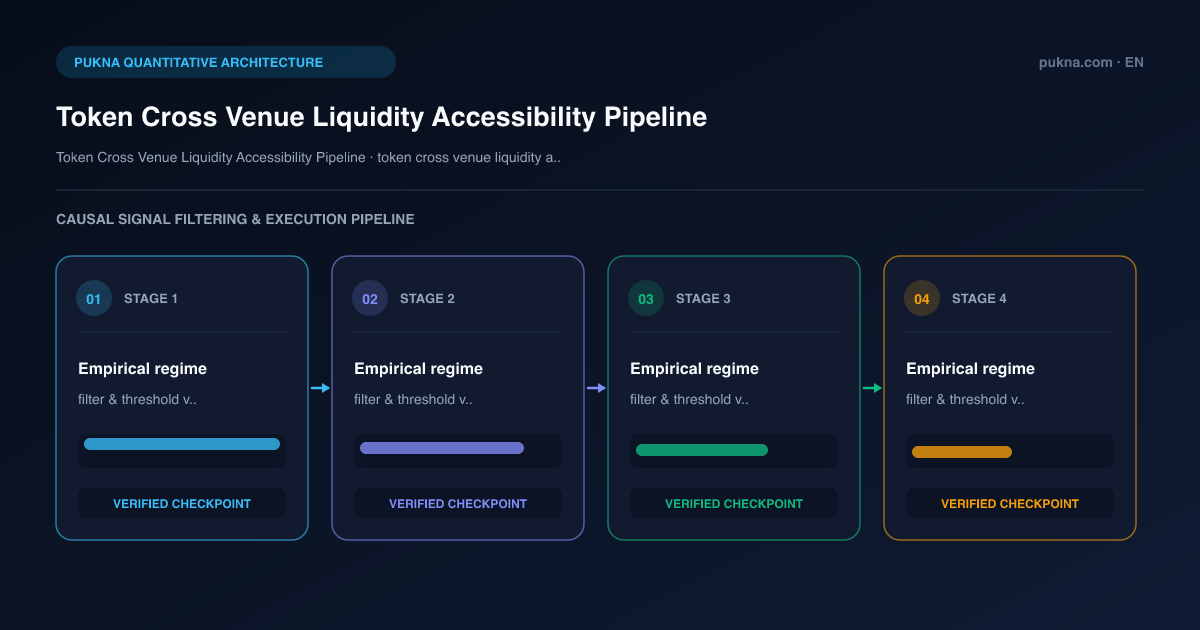
Token Cross Venue Liquidity Accessibility Pipeline
| Checkpoint | Empirical Criterion & Execution Guardrail |
|---|---|
| Phase 01: Venue Access | Verify active CEX and DEX access, open deposit and withdrawal rails, and bridge capacity before counting liquidity as executable. |
| Phase 02: Unified Depth | Measure executable bid depth within a fixed price-deviation band at one timestamp and quote currency while removing duplicated or unreachable pool liquidity. |
| Phase 03: Stress Friction | Model spread widening, market-maker quote pullback, transfer delays, and fee drag so marginal last-trade price is never mistaken for full-size exit value. |
Why Do Positive Staking Rewards Fail to Offset Capital Losses?
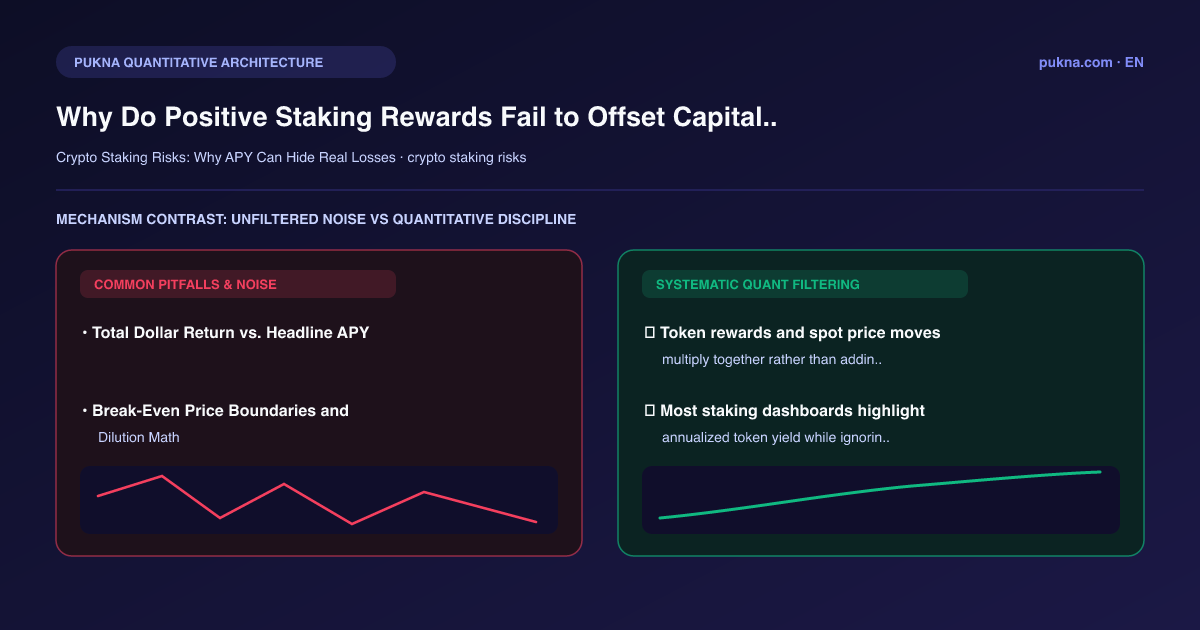
Token rewards and spot price moves multiply together rather than adding cleanly, so moderate price drawdowns routinely overpower a full year of staking payouts. Mathematically, a 5% net token return offsets only a 4.76% price drop before trading costs.
Total Dollar Return vs. Headline APY
Most staking dashboards highlight annualized token yield while ignoring fiat capital outcomes. To evaluate whether a staking position actually grew purchasing power, combine realized token accumulation with the spot price move over the exact same holding period.
Before separately incurred gas fees, trading commissions, exit slippage, or taxes, the simplified dollar total-return equation is: Dollar Return = (1 + Net Token Return) × (1 + Token Price Return) − 1. Use rewards actually accrued during your holding window after validator commissions, never a projected APY that assumes uninterrupted compounding at a fixed rate.
Consider a hypothetical one-year position earning a 5% net token reward after provider fees. If the underlying token falls 20%, ending dollar return equals (1.05 × 0.80) − 1, or −16.0%. If the token rises 20%, ending dollar return equals (1.05 × 1.20) − 1, or +26.0%. Positive yield never prevents double-digit losses.
Break-Even Price Boundaries and Dilution Math
Investors often want to know how far a token’s price can fall before a year of staking rewards stops covering the loss. Setting the dollar total-return formula to zero yields a simple break-even boundary: Maximum Offsettable Price Drop = Net Token Return / (1 + Net Token Return).
Under that formula, a hypothetical 5% net token return breaks even at a −4.76% price drop before transaction costs. Even a 12% net token return only buffers a −10.71% price decline. The table below maps these hypothetical one-year scenarios across four net token return tiers, all expressed in percent before gas, slippage, and tax obligations.
| Hypothetical Net Token Return | Token −30% | Token −20% | Token −10% | Token 0% / Token +20% / Break-Even Price Drop |
|---|---|---|---|---|
| 3.0% Net Yield | −27.9% | −17.6% | −7.3% | Token 0%: +3.0% · Token +20%: +23.6% · Break-Even Price Drop: −2.91% |
| 5.0% Net Yield | −26.5% | −16.0% | −5.5% | Token 0%: +5.0% · Token +20%: +26.0% · Break-Even Price Drop: −4.76% |
| 8.0% Net Yield | −24.4% | −13.6% | −2.8% | Token 0%: +8.0% · Token +20%: +29.6% · Break-Even Price Drop: −7.41% |
| 12.0% Net Yield | −21.6% | −10.4% | +0.8% | Token 0%: +12.0% · Token +20%: +34.4% · Break-Even Price Drop: −10.71% |
Dilution requires a separate calculation. When circulating supply grows at an annualized issuance rate i while net staking yield equals r, relative ownership shifts by (1 + r) / (1 + i) − 1. In an illustrative year, a 10% reward against 9% supply inflation lifts proportional ownership by just 0.92%. That ratio still reveals nothing about dollar return if spot demand weakens.
What Quantitative Market Research Can and Cannot Verify
Historical performance comparisons only hold up when analysts align start dates, end dates, benchmark price feeds, validator fee assumptions, and exit costs identically across staked and unstaked baselines. Unverified back-of-the-envelope yield estimates hide regime drawdowns.
Because spot drawdowns routinely dwarf single-digit staking yields, checking macro liquidity and derivatives positioning helps frame beta risk before locking capital. Rather than reconciling scattered feeds manually, analysts can inspect the 8-dimension, 39-indicator environment library and 43-token research library in Pukna’s market research workspace. Those dashboards track macro rates, liquidity, sentiment, derivatives, and on-chain flows, yet they never audit validator infrastructure, contract code, or custodian solvency.
How Do Ethereum Staking Risks Differ From Bitcoin Yield Products?
Ethereum offers native proof-of-stake validation governed by base-layer consensus rules, whereas Bitcoin runs on proof-of-work and has no native protocol staking yield. Mixing these architectures misprices counterparty and smart contract risk.
| Structural Dimension | Ethereum Native Staking | Bitcoin-Linked Yield Products |
|---|---|---|
| Base Consensus | Proof-of-stake (native validator security) | Proof-of-work (no native base-layer staking) |
| Primary Reward Source | Protocol issuance, priority fees, and MEV | External protocol incentives, lending, or custody yield |
| Withdrawal Path | Base-layer validator exit queue plus sweep | External bridge, custodian, lending pool, or lock script |
| Core Incremental Risk | Slashing, exit-queue lag, and LST smart contracts | Custodian default, bridge or wrapper risk, external protocol bugs |
What Can Go Wrong When Staking ETH?
Staking ETH natively involves running or funding validator credentials that attest to and propose Ethereum blocks. Validators face inactivity penalties during downtime, slashing if signing keys double-vote or surround-vote, and variable withdrawal wait times driven by active exit-queue congestion.
Never assume a fixed withdrawal duration from outdated guides. Consult the official Ethereum withdrawal documentation for current exit mechanics, and separate base-layer rules from extra redemption delays added by exchanges or liquid pools. Even when Ethereum’s consensus layer operates normally, a third-party staking provider can still impose separate fee changes, liquidity buffers, or service restrictions.
Why Native Bitcoin Staking Does Not Exist on Base Consensus
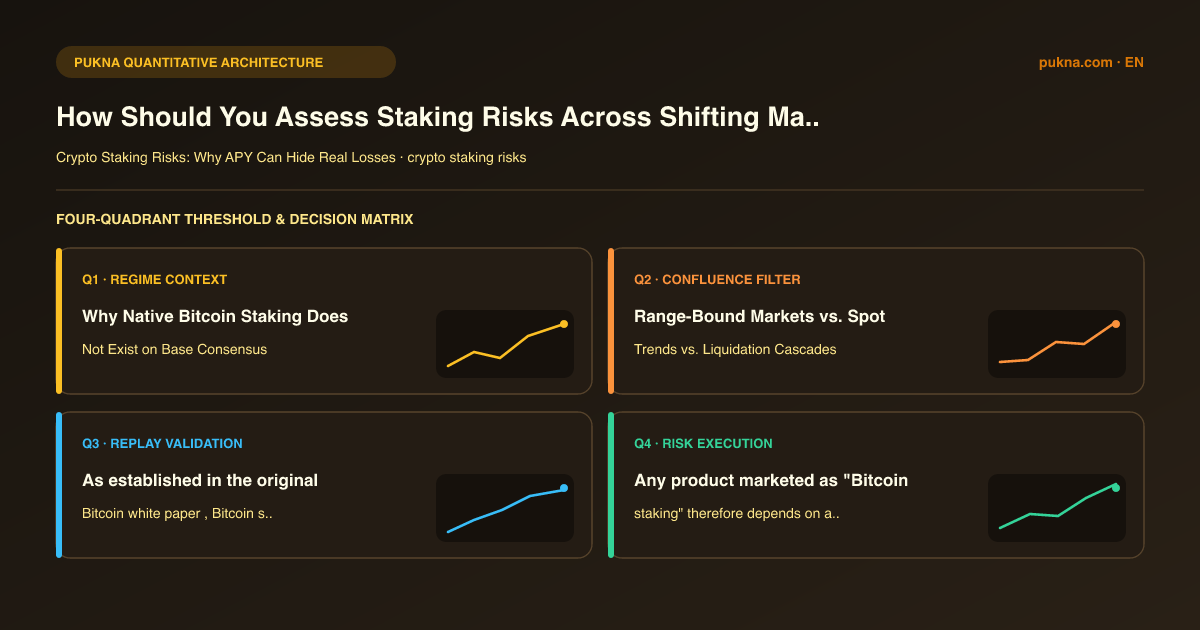
As established in the original Bitcoin white paper, Bitcoin secures its ledger through proof-of-work mining rather than staked validator collateral. The base protocol pays zero native staking yield to passive BTC holders.
Any product marketed as “Bitcoin staking” therefore depends on an external mechanism. That wrapper may involve custodial lending desks, bridged BTC tokens on proof-of-stake chains, or time-locked scripts backing external networks. Every wrapper introduces distinct contract, bridge, or counterparty failure modes outside Bitcoin’s base-layer security. Evaluating BTC exposure requires analyzing Bitcoin supply cycles and liquidity regimes separately from the credit and code risks of third-party yield structures.
How Should You Assess Staking Risks Across Shifting Market Regimes?
The exact same 6% staking yield carries sharply different risk-reward implications in a quiet range than in a leveraged liquidation cascade. Reliable due diligence pairs regime-aware liquidity checks with a strict protocol audit.
Range-Bound Markets vs. Spot Trends vs. Liquidation Cascades
Single yield figures mislead investors because shifting market microstructure changes the real cost of being locked up. Four derivatives gauges indicate when exit friction may spike. Implied volatility DVOL tracks expected 30-day price swings, while perpetual funding rates measure periodic cash transfers balancing futures against spot. Open interest totals unsettled derivatives contracts, and perpetual basis tracks the futures-to-spot price spread.
| Market Regime | Derivatives & Liquidity Context | Impact on Staking Yield & Exits | Risk-Control Priority |
|---|---|---|---|
| Range-Bound / Low Volatility | Contained implied volatility DVOL, neutral funding rate, balanced spot depth | Modest net rewards can cushion flat spot returns; LST pegs stay tight | Audit commissions, issuance dilution, and baseline custody terms |
| Spot-Led Directional Trend | Rising macro real yield headwinds or crowded perpetual basis and open interest | Token beta overwhelms annual yield within days; leverage builds fragility | Stress-test drawdowns against break-even yield before extending lockups |
| Acute Liquidation Cascade | Forced futures deleveraging, spiking DVOL, and vanishing order-book bids | Exit queues lengthen while liquid staking tokens trade at steep discounts | Maintain liquid reserves outside staking; avoid forced market-order exits |
In range-bound regimes, subdued volatility lets modest net yields compound gradually while secondary markets clear liquid staking tokens near par value. Still, calm prices frequently breed complacency over validator concentration or smart contract upgrade risks.
In spot-led directional trends, macro real yield headwinds and a shifting dollar liquidity impulse can drive multi-week drawdowns far beyond any staking buffer. Rapid capital rotations tracked through altcoin breadth and dominance shifts amplify that downside. Pairing equity market volatility benchmarks with Bitcoin derivatives account positioning also signals when basis-trade crowding and perp funding-yield compression leave spot markets fragile. Still, macro gauges never replace checking your specific token’s bid depth and transfer rails.
In acute liquidation cascades, exit queues and market slippage collide simultaneously. Validators queue up to exit, leveraged LST loops unwind on-chain, and secondary-market bids pull back. Selling a receipt token at a hypothetical 4% discount can erase nearly a year of net staking yield in seconds.
Five-Step Verification Checklist Before Locking Tokens
Run five concrete checks before committing funds to any staking arrangement, treating every unverified input as an unknown loss vector.
- Test break-even math against historical drawdowns: Compute your post-commission break-even price drop and compare it against realistic multi-month token drawdowns. If an illustrative 25% pullback dwarfs a 4.76% yield buffer, size the position around spot risk rather than yield.
- Separate protocol withdrawal rules from provider redemption terms: Verify native unbonding windows or live exit-queue rules from official protocol docs. Then review provider legal terms for separate freeze rights, notice periods, or fee changes.
- Map custody rights, validator diversity, and contract permissions: Confirm who holds withdrawal keys and how stake distributes across independent validators and software clients. Verify recent contract audits and check who controls admin upgrade keys.
- Audit real cross-venue exit liquidity: For liquid staking tokens, measure live executable bid depth across venues you can actually access rather than trusting aggregate 24-hour volume or headline market capitalization.
- Ring-fence liquid cash outside lockups: Keep emergency liquidity and near-term portfolio obligations completely unstaked so withdrawal delays never force distressed sales during secondary-market depegs.
Separating Market-Regime Research From Protocol Due Diligence
Never confuse active trading signals with staking safety. A constructive spot regime indicator may show that excess derivatives leverage has cleared, yet a smart contract bug or insolvent custodian can still wipe out locked capital overnight.
Investors who evaluate active market timing separately from passive staking can inspect 15m, 1h, 4h, and 1d bar-level causal signals across Pukna’s 42 mainstream USDT pairs. Each signal pairs with a P-score (0–100) relative return-quality ranking across horizon_bars, the fixed forward candle evaluation window. A P=50 neutral baseline matches ordinary nearby candles; higher readings rank combined best-return and final-return quality, never win-rate probability.
Before enabling optional AUTO real-time strategy alerts, traders can complete an AUTO simulated win-rate and max-drawdown audit across 1x, 2x, and 3x integer leverage settings alongside historical equity curves. Keep active timing strictly separate from protocol auditing. Neither market-regime indicators nor strategy simulations monitor validator uptime, exit queues, or custody solvency.
For readers comparing staking lockups against adjacent DeFi lending kinks, arbitrage execution hurdles, compounding math, and causal signal audits, the digest below compiles core empirical criteria across related studies.
| Research Scenario | Core Criterion | Empirical Takeaway | Full Study |
|---|---|---|---|
| Evaluating high-APY DeFi lending pools or managing leveraged collateral positions. | Proximity to 80%–92% utilization kinks, rate-curve slope, and regime-adjusted Health Factor buffers. | Headline APY and gross TVL hide 80%–92% utilization kinks; rate-curve math and backtested Health Factor buffers prevent sudden rate-spike liquidations. | Crypto Lending Protocols: High APY vs 80%+ Kink Risk → |
| Testing spot, cross-exchange, or funding arbitrage models under live fee constraints. | Multi-leg fees, order-book depth, slippage, and regime conditions against a 45 bps execution hurdle. | Raw 10–40 bps spot spreads rarely survive live execution; only strategies clearing the 45 bps cost hurdle with verified depth remain viable. | Is Crypto Arbitrage Profitable: Spreads vs 45 bps Hurdle → |
| Positioning portfolio exposure across multi-year Bitcoin market phases and macro shifts. | Verified 210,000-block halving intervals paired with dollar liquidity, ETF flows, and derivatives regimes. | Bitcoin cycles follow 210,000-block halvings rather than fixed calendar dates and depend on dollar liquidity, ETF flows, and leverage confirmation. | Bitcoin 4-Year Cycle: 210,000-Block Halvings vs. Liquidity, ETFs, and Regimes → |
| Comparing staking, vault, and lending yield quotes across disparate compounding terms. | Reinvestment cadence, gas friction, variable rate decay, and underlying token drawdown risk. | APY makes returns look larger than APR; normalizing compounding frequency, gas costs, rate variability, and token drawdowns isolates real net yield. | APR vs APY Crypto: Compounding, Fees, and Net Returns → |
| Auditing AI trading bots and distinguishing causal quant signals from AI-sector tokens. | Walk-forward out-of-sample audits, regime filters, and 1x–3x leverage drawdown stress checks. | Bots boasting 75% hit rates are often curve-fitted; causal candlestick signals audited with walk-forward tests and 1x–3x drawdown checks hold up better. | AI Crypto: Causal Signals vs 75% Hit-Rate Bot Traps → |
Frequently Asked Questions
Can you lose your original cryptocurrency when staking?
Yes. You can lose both dollar value and original token units while staking. A decline in the underlying token’s market price can quickly erase months of staking rewards in fiat terms. Original token balances can also shrink through protocol slashing after validator misconduct, smart contract exploits, compromised wallets, or custodial platform insolvency. Verifying custody rights, contract audits, and validator safeguards matters before locking assets.
Is staking Ethereum safer or riskier than holding unstaked ETH?
Staking Ethereum is operationally riskier than holding unstaked ETH in self-custody. Both positions carry identical ETH spot-price exposure, yet staking adds protocol exit queues, validator penalties, and slashing risk. Using an exchange, staking pool, or liquid staking protocol introduces further custody, governance, and smart contract layers. Native rewards compensate for those added dependencies rather than removing downside price risk.
Can you withdraw staked crypto at any time?
Usually not immediately. Most proof-of-stake networks enforce protocol unbonding periods or dynamic validator exit queues that delay full settlement during heavy redemption demand. Centralized exchanges and staking pools can also apply separate withdrawal terms or temporary pauses during market stress. Liquid staking tokens let holders sell on secondary markets without waiting, though rapid exits can incur wide spreads or discounts below redemption value.
Put this into practice
Create a free account to browse live signals and test your own rules.