Contents7 sections
- What Is the Difference Between USDT and USDC at a Glance?
- Core Structural Differences Between Tether (USDT) and USD Coin (USDC)
- Quick Selection Matrix by Trader Profile and Region
- Which Stablecoin Is Safer: Reserves, Attestations, and Depeg Stress Tests?
- Reserve Composition and Attestations: BDO Quarterly vs. Deloitte Monthly
- Historical Depeg Stress Tests, Banking Exposure, and Centralized Freeze Risk
- How Do EU MiCA Rules and Institutional Payment Rails Divide USDT and USDC?
- EU MiCA Authorization and U.S. Institutional Payment Integrations
- Offshore Exchange Dominance, Emerging Markets, and Where USDG Fits
- Why Does Exchange Execution Liquidity Cluster in USDT Despite Multi-Chain Fees?
- Order Book Depth, Slippage, and Perpetual Margin Mechanics
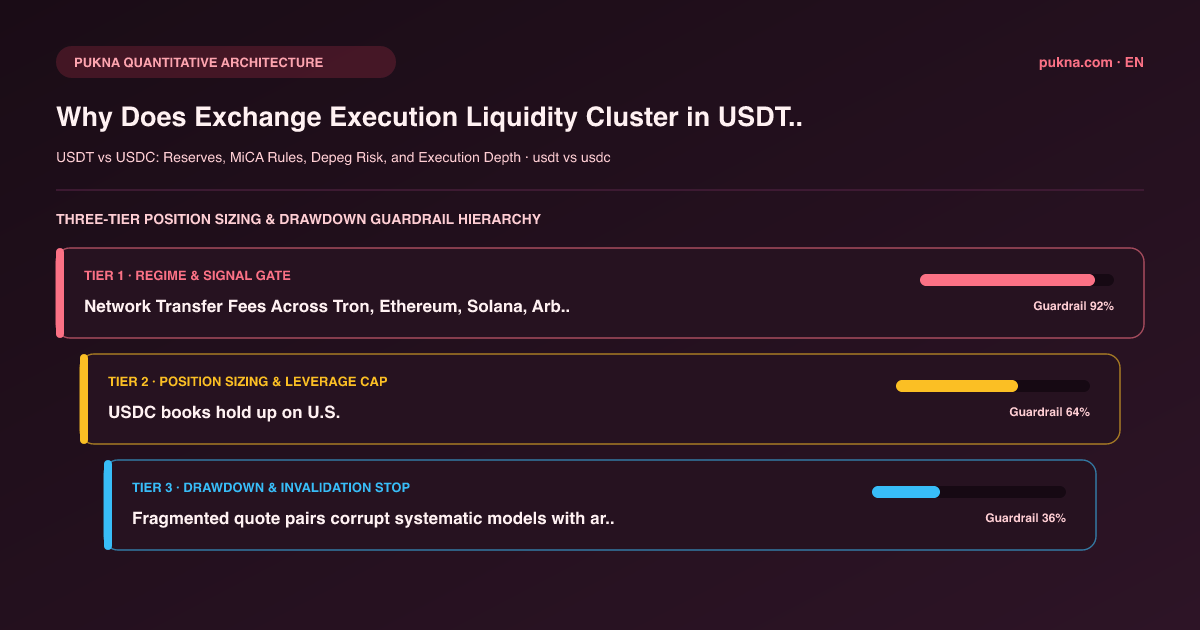
- Network Transfer Fees Across Tron, Ethereum, Solana, Arbitrum, and Base
- Can You Stake USDT or USDC, and How Do Supply Flows Signal Macro Regimes?
- Lending Yield Sources, Borrower Demand, and Counterparty Risk
- Reading Stablecoin Mint-Burn Netflows and Micro Peg Basis Across Market Regimes
- How to Split Capital Between USDT and USDC with Pre-Trade Risk Guardrails
- The Two-Bucket Treasury Split: Regulated Idle Reserves vs. Active Trading Margin
- Pre-Execution Multi-Timeframe and Drawdown Verification Checklist
- Frequently Asked Questions: USDT vs. USDC
USDT (Tether) and USDC (USD Coin) are centralized, dollar-pegged tokens—not FDIC-insured bank deposits—that divide crypto liquidity and regulatory compliance along clear lines. USDT anchors global exchange books with over $183 billion in circulating supply and 55% to 60% market share, whereas USDC (~$75 billion) leads EU MiCA authorization and weekly reserve disclosures. Neither supply scale nor domestic licensing eliminates tail risk alone, so cross-check reserve liquidity, venue depth, and macro flows first.
Key Takeaways:
- Active Trading & Margin: Trade USDT for deeper global spot and perpetual order books, tighter spreads, and lower slippage on size.
- Regulated Custody & Payments: Hold USDC for EU MiCA Electronic Money Token (EMT) compliance, U.S. payment rails, and weekly reserve snapshots.
- No Risk-Free Peg: Both tokens lack FDIC coverage, embed centralized wallet-freeze controls, and carry distinct banking or reserve tail risks.
- Two-Bucket Discipline: Park idle treasury cash in USDC or insured bank USD, fund active margin in USDT, and check macro liquidity first.
What Is the Difference Between USDT and USDC at a Glance?
Core Verdict: USDT holds roughly 2.4x the circulating supply of USDC and anchors global exchange volume, while USDC carries the cleaner compliance footprint across European and U.S. banking rails. Both issuers run centralized $1.00 pegs, forcing a clear trade-off between execution depth and regulatory visibility. Pick the rail matching your mandate.
| Dimension | USDT (Tether) | USDC (USD Coin) |
|---|---|---|
| Issuer & Domicile | Tether Holdings (El Salvador / offshore structure) | Circle Internet Group (United States; EU EMT entity in France) |
| Market Cap & Share | ~$183B+ circulating supply (~55–60%+ stablecoin share) | ~$75B+ circulating supply (~22–26% stablecoin share) |
| Reserve Composition | Predominantly U.S. Treasury bills plus secured loans, precious metals, Bitcoin, and other investments | Cash and short-dated U.S. Treasury bills (mainly via the BlackRock-managed Circle Reserve Fund) |
| Assurance Cadence & Firm | Quarterly independent assurance reports by BDO Italia | Weekly Circle reserve disclosures plus monthly Deloitte attestations |
| EU MiCA Status | Not authorized as a MiCA EMT; restricted on compliant EEA exchanges | Authorized MiCA Electronic Money Token (EMT) across the EEA |
| Primary Blockchains | Tron (TRC-20), Ethereum (ERC-20), TON, Solana, Arbitrum | Ethereum (ERC-20), Solana (SPL), Base, Arbitrum, Polygon |
| Exchange Liquidity Strength | Deepest global spot and perpetual futures quote currency; lowest slippage on size | Strongest on U.S.-regulated venues, fiat ramps, and EVM/Solana DeFi pools |
| Best-Fit Use Case | Active spot/perpetual trading margin, offshore venues, and emerging-market transfers | Regulated corporate treasuries, EEA/U.S. compliance, fintech rails, and idle cash |
Core Structural Differences Between Tether (USDT) and USD Coin (USDC)
A shared $1.00 ticker hides two opposite balance-sheet models. Tether optimizes for offshore derivatives collateral, global exchange distribution, and diversified reserve income, anchoring the deepest liquidity layer inside aggregate crypto market value. Circle builds around Western banking integration and high-frequency reserve transparency instead.
Direct primary redemption stays closed to retail wallets on both rails. Only verified institutional partners meeting wire minimums can mint or burn tokens 1:1 with Tether or Circle, leaving everyday traders reliant on secondary exchange order books near $1.00. Both issuers also retain smart-contract freeze keys, while on-chain transfer fees vary across Arbitrum vs Optimism rollups.
Quick Selection Matrix by Trader Profile and Region
- Active Global Spot & Perpetual Traders: Deploy working margin in USDT where order books absorb size with minimal spread cost.
- EEA & U.S. Regulated Users: Hold USDC for MiCA continuity, compliant exchange access, and cleaner domestic bank off-ramps.
- Corporate Treasuries & Fintech Teams: Standardize on USDC for Big Four monthly attestations and native Stripe or Visa settlement rails.
- Emerging-Market Remitters: Move TRC-20 USDT where local OTC desks quote tighter dollar spreads and faster cash-out liquidity.
Which Stablecoin Is Safer: Reserves, Attestations, and Depeg Stress Tests?
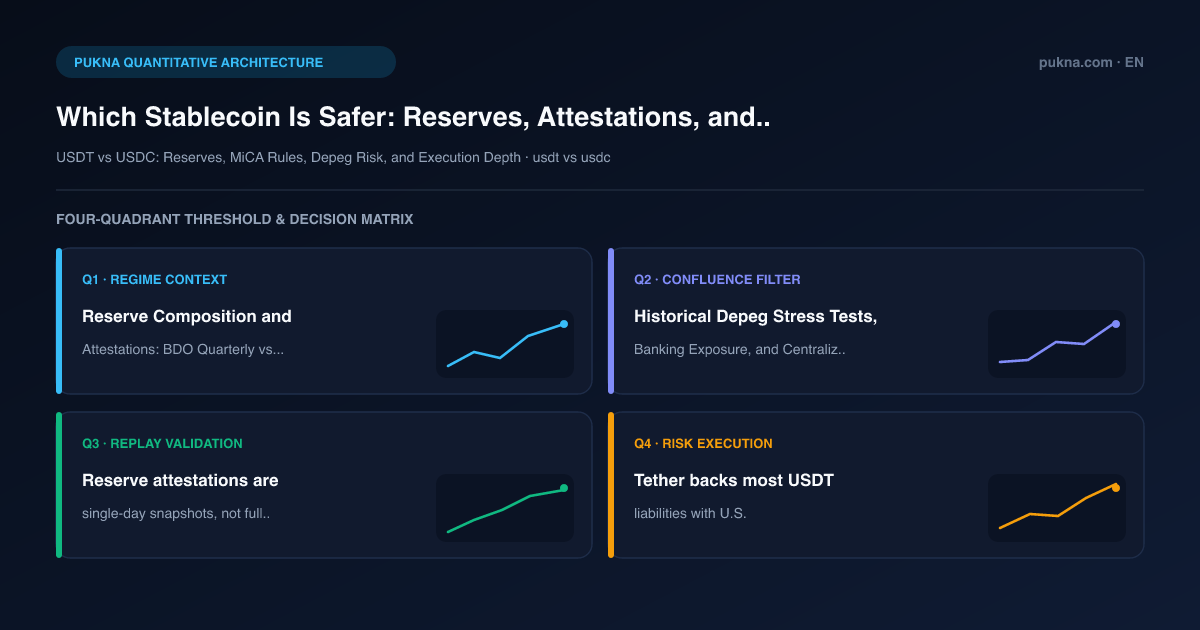
Safety Verdict: USDC limits asset-mix risk through weekly disclosures and monthly Deloitte attestations, while USDT backs its float with larger excess equity cushions and deeper crisis liquidity. Neither issuer provides a full PCAOB financial statement audit. Safety depends on which shock strikes first.
Reserve Composition and Attestations: BDO Quarterly vs. Deloitte Monthly
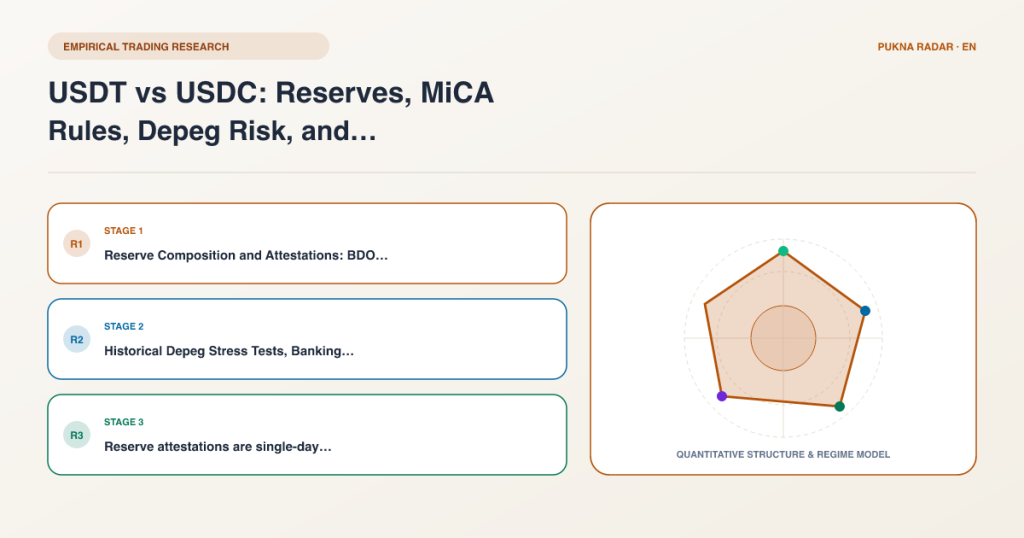
Reserve attestations are single-day snapshots, not full audits. Circle holds the bulk of USDC reserves in short-dated U.S. Treasury bills and overnight reverse repos inside the SEC-registered, BlackRock-managed Circle Reserve Fund, alongside cash at regulated banks. Weekly snapshots and monthly Deloitte reports under AICPA rules keep that backing visible.
Tether backs most USDT liabilities with U.S. Treasury bills and cash equivalents, supplemented by smaller sleeves in secured loans, precious metals, Bitcoin, and corporate investments verified quarterly by BDO Italia. Multi-billion-dollar excess equity above issued liabilities buffers asset volatility, though quarterly reporting leaves wider blind spots. Reporting cadence matters when markets crack.
An attestation confirms reserve balances on one cut-off date. Unlike a full PCAOB financial statement audit, it never examines year-round cash flows, internal accounting controls, or interim balance shifts between reporting timestamps. Check reserve liquidity and disclosure cadence directly instead of treating an attestation like a bank audit.
Two Common Stablecoin Myths Clarified:
- Attestation vs. Full Audit: Monthly Deloitte and quarterly BDO reports confirm reported reserves exceeded token liabilities on a single cut-off date; they do not equal an audited GAAP/PCAOB annual financial statement.
- USDT/USDC vs. Fiat USD: Eligible U.S. bank deposits carry FDIC insurance up to statutory limits. Holding a 1:1 on-chain dollar token carries issuer, bank-custodian, smart-contract, and secondary-market basis risk instead.
Historical Depeg Stress Tests, Banking Exposure, and Centralized Freeze Risk
Domestic regulation never erased USDC tail risk—it relocated it. During calm sessions, both stablecoins trade within a few basis points of $1.00 and reserve differences look purely academic across spot books. Real stress regimes expose opposite breaking points.
The March 2023 Silicon Valley Bank (SVB) collapse proved how fast bank contagion hits on-chain dollars. Once SVB failed over a weekend with $3.3 billion of Circle’s cash locked inside, redemption wires froze and USDC dropped near $0.87 on secondary markets. Desks rotated straight into offshore USDT, pushing it above $1.00 until Monday federal backstops restored parity.
Crypto-native panics and regulatory headlines hit USDT along a different vector. Across past exchange blowups and historical New York and CFTC settlements, USDT printed brief 0.5% to 2% secondary-market discounts before institutional arbitrageurs closed the spread. Both issuers also embed smart-contract blacklists for lawful freezes, leaving zero censorship resistance.
How Do EU MiCA Rules and Institutional Payment Rails Divide USDT and USDC?
Regulatory Verdict: Regulation divides stablecoins by jurisdiction rather than eliminating either rail. Circle’s EU MiCA Electronic Money Token (EMT) license protects compliant European exchange listings and Western fintech corridors, while Tether commands offshore derivatives liquidity. Geography now sets your default dollar rail.
EU MiCA Authorization and U.S. Institutional Payment Integrations
Europe’s MiCA rules drew a hard compliance border. Fiat-backed stablecoins on regulated European Economic Area (EEA) platforms require Electronic Money Token authorization alongside mandated cash reserves inside EU credit institutions. Circle secured French EMI approval for USDC, keeping European spot listings and payment corridors open.
Unlicensed tokens face delistings or trading curbs across compliant European venues, pushing EEA retail and institutional accounts toward USDC or euro-denominated books. U.S. regulated venues, corporate treasuries, and payment processors like Stripe and Visa follow the same playbook because audit committees approve Big Four monthly paper far faster than offshore filings.
Offshore Exchange Dominance, Emerging Markets, and Where USDG Fits
Offshore liquidity rarely moves just because regulators redraw borders. Exchanges across Asia, Latin America, Africa, and Eastern Europe continue quoting spot and linear perpetual books primarily in USDT, while local OTC desks and remittance corridors default to TRC-20 USDT where counterparties hold balances. Liquidity network effects compound slowly.
| Region / Ecosystem | Primary Stablecoin Rail | Regulatory & Operational Reality |
|---|---|---|
| European Economic Area (EEA) | USDC (MiCA EMT Authorized) | Compliant exchanges restrict non-EMT stablecoins; USDC maintains full spot, custody, and payment access. |
| United States Institutional | USDC | Preferred by U.S.-regulated venues, corporate finance teams, and auditors requiring monthly Deloitte attestations. |
| Global Offshore Derivatives | USDT | Anchors the majority of spot volume, linear perpetual margin, and altcoin market-making inventory. |
| Fintech & Payment Networks | USDC | Integrated into Stripe merchant payouts, Visa settlement workflows, and programmable corporate APIs. |
| Emerging Markets (LatAm, Africa, SEA) | USDT (TRC-20 Led) | Functions as high-velocity informal dollar liquidity for remittances, OTC trade, and savings hedges. |
Paxos’s Global Dollar (USDG) targets the middle ground between Western oversight and exchange economics. USDG pairs Singapore regulatory supervision with partner revenue sharing designed to reward exchanges and fintech distributors, yet its circulating float and secondary order-book depth still trail USDT and USDC widely. Rebates buy listings, not deep books.
Why Does Exchange Execution Liquidity Cluster in USDT Despite Multi-Chain Fees?
Execution Verdict: Active traders quote in USDT because deep order books cut market-impact costs far more than minor gas savings ever recover. Across major spot and perpetual pairs, USDT posts narrower bid-ask spreads and denser resting bids than USDC. Transfer costs belong to your blockchain rail, not the ticker.
Order Book Depth, Slippage, and Perpetual Margin Mechanics
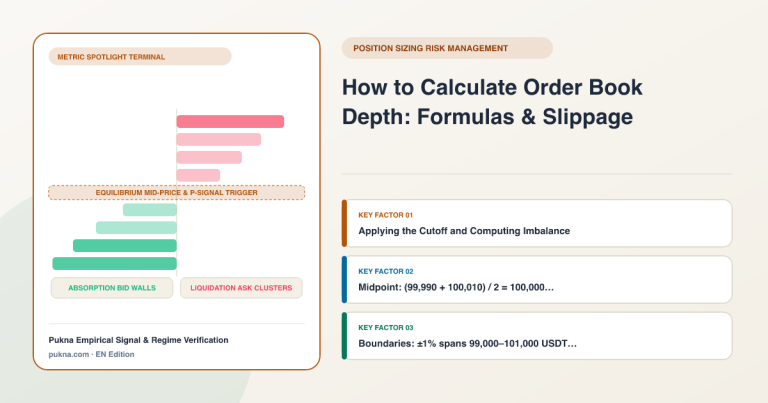
Execution quality cracks first on thin quote pairs. Global market makers pool inventory in USDT-margined linear perpetuals and spot books so one unified collateral balance covers BTC/USDT, ETH/USDT, and dozens of mid-cap altcoins with lower slippage on size. Capital efficiency keeps inventory anchored there.
USDC books hold up on U.S. venues and top DeFi pools, yet thin offshore altcoin pairs distort tape. Shallow resting depth amplifies stop clusters into violent liquidity sweeps (stop-hunt wicks) beyond a session VWAP deviation band, trapping early mean-reversion fades across mid-cap books. Cross-check USDT perpetuals alongside open interest and funding rate filters first, since basis shifts price there before thin pairs react. Thin books breed fake breakouts.
Fragmented quote pairs corrupt systematic models with artificial wicks. That market-structure constraint explains why Pukna’s 42-pair (15m/1h/4h/1d) causal signal feed screens 42 mainstream USDT trading pairs across four timeframes instead of noisy secondary quote books. Each bar-level causal buy or sell signal pairs with a 0–100 relative P-score measuring combined peak return and final return over the horizon_bars forecast window. Here, 50 marks the neutral candle baseline—relative return quality, never a win-rate probability. Deep USDT books keep structure honest.
Network Transfer Fees Across Tron, Ethereum, Solana, Arbitrum, and Base
Your chosen blockchain sets transfer costs, not the issuer ticker. Ethereum mainnet gas spikes hit both ERC-20 USDT and ERC-20 USDC whenever volatility surges across spot and derivatives venues. Compare Layer 1 and Layer 2 fee mechanics and the routing split stands out immediately: Tron (TRC-20) leads cheap offshore USDT flows, whereas Solana, Arbitrum, and Base anchor low-cost USDC settlement.
| Network / Standard | Token Availability | Typical Transfer Cost | Settlement Speed | Primary Execution Role |
|---|---|---|---|---|
| Ethereum (ERC-20) | Native USDT & Native USDC | Variable ($0.50–$10+ during congestion) | ~12–60 seconds | Institutional custody, large treasury wires, mainnet DeFi |
| Tron (TRC-20) | Native USDT dominant; native USDC minting discontinued | Low–Moderate (~$1–$3 exchange fee) | ~3–15 seconds | Offshore exchange funding and emerging-market transfers |
| Solana (SPL) | Native USDC & Native USDT | Sub-cent (<$0.01) | <2 seconds | High-speed DeFi routing, payments, and retail transfers |
| Arbitrum (L2) | Native USDC & Native USDT | Cents (~$0.01–$0.05) | ~1–3 seconds | On-chain perpetual DEX margin and EVM liquidity pools |
| Base (L2) | Native USDC dominant | Sub-cent (~$0.005–$0.02) | ~2 seconds | Fintech settlement, low-cost retail transfers, Stripe/Coinbase rails |
Hidden conversion markups cost far more than chain gas. Instant-buy retail widgets often bury 0.5% to 1.5% spreads inside quoted fiat rates, silently taxing every entry before you trade. Wire funds to an order-book exchange, buy USDC near zero fee where offered, and convert to USDT via a limit order on a deep USDC/USDT book. Always verify exact chain support before withdrawing.
Can You Stake USDT or USDC, and How Do Supply Flows Signal Macro Regimes?
Yield & Liquidity Verdict: Neither USDT nor USDC supports native Proof-of-Stake staking. Advertised APYs pay you for leveraged borrowing demand, pool fees, or Treasury wrappers carrying real counterparty risk, while net supply flows and peg spreads act as live macro regime gauges. Never confuse lending risk with protocol staking.
Lending Yield Sources, Borrower Demand, and Counterparty Risk
Exchanges label stablecoin lending “staking” purely for marketing convenience. Proof-of-Stake validators lock native network assets like ETH or SOL to secure consensus and earn issuance, whereas dollar stablecoins secure zero blockchains. Any 5% to 15% APY on USDT or USDC pays you for funding leveraged margin borrowers or carrying platform credit risk.
Borrowing yields split along the exact same liquidity divide. Offshore USDT lending rates jump during leveraged rallies as perpetual funding climbs and traders borrow dollars to expand margin, whereas USDC anchors institutional DeFi money markets and tokenized Treasury wrappers with steadier, lower-volatility returns. Higher stablecoin APY always prices in higher leverage or credit risk.
| Yield Channel | Underlying Return Source | Primary Risk Exposure |
|---|---|---|
| CeFi Exchange Earn | Margin borrower demand and institutional lending desks | Platform insolvency, collateral rehypothecation, and withdrawal freezes |
| DeFi Lending Pools (Aave, Compound) | Algorithmic over-collateralized crypto borrowing demand | Smart-contract exploits, oracle lag, and bad debt during flash crashes |
| Treasury-Backed Yield Products | Short-dated U.S. Treasury bills via regulated tokenized wrappers | KYC transfer restrictions, issuer terms, and rate-cut yield compression |
Reading Stablecoin Mint-Burn Netflows and Micro Peg Basis Across Market Regimes
Raw stablecoin supply prints mislead traders who ignore macro context. In a balanced accumulation regime, steady positive stablecoin mint-burn netflow and rising dry powder velocity alongside neutral perpetual funding signal fresh spot purchasing power absorbing overhead supply sustainably. That exact same inflow turns bearish inside an overheated tape.
Watch how that signal flips during late-stage euphoria. Rapid USDT minting paired with steep perpetual basis, crowded crypto sentiment and risk-appetite readings, and a compressed implied volatility vs. realized volatility (VRP) spread signals leveraged chase flow rather than durable spot accumulation. Under real yield headwinds and a tightening dollar liquidity impulse, late inflows often become exit liquidity right before forced liquidations.
Track live USDT/USDC peg spreads during stress windows too. A brief USDT premium above $1.001 during banking headlines signals capital fleeing regulated bank rails. Conversely, a USDT discount coinciding with spiking implied volatility DVOL pricing on Deribit ahead of macro prints or Friday 08:00 UTC options expiry flags offshore collateral strain. One flow metric reverses meaning across regimes.
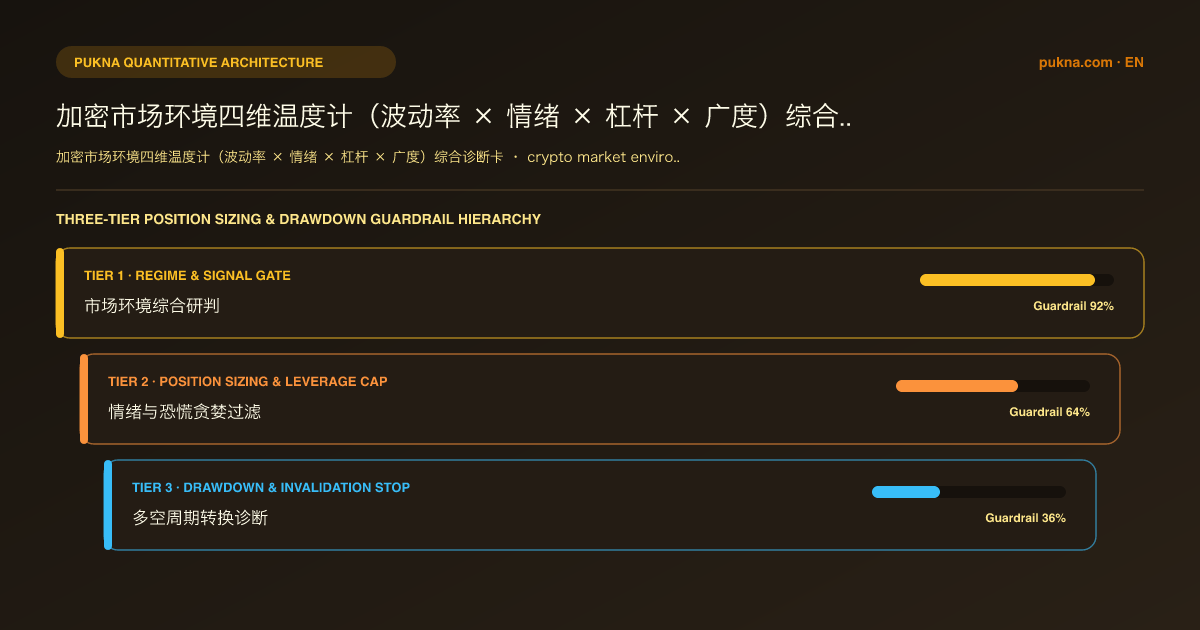
| Environment Pillar | Overheated / Fragile Zone | Balanced Constructive Zone | Capitulation / Value Zone |
|---|---|---|---|
| Volatility (DVOL & VRP) | Compressed DVOL masking catalyst risk or erratic spikes into options expiry | Stable implied-to-realized spread supporting orderly trend discovery | Panic DVOL surge as forced hedgers overpay for downside protection |
| Sentiment & Crowding | Euphoric readings paired with aggressive retail chase inflows | Balanced sentiment with steady dip absorption on spot order books | Extreme fear paired with defensive stablecoin hoarding on sidelines |
| Perpetual Leverage | Elevated funding rates, steep perpetual basis, and crowded open interest | Neutral-to-modest funding with spot-led open interest expansion | Negative funding rates and flushed open interest after liquidations |
| Liquidity & Breadth | Narrow leadership as late USDT inflows chase stretched altcoin beta | Broad spot participation backed by sustained net stablecoin minting | Shrinking dry-powder velocity and defensive flight toward BTC and cash |
How to Split Capital Between USDT and USDC with Pre-Trade Risk Guardrails
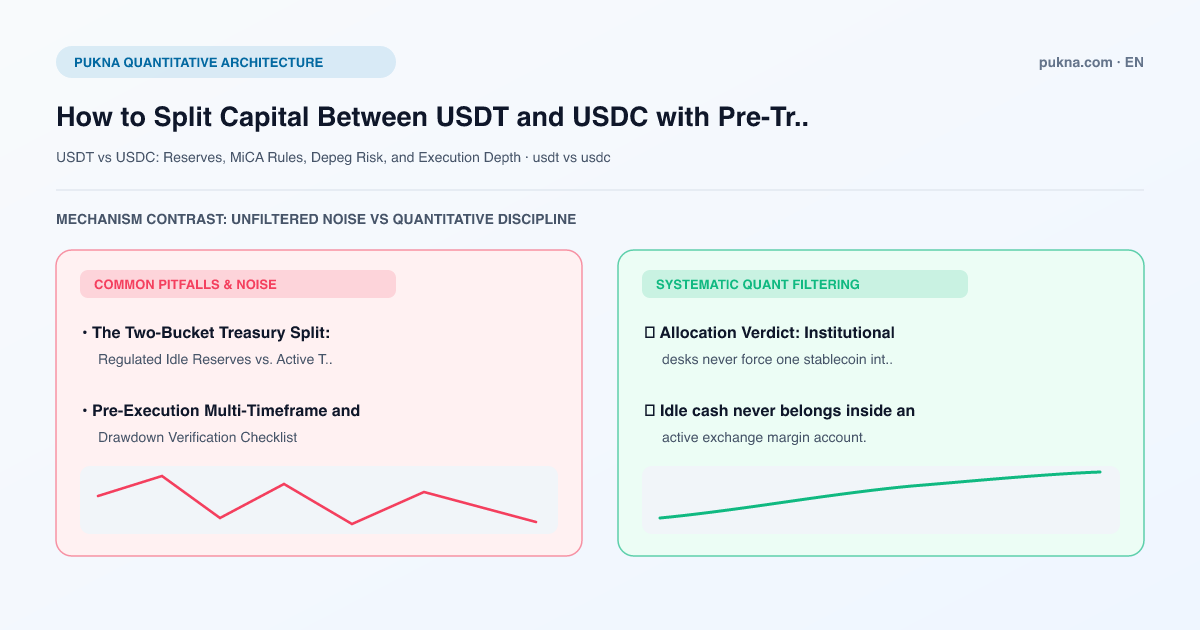
Allocation Verdict: Institutional desks never force one stablecoin into every role. Split capital into two functional buckets: hold idle reserves, tax cash, and regulated off-ramps in USDC or insured bank USD, while funding active exchange margin with USDT. Verify macro regimes and strategy drawdowns before sizing up.
The Two-Bucket Treasury Split: Regulated Idle Reserves vs. Active Trading Margin
Idle cash never belongs inside an active exchange margin account. Bucket One protects capital you are not deploying today by holding long-term dry powder, tax cash, and fiat-settlement balances in USDC across regulated custody, hardware wallets, or FDIC-insured bank accounts. Keep operational reserves ring-fenced.
Bucket Two powers live execution across global order books. Fund spot and perpetual accounts strictly with USDT sized to your defined risk budget, capturing deeper books and tighter spreads without parking excess wealth offshore. Never leave a full year of operating cash sitting on one exchange.
Pre-Execution Multi-Timeframe and Drawdown Verification Checklist
The right stablecoin never rescues a badly timed trade. Perpetual funding and open interest never move in isolation; policy rates (EFFR), U.S. dollar liquidity (DXY), aggregate sentiment, and options implied volatility (DVOL and Put/Call skew) set the true sizing boundary. Map that top-down chain before committing margin.
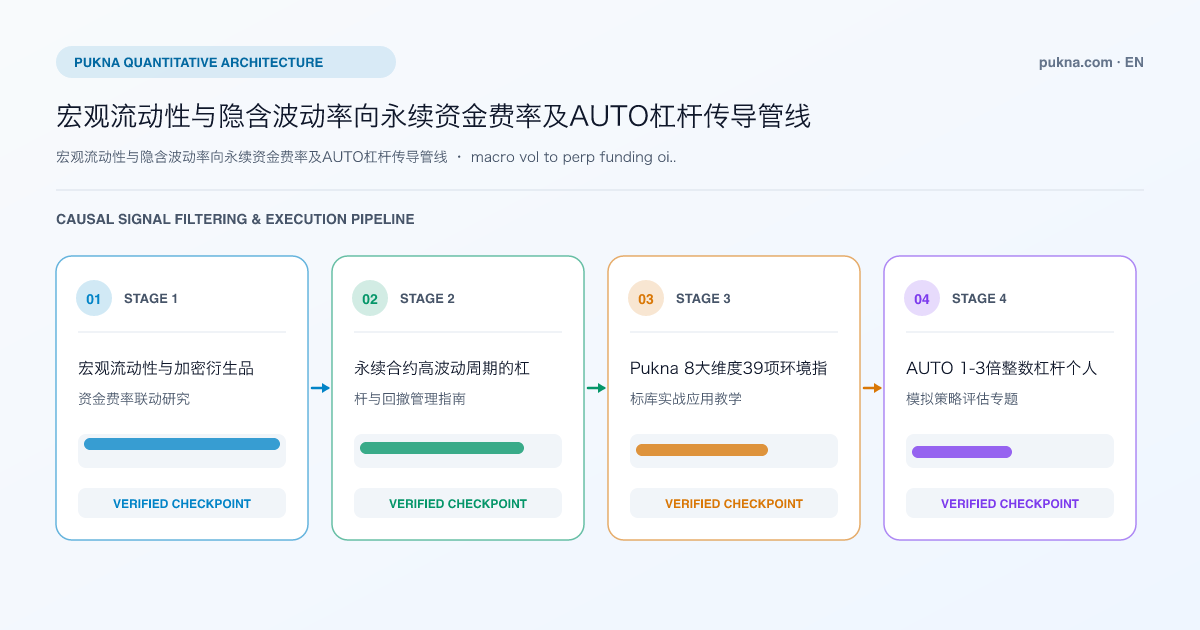
Top-Down Macro & Volatility to Perpetual Funding Execution Pipeline
- Stage 1 · Macro Liquidity BaselineTrack policy rate expectations (EFFR), dollar strength (DXY), and net stablecoin mint-burn flows to classify liquidity tailwinds versus headwinds.
- Stage 2 · Implied Volatility & Options PricingCompare Bitcoin implied volatility (DVOL) and Put/Call ratios against realized volatility to flag expensive event hedges ahead of macro releases or Friday 08:00 UTC expiries.
- Stage 3 · Perpetual Crowding & Causal Signal GatingCross-check funding rates and open interest, then filter 15m–1d USDT setups using bar-level causal signals and relative P quality scores (0–100; 50 = neutral candle baseline for combined peak and final return over horizon_bars, never win rate).
- Stage 4 · 1x–3x AUTO Drawdown Audit & ExecutionAudit historical equity curves, win rates, and maximum drawdowns inside 1x–3x integer-leverage AUTO personal simulations before enabling live alerts.
Sound logic on paper never guarantees survivable live execution. Run these five pre-trade checks before deploying active margin:
- Lock In Jurisdiction, Rail, and Bucket Caps: Confirm local compliance rules (including EU MiCA), cap offshore USDT balances at active margin limits, and verify exact transfer chains before withdrawing.
- Check the 39-Indicator Regime Filter First: Cross-check macro, interest-rate, liquidity, sentiment, derivatives, and on-chain context inside Pukna’s 8-dimension, 39-indicator environment library—paired with its 43-token research library—before expanding beta exposure.
- Sequence Timeframes from 1d Down to 15m: Set directional bias on 1d candles, map structural levels on 4h and 1h charts, and time entries on 15m bars instead of chasing lower-timeframe noise.
- Filter Setups by Relative P-Score Quality: Screen candidate setups across 42 USDT pairs using bar-level causal signals and their 0–100 relative P-score. Remember that 50 is the neutral benchmark of surrounding ordinary candles for combined peak and final return over
horizon_bars—never a win-rate percentage. - Run a 1x–3x AUTO Max-Drawdown Audit First: Backtest your pair and rules inside Pukna AUTO personal simulation strategies at 1x, 2x, or 3x integer leverage before going live. Audit historical equity curves, win rates, and maximum drawdowns, and subscribe to real-time push alerts only when historical drawdown fits your risk ceiling.
Frequently Asked Questions: USDT vs. USDC
Which Is Safer to Hold Long-Term: USDT or USDC?
USDC carries narrower asset-mix risk and clearer long-term transparency because Circle holds cash and short-dated U.S. Treasuries backed by weekly disclosures, monthly Deloitte attestations, and EU MiCA approval. Even so, USDC’s brief drop to $0.87 during the March 2023 SVB collapse proved bank concentration creates real tail risk. Split idle cash across USDC and FDIC-insured bank USD.
Why Do Most Active Trading Pairs Quote in USDT Instead of USDC?
Global spot and perpetual venues quote primarily in USDT because market makers pool inventory and cross-margin collateral in one shared settlement token. With over $183 billion in circulating supply and 55% to 60% stablecoin share, USDT supports deeper order books and tighter bid-ask spreads across spot and perpetual pairs. That depth cuts slippage on size.
Which Has Lower Transfer Fees: USDT or USDC?
Neither ticker is inherently cheaper because your chosen blockchain rail drives gas fees. Ethereum Layer 1 transfers incur volatile gas spikes on either token during busy sessions, whereas offshore USDT clears cheaply on Tron (TRC-20) and USDC settles for pennies or less across Solana, Base, and Arbitrum.
How Are USDT and USDC Different from Holding Fiat USD?
Fiat dollars inside eligible U.S. banks carry FDIC deposit insurance but settle only during banking hours. USDT and USDC move 24/7 on public blockchains with programmable transferability, yet both lack FDIC protection and restrict direct 1:1 redemption to verified institutional desks. Both centralized issuers can also freeze targeted wallet addresses upon lawful enforcement requests.
Put this into practice
Create a free account to browse live signals and test your own rules.