Contents7 sections
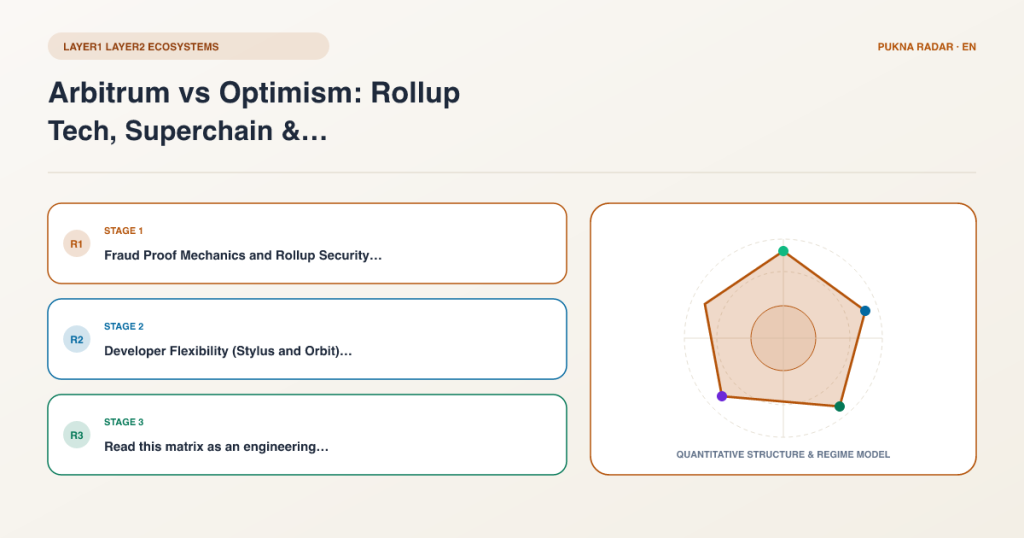
- Arbitrum vs. Optimism at a Glance: Architecture, Liquidity, and Ecosystem Verdict
- Vertical DeFi Liquidity vs. Horizontal Superchain Federation
- Executive Comparison Matrix: Arbitrum One vs. OP Mainnet and Superchain
- How Do Arbitrum Nitro and Stylus Compare With OP Stack and Cannon?
- Fraud Proof Mechanics and Rollup Security Trade-Offs
- Developer Flexibility (Stylus and Orbit) vs. Standardized Modularity (OP Stack)
- Which Layer 2 Has Lower Fees and Faster Finality After EIP-4844?
- Why Post-Blob Swap Fees Converged — and When Costs Still Diverge
- Bridge Finality, Sequencer Dependency, and Nova vs. Rollup Security
- How Do Base, Polygon, and Incentives Reshape the Arbitrum vs. Optimism Split?
- Single-Chain DeFi Capital vs. Federated Superchain Distribution
- Where Base, Polygon, and Grant Models Fit in the L2 Trade-Off
- Why Do ARB and OP Tokenomics Decouple From Layer 2 Network Growth?
- Supply Unlocks, FDV Overhang, and the Governance-Only Capture Gap
- Token Supply Structure vs. Market Depth Four-Quadrant Matrix
- Why L2 Token Valuations Require Macro and Liquidity Regime Filtering
- Decision Framework: Choosing Between Arbitrum and Optimism in Practice
- Selection Criteria for DeFi Traders, Protocol Builders, and App Teams
- Pre-Allocation Risk and Multi-Timeframe Verification Workflow
- Frequently Asked Questions
Arbitrum and Optimism are Ethereum optimistic rollups that settle execution batches to Layer 1 and collect gas in ETH, splitting cleanly between single-chain depth and Superchain federation. Once Ethereum’s EIP-4844 blob upgrade compressed standard swaps into a $0.01–$0.10 band on both networks, Arbitrum One kept Ethereum’s deepest standalone DeFi liquidity while Optimism scaled horizontally through OP Stack rollups like Base. Raw chain TVL alone never clears unlock overhang or tight liquidity.
Key Takeaways
- Topology split: Arbitrum concentrates DeFi depth on Arbitrum One alongside Stylus and Orbit L3s, whereas Optimism federates modular OP Stack chains.
- Fee convergence: EIP-4844 blob pricing pushed standard swaps to $0.01–$0.10 on both rollups, ending basic gas cost as a standalone tiebreaker.
- TVL distortion: Analysts who lump Base, Unichain, and World Chain traffic into OP Mainnet liquidity misprice both networks.
- Token capture gap: Users pay L2 gas in ETH, leaving ARB and OP as high-beta Ethereum liquidity proxies exposed to unlock dilution.
Arbitrum vs. Optimism at a Glance: Architecture, Liquidity, and Ecosystem Verdict
Arbitrum leads Ethereum’s single-chain DeFi liquidity race through Arbitrum One, whereas Optimism leads federated horizontal scaling across the OP Stack Superchain powering Base and partner rollups. Both networks settle to Ethereum and collect transaction gas strictly in ETH rather than ARB or OP.
Vertical DeFi Liquidity vs. Horizontal Superchain Federation
Many surface-level guides still treat Arbitrum and Optimism as identical clones fighting for the same order flow. That framing fails fast. Offchain Labs built Arbitrum around deep vertical liquidity on Arbitrum One, then layered on Stylus multi-language contracts, Orbit Layer 3 chains, and Nova for low-cost social apps.
OP Labs prioritized horizontal standardization over single-chain concentration from the outset. Rather than funneling every application onto OP Mainnet, Optimism open-sourced the modular OP Stack so independent operators can deploy interoperable Ethereum rollups. Coinbase’s Base proved that blueprint at consumer scale while remitting sequencer revenue back to the Optimism Collective.
Practical stack selection splits along concrete execution bottlenecks rather than tribal loyalty. Size-sensitive DeFi traders and Rust or C++ engineers gravitate toward Arbitrum One and Stylus, whereas consumer app teams targeting standardized EVM distribution build inside the OP Stack Superchain.
Executive Comparison Matrix: Arbitrum One vs. OP Mainnet and Superchain
| Core Dimension | Arbitrum (Arbitrum One / Orbit / Nova) | Optimism (OP Mainnet / OP Stack Superchain) |
|---|---|---|
| Rollup Stack & VM | Arbitrum Nitro (WASM execution) plus Stylus supporting Rust, C, and C++ alongside Solidity. | Modular OP Stack engineered for strict Ethereum EVM equivalence across member chains. |
| Fault Proof Design | Multi-round interactive fraud proofs bisecting disputes to a single instruction on Ethereum L1. | Cannon MIPS-based fault-proof system built for repeatable Superchain interoperability. |
| Scaling Topology | Vertical single-chain liquidity core (Arbitrum One) plus customizable Orbit L3s and Nova. | Horizontal federation linking OP Mainnet, Base, Unichain, World Chain, and peer rollups. |
| Typical Post-Dencun Swap Fee | Roughly $0.01–$0.10 on Arbitrum One; sub-cent on Nova via AnyTrust committee. | Roughly $0.01–$0.10 on OP Mainnet and peer OP Stack rollups under normal blob load. |
| Single-Chain TVL vs. Reach | Deepest standalone single-chain DeFi TVL and derivatives liquidity among Ethereum L2s. | Smaller standalone OP Mainnet TVL, offset by wide aggregate Superchain transaction reach. |
| Flagship Protocols & Chains | GMX, Camelot, Uniswap, Aave, plus specialized Orbit L3 application chains. | Velodrome, Synthetix, Aerodrome (via Base), Base, Unichain, and World Chain. |
| Native Token Role | ARB governs Arbitrum DAO upgrades and treasury grants; gas is paid in ETH. | OP governs Optimism Collective upgrades and RetroPGF grants; gas is paid in ETH. |
| Primary Structural Risk | Governance-only fee capture gap, unlock supply overhang, and Orbit liquidity fragmentation. | OP Mainnet liquidity dilution across Superchain peers and ongoing OP emission pressure. |
Read this matrix as an engineering blueprint, not a buy list. Heavy sequencer traffic routinely coexists with steep governance-token unlock schedules across both Layer 2 networks. Before pricing either asset, inspect the virtual machine and fault-proof architectures that drove this structural divergence.
How Do Arbitrum Nitro and Stylus Compare With OP Stack and Cannon?
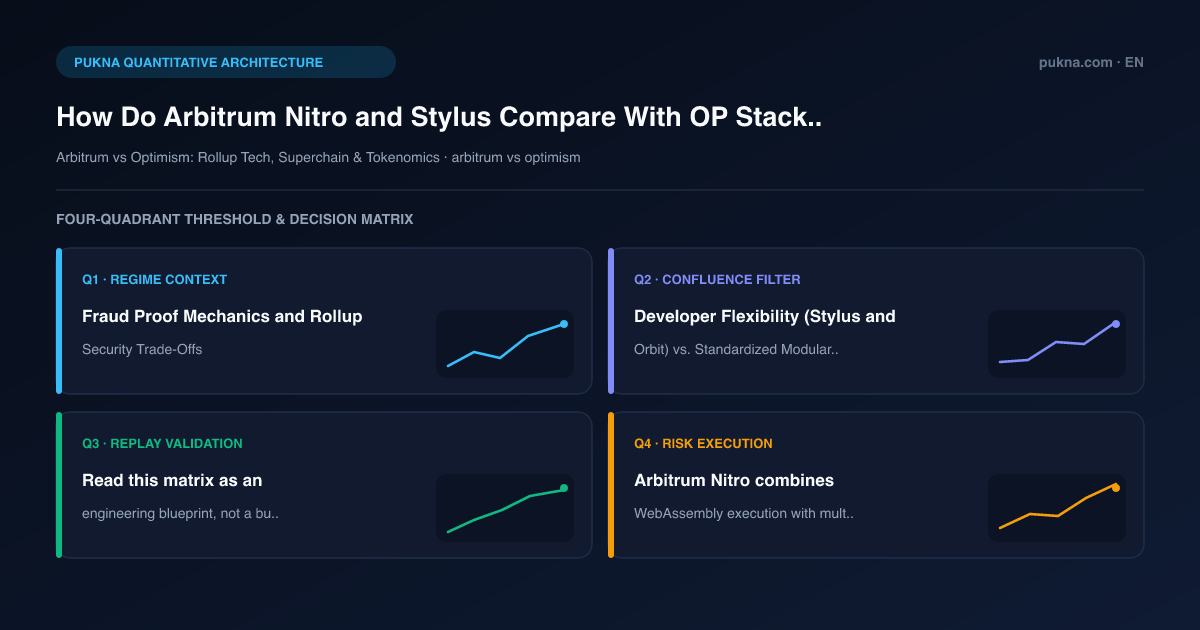
Arbitrum Nitro combines WebAssembly execution with multi-round interactive fraud proofs and Rust, C, and C++ compilation via Stylus, while Optimism’s OP Stack enforces strict EVM equivalence alongside Cannon fault proofs. Both inherit Ethereum settlement security, yet each optimizes for a distinct engineering constraint.
Fraud Proof Mechanics and Rollup Security Trade-Offs
Optimistic rollups assume posted state roots are valid unless a verifier challenges a faulty state transition during the dispute window. Dispute mechanics split the two stacks sharply. Arbitrum runs multi-round interactive bisection to isolate a single contested WebAssembly instruction before executing final verification on Ethereum Layer 1.
Interactive bisection keeps Layer 1 verification gas low even during complex smart-contract disputes. Optimism upgraded OP Mainnet to Cannon, a MIPS-based fault-proof system engineered for repeatable rollout across OP Stack chains. Because both rollups retain multisig security-council failsafes, check Layer 1 vs. Layer 2 security and fee mechanics to weigh those trust bounds against Ethereum settlement.
Neither rollup operates a permissionless decentralized sequencer yet. Centralized sequencers order transactions in fractions of a second, yet any sequencer outage stalls soft confirmations until operators restore liveness. Both networks expose Layer 1 force-inclusion queues, though fallback transactions cost far more and settle slower under peak stress.
Developer Flexibility (Stylus and Orbit) vs. Standardized Modularity (OP Stack)
Arbitrum Stylus removes the Solidity-only execution ceiling on Ethereum optimistic rollups. Engineers compile Rust, C, and C++ contracts into WebAssembly that share state natively with standard Solidity contracts on Arbitrum One. Compute-heavy cryptography, custom orderbook matching, and quantitative pricing loops consume far less memory than pure EVM bytecode.
Arbitrum widens that customization lane through Orbit Layer 3 chains with bespoke gas tokens and Arbitrum Nova for high-throughput gaming or social traffic. Nova delegates data availability to an external AnyTrust committee instead of posting full payloads to Ethereum blobs. Desks must price that weaker trust model explicitly.
Optimism makes the opposite engineering trade by locking every OP Stack deployment to strict EVM equivalence. Builders porting contracts across OP Mainnet, Base, or Unichain reuse standard Ethereum execution clients and tooling without rewrites. Standardized modularity trades custom virtual machines for unified Superchain upgrades.
Which Layer 2 Has Lower Fees and Faster Finality After EIP-4844?
Standard token swaps cost roughly $0.01–$0.10 on both Arbitrum One and OP Mainnet after Ethereum’s EIP-4844 blob upgrade. Raw transfer cost no longer breaks the tie. Practical fee and UX gaps now appear only during blob-market spikes, sub-cent Nova workloads, or canonical Layer 1 exits.
Why Post-Blob Swap Fees Converged — and When Costs Still Diverge
Pre-Dencun comparisons routinely cited half-dollar fee spreads between Arbitrum One and OP Mainnet. EIP-4844 ended that spread. Dedicated blob space decoupled Layer 2 data-availability pricing from Ethereum Layer 1 execution calldata, compressing routine swaps and token approvals into pennies on both optimistic rollups.
Fee spreads reappear whenever aggregate Layer 2 throughput pushes past Ethereum’s per-block blob target. Blob base fees then reprice abruptly across every full rollup competing for Ethereum data availability. During those congestion bursts, Arbitrum’s tighter calldata compression and Stylus execution trim gas on complex DeFi routers while plain ETH transfers stay nearly tied.
| Network Rail | Typical Swap Fee Band | Soft Confirmation UX | Canonical L1 Withdrawal | Data Availability Model |
|---|---|---|---|---|
| Arbitrum One | $0.01–$0.10 (normal blob load) | Sub-second via sequencer | ~7-day challenge window | Full Ethereum L1 blobs / calldata |
| OP Mainnet | $0.01–$0.10 (normal blob load) | Sub-second via sequencer | ~7-day challenge window | Full Ethereum L1 blobs / calldata |
| Base (OP Stack) | $0.01–$0.10 (normal blob load) | Sub-second via sequencer | ~7-day challenge window | Full Ethereum L1 blobs / calldata |
| Arbitrum Nova | Sub-cent ($<0.01 typical) | Sub-second via sequencer | ~7-day challenge window | AnyTrust DAC (lower L1 trust) |
| Ethereum L1 | Multi-dollar, highly variable | ~12-second block slots | Native Layer 1 finality | Ethereum validator consensus |
Bridge Finality, Sequencer Dependency, and Nova vs. Rollup Security
Snappy UX on both rollups reflects sequencer soft confirmations rather than settled Ethereum finality. Fast execution hides a strict exit constraint. Pull funds back to Layer 1 through either canonical bridge, and capital stays locked across a roughly 7-day challenge window so verifiers can contest invalid state roots.
Active traders sidestep that 7-day lock using third-party liquidity bridges or centralized exchange rails, paying narrow spreads for near-instant settlement. Never equate Arbitrum Nova’s sub-cent fees with Arbitrum One’s rollup security. Once basic fees converge near pennies, liquidity gravity and distribution partnerships decide where capital settles.
How Do Base, Polygon, and Incentives Reshape the Arbitrum vs. Optimism Split?
Arbitrum One dominates single-chain DeFi depth across perpetuals, lending, and DEX routing, whereas Optimism captures wider multi-chain transaction reach through OP Stack members led by Coinbase’s Base. OP Mainnet’s standalone TVL tells only half the story.
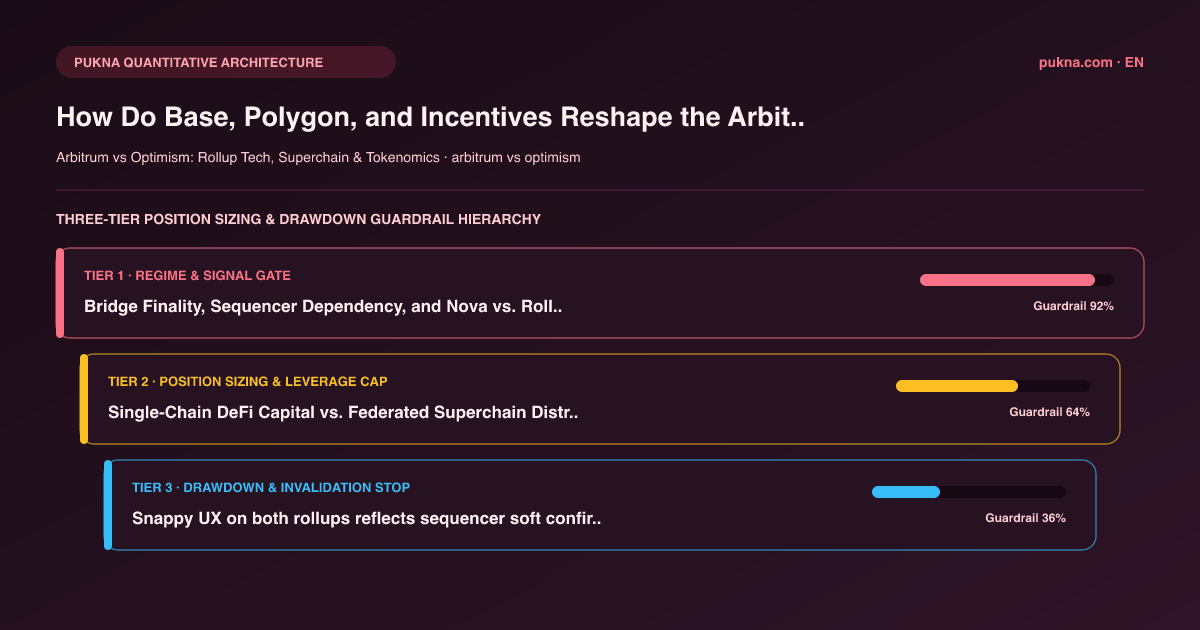
Single-Chain DeFi Capital vs. Federated Superchain Distribution
Audit standalone chain liquidity first, then measure federated network reach on a separate ledger. Inside one execution environment, Arbitrum One remains Ethereum’s deepest Layer 2 venue for capital-intensive DeFi protocols including GMX, Camelot, Uniswap, and Aave. Concentrated pools eliminate bridge hops and hold execution slippage tighter on institutional order size.
Standalone OP Mainnet TVL misses Optimism’s real distribution engine. Coinbase launched Base on the OP Stack alongside Unichain, World Chain, and peer chains that share standardized upgrades and remit sequencer revenue to the Optimism Collective. Optimism trades single-chain concentration for horizontal exchange-backed consumer scale across partner rollups.
Headline DEX volume rankings also mask execution fragility across every Ethereum Layer 2. Concentrated-liquidity AMMs routinely experience just-in-time (JIT) liquidity sniping & LP fee dilution, where single-block MEV bots harvest swap fees without holding multi-block inventory risk. Once short-term token grants expire, mercenary volume vanishes fast.
| Ecosystem Tier | Liquidity Topology | Primary Distribution Edge | Incentive Architecture | Core Strategic Trade-Off |
|---|---|---|---|---|
| Arbitrum One (+ Orbit/Nova) | Concentrated single-chain DeFi hub with custom L3 extensions. | Deep on-chain derivatives, DEX routing, and Stylus builders. | Arbitrum DAO targeted grant waves (STIP / LTIPP). | Incentive-driven TVL can rotate once grant streams taper. |
| OP Mainnet | Moderate standalone DeFi base anchored by Synthetix and Velodrome. | Original flagship reference chain for OP Stack governance. | Optimism Retroactive Public Goods Funding (RetroPGF). | Standalone liquidity competes directly with sibling OP Stack chains. |
| OP Stack Superchain (Base, Unichain, World Chain) | Federated multi-chain liquidity linked by shared OP Stack standards. | Direct Coinbase retail onboarding on Base plus brand-native apps. | Shared sequencer revenue remitted to Optimism Collective. | Cross-chain liquidity stays fragmented until native interop matures. |
| Polygon (PoS & zkEVM) | Multi-architecture ecosystem spanning PoS sidechain and ZK scaling. | Enterprise partnerships, payments rails, and long-standing consumer apps. | Ecosystem grants and AggLayer unified liquidity roadmap. | Sits outside the optimistic rollup model with distinct security assumptions. |
Where Base, Polygon, and Grant Models Fit in the L2 Trade-Off
Grant designs dictate which protocols survive low-volume bear markets without draining treasuries. Arbitrum DAO deploys targeted liquidity and builder incentives through structured waves like STIP and LTIPP to deepen Arbitrum One pools. Optimism leans on Retroactive Public Goods Funding (RetroPGF), rewarding open-source tooling and core infrastructure teams after verified delivery.
Base and Polygon reshape the Ethereum scaling map from opposite ends. Base runs inside Optimism’s Superchain without a native token, routing Coinbase retail balances straight onto OP Stack contracts. Polygon sits outside the optimistic rollup lane altogether, spanning Polygon PoS and zero-knowledge rails for consumer payments and enterprises.
Capital rarely stays parked in one Layer 2 narrative across a full cycle. Cross-check altcoin rotation cycles and 90-day lag traps before chasing a crowded TVL leaderboard, because late buyers routinely enter as liquidity rotates back into Bitcoin. Even sticky chain usage often fails to lift ARB or OP prices.
Why Do ARB and OP Tokenomics Decouple From Layer 2 Network Growth?
Users pay Layer 2 gas in ETH instead of ARB or OP, leaving both assets as governance tokens with zero automatic fee-burn capture from rising chain traffic. Scheduled team, investor, and treasury unlocks widen that disconnect whenever secondary orderbooks cannot absorb fresh supply.
Supply Unlocks, FDV Overhang, and the Governance-Only Capture Gap
Protocol adoption and token value accrual sit on two separate ledgers. Heavy swap volume on Arbitrum One or OP Stack chains generates ETH sequencer surpluses rather than automatic buy pressure for ARB or OP. Until binding DAO votes activate fee sharing or staking sinks, both tokens price governance optionality instead of direct cash yield.
Supply schedules distort headline valuation ratios just as sharply across peer rollups. Circulating market cap prices only unlocked tokens, whereas fully diluted valuation (FDV) multiplies current spot price across the complete defined supply cap. Under a consistent supply definition, FDV divided by circulating market cap equals the inverse of the float ratio: a 20% float implies a 5x expansion multiple.
Neither figure measures actual capital invested in the asset. That multiple quantifies future supply overhang, not a directional price call. Low float never guarantees declines, and high float never proves cheap value; benchmark float and orderbook depth against peer L2s across identical venues and lookback windows.
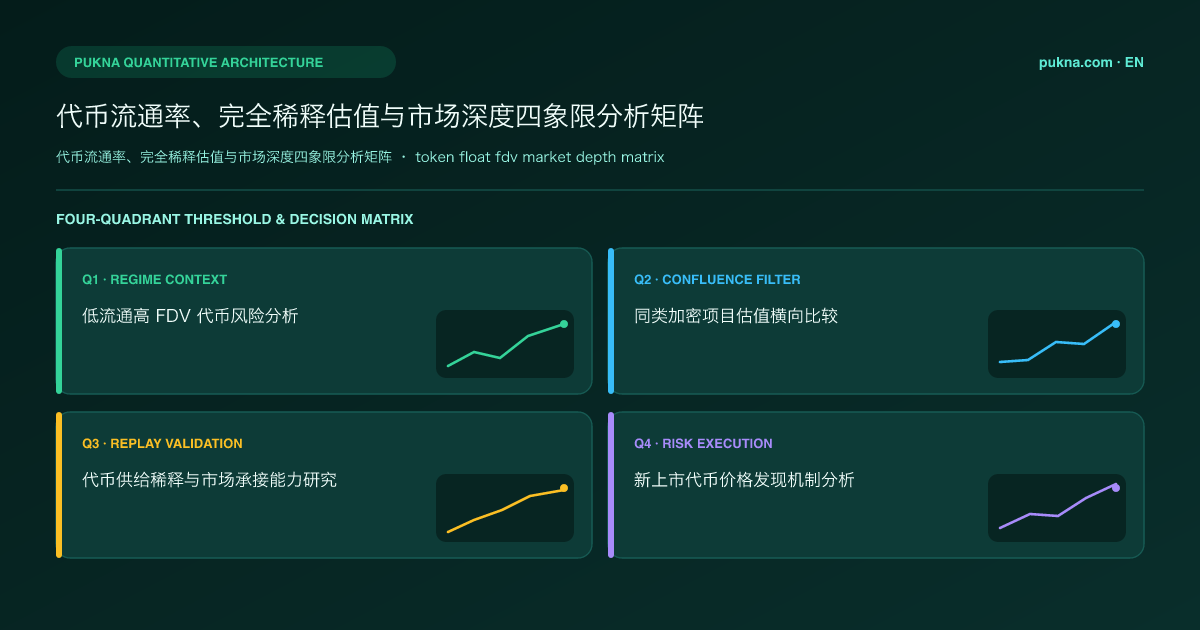
Token Supply Structure vs. Market Depth Four-Quadrant Matrix
Core question: Does secondary-market bid liquidity match a token’s scheduled supply expansion?
- Float Ratio
- Circulating Supply ÷ Fully Diluted Supply
- Valuation Expansion Multiple
- FDV ÷ Circulating Market Cap = 1 ÷ Float Ratio
- Relative Market Depth
- Effective Bid Depth Within a Uniform Slippage Band ÷ Circulating Market Cap
| Supply & Depth Quadrant | Structural Profile | Primary Valuation Risk |
|---|---|---|
| High Float + Deep Orderbook | Supply dilution is largely realized while institutional bids absorb routine turnover. | Narrative crowding can still stretch multiples beyond verifiable fee capture. |
| High Float + Thin Orderbook | Minimal future unlock pressure, yet shallow books amplify marginal order impact. | Modest spot outflows trigger sharp slippage gaps and derivatives liquidation cascades. |
| Low Float + Deep Orderbook | Active market making cushions daily trading while substantial supply remains locked. | Scheduled investor, team, and grant unlocks cap rebounds unless spot demand scales. |
| Low Float + Thin Orderbook | High nominal FDV sits atop narrow circulating float and fragile passive bids. | Pre-unlock hedging or routine recipient selling forces steep valuation discounts. |
External liquidity regimes govern whether spot books absorb unlocks or reprice sharply lower. Check aggregate crypto market cap expansion, Bitcoin implied volatility (DVOL) regimes, and US dollar funding pressure—including Standing Repo Facility (SRF) take-up during a quarter-end funding squeeze. Expanding risk budgets digest emissions smoothly; tight-dollar volatility turns routine unlocks into heavy overhead supply.
| Valuation Dimension | ARB (Arbitrum) | OP (Optimism) |
|---|---|---|
| Gas Token & Fee Demand | ETH pays gas on Arbitrum One; ARB receives no direct gas-burn flow. | ETH pays gas on OP Mainnet and Superchain; OP receives no direct gas-burn flow. |
| Supply & FDV Overhang | Large initial locked allocation for team, investors, and DAO treasury creates multi-year float expansion. | Ongoing core contributor, investor, RetroPGF, and partner allocations expand circulating float over time. |
| Grant & Treasury Sell Pressure | STIP and LTIPP programs distribute ARB directly to ecosystem protocols and liquidity miners. | RetroPGF and Superchain growth grants distribute OP to builders and partner ecosystems. |
| Governance Utility | Controls Arbitrum DAO protocol upgrades, security council elections, and treasury deployment. | Bicameral Token House and Citizens’ House oversee upgrades, Superchain rules, and RetroPGF. |
| Sequencer Revenue Path | ETH sequencer surpluses accrue to the Arbitrum DAO treasury subject to governance votes. | OP Mainnet and Superchain partners (including Base) route revenue shares to the Optimism Collective. |
| Auditable Fundamental Catalysts | DAO-approved staking or fee-switch governance, Stylus adoption, and sequencer decentralization. | Superchain interoperability rollout, growing Base/partner revenue inflows, and OP staking mechanics. |
| Evaluation Dimension | Absorbed Unlock Regime (High Resilience) | Dilutive Overhang Regime (Steep Discount) |
|---|---|---|
| Supply Shock vs. Turnover | Single-tranche unlock stays small relative to 30-day spot daily volume; bids reload steadily. | Unlock tranche rivals or exceeds spot daily turnover; passive depth thins ahead of cliff dates. |
| Derivatives Basis & Hedging | Perpetual funding rate stays near neutral and open interest builds alongside genuine spot-led bids. | Pre-unlock short hedging pushes perpetual basis negative, or crowded longs unwind violently. |
| Orderbook Execution Quality | Limit-orderbook (LOB) bid depth absorbs taker sells without persistent ask-side skew. | LOB skew tilts heavily toward asks while taker-flow exhaustion stalls relief bounces. |
| Macro & Volatility Backdrop | Expanding market cap and contained Bitcoin DVOL sustain secondary-market risk budgets. | Elevated DVOL and contracting liquidity force unlock recipients to liquidate into weak bids. |
Why L2 Token Valuations Require Macro and Liquidity Regime Filtering
Identical L2 derivatives readings flip polarity across volatility states. Never treat rising USD-notional open interest as automatic bullish conviction. In range-bound chop, climbing perpetual open interest paired with elevated positive funding typically marks crowded mean-reversion leverage rather than fresh institutional spot accumulation.
Spot rallies also hide positioning traps when desks monitor USD-notional open interest alone. When ARB or OP spikes while coin-denominated open interest shrinks and perpetual basis stays muted, short covering—not spot buying—drives the move. Separate spot-led bid vs. perp-driven froth through coin-denominated open interest and funding squeezes before chasing breakout candles.
Extreme volatility shocks override chain fundamentals outright. Ahead of Friday 08:00 UTC Deribit options expiry cliffs or CME macro rate repricings, compare the implied volatility vs. realized volatility (VRP) spread against sentiment crowding and risk-appetite shifts. When options desks price steep tail stress, strong DeFi TVL will not shield high-beta L2 tokens from correlated drawdowns.
Even an accurate Arbitrum vs. Optimism thesis bleeds inside a hostile Ethereum liquidity regime. Manual tab-switching across TVL dashboards, unlock schedules, and perpetual funding feeds misses sudden turning points under volatility. Pair Pukna’s 43-token research library with its eight-dimension, 39-indicator macro, derivatives, and on-chain environment library to anchor static L2 fundamentals inside live regime data.
Decision Framework: Choosing Between Arbitrum and Optimism in Practice
Choose Arbitrum One, Stylus, or Orbit for deep single-chain DeFi pools and multi-language compute; choose OP Stack and Superchain rails for strict EVM equivalence and consumer distribution beside Base. Token investors must still separate chain conviction from trade timing through multi-timeframe regime and drawdown filters.
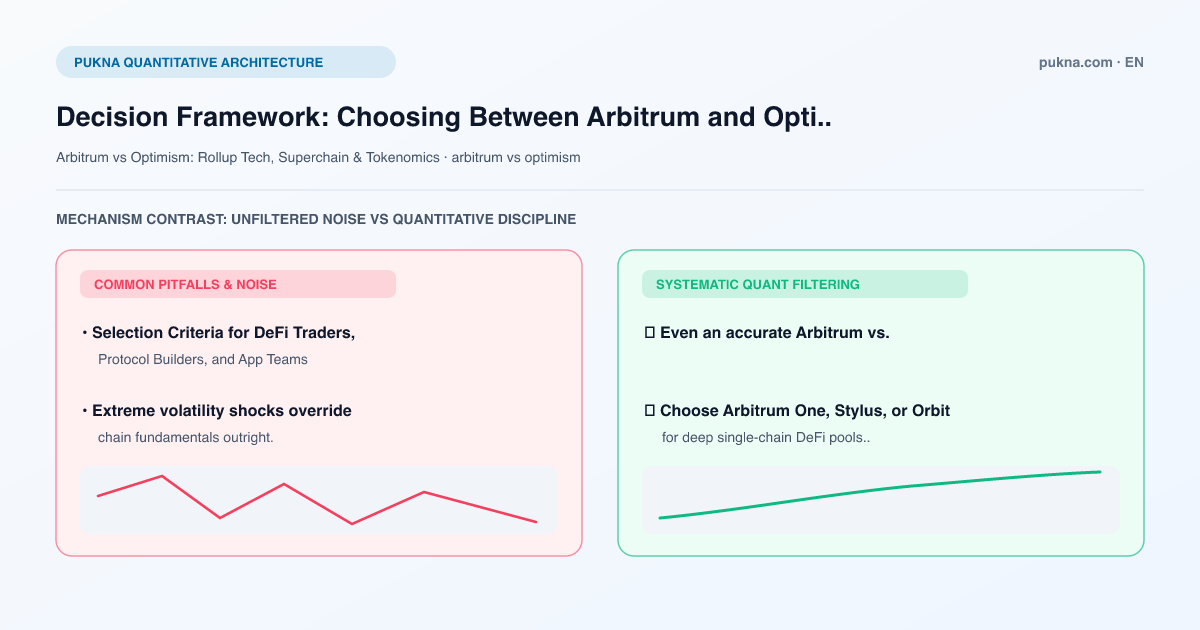
Selection Criteria for DeFi Traders, Protocol Builders, and App Teams
Most Layer 2 commentary still frames Arbitrum vs. Optimism as a winner-take-all fight. Binary rankings miss how the market actually cleared. Ethereum Layer 2 adoption has already segmented into specialized lanes where Arbitrum anchors concentrated DeFi capital while the OP Stack powers exchange-backed consumer ecosystems and federated appchains.
| User Persona | Primary Decision Trigger | Preferred Stack | Structural Trap to Avoid |
|---|---|---|---|
| DeFi Trader / Yield User | Tightest single-chain pool depth for perps, lending, and large swaps. | Arbitrum One | Chasing temporary STIP/LTIPP yields exposed to JIT LP fee dilution. |
| Custom-Stack Builder | Rust/C/C++ compute performance or custom Layer 3 gas token economics. | Arbitrum Stylus & Orbit | Confusing Arbitrum Nova’s AnyTrust trust model with full rollup security. |
| Consumer App Team | Zero-friction EVM equivalence and direct retail onboarding next to Base. | OP Stack / Superchain | Assuming OP Mainnet liquidity automatically mirrors Base consumer traffic. |
| Fundamental & Quant Investor | Risk-adjusted exposure to L2 beta without absorbing blind unlock drawdowns. | Regime-filtered ARB / OP | Equating rising chain TVL or swap counts directly with token price upside. |
Pre-Allocation Risk and Multi-Timeframe Verification Workflow
A clean fundamental thesis never guarantees an executable market entry. Run a disciplined top-down desk sequence before risking capital in ARB, OP, or peer Layer 2 tokens. Anchor directional bias on 1d candles, map structural invalidation on 4h and 1h charts, and time 15m execution once limit-orderbook (LOB) skew clears taker-flow exhaustion.
Manual chart scans across 42 mainstream USDT trading pairs drift into confirmation bias fast. Pukna’s bar-level causal signals and 0–100 P-score ranking evaluate every 15m, 1h, 4h, and 1d bar by combined best return and final return over the forward horizon_bars window. A 50-baseline P-score marks the neutral quality of surrounding ordinary candles—it measures relative return quality, never win-rate probability. Cut weak setups early.
- Separate network traction from token accrual: Check whether active DAO votes alter sequencer fee sharing, staking demand, or emission rates before mapping chain volume onto ARB or OP.
- Audit float ratio and unlock absorption: Compare upcoming unlock cliffs against 30-day spot daily volume, perpetual basis, and bid-side orderbook depth across primary venues.
- Respect explicit regime invalidation triggers: Stand down ahead of Friday 08:00 UTC options expiry cliffs, extreme perp funding crowding, or thin-book liquidation wicks when Bitcoin DVOL spikes.
- Enforce 1d-to-15m timeframe alignment: Require daily regime support and above-50 relative P-score quality before acting on 4h, 1h, or 15m triggers.
- Audit simulation drawdowns before activating alerts: Clean logic never guarantees live durability; inspect the historical equity curve, win rate, and max drawdown across 1x–3x integer-leverage AUTO personal simulations before subscribing to real-time alerts.
Frequently Asked Questions
Which is cheaper after Ethereum’s EIP-4844 upgrade: Arbitrum or Optimism?
Neither rollup holds a meaningful routine gas edge anymore. After Ethereum’s EIP-4844 blob upgrade, standard swaps cost roughly $0.01–$0.10 on both Arbitrum One and OP Mainnet under normal blob load. Real fee gaps appear mainly during Ethereum blob congestion spikes, compute-heavy Arbitrum Stylus calls, or sub-cent traffic routed onto Arbitrum Nova’s AnyTrust chain.
Do ARB or OP tokens pay transaction gas fees or capture sequencer revenue?
No—both rollups collect transaction gas strictly in ETH. Rising on-chain activity generates ETH sequencer surpluses rather than automatic fee-burn demand for ARB or OP. Both tokens operate primarily as governance assets steering upgrades and treasury grants until binding DAO votes activate direct fee sharing or staking sinks.
How is Coinbase’s Base connected to Optimism and the OP Stack Superchain?
Coinbase built Base on Optimism’s open-source OP Stack as a flagship chain inside the Superchain federation. Base issues no native token. Instead, it shares standardized Ethereum upgrade tooling with OP Mainnet and remits a slice of its sequencer revenue to the Optimism Collective to fund public goods.
Should DeFi users and builders choose Arbitrum One or OP Mainnet?
Match the stack to your primary bottleneck. DeFi traders chasing Ethereum’s deepest single-chain rollup pools—and engineers compiling Rust, C, or C++ contracts via Stylus—favor Arbitrum One and Orbit Layer 3 chains. Consumer app teams prioritizing strict EVM equivalence and direct retail onboarding beside Base fit better on OP Mainnet and the OP Stack.
Put this into practice
Create a free account to browse live signals and test your own rules.