Crypto Deleveraging: Separating Nominal USD OI Drops from Leverage Resets
USD open interest falls mechanically with spot prices, even without forced exits. Learn to verify leverage resets with coin OI, basis, depth, and DVOL before sizing trades.
A tactical execution tag focused on quantitative market liquidity thresholds, extreme order-book imbalance filters, and practical diagnostic checklists. Here researchers audit stablecoin netflow boundaries, bid-ask depth decay, and thin-liquidity wick anomalies across 42 USDT pairs (15m–1d) to flag when low depth distorts causal signals, skews relative P-scores, or requires stricter max-drawdown and 1x–3x leverage filters in AUTO simulations. For the overarching structural framework, explore our complete guide in Macro & Market Regime Intelligence (https://pukna.com/category/blog/macro-market-regime/).
USD open interest falls mechanically with spot prices, even without forced exits. Learn to verify leverage resets with coin OI, basis, depth, and DVOL before sizing trades.
Rising stablecoin supply does not equal immediate spot demand. Cross-check mint-burn netflows, issuer share, bid depth, and derivatives positioning to verify real dry powder.
USD gains and falling BTC dominance do not confirm altcoin season. Screen 90-day BTC-pair breadth, ETH/BTC, 2% spot depth, and perpetual basis to separate broad rotation…
Not every RWA coin is backed by a real asset. Screen nine tokens by holder rights, net issuance and order-book depth to separate direct claims from…
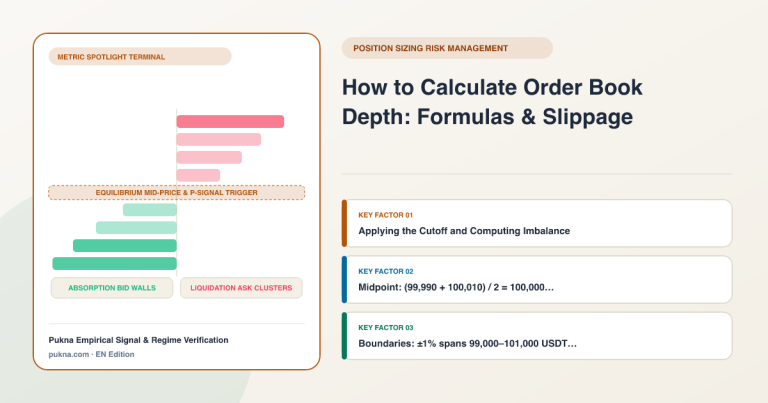
Sum price times quantity on each side within mid-price bands. Then walk the book to estimate slippage and check quote persistence before sizing orders.
USDT anchors global exchange liquidity while USDC leads MiCA rules and weekly reserve snapshots. Check depeg history, chain fees, and mint-burn flows to split margin and…