Contents7 sections
- What Bitcoin Options Are and How Payoff Math Works
- Calls, Puts, and Asymmetric Buyer vs. Seller Risk
- Worked Breakeven Example and European vs. American Exercise
- Inverse vs. Linear Settlement and Where Bitcoin Options Trade
- Inverse BTC-Margined vs. Linear Stablecoin Settlement
- Comparing Deribit, CME Futures Options, and US Spot Bitcoin ETF Options
- How Bitcoin Options Are Priced: Implied Volatility, Skew, and the Greeks
- Implied Volatility vs. Realized Volatility and IV Crush
- Delta, Gamma, Theta, and Vega in Practical BTC Positioning
- Reading 25-Delta Skew and Term Structure
- How to Read a Bitcoin Options Chain and Match Strategies to Volatility Regimes
- Triaging Liquidity, Open Interest, and Delta on a Live Options Chain
- Expiry Pinning Dynamics and Selecting Structures by IV Regime
- Backtesting Bitcoin Options Hypotheses and Filtering Regimes Before Paying Premium
- Why Naive Crypto Options Backtests Break in Live Execution
- Combining Macro/Derivatives Regime Filters with Directional Signal Validation
- Risk Controls, Short-Option Tail Risk, and a Pre-Trade Checklist
- Why Short Options Carry Gap and Collateral Liquidation Risk
- Five-Step Pre-Trade Bitcoin Options Risk Checklist
- Frequently Asked Questions
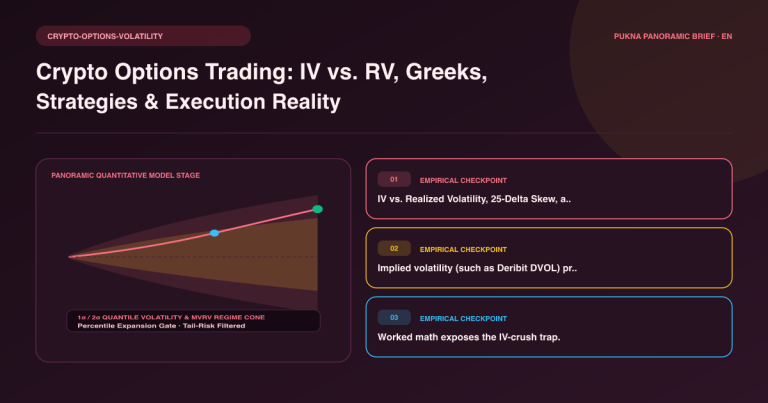
Bitcoin options grant buyers the right, without obligation, to buy (call) or sell (put) BTC at a fixed strike by expiration, capping loss at the upfront premium. Calling direction right still loses money when implied volatility collapses or daily time decay outruns spot gains. Direction alone never pays for overpriced volatility. For relative market context, track Bitcoin dominance.
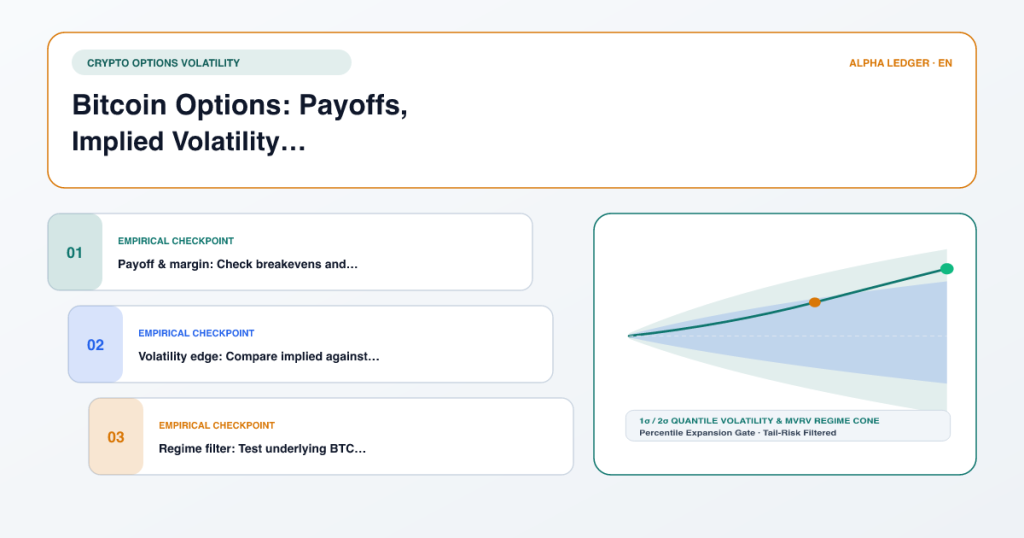
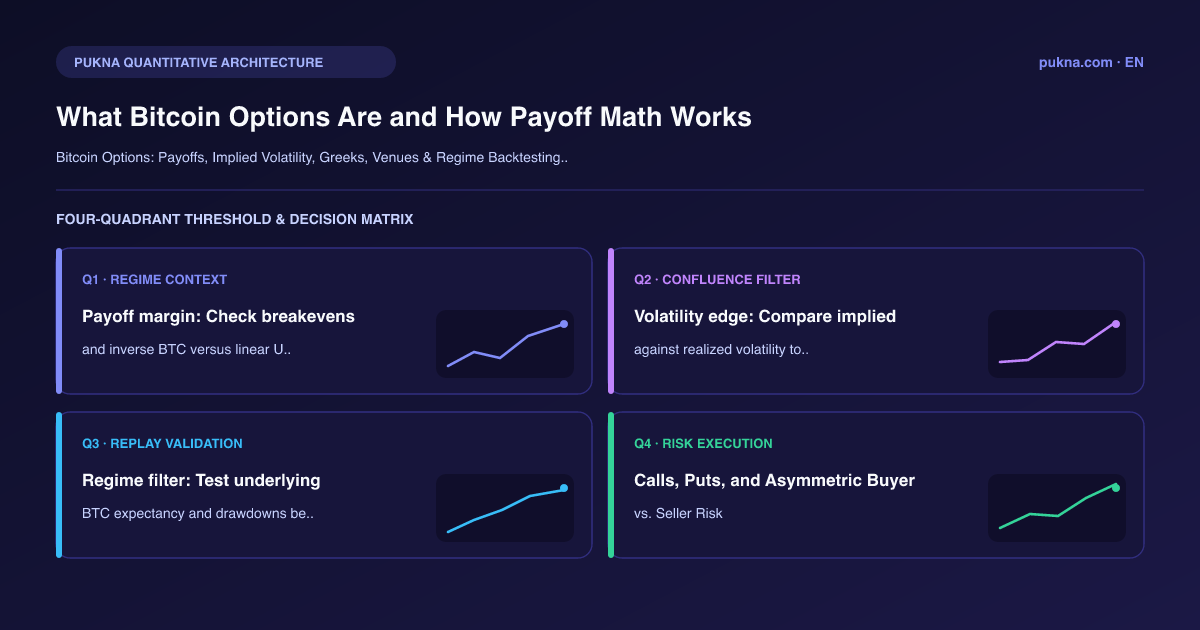
- Payoff & margin: Check breakevens and inverse BTC versus linear USD/stablecoin convexity.
- Volatility edge: Compare implied against realized volatility to dodge post-event IV crush.
- Regime filter: Test underlying BTC expectancy and drawdowns before paying daily Theta.
What Bitcoin Options Are and How Payoff Math Works
Key takeaway: Bitcoin options cap buyer losses at the upfront premium, yet spot price must clear the strike plus cost at expiration to turn a profit.
Calls, Puts, and Asymmetric Buyer vs. Seller Risk
A Bitcoin call grants upside above a chosen strike price, while a put delivers downside protection or bearish leverage below it. Every premium splits into intrinsic value (immediate in-the-money payoff) and extrinsic value (remaining time and volatility value). Long options remove mid-trade margin calls. Maximum loss stops at the upfront cost.
Option sellers—known as writers—sit on the opposite side of that curve. Writers pocket the premium upfront and hit maximum profit if the contract expires worthless, yet steep BTC trends past strike plus premium inflict heavy tail losses. Treating options like safer leveraged perpetuals misses how fast time decay and falling volatility punish mistimed entries.
Worked Breakeven Example and European vs. American Exercise
Take a hypothetical $90,000 BTC spot benchmark with 30 days to expiration. A 1-BTC $95,000 call costing $2,400 breaks even only at $97,400 ($95,000 strike plus $2,400 premium). A 1-BTC $85,000 put costing $2,200 breaks even at $82,800 ($85,000 strike minus $2,200 premium). The table below maps exact expiration payoffs across five settlement levels.
| Expiry BTC Spot | Long $95k Call ($2,400 Cost) | Long $85k Put ($2,200 Cost) | Payoff Outcome |
|---|---|---|---|
| $78,000 | -$2,400 (-100.0%) | +$4,800 (+218.2%) | Put deep ITM; call expires worthless |
| $82,800 | -$2,400 (-100.0%) | $0 (0.0%) | Put breakeven ($85k − $2.2k) |
| $90,000 | -$2,400 (-100.0%) | -$2,200 (-100.0%) | Both OTM; maximum buyer loss |
| $97,400 | $0 (0.0%) | -$2,200 (-100.0%) | Call breakeven ($95k + $2.4k) |
| $105,000 | +$7,600 (+316.7%) | -$2,200 (-100.0%) | Call deep ITM; put expires worthless |
Exercise timing depends strictly on the listing venue. Crypto-native exchanges (Deribit, OKX, Bybit, Binance) and CME Bitcoin futures options settle European-style, meaning exercise happens only at expiration. US-listed spot Bitcoin ETF options—such as IBIT—trade American-style instead. Buyers can exercise on any trading day before expiry, adding early-assignment risk for short sellers.
Inverse vs. Linear Settlement and Where Bitcoin Options Trade
Key takeaway: Settlement currency and venue trading hours directly govern USD payoff convexity, weekend gap exposure, and order-book liquidity.
Inverse BTC-Margined vs. Linear Stablecoin Settlement
Inverse Bitcoin options—Deribit’s flagship format—require BTC margin and pay out in BTC, so your collateral shifts in dollar value at the same time your option P&L moves. That double movement makes dollar returns non-linear. Fast trends bend effective exposure far harder than spot payoff charts imply.
Take a hypothetical $95,000 inverse call settling at $105,000 BTC: the $10,000 intrinsic value pays 0.0952 BTC ($10,000 divided by $105,000), tapering BTC upside while posted BTC margin gains in dollars. Now flip sides on a short $85,000 inverse put if BTC drops from $90,000 to $70,000. The $15,000 obligation swells to 0.2143 BTC while posted BTC collateral loses 22.2% of its dollar value. Collateral shrinks precisely when payouts expand.
Linear contracts margined and settled in USDC or USDT remove collateral-currency drift. Premiums, margin buffers, and settlement payouts stay dollar-pegged, keeping USD P&L linear against spot. Clean USD accounting simplifies hedging spot holdings or structuring arbitrage against perpetual basis and funding spreads. Settlement currency only solves half the execution puzzle—venue hours decide when you can hedge.
Comparing Deribit, CME Futures Options, and US Spot Bitcoin ETF Options
Global Bitcoin options liquidity splits into three venue tiers governed by regulatory access, margin rails, and operating hours. Offshore crypto-native order books anchor 24/7 global open interest (OI), while CME futures options and US spot ETF options expand compliant access across multi-year Bitcoin halving and dollar liquidity cycles.
| Venue Tier | Settlement & Margin | Exercise & Hours | Access & Structural Trade-Off |
|---|---|---|---|
| Offshore Crypto-Native (Deribit, OKX, Bybit, Binance) | Inverse BTC-margined (Deribit flagship) or linear USDC/USDT | European-style; 24/7 trading, 08:00 UTC expiry | Deepest strike liquidity; restricted for US retail and subject to regional rules |
| US Regulated Futures Options (CME BTC / Micro BTC) | Linear USD margin; exercises into CME Bitcoin futures | European-style; near-24/5 Globex session | CFTC oversight and clean USD accounting; exposed to weekend spot gaps |
| US Spot Bitcoin ETF Options (e.g., IBIT on Robinhood) | Linear USD premium; physically settles into 100 ETF shares | American-style; US equity market hours | Broad US retail brokerage access via OCC; widest overnight and weekend gap risk |
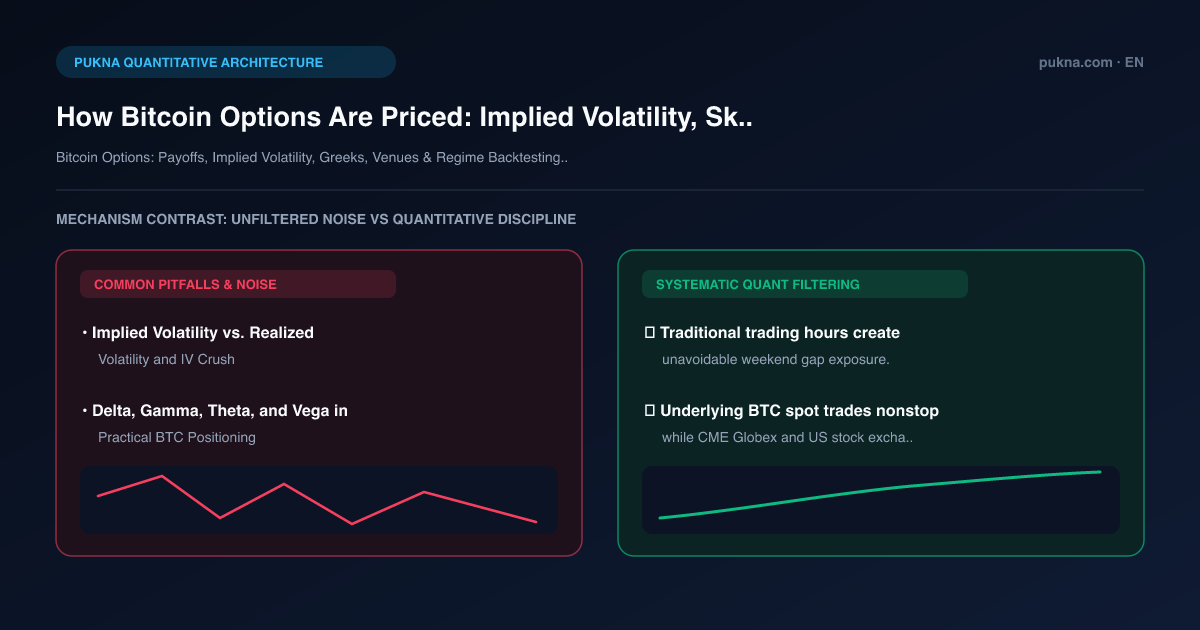
Traditional trading hours create unavoidable weekend gap exposure. Underlying BTC spot trades nonstop while CME Globex and US stock exchanges close, leaving hedged positions frozen through Saturday shocks. If you trade from a restricted jurisdiction—such as US retail accounts or India-based desks operating under domestic VDA rules—verify local eligibility directly instead of relying on unverified offshore workarounds.
How Bitcoin Options Are Priced: Implied Volatility, Skew, and the Greeks
Key takeaway: Implied volatility repricing and daily time decay move option premiums as sharply as spot direction, making the Greeks essential for risk sizing.
Implied Volatility vs. Realized Volatility and IV Crush
Implied volatility (IV) reflects how wide a forward price swing live option premiums expect, tracked across 30-day crypto expiries by the DVOL benchmark. Realized volatility (RV) records actual trailing spot movement instead. Comparing the implied volatility vs. realized volatility (VRP) spread tells you whether option premiums overprice fear or underprice upcoming turbulence.
Suppose BTC sits at a hypothetical $90,000 before an FOMC or CPI release. A 14-day $95,000 call trades at 70% IV versus 50% RV (+0.37 Delta, +0.000031 Gamma, -$167/day Theta, +$67 Vega). BTC rallies $1,500 in one day to $91,500 while IV drops 12 vol points to 58%. Delta (+$555) and Gamma (+$35) add $590, yet Theta (-$167) and Vega (-$804) leave the position down -$381.
That sudden Vega contraction—known as implied volatility crush (IV crush) & event-vol repricing—explains why right-direction call buyers lose money after macro headlines. Cheap out-of-the-money tickets rarely offer real edge when IV sits far above RV. Low Delta simply cannot outrun daily time decay.
Delta, Gamma, Theta, and Vega in Practical BTC Positioning
Four core Greeks break option repricing into exact dollar sensitivities across spot price, convexity, calendar decay, and implied volatility. Setting dollar Greek limits before entering stops hidden Vega bets from posing as directional trades. Spot conviction means little when Vega dominates P&L.
| Greek / Vol Metric | Core Definition | Illustrative BTC Sensitivity | Practical Trading Implication |
|---|---|---|---|
| Delta | Option price change per $1 move in BTC spot | +0.37 Delta gains ~$370 on a +$1,000 move | Acts as directional exposure and rough hedge ratio |
| Gamma | Rate of Delta change per $1 spot move | +0.000031 adds +0.031 Delta per $1,000 move | Accelerates convexity and short-option risk near expiry |
| Theta | Daily extrinsic value decay holding spot constant | -$167/day on a high-IV 14-DTE call | Compounds non-linearly inside the final 14 days to expiry |
| Vega | Premium change per 1 vol-point IV shift | +$67 per +1% IV; -$804 on a 12-point IV drop | Dominates pre-catalyst P&L on medium-dated options |
| VRP Spread (IV − RV) | Gap between implied and realized volatility | 70% IV vs. 50% RV = +20 vol-point premium | Wide positive spread favors spreads over naked buying |
| 25-Delta Skew | 25-delta call IV minus 25-delta put IV | -6% skew = puts priced richer than calls | Reveals institutional crash hedging vs. upside FOMO |
Reading 25-Delta Skew and Term Structure
Reading implied volatility skew & DVOL term structure exposes institutional hedging beneath raw price charts. Sharp negative 25-delta skew shows market makers charging steep premiums for downside puts against liquidation tail risk, whereas positive call skew flags crowded upside speculation. Skew alone still misleads during thin sessions, so cross-check it against spot sentiment and crowd positioning gauges.
Term structure compares IV across successive expirations. Calm markets hold contango, where longer-dated options carry higher IV than front-week contracts. Ahead of scheduled macro prints or forced deleveraging, front-end IV spikes above back-month expiries (backwardation), warning buyers of severe short-dated Vega risk alongside stretched perpetual BTC long/short account balance. Even fair volatility pricing still fails if wide spreads ruin live execution.
How to Read a Bitcoin Options Chain and Match Strategies to Volatility Regimes
Key takeaway: Screening bid-ask spread drag, strike open interest, and volatility regimes prevents overpaying for thin contracts and pairs each payoff structure with market conditions.
Triaging Liquidity, Open Interest, and Delta on a Live Options Chain
Start every options-chain scan with execution friction, not best-case upside. Calculate the bid-ask spread as a share of mid-price: (Ask − Bid) divided by Mid. An out-of-the-money call quoted at $420 bid and $470 ask ($445 mid) taxes entry by 11.2% immediately. Risk-reward erodes before BTC ticks one dollar.
Next, check strike-level OI alongside the daily volume-to-OI ratio: daily volume above standing OI signals fresh institutional positioning rather than routine rollouts or closures. For directional trades, 0.25–0.40 delta strikes balance capital efficiency against intrinsic-value odds. Skip far-OTM lottery tickets below 0.10 delta.
Expiry Pinning Dynamics and Selecting Structures by IV Regime
Weekly, monthly, and quarterly expiries—settling at 08:00 UTC Fridays on offshore crypto venues—drive recurring mechanical spot flows through gamma pinning, where dealer hedging pulls price toward heavy round strikes. Net long-gamma dealers sell rallies and buy dips to hold price near major strikes, whereas net short-gamma dealers hedge with momentum and amplify breakouts. Expiry mechanics often override chart patterns.
Picking an option structure without classifying the market regime drains equity fast. It mirrors enduring chopsolidation & funding bleed on leveraged perpetuals while funding rates and perpetual basis grind sideways. Before choosing strikes, diagnose sentiment, derivatives leverage, volatility structure, and market breadth across four pillars.
| Environment Pillar | Overheated / Fragile Zone | Balanced Constructive Zone | Capitulation / Value Zone |
|---|---|---|---|
| Sentiment & Greed | Extreme euphoria, retail FOMO surge | Neutral-to-constructive participation | Deep fear & forced de-risking |
| Derivatives Leverage | Crowded positive funding + stretched OI | Moderate basis, spot-led volume | Washed-out OI & negative funding |
| Volatility Structure | Inverted front-end IV spike | Contained term-structure contango | Post-liquidation volatility compression |
| Market Breadth | Narrow speculative blow-off | Broad spot-supported expansion | Deleveraged accumulation base |
Match your contract structure to neutralize the dominant pricing drag once those four pillars are clear. Vertical debit spreads pair a closer-to-the-money long strike with a further-OTM short strike, cutting Vega and Theta bleed in high-IV trends. Covered calls and cash-secured puts monetize rich range-bound premiums instead, trading away uncapped upside or accepting downside assignment. Each structure carries a distinct failure mode.
| Market Trend & IV Regime | Matched Strategy Structure | Defined Max Risk | Primary Failure Mode |
|---|---|---|---|
| Low IV + Emerging Trend | Long Call or Long Put (0.30–0.40 Delta) | Upfront premium paid | Stalled breakout triggering accelerating Theta bleed |
| High IV + Directional Trend | Vertical Debit Spread (Bull Call / Bear Put) | Net debit paid | Capped upside if BTC trends far past short strike |
| High IV + Range-Bound | Covered Call or Cash-Secured Put | Spot drawdown minus premium | Tail selloff or sharp breakout capping spot gains |
| Pre-Event Catalyst + Inverted IV | Calendar Spread or Narrow Debit Spread | Net debit paid | Extreme spot gap blowing past both strikes |
Backtesting Bitcoin Options Hypotheses and Filtering Regimes Before Paying Premium
Key takeaway: Naive crypto options backtests fail under missing volatility surfaces and wide spreads, so validating macro regimes and underlying directional expectancy must precede live premium spend.
Why Naive Crypto Options Backtests Break in Live Execution
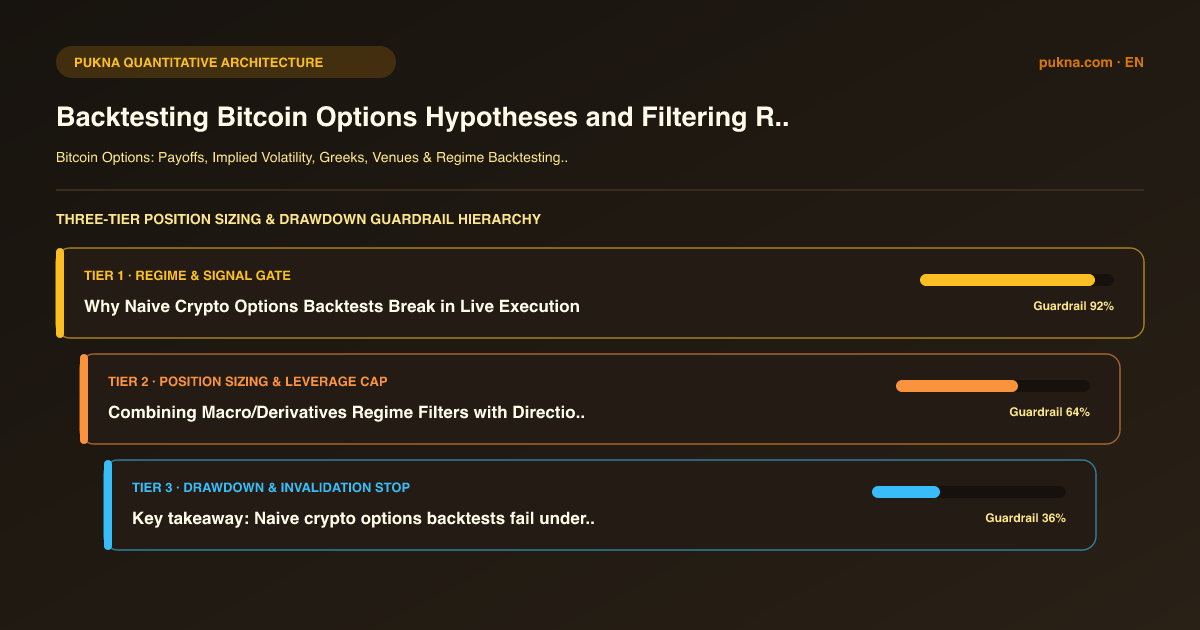
Retail Bitcoin options backtests regularly print smooth equity curves that fail in live execution. Three structural blind spots explain why. First, clean historical strike-level IV surfaces are scarce. Approximating historical premiums with flat Black-Scholes volatility erases 25-delta skew shifts, DVOL spikes, and post-event IV crush.
Second, filling simulated entries at theoretical mid-price ignores wide OTM bid-ask spreads and thinning order-book depth during stress events. Third, macro liquidity shocks break rules overfit to low-volatility bull phases. An abrupt shift in the OIS-implied rate path & front-end carry-trade unwind rapidly reprices front-end put skew and funding liquidity, invalidating static rules overnight.
Combining Macro/Derivatives Regime Filters with Directional Signal Validation
Split options validation into two testable upstream layers before paying recurring Theta. Layer one checks whether macro liquidity, interest rates, sentiment, derivatives positioning, and on-chain activity support trend expansion or range compression. Layer two verifies whether the underlying BTC directional setup holds positive out-of-sample expectancy across historical drawdown cycles. Only setups clearing both gates justify convex option spend.
- Raw Bar Signal Capture: Detect multi-timeframe structural inflection across 15m/1h/4h/1d bars.
- Relative Quality Gate (P-Score): Filter out sub-50 random noise bars; prioritize higher relative payoff regimes.
- Out-of-Sample Replay: Simulate 1x–3x integer leverage rules to inspect net return vs. max drawdown.
- Disciplined Execution: Subscribe to validated live alerts with predefined invalidation stops.
To run this screen without stitching separate feeds together, start with Pukna’s 39-indicator market environment library across eight macro, rate, liquidity, sentiment, derivatives, and on-chain dimensions. Cross-check that backdrop against 15m/1h/4h/1d causal K-line signals spanning 42 USDT pairs, including BTCUSDT. Each signal carries a 0–100 P relative quality score, where 50 marks the neutral baseline of ordinary surrounding candles. Higher scores track stronger combined peak and final returns over horizon_bars—never a win probability. Drop sub-50 noise first.
A strong candle score still cannot guarantee an option will outrun Theta or gap risk. Before buying decaying premium, run a pre-subscription AUTO backtest audit (equity curve, win rate & max drawdown) across 1x–3x integer leverage on BTCUSDT. Verify that historical max drawdown fits your book first. Only then should you weigh real-time alert subscriptions—or commit cash to options.
| Validation Dimension | Ad-Hoc Naked Option Guessing | Regime-Filtered Quantitative Workflow |
|---|---|---|
| Macro & Derivatives Context | Ignores DVOL, skew, and macro liquidity shifts | Cross-checks 8-dimension, 39-indicator macro, derivatives & on-chain regime alignment |
| Underlying Directional Edge | Subjective chart bias with untested win/loss skew | Filters BTCUSDT 15m–1d causal signals via 0–100 P relative quality score (50 neutral, non-probabilistic) |
| Execution & Cost Benchmark | Pays recurring Theta and wide OTM spreads blindly | Audits underlying expectancy via 1x–3x AUTO simulated equity curve, win rate & max drawdown |
| Capital Commitment Trigger | Enters ahead of crowded catalysts at peak IV | Deploys spreads or directional longs only when regime and VRP spread align |
Risk Controls, Short-Option Tail Risk, and a Pre-Trade Checklist
Key takeaway: Explicit premium caps, liquidity gates, and pre-14-DTE exit rules separate capped buyer risk from asymmetric short-option liquidation cascades.
Why Short Options Carry Gap and Collateral Liquidation Risk
Option buyers cap maximum loss at entry, while naked sellers absorb severe negative skew. One multi-sigma BTC rally or flash crash can erase months of collected premium in hours. On inverse BTC-margined exchanges, falling spot shrinks dollar collateral right as BTC payout obligations expand. Forced liquidations cascade fast.
Regulated venues introduce a parallel structural threat: weekend volatility gaps. Because spot BTC and offshore options trade 24/7 while CME futures options and US spot ETF options close over weekends, short sellers cannot delta-hedge Saturday shocks until Monday opens. Overnight gaps routinely blow past standard stop orders.
Five-Step Pre-Trade Bitcoin Options Risk Checklist
Run these five hard gates before routing any Bitcoin options order. If a trade trips any invalidation condition below, stand down.
- Cap Premium at Risk (1%–2% Rule): Size long directional options so upfront premium never exceeds 1%–2% of portfolio risk capital per thesis. Assume a 100% premium write-off stays possible; cut size immediately if one trade breaches that cap.
- Audit VRP Spread and Skew: Compare target-strike IV and DVOL against trailing RV, and review intraday Vol/OI anomalies and DVOL skew shifts. Invalidate naked long calls or puts when positive VRP is stretched—switch to vertical debit spreads or pass.
- Enforce Spread and OI Liquidity Gates: Reject any strike whose bid-ask spread tops 5%–8% of mid-price. Inspect options open interest concentration across expiries to flag pin magnets and thin books before routing limit orders.
- Lock Pre-14-DTE Exit Rules: Commit to explicit take-profit, stop, and roll dates before entering the final 14 days to expiration. Accelerating Theta compresses extrinsic value non-linearly inside that two-week window, invalidating passive holds.
- Validate Upstream Regime and Drawdowns: Inspect BTC fundamentals in Pukna’s 43-token research library alongside the 39-indicator environment metrics and 1x–3x AUTO simulated history on app.pukna.com. Skip live alerts and option spend if historical max drawdown or regime alignment breaches your tolerance.
| Research Scenario | Core Criterion | Empirical Takeaway | Full Study |
|---|---|---|---|
| Intraday unusual flow | Strike OI, Vol/OI >= 1.5x, IV/DVOL | Live 1.5x+ Vol/OI spikes isolate fresh positioning beyond T+1 equity OI lag. | Intraday Vol/OI Ratio Anomaly Options Strategy: Implied Volatility Skew, DVOL & Bias-Free Backt → |
| Call OI surge screening | Contract math, DVOL, funding rate | Rising call OI often reflects covered-call selling until funding and DVOL confirm. | Call Open Interest Surge: Covered Call Selling vs. Bullish Buying With DVOL, Funding Rates, and → |
| Strike wall setups | Strike OI walls, live Vol/OI, funding flips | High OI marks battlegrounds, not direction; pair live Vol/OI with funding flips. | Open Interest Options Strategy: Strike Walls, Live Vol/OI, Funding Rate & Bias-Free Backtest → |
| ETH volatility sizing | Black-Scholes ATM IV, ETH DVOL, √365 | ETH IV prices expected move width via √365 bands rather than direction or ATR. | How Ethereum Implied Volatility Is Calculated: ATM IV, ETH DVOL, Skew & Regime Risk → |
| Cross-venue OI analysis | Coin-denominated OI, GEX pinning, IV shifts | Options OI is non-linear; weigh coin OI, dealer GEX pinning, and causal signals. | Crypto Options Open Interest: How It Is Calculated Across Strikes, Expiries, and Venues → |
Frequently Asked Questions
How do Bitcoin call and put options calculate breakeven and maximum loss?
A call buyer breaks even at expiration when BTC finishes at strike plus upfront premium, while a put buyer breaks even at strike minus premium. For both structures, buyer loss stops strictly at the upfront cost. Sellers pocket that premium immediately yet absorb steep tail losses if BTC moves far past breakeven. Before choosing strikes, map dealer positioning across options open interest concentrations.
Why can a Bitcoin option lose money even when BTC moves in the right direction?
Option premiums combine intrinsic value with extrinsic time-and-volatility value. Even when spot BTC rallies as expected, a long call loses mark-to-market value if post-event implied volatility drops sharply (IV crush) or daily Theta outpaces Delta gains. Buying high-IV contracts right before macro prints or inside 14 days to expiry creates heavy Vega and decay drag. Track intraday Vol/OI anomalies and DVOL skew shifts before paying elevated pre-event premiums.
What is the practical difference between inverse BTC-margined and linear stablecoin-settled Bitcoin options?
Inverse options use BTC as both collateral and payout currency, making USD returns non-linear as margin value moves with spot. During sharp selloffs, inverse short-put sellers face compounding pressure because BTC collateral loses dollar value while BTC payout obligations grow. Linear contracts settled in USDC, USDT, or USD eliminate collateral drift. That clean dollar P&L makes hedging easier alongside perpetual BTC long/short positioning.
How do implied volatility, 25-delta skew, and Greeks guide strike and expiry selection?
Start by comparing strike IV and DVOL against trailing realized volatility. Elevated IV favors vertical debit spreads over naked longs to curb Vega and Theta drag. Next, check 25-delta skew to see whether downside puts or upside calls carry rich hedging premiums. Target 0.25–0.40 delta strikes with 30–60 days to expiry, and confirm backdrop alignment with spot sentiment gauges and macro and derivatives regime metrics.
Put this into practice
Create a free account to browse live signals and test your own rules.