Contents7 sections
- How Does Crypto Options Trading Work Across Settlement Models?
- Calls, Puts, and Defined vs. Asymmetric Risk Profiles
- Inverse Coin-Margined vs. Linear USDT/USDC Settlement
- Why Do Implied Volatility and Greeks Override Spot Direction?
- Delta, Gamma, Theta, and Vega in 24/7 High-Volatility Markets
- IV vs. Realized Volatility, 25-Delta Skew, and Term Structure
- Which Crypto Options Strategies Fit Low vs. High Volatility Regimes?
- Directional Setups: Outright Calls/Puts vs. Vertical Spreads
- Non-Directional & Hedging Structures: Straddles, Iron Condors, and Collars
- How Can Quantitative Regime Filtering Prevent Premature Premium Decay?
- Combining Options Chain Metrics with Multi-Dimensional Market Regimes
- Backtesting Underlying Directional Edge Against Option Time Decay
- US-Regulated vs. Global Crypto Options Platforms: Where Does Liquidity Sit?
- US-Regulated Routes vs. Global Crypto-Native and On-Chain Venues
- Evaluating Orderbook Liquidity, Bid-Ask Spreads, and Fee Caps
- Token Cross Venue Liquidity Accessibility Pipeline
- How Do Traders Control Tail Risk and Spot Crypto Options Scams?
- Red Flags of Fake Binary Options and Counterparty Scams
- Five-Step Pre-Trade Risk Checklist for Options Traders
- Frequently Asked Questions
Crypto options give traders the right, not the obligation, to buy or sell BTC, ETH, or SOL at a fixed strike—without perpetual funding carry or buyer liquidation. Unlike linear futures, payoffs track direction (Delta), accelerating decay (Theta), and implied versus realized volatility (Vega), so right-direction calls still bleed money when IV runs 15+ points rich. Disciplined trade selection pairs strike structure with volatility regimes, perpetual funding basis, and live orderbook depth.
| Market Variable | Naive Single-Metric Reading | Multi-Factor Options Reality |
|---|---|---|
| Spot Direction | Bullish breakout automatically pays calls. | Spot must beat strike plus premium before Theta and IV crush erode value. |
| Implied Volatility (DVOL) | High IV automatically signals cheap selling. | Rich IV only pays sellers when DVOL exceeds realized movement (positive VRP). |
| Funding Rate & Basis | Positive funding confirms upside continuation. | Carry above +0.01% per 8h (10.95% annualized) often signals crowded long fragility. |
| Open Interest (OI) | Rising USD OI always shows fresh conviction. | USD nominal OI inflates mechanically with price; coin-denominated OI reveals true leverage. |
How Does Crypto Options Trading Work Across Settlement Models?
Crypto options separate directional bets from margin liquidation, yet realized P&L still hinges on expiry timing and settlement collateral. Every contract fixes an underlying asset, strike, upfront premium, and expiry timestamp. Crypto-native venues settle daily through quarterly expiries at 08:00 UTC.
Calls, Puts, and Defined vs. Asymmetric Risk Profiles
A call gives the holder the right to buy at the strike; a put gives the right to sell. Buyers pay the premium upfront and face zero forced liquidation before expiry, capping max loss strictly at entry cost. Naked sellers collect that fee in exchange for steep tail liability. One side caps risk; the other absorbs tails.
Concrete strike arithmetic exposes how easily directional traders misprice option leverage. Suppose BTC trades at a hypothetical $80,000, and you buy an $84,000 strike call for a $2,400 premium (3% of spot). Breakeven at expiry sits at $86,400—requiring an +8.0% rally just to recover cost. A +5.0% rally to $84,000 still expires worthless.
Exercise style also changes execution mechanics across jurisdictions. Crypto-native venues—Deribit, Binance, OKX, Delta Exchange, Derive, and Aevo—list European cash-settled contracts that settle automatically only at expiry. Regulated US spot Bitcoin ETF options (such as IBIT) use American physical exercise, while CME contracts settle into regulated futures. For deeper contract math, see our Bitcoin options payoff and venue mechanics study.
Inverse Coin-Margined vs. Linear USDT/USDC Settlement
Settlement currency creates a hidden convexity trap that regularly ambushes spot traders. Inverse options post and settle margin in the underlying coin (BTC or ETH), whereas linear contracts margin strictly in stablecoins (USDT or USDC). During violent selloffs, the two behave nothing alike.
Suppose you sell a BTC-margined inverse put and spot drops 20% overnight. Your dollar liability jumps at the exact moment your posted BTC collateral loses 20% in dollar value, compounding margin stress non-linearly. Linear USDT or USDC settlement removes that collateral feedback loop and keeps dollar P&L clean. Coin-margined leverage cuts both ways.
| Contract Dimension | Call vs. Put Mechanics | Inverse (Coin-Margined) vs. Linear (USDT/USDC) |
|---|---|---|
| Buyer Risk Ceiling | Strictly limited to paid premium; no liquidation before expiry. | Inverse payouts grow faster in USD during rallies; linear payouts track dollar payoff cleanly. |
| Naked Seller Liability | Short calls carry theoretically uncapped upside loss; short puts carry full downside loss to zero. | Inverse short puts face double drawdown as collateral falls alongside spot; linear margin holds USD stability. |
| Primary Venues | Standardized across Deribit, Binance, OKX, CME, and US ETF chains. | Deribit anchors inverse BTC/ETH liquidity; Binance, OKX, Delta, and Aevo emphasize linear stablecoin settlement. |
| Margin Efficiency | Defined-risk spreads slash maintenance margin versus naked short legs. | Portfolio margin offsets inverse options against perpetual hedges; linear margin simplifies multi-asset dollar sizing. |
Strike math and settlement rules prevent collateral shocks, yet neither saves a long option when implied volatility collapses post-entry.
Why Do Implied Volatility and Greeks Override Spot Direction?
Option prices bake in forward volatility expectations and accelerating decay, so overpaying for implied volatility turns right-direction trades into net losses. Unlike perpetual swaps tracking spot one-for-one, fair value shifts constantly through four interacting Greeks. Direction alone never sets the ticket price.
Delta, Gamma, Theta, and Vega in 24/7 High-Volatility Markets
Each Greek isolates one risk axis, not a standalone entry signal. Delta measures dollar exposure per $1 spot move and offers a rough expiry in-the-money proxy—never a fixed win probability. Gamma tracks how fast Delta shifts with price, spiking violently on daily and weekly expiries.
Theta measures daily time decay, while Vega quantifies P&L per 1-point shift in implied volatility. Because crypto trades 24/7 with zero weekend halt, Sunday liquidity gaps and 08:00 UTC expiries amplify short-dated curvature risk. Around major expiries, opex-pin release & post-expiry delta-hedge unwind regularly unlock sharp directional breaks once dealer gamma hedges roll off. Short-dated gamma leaves zero room for hesitation.
| Greek | Operational Definition | Behavior Near Expiry | 24/7 Crypto Failure Mode |
|---|---|---|---|
| Delta (Δ) | Expected option price change per $1 underlying move (0 to ±1.0). | Snaps rapidly toward 1.0 (ITM) or 0.0 (OTM) at the strike. | Treating a 0.25-Delta OTM call like 4x spot leverage ignores high expiry-zero odds. |
| Gamma (Γ) | Rate of change in Delta per $1 spot shift (convexity curvature). | Explodes on ATM strikes inside the final 72 hours before 08:00 UTC expiry. | Short weekly strangles blow through margin during sudden 8%–12% liquidation wicks. |
| Theta (Θ) | Extrinsic value lost per day from passage of time alone. | Accelerates non-linearly over the final 14 days for ATM options. | Holding long directional calls through sideways weekend chop bleeds principal daily. |
| Vega (ν) | Option price sensitivity to a 1% shift in Implied Volatility. | Drops toward zero near expiry; highest on 30–90 DTE contracts. | Overpaying for long options ahead of FOMC or CPI triggers steep post-event IV crush. |
IV vs. Realized Volatility, 25-Delta Skew, and Term Structure
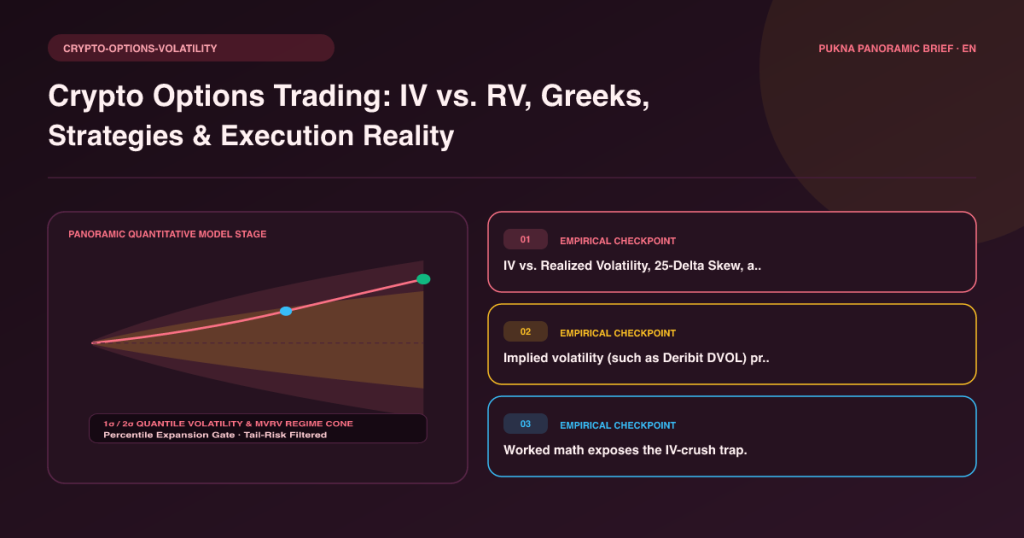
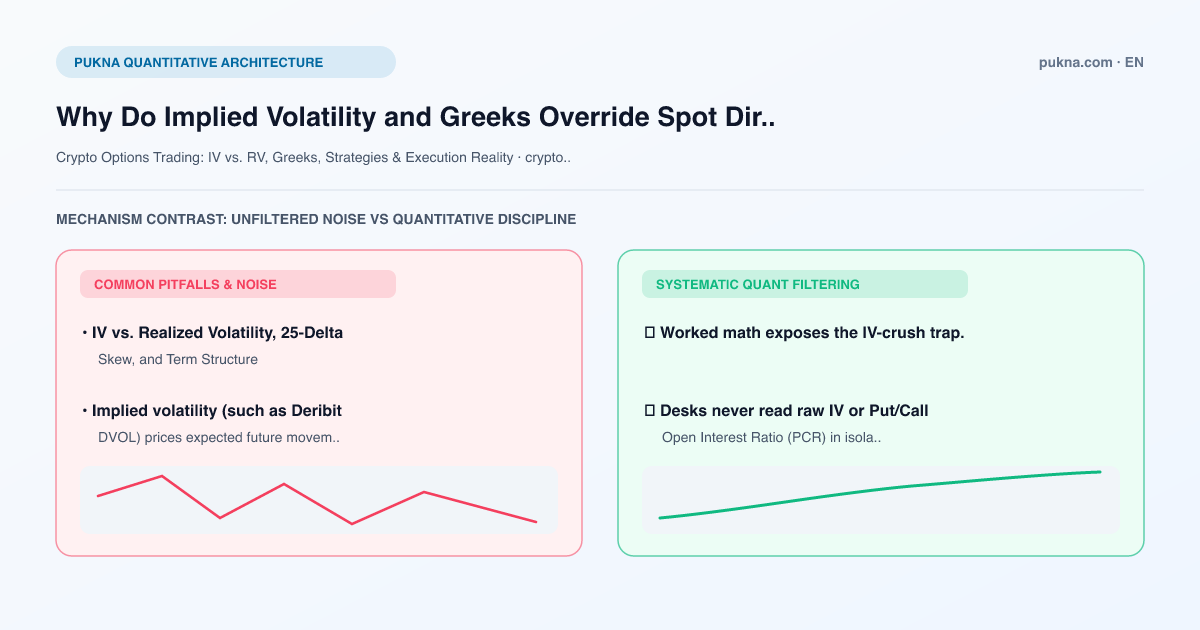
Implied volatility (such as Deribit DVOL) prices expected future movement, whereas realized volatility (RV) records how much spot actually moved. They never measure the same thing. The IV-minus-RV spread—known as the volatility risk premium (VRP)—shows whether buyers pay fair value or subsidize market makers.
Worked math exposes the IV-crush trap. Suppose 30-day IV trades at 75% while trailing 30-day RV sits at 48% (+27-point VRP) ahead of a rate decision. On a long ATM call with $120 Vega, a +2.5% rally adds $1,000 in Delta, but a 15-point IV drop (−$1,800) plus two days of Theta (−$280) overwhelms it. You nailed direction and still lost $1,080.
Desks never read raw IV or Put/Call Open Interest Ratio (PCR) in isolation because identical numbers flip meaning across regimes. High IV during sideways consolidation pays disciplined sellers, yet high IV during forced liquidations often underprices cascading gaps. Pair IV Rank with 25-Delta Risk Reversal (call IV minus put IV) and term structure using implied-to-realized volatility spread benchmarks. Raw IV lies without realized context.
Spotting mispriced volatility only protects capital once you match the contract structure to that exact regime.
Which Crypto Options Strategies Fit Low vs. High Volatility Regimes?
Matching option structure to implied volatility valuation and directional conviction outperforms blind call-buying by aligning net Vega and Theta with the tape. Buying cheap convexity works when IV sits compressed; selling defined-risk spreads captures the volatility risk premium when IV stretches. Structure decides whether an edge survives.
Directional Setups: Outright Calls/Puts vs. Vertical Spreads
When IV trades near or below realized volatility alongside clear trend momentum, outright calls, puts, or vertical debit spreads capture asymmetric upside. A bull call debit spread—buying a nearer strike and selling a higher one—cuts upfront cost, trims Vega drag, and pulls breakeven closer. Capping upside often saves the trade.
When IV spikes well above RV, outright buyers fight brutal Vega headwinds. Express directional bias through defined-risk credit spreads—bull put spreads for upside, bear call spreads for downside—so Theta and IV decay work for you while max loss stays capped. Defined outer wings survive 10% overnight gaps.
Myth vs. Reality — Cheap Far-OTM Weekly Calls: Low ticket prices fool retail buyers into treating far-OTM weekly calls as low-risk leverage. Low Delta demands an immediate tail move while 7-DTE Theta burns relentlessly. Historical samples show most far-OTM weekly bets expire at zero.
| Volatility & Trend Quadrant | Primary Structures | Max Profit / Max Loss | Net Theta & Vega Tilt | Ideal Expiry Horizon |
|---|---|---|---|---|
| Low IV + Strong Direction | Long Call / Put or Vertical Debit Spread | Uncapped (outright) or Strike Width − Debit / Paid Debit | Negative Theta, Positive Vega (reduced on spreads) | 21–60 DTE to slow near-term Theta decay |
| High IV + Directional Bias | Bull Put or Bear Call Credit Spread | Net Credit / Strike Width − Credit | Positive Theta, Negative Vega | 14–35 DTE to capture accelerating decay & IV drop |
| Low IV + Catalyst Compression | Long Straddle or Long Strangle | Uncapped / Total Debit Paid | Negative Theta, Strongly Positive Vega | 7–30 DTE bracketing scheduled macro or protocol events |
| High IV + Range-Bound Chop | Iron Condor or Iron Butterfly | Net Credit / Wing Width − Credit | Positive Theta, Negative Vega | 14–30 DTE around established support/resistance ranges |
Non-Directional & Hedging Structures: Straddles, Iron Condors, and Collars
Volatility compression before macro rate decisions or ETF catalysts favors long straddles or strangles only if the market-implied move underprices historical event swings. When post-spike IV stays rich inside a defined horizontal range, iron condors collect two-sided Theta while protective outer wings cap tail risk. Naked strangles invite ruin in 24/7 crypto.
Spot BTC and ETH holders use protective puts for hard downside floors, or zero-cost collars—buying a put funded by an OTM call—to cap drawdowns without spending cash. Before routing any multi-leg spread, compare your payoff breakeven width against the expiry’s implied move. Skipping the breakeven math invites quiet losses.
Even a disciplined spread or iron condor bleeds quickly when ignored macro shifts or leverage squeezes reverse spot right after entry.
How Can Quantitative Regime Filtering Prevent Premature Premium Decay?
Option-chain metrics price implied movement, not whether underlying capital flows will sustain a breakout before Theta drains your premium. Filtering macro liquidity, derivatives crowding, and multi-timeframe alignment upstream keeps you from buying convexity into exhausted squeezes. Options chains rarely warn you first.
Combining Options Chain Metrics with Multi-Dimensional Market Regimes
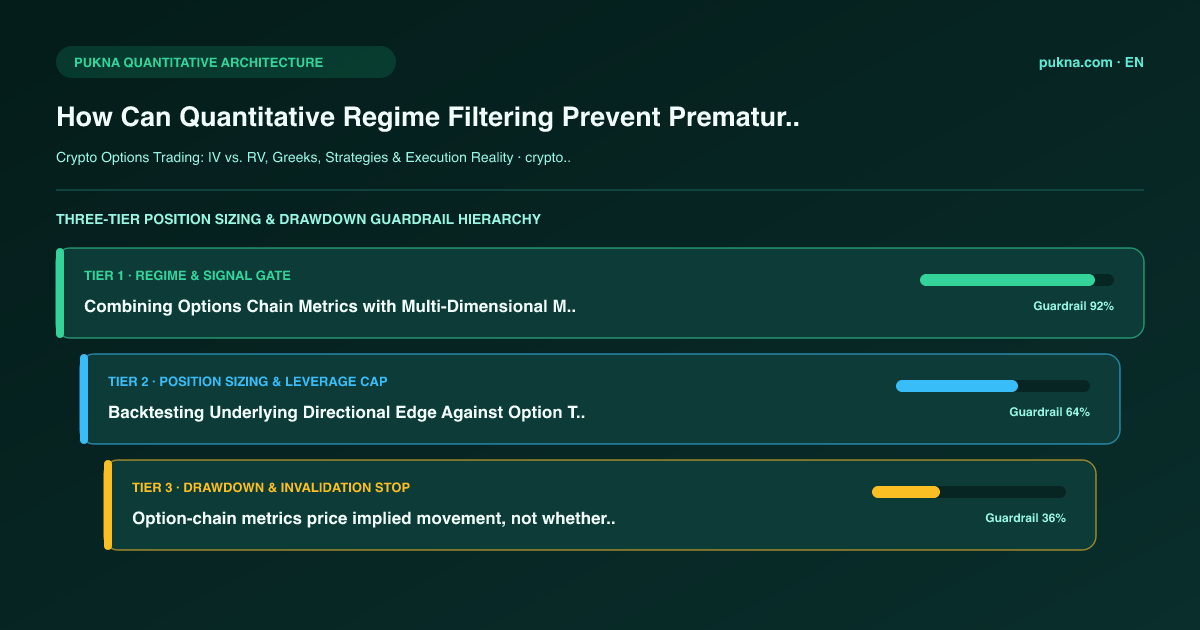
Disciplined desks run a three-layer upstream filter before touching an options order ticket. First, screen macro risk appetite via real yield headwinds & dollar liquidity impulse, cross-asset equity volatility spillovers, and stablecoin mint-burn netflow & dry powder velocity. Tightening dollar liquidity systematically compresses crypto upside tails.
Second, audit perpetual crowding before buying directional convexity. Baseline funding clamped at +0.01% per 8 hours equals 10.95% annualized carry; spikes well above that with rising coin-denominated open interest flag fragile longs. Under crowded leverage, raw breakouts routinely snap back into long liquidations. Third, check 15m, 1h, 4h, and 1d alignment so intraday noise never drags long Vega into daily resistance.
Backtesting Underlying Directional Edge Against Option Time Decay
Because options expire, validating underlying directional edge historically matters more than tweaking strike deltas. Closed-candle equity curves often hide brutal intraday drawdowns that wipe out short-dated spreads before a trend resumes. Non-linear recovery math is unforgiving: a 50% drawdown demands a +100% rally just to break even, and 3x leverage turns a 12% pullback into roughly a 36% hit.
Options execution stays on your chosen exchange, while upstream validation works best in one research loop. On Pukna, researchers screen 42 major USDT pairs by pairing multi-dimensional macro and derivatives indicators with multi-timeframe causal signal methodology on 15m, 1h, 4h, and 1d charts. Strict point-in-time causality strips out look-ahead bias.
Gauge setup strength using the P relative quality score (0–100) across horizon_bars, where 50 marks neutral parity with surrounding ordinary candles. Higher scores reflect stronger combined peak and terminal return quality over that window—never a win-rate probability. Next, run an AUTO historical equity curve & 1x–3x integer-leverage review to audit win rates and max drawdowns before paying Theta. Unverified trends never justify steep time decay.
| Pre-Trade Step | Unfiltered Discretionary Option Entry | Regime-Filtered Quantitative Workflow |
|---|---|---|
| Macro & Liquidity Context | Ignores equity VIX, dollar liquidity, and stablecoin flow shifts. | Screens macro rates, liquidity, sentiment, and on-chain flows via unified environment indicators first. |
| Derivatives Crowding Check | Buys breakout calls into overheated funding and stretched basis. | Flags funding spikes above 10.95% annualized carry and coin-OI crowding before sizing directional legs. |
| Underlying Timing | Relies on single-timeframe chart breakouts prone to whip-saw. | Requires 15m/1h/4h/1d causal alignment plus above-neutral P relative quality score (>50 baseline). |
| Risk & Drawdown Audit | Guesses option leverage without historical underlying path testing. | Audits AUTO 1x–3x simulated equity curves and max drawdowns to verify trend edge justifies Theta cost. |
Accurate regime filtering improves timing, yet poor venue selection and fragmented liquidity can still erase your analytical edge at the bid-ask spread.
US-Regulated vs. Global Crypto Options Platforms: Where Does Liquidity Sit?
Crypto options liquidity splits sharply along jurisdictional lines, routing US and global traders onto separate rails with distinct spreads and fee caps. Treating offshore and domestic books as interchangeable invites geo-blocks, thin fills, and hidden slippage. Venue choice directly shapes net return.
US-Regulated Routes vs. Global Crypto-Native and On-Chain Venues
Search results often point global traders to India-focused INR venues, muddying real US and international access rules. Offshore leaders like Deribit and Binance restrict US residents outright. US participants instead trade regulated crypto volatility via CME Bitcoin and Ether futures options, spot ETF chains (IBIT, ETHA) at standard brokerages, or CFTC-regulated Coinbase Derivatives.
Outside restricted jurisdictions, Deribit dominates institutional BTC and ETH open interest because its portfolio margin offsets options directly against perpetual hedges. Binance, OKX, and Delta Exchange instead emphasize smaller linear USDT contracts. On-chain venues such as Derive and Aevo provide self-custodial smart-contract settlement, though longer-dated and far-OTM orderbooks remain relatively thin. Thin altcoin books punish impatient entries.
| Venue Tier & Examples | Core Underlyings | Settlement Currency | Liquidity Profile | Fee Mechanics / US Access |
|---|---|---|---|---|
| Offshore Institutional (Deribit) | BTC, ETH, select majors | Inverse (BTC/ETH) & USDC linear | Deepest 24/7 crypto-native OI & multi-expiry depth | Fee Mechanics: Per-contract maker/taker capped as % of premium · US Access: Restricted |
| Global Retail CEX (Binance, OKX, Delta) | BTC, ETH, SOL, select alts | Linear USDT/USDC (plus select inverse) | Solid front-month majors; wider spreads on alts | Fee Mechanics: Low notional fee with premium percentage caps · US Access: Restricted / Geo-fenced |
| On-Chain DeFi (Derive, Aevo) | BTC, ETH, majors | USDC / stablecoin margin | Growing ATM depth; thinner far-OTM books | Fee Mechanics: Gas plus protocol taker/maker & fee caps · US Access: Check protocol terms |
| US Regulated TradFi (CME, IBIT/ETHA ETFs, Coinbase Derivatives) | BTC & ETH futures or spot ETFs | USD cash / physical ETF shares | Deep institutional CME & US equity-hours ETF liquidity | Fee Mechanics: Brokerage per-contract fee; no 24/7 ETF trading · US Access: Fully Regulated |
Evaluating Orderbook Liquidity, Bid-Ask Spreads, and Fee Caps
Headline maker-taker fees rarely drive your largest execution drag in crypto options. On thin altcoin chains or distant quarterly expiries, a widening bid-ask spread of 5%–10% creates steep implementation shortfall before Theta even starts ticking. Always check exchange premium fee caps alongside delivery charges before routing low-cost OTM hedges. Use limit orders—never market-buy thin chains.
Orderbook depth split across CEXs, DeFi vaults, and TradFi venues never sums into one usable liquidity pool. As documented in BIS research on crypto market fragmentation, margin silos and collateral transfer lags stop arbitrageurs from unifying books during shocks. Macro gauges like DVOL, funding, and VIX frame broad stress, yet never replace checking live depth on your exact strike. Summed global volume hides real execution slippage.
Token Cross Venue Liquidity Accessibility Pipeline
| Checkpoint | Empirical Criterion & Execution Guardrail |
|---|---|
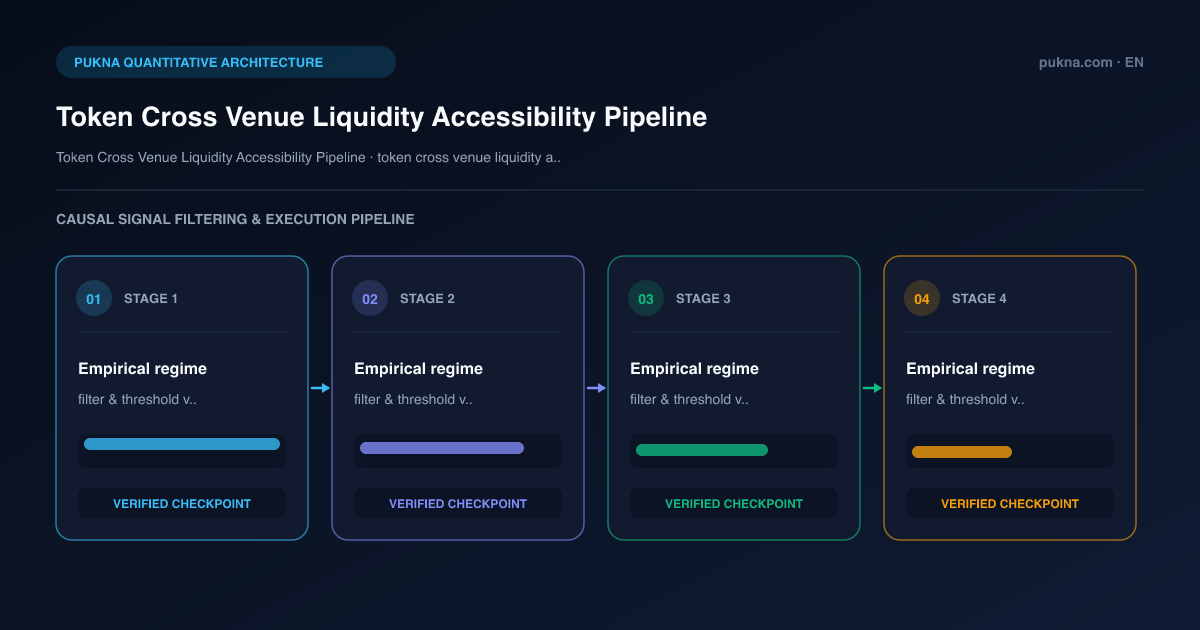
| Phase 01 | Verify real venue accessibility, jurisdictional eligibility, and non-overlapping margin silos before aggregating CEX and DEX liquidity. |
| Phase 02 | Measure executable bid-ask depth within fixed slippage bands using uniform quote currency, timestamp, and reference strike pricing. |
| Phase 03 | Stress-test quote withdrawal, spread widening, bridge transfer latency, and exercise fees under volatility spikes before scaling size. |
Deep, compliant venues cut execution slippage, yet strict position sizing and scam filters remain the final firewall protecting your account.
How Do Traders Control Tail Risk and Spot Crypto Options Scams?
Capital survival in crypto options rests on capping single-expiry premium risk, rejecting naked short convexity, and avoiding fake betting apps. Most severe retail wipeouts stem from oversized weekly tickets or fraudulent offshore interfaces rather than subtle Greek errors. Sizing mistakes kill faster than bad models.
Red Flags of Fake Binary Options and Counterparty Scams
Scammers routinely rebrand unregulated “binary options” apps—fixed-timer up-or-down bets on rigged feeds—as real crypto options trading. Legitimate contracts offer two-sided orderbooks, transparent composite settlement indexes, and early exit before expiry. Social-media signal groups advertising steady daily payouts or cloned apps demanding “withdrawal taxes” are instant fraud red flags. No legitimate exchange holds withdrawals for ransom.
Even on regulated or major venues, two misconceptions routinely drain accounts. Oversizing far-OTM weekly lottery calls invites rapid 100% premium wipeouts. Treating quarterly Max Pain levels as reliable price magnets ignores live order flow—heavy spot inflows or forced liquidations regularly slice straight through Max Pain strikes. Never trade folklore over defined risk.
| Verification Check | Legitimate Options Venue | Fraudulent Options / Fake Binary App |
|---|---|---|
| Contract Structure | Standardized strikes, expiries, Greeks, and early exit on a live orderbook. | Fixed 60-second “up/down” binary wagers with no transferable secondary market. |
| Price Discovery | Public composite spot index and auditable mark-price calculation. | Opaque internal price feed that diverges from major spot exchanges near expiry. |
| Return Claims | Explicit risk disclosures covering total premium loss and margin liquidation. | Promises of steady daily payouts, managed recovery trades, or zero-downside income claims. |
| Withdrawals & Custody | Published fee schedules, verifiable licensing or open-source smart contracts. | Unexpected withdrawal freezes demanding upfront “tax” or “liquidity unlock” deposits. |
Five-Step Pre-Trade Risk Checklist for Options Traders
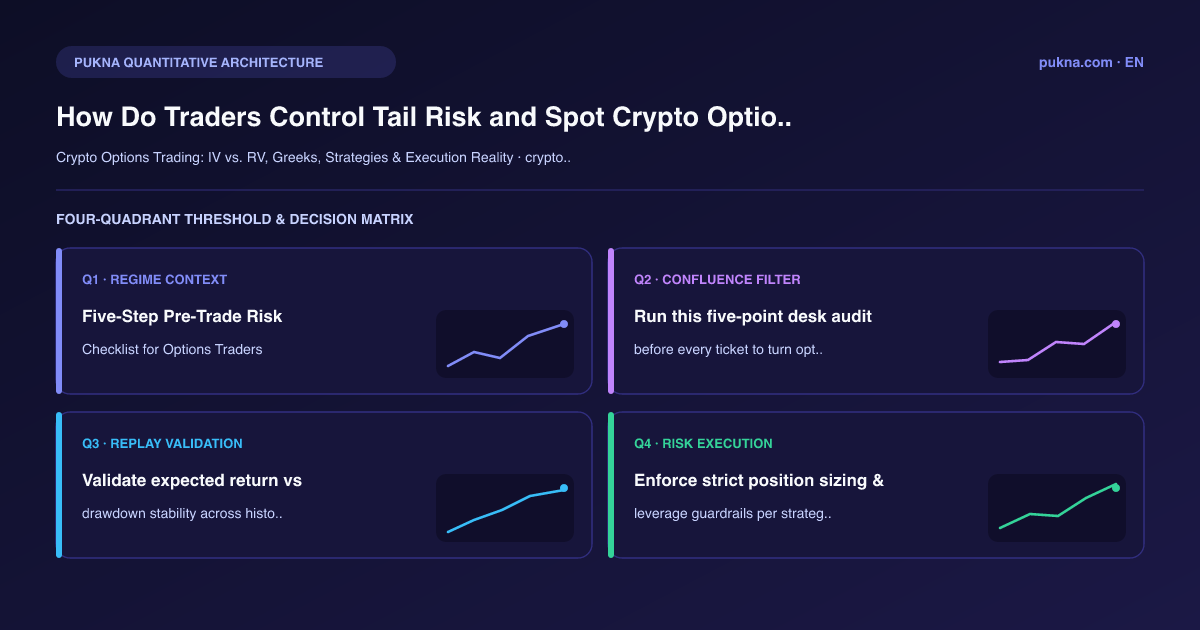
Run this five-point desk audit before every ticket to turn options theory into repeatable execution discipline:
- Confirm Macro & Crowding Regime: Screen dollar liquidity, perpetual funding carry, and overheated retail sentiment readings before buying calls into exhausted late-stage squeezes.
- Audit the IV–RV Spread: Compare target-expiry implied volatility against trailing realized volatility; favor debit spreads when IV sits cheap and defined-risk credit spreads when VRP runs rich.
- Enforce Hard Defined Risk: Cap total premium at risk per expiry to a small fixed equity slice (typically 1%–2%), and replace naked short options with capped verticals or iron condors.
- Check Strike Depth & Fee Caps: Confirm tight spreads, resting orderbook depth, and exchange premium fee caps on your exact strike before placing limit orders—never market-buy thin OTM chains.
- Cross-Check Token Catalysts & Drawdowns: Before paying directional premium, check asset-specific catalysts in the Pukna 43-token research library. Pair that with an AUTO simulated win-rate and max-drawdown audit so your thesis survives normal volatility noise.
| Research Scenario | Core Criterion | Empirical Takeaway | Full Study |
|---|---|---|---|
| Judging whether options are expensive or cheap | IV–RV spread, 25-delta skew, and term structure | High implied volatility alone is neither a sell signal nor proof of overpriced options without realized volatility context. | Crypto Options Volatility: IV–RV Spread, Skew & Regimes → |
| Filtering 1h/4h Bitcoin breakout setups | Zero-gamma flip, coin OI, DVOL, Deribit vs. CME | Positive Bitcoin gamma exposure pins price near key strikes rather than fueling directional breakouts. | Bitcoin Gamma Exposure: +GEX Pinning, Flip & Coin OI → |
| Screening post-liquidation volatility regimes | Deribit DVOL, rolling Z-scores, funding, 1d–15m drawdown | Trailing realized volatility peaks after forced liquidations finish in 24/7 crypto markets. | Crypto Market Volatility: Raw Swings vs. DVOL, Z-Scores & Funding → |
| Classifying the four crypto market cycle phases | Dollar liquidity, perp funding, coin OI, DVOL, 1x–3x drawdown | Single indicators invert polarity across volatility shifts, requiring liquidity and derivatives confirmation. | Crypto Market Cycle: 4 Phases, Liquidity, Funding & DVOL → |
| Structuring and backtesting Bitcoin options trades | Payoff breakevens, inverse vs. linear venues, skew, Greeks | Bitcoin options outcomes depend on volatility pricing and venue mechanics rather than spot direction alone. | Bitcoin Options: Payoffs, Implied Volatility, Greeks, Venues & Regime Backtesting → |
Frequently Asked Questions
Can US residents legally trade crypto options?
Offshore crypto-native venues like Deribit and Binance geo-block US residents from direct orderbook access. Instead, US traders access regulated volatility through CME Bitcoin and Ether futures options, CFTC-regulated Coinbase Derivatives, or listed US spot ETF options (IBIT, ETHA) via standard brokerages. Because depth clusters near front-month strikes, check bid-ask spreads before routing orders.
Why can a Bitcoin call option lose money even when BTC rallies?
A long call must clear both strike and upfront premium at expiry just to break even. Before expiry, post-event IV crush can wipe out Vega faster than Delta gains build while daily Theta bleeds extrinsic value. Correct direction never rescues an overpriced ticket; check implied-to-realized volatility spread benchmarks first.
What is the difference between inverse coin-margined and linear USDT crypto options?
Inverse options use the underlying coin (BTC or ETH) for margin and settlement, while linear contracts settle strictly in stablecoins like USDT or USDC. That difference compounds tail risk: if spot drops 20% against a short inverse put, dollar obligations jump as posted BTC collateral falls 20%. See our Bitcoin options payoff and venue mechanics guide for settlement sizing.
Does options Max Pain reliably predict Bitcoin’s expiry price?
Max Pain does not reliably predict expiry prices. It merely marks the strike where expiring buyers face peak theoretical loss under static open interest. During low-volatility chop, dealer hedging can create mild pinning near 08:00 UTC. Strong spot flows routinely break that pin, making dealer gamma flip mechanics a cleaner structural gauge.
Put this into practice
Create a free account to browse live signals and test your own rules.