Crypto Market Cycles: Halving Clock vs. 4-Phase Regimes
Crypto market cycles do not run on a halving clock. Screen four phases with trend, valuation, and liquidity, then validate strategy drawdowns via point-in-time backtests.
Focused tactical archives for calibrating P-score cutoff thresholds, tuning horizon_bars windows, and setting 1–3x integer leverage caps. Articles here provide concrete anomaly-filtering rules for liquidity spikes and macro-event outliers, alongside hands-on checklists to audit look-ahead bias, equity-curve stability, and max drawdown before enabling real-time AUTO alerts. For the overarching structural framework, explore our complete guide in Quantitative Signals & Empirical Backtesting (https://pukna.com/category/blog/crypto-quant-analysis/quant-signals-backtesting/).
Crypto market cycles do not run on a halving clock. Screen four phases with trend, valuation, and liquidity, then validate strategy drawdowns via point-in-time backtests.
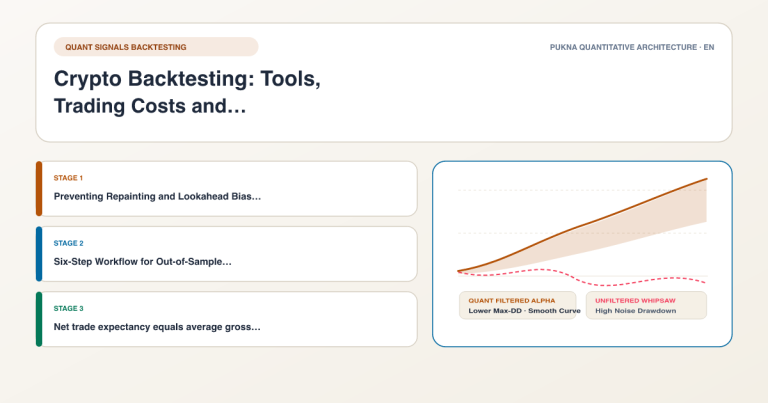
Ignoring fees, funding and lookahead bias can inflate backtest returns. Compare tools and evaluate net expectancy and drawdowns on unseen market data.
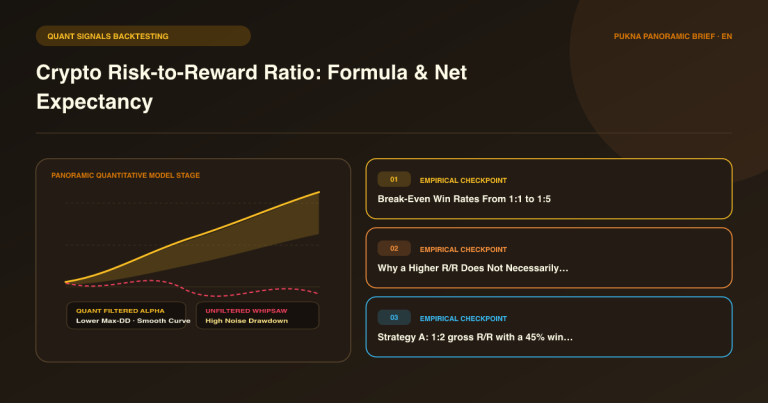
A 1:3 chart setup can have negative expectancy. Calculate net risk-to-reward, break-even win rates and position sizes, then validate them with backtests.
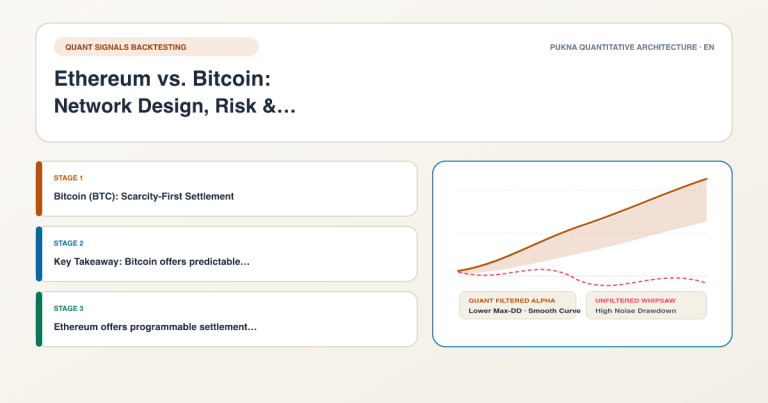
Bitcoin has a fixed cap and often lower volatility than programmable Ethereum. Use the ETH/BTC ratio and 15m–1d backtests to compare risk, not just returns.
Meme coins do not trade on social hype alone. Filter liquidity tiers, screen out micro-cap traps, and validate 15m–1d causal signals with drawdown-tested backtests.
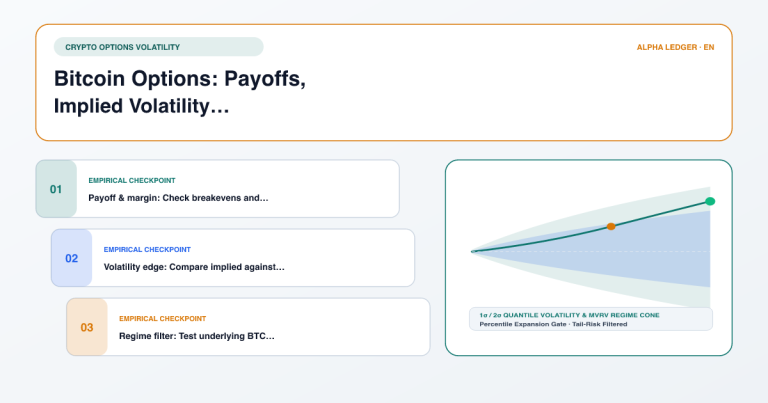
Bitcoin options hinge on volatility pricing, not direction alone. Filter trades by payoff breakevens, inverse or linear venues, IV skew, Greeks, and regime backtests.