Contents6 sections
- How Do Decentralized Exchanges Work vs. CEXs and Aggregators?
- Non-Custodial Smart-Contract Settlement vs. Custodial Matching Engines
- Four Core DEX Architectures: AMMs, StableSwap Curves, On-Chain CLOBs, and Aggregators
- How Do DEX Liquidity and Slippage Shift Across Volatility Regimes?
- Range-Bound Regimes: Tight Concentrated Depth and Narrow Spreads
- Directional Trends: Active-Tick Depletion and CEX-to-DEX Arbitrage Lag
- Volatility Shocks: Gas Congestion, Slippage Expansion, and MEV Extraction
- Why Do Headline TVL, Pool Fees, and DEX Volume Mislead Traders?
- Headline TVL vs. Usable Depth Within ±2% of Mid-Price
- Nominal Pool Fees vs. All-In Execution Cost (Impact, Gas, and MEV)
- Layer-2 Rollups (Base), Stablecoin Curves, and Native vs. Wrapped BTC
- Token Cross-Venue Liquidity Accessibility Pipeline
- How Do DEX Venue Archetypes Compare and Filter On-Chain Flow?
- Objective Screening Criteria Across Spot AMMs, L2s, Stablecoin Pools, and BTC Routers
- Filtering Noisy DEX Volume Spikes Against Multi-Factor Market Regimes
- How Should Traders Execute and Audit DEX Strategies Safely?
- Pre-Trade Contract Hygiene, Slippage Caps, and MEV Protection
- Benchmarking All-In Costs and Auditing Timing With Historical Drawdowns
- Related Quantitative Microstructure and Execution Studies
- Frequently Asked Questions
Decentralized exchanges (DEXs) are non-custodial smart-contract venues that settle peer-to-peer or peer-to-pool swaps directly on-chain, distinct from custodial CEX order books and wallet swap front-ends. Headline Total Value Locked (TVL) and 0.05%–0.30% nominal pool fees conceal real execution friction, which turns on usable ±1% to ±2% depth and all-in basis-point cost across price impact, gas, and MEV. Traders must verify venue mechanics, mempool congestion, and spot liquidity regimes before routing size or reading raw DEX volume as directional flow.
How Do Decentralized Exchanges Work vs. CEXs and Aggregators?
Decentralized exchanges eliminate custodial counterparty risk via on-chain smart-contract settlement, yet execution quality depends on liquidity-curve geometry rather than interface design.
| Venue Model | Custody & Settlement | Price Discovery | Dominant Cost Driver | MEV Exposure / Optimal Trade Fit |
|---|---|---|---|---|
| Custodial CEX | Exchange omnibus wallets; off-chain ledger matching | Central Limit Order Book (CLOB) | Maker/taker fee + bid-ask spread | MEV Exposure: None (private matching engine) · Optimal Trade Fit: Deep majors, high-frequency flow, fiat ramps |
| Constant-Product / Concentrated AMM | Non-custodial smart-contract pools; atomic settlement | Algorithmic curve (x · y = k or active ticks) |
Pool fee + price impact + gas | MEV Exposure: High on public mempool swaps · Optimal Trade Fit: Permissionless spot pairs, mid-sized calm fills |
| StableSwap DEX | Non-custodial pooled reserves on-chain | Amplified flat curve near 1:1 parity | Low pool fee (0.01%–0.04%) + gas | MEV Exposure: Low to moderate (tight bands) · Optimal Trade Fit: Large stablecoin or pegged-asset rebalancing |
| On-Chain / Hybrid CLOB | Non-custodial margin or vault contracts | Discrete limit bids and asks by tick | Taker fee + cancel/gas latency | MEV Exposure: Low to moderate (fast finality) · Optimal Trade Fit: Active limit orders and tight spread capture |
| DEX Aggregator / Intent Router | Non-custodial pass-through router or solver settlement | Split routing across pools and RFQ makers | Multi-hop fees + added gas cost | MEV Exposure: Low via batch auctions / private RFQ · Optimal Trade Fit: Large tickets across fragmented liquidity |
Non-Custodial Smart-Contract Settlement vs. Custodial Matching Engines
Centralized exchanges take custody of user deposits and match trades on internal off-chain ledgers until withdrawal. Decentralized exchanges keep tokens inside self-custodial wallets until atomic block execution settles directly against smart contracts. Self-custody removes exchange insolvency risk. It does not eliminate smart-contract bugs, adverse selection, or thin order book slippage.
Wallet swap buttons create a common execution blind spot. Browser wallets and aggregator interfaces operate as routing front-ends, not standalone liquidity venues. They query external on-chain pools, split routes automatically, and frequently tack on a 0.15% to 0.875% interface markup. Inspect the underlying pool route before signing any swap.
Four Core DEX Architectures: AMMs, StableSwap Curves, On-Chain CLOBs, and Aggregators
Automated Market Makers (AMMs) replace resting limit bids with pooled token reserves priced along deterministic curves. Classic constant-product pools enforce a strict reserve invariant across every trade:
x · y = k
Inside a balanced $2,000,000 ETH/USDC constant-product pool ($1,000,000 per side), a $100,000 ETH purchase pushes the average fill price 10% worse than spot before pool fees. Concentrated-liquidity AMMs pack capital into narrow price ticks to slash that slippage dramatically. StableSwap curves flatten pricing around 1:1 parity, letting large pegged-asset swaps clear with minimal drift.
On-chain and hybrid CLOBs restore discrete limit orders on high-throughput rollups or app-chains, letting professional makers re-quote rapidly without passive inventory bleed. DEX aggregators sit one layer higher across both models. Splitting a large clip across multiple pools lowers price impact, yet extra routing hops turn net-negative when gas spikes on small tickets.
How Do DEX Liquidity and Slippage Shift Across Volatility Regimes?
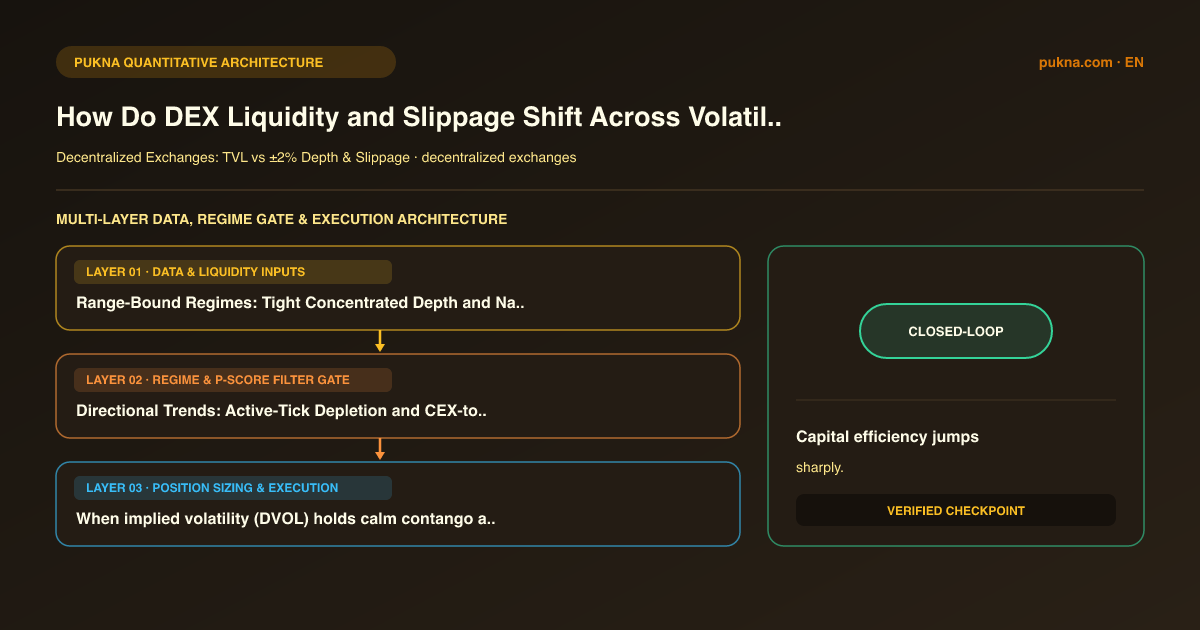
Identical DEX pool depth and nominal fee tiers deliver CEX-competitive fills in calm markets, yet break down fast once directional breakouts or liquidation shocks drain active ticks.
| Market Volatility Regime | Active ±2% Pool Depth | Slippage, Gas & MEV Friction | CEX–DEX Price Basis | Execution & Signal Interpretation |
|---|---|---|---|---|
| Range-Bound Consolidation (Low DVOL, balanced funding) | Dense; LPs cluster tightly near spot mid-price | Compressed; competitive with Tier-1 CEX taker fees on ≤$50K clips | Tight (±2–8 bps); fast arbitrage aligns quotes | Active depth stays reliable; turnover tracks organic spot flow |
| Directional Breakout (Rising DVOL, persistent trend) | Hollows out quickly as price exits active ticks | Rising price impact + stale-quote arbitrage lag | Widens (±15–50 bps) as CEX leads on-chain pools | Nominal TVL looks unchanged while LPs absorb heavy LVR |
| Liquidation & Stress Shock (DVOL spike, funding flips) | Severely depleted; LPs withdraw or fall out of range | Surging block gas, priority tips, and sandwich MEV | Severe dislocations (±50–200+ bps) across venues | Cheap 0.05% pools turn costly; volume reflects forced churn |
Range-Bound Regimes: Tight Concentrated Depth and Narrow Spreads
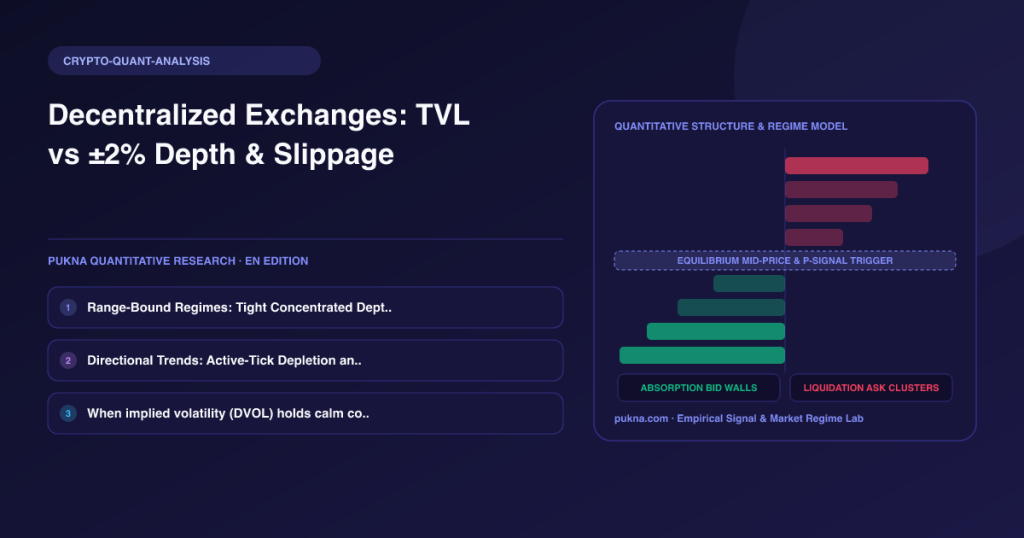
When implied volatility (DVOL) holds calm contango and spot oscillates inside a defined range, concentrated liquidity providers cluster reserves within ±1% to ±3% of mid-price. Capital efficiency jumps sharply. A $5 million concentrated pool can match far deeper constant-product reserves on routine spot clips. Low block congestion keeps gas predictable while arbitrageurs pin on-chain quotes near CEX mid-prices.
Directional Trends: Active-Tick Depletion and CEX-to-DEX Arbitrage Lag
Fast directional breakouts shatter that equilibrium. Once spot crosses active tick boundaries, pool reserves convert wholly into the weaker asset, leaving hollow depth exactly where momentum traders demand execution. Passive LPs simultaneously suffer Loss-Versus-Rebalancing (LVR) because centralized matching engines reprice in milliseconds while blockchains update only per block. Arbitrageurs extract that stale-quote lag straight from passive pools.
Tight concentrated LP ranges mirror range-bound grid spacing versus trend bleed. Narrow bands harvest steady fees during sideways chop, then lose capital efficiency the moment trend velocity accelerates. Headline TVL masks that decay completely. Usable ±2% depth often drops 60% to 80% while total locked value barely shifts.
Volatility Shocks: Gas Congestion, Slippage Expansion, and MEV Extraction
Liquidation cascades trigger simultaneous friction spikes across Ethereum and congested rollups. Forced collateral auctions and a funding-flip short squeeze on derivatives venues flood block space with urgent orders, driving base gas and priority tips sharply higher. Widened spreads draw Maximal Extractable Value (MEV) bots hunting public mempools for loose swaps. Slippage expands fastest right when traders seek deleveraging confirmation during deep drawdowns.
Under liquidation stress, a 0.05% nominal pool fee becomes irrelevant. Combined price impact, elevated priority gas, and sandwich extraction routinely push round-trip friction past 150–300 bps on mid-cap pairs. Waiting for congestion to clear or shifting to private intent settlement frequently saves over 100 bps.
Why Do Headline TVL, Pool Fees, and DEX Volume Mislead Traders?
Single-metric DEX dashboards systematically understate execution friction because headline TVL, nominal fee tiers, and gross 24-hour volume hide inactive ticks, gas drag, and incentive-farmed churn.
| Raw Metric Reading | Underlying Distortion Mechanism | Verified Threshold Check |
|---|---|---|
| High Headline TVL ($50M+) | Reserves sit in full-range pools or out-of-range ticks far from spot | Audit active depth within ±1% to ±2% of mid-price; cap clips at ≤1%–2% of active band |
| Low Pool Fee Tier (0.01%–0.05%) | Excludes price impact, network gas, wallet UI markups, and MEV | Benchmark all-in bps execution cost directly against liquid CEX spot mid-price |
| Spiking 24h DEX Volume | Driven by liquidity-mining wash loops, peg churn, or CEX–DEX arbitrage | Verify net taker direction, perpetual open interest changes, and cross-venue spot flows |
| Multi-Chain Aggregated Volume | Fragmented L1, L2, and wrapped liquidity cannot merge atomically | Measure single-venue reachable depth, canonical contract reserves, and bridge transfer drag |
Headline TVL vs. Usable Depth Within ±2% of Mid-Price
Headline TVL sums every dollar parked along a pool curve, including idle reserves sitting 35% away from live spot. A $50 million full-range pool can impose heavier price impact on a $100,000 swap than a $5 million concentrated pool holding 70% of its reserves inside ±1% of mid-price. Active depth near spot sets slippage. Out-of-range liquidity provides zero buffer.
Cross-protocol stress widens that blind spot. Once DeFi lending utilization breaches the 80%–92% rate kink, spiking borrow costs force leveraged LPs to unwind paired DEX positions at once. Auditing single-pool depth alongside broad crypto market capitalization benchmarks stops traders from mistaking macro asset scale for immediately executable on-chain depth.
Nominal Pool Fees vs. All-In Execution Cost (Impact, Gas, and MEV)
Picking a venue by its advertised 0.05% or 0.30% pool tier ignores implementation shortfall and market-impact cost. True execution accounting tracks every basis point leaving the fill:
All-In Cost (bps) = Pool Fee + Price Impact + (Gas Fee / Order Size) + MEV Drag
Consider a $2,000 swap routed on Ethereum Layer-1 during active hours inside a 0.05% pool. A $12 gas fee alone adds 60 bps, while 20 bps of price impact and 25 bps of sandwich drag lift realized cost to 110 bps. That equals 22 times the advertised tier. Much like fee-drag accounting across hedged staking vehicles, unmeasured swap friction quietly compounds against net returns.
Layer-2 Rollups (Base), Stablecoin Curves, and Native vs. Wrapped BTC
Liquidity split across Ethereum Layer-1, Layer-2 rollups, and sovereign chains cannot merge atomically. As documented in the BIS study on blockchain scalability and market fragmentation, transfer latency, bridge tolls, and separate fee markets lock trading capacity inside isolated pools. Sub-cent gas on rollups like Base makes $500–$5,000 swaps far cheaper, yet large clips still require venue-level depth audits.
Asset design introduces equally sharp trade-offs. Routing large USDC/USDT swaps across standard constant-product pools leaks unnecessary slippage, whereas StableSwap curves flatten pricing near parity to keep fills near 1–4 bps. Bitcoin adds a custody boundary as well. Wrapped BTC (WBTC or cbBTC) accesses deep EVM liquidity under issuer custody assumptions. Native cross-chain BTC routers preserve Layer-1 Bitcoin settlement, yet carry slower confirmation times and wider spreads.
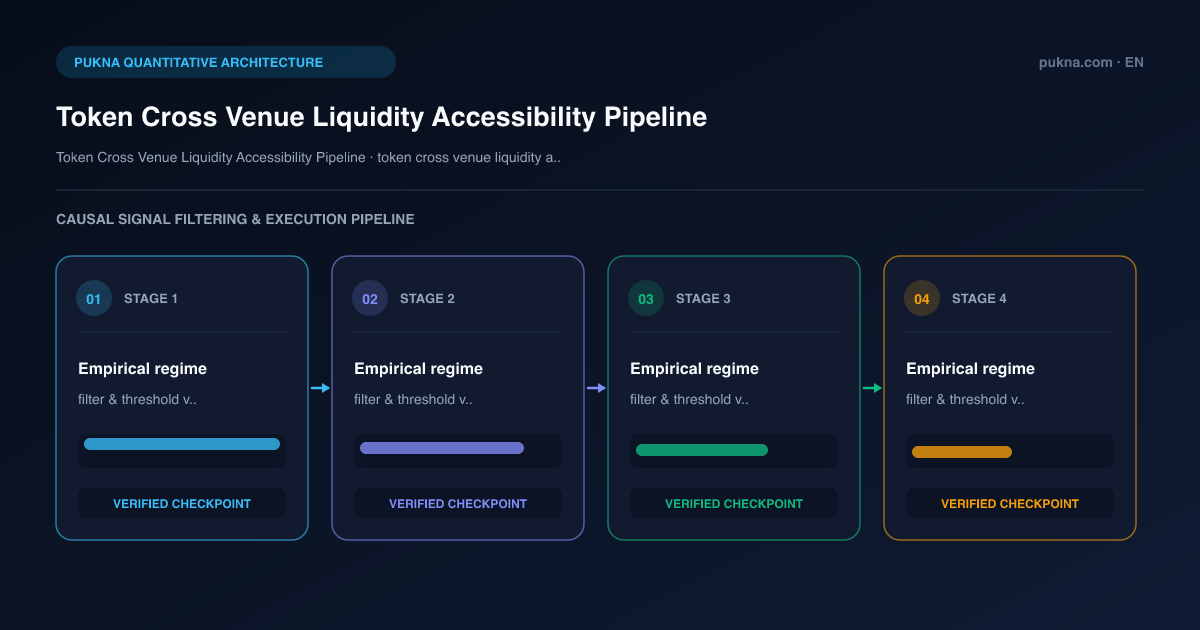
Token Cross-Venue Liquidity Accessibility Pipeline
| Checkpoint | Empirical Criterion & Execution Guardrail |
|---|---|
| Phase 01 · Venue Accessibility | Confirm each CEX, DEX pool, and chain route is directly accessible without transfer halts, withdrawal locks, or non-fungible wrapped bridges. |
| Phase 02 · Unified Depth Audit | Measure executable bid depth within ±1% to ±2% using a single timestamp, quote currency, and reference mid-price while stripping double-counted router liquidity. |
| Phase 03 · Stress Haircut Check | Apply explicit spread-widening, gas-spike, and bridge-friction haircuts rather than extrapolating marginal swap price across large position exits. |
How Do DEX Venue Archetypes Compare and Filter On-Chain Flow?
Matching ticket size, asset design, and chain finality to venue architecture beats chasing protocol rankings, provided traders filter DEX flow against broader market regimes.
Objective Screening Criteria Across Spot AMMs, L2s, Stablecoin Pools, and BTC Routers
No single decentralized exchange leads across every ticket size and asset class. Protocol rankings anchored to gross TVL or token incentives ignore gas floors, MEV exposure, and active depth. Screen venue archetypes instead on four auditable criteria: usable ±2% depth, MEV defense, gas-to-notional efficiency, and battle-tested smart-contract security.
| Venue Archetype | Primary Execution Fit | Active Depth & Cost Edge | MEV & Gas Profile | Core Structural Risk |
|---|---|---|---|---|
| Concentrated AMMs (L1) | Mid-to-large blue-chip spot swaps | Deepest on-chain majors inside ±2% ticks | High L1 gas floor; pair with private RPC | LP LVR in breakouts; contract risk |
| Layer-2 Hubs (e.g., Base) | Sub-$10K spot swaps & active rebalancing | Sub-cent gas removes small-ticket fee drag | Minimal gas; sequencer ordering reliance | Thinner mid-cap depth; bridge exit lag |
| StableSwap Pools | Large stablecoin & pegged-asset swaps | Flat parity curve holds fills near 1–5 bps | Low sandwich payoff within tight bounds | De-peg events drain healthy pool leg |
| On-Chain / Hybrid CLOBs | Limit-order execution & spread capture | Zero curve slippage on filled limit bids | Fast finality curbs stale-quote arbitrage | Thin order book depth on long-tail pairs |
| Intent / Aggregator Routers | Large orders across fragmented pools | Blends DEX depth with off-chain RFQ solvers | Batch auctions neutralize mempool MEV | Solver availability or quote fallback |
| Native Cross-Chain BTC Routers | Self-custodial native BTC swaps | Eliminates wrapped-BTC issuer custody | Higher block latency and outbound fees | Cross-chain validator & liquidity caps |
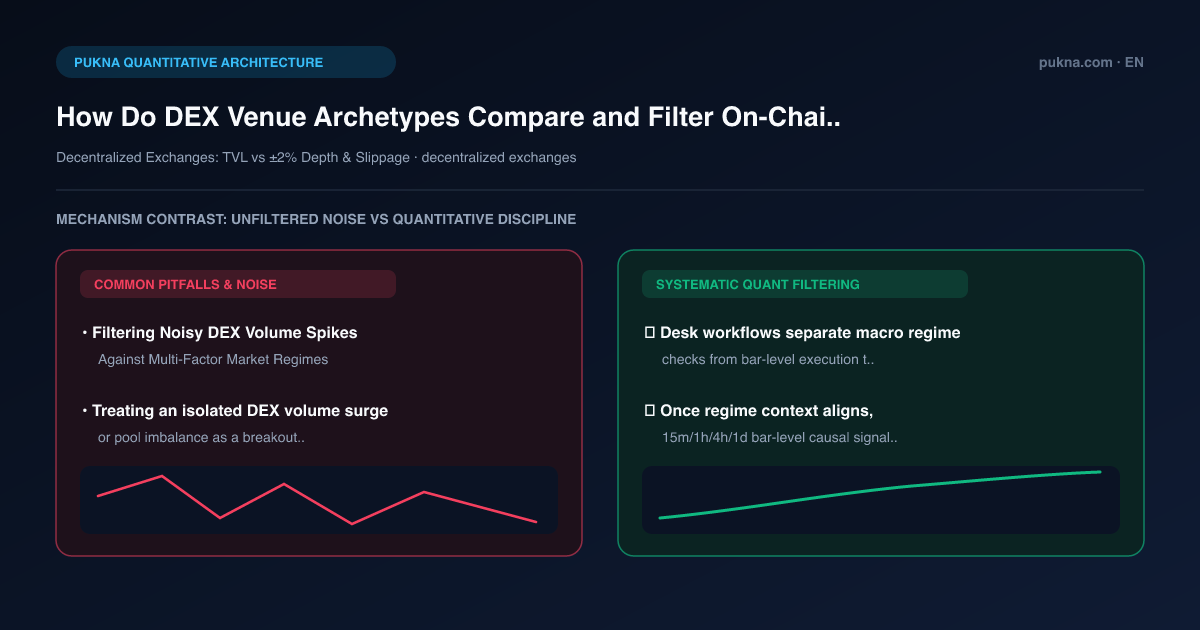
Filtering Noisy DEX Volume Spikes Against Multi-Factor Market Regimes
Treating an isolated DEX volume surge or pool imbalance as a breakout signal invites costly whipsaws. Liquidity-mining wash loops, stablecoin rotations, and CEX–DEX arbitrage routinely inflate raw turnover without genuine spot demand. Confirm whether on-chain flow aligns with perpetual basis, funding rates, Bitcoin derivatives account positioning skew, and the composite investor sentiment benchmark.
Desk workflows separate macro regime checks from bar-level execution timing. On Pukna, inspecting the 8-dimension 39-indicator environment library and 43-token research library filters out noisy pool churn whenever macro liquidity, funding, and implied volatility diverge.
Once regime context aligns, 15m/1h/4h/1d bar-level causal signals across 42 major USDT pairs sharpen entry timing. Each signal outputs a P-score (0–100) relative return-quality ranking across horizon_bars, anchored to a P=50 neutral baseline comparable to ordinary surrounding bars. Higher scores capture stronger combined peak-return and final-return quality, never win probability.
How Should Traders Execute and Audit DEX Strategies Safely?
Disciplined DEX execution enforces contract hygiene, 0.10%–0.50% slippage bounds, MEV-protected routing, and historical drawdown audits before committing directional capital.
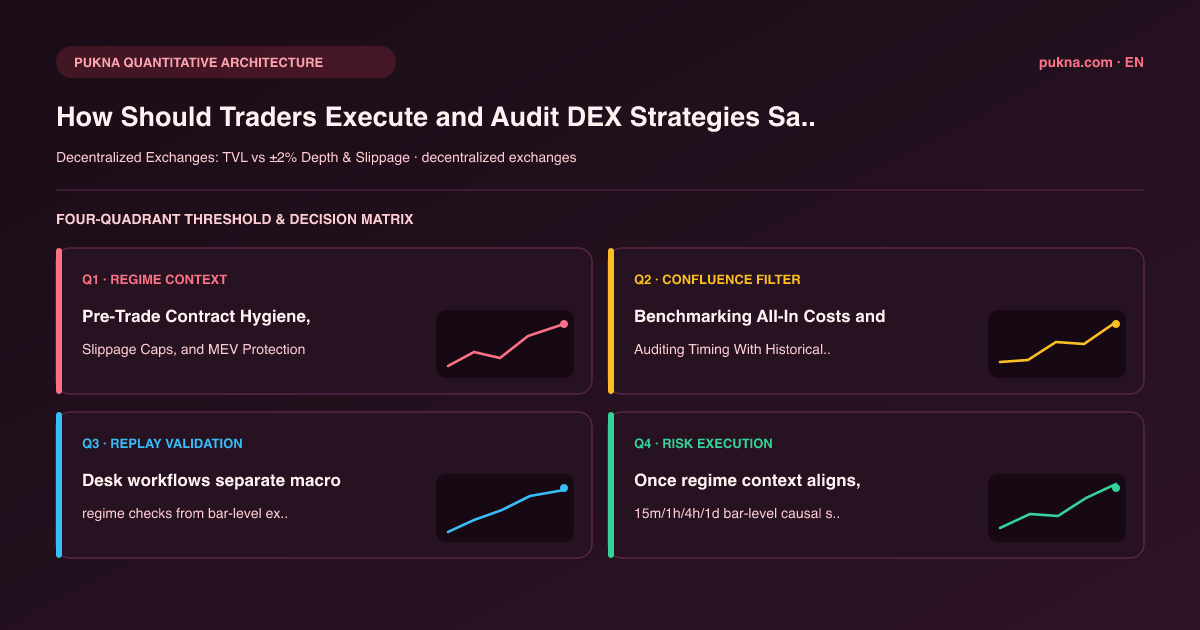
Pre-Trade Contract Hygiene, Slippage Caps, and MEV Protection
On-chain settlement offers no undo button. One spoofed token address or careless 5% slippage cap can drain capital straight into malicious contracts or sandwich bots. Run this five-step checklist before routing meaningful DEX size:
- Verify canonical contracts and transfer rules: Confirm the exact token address on a trusted block explorer, audit hidden buy/sell tax flags, and screen out honeypot contracts blocking exits.
- Cap ERC-20 approvals to exact swap size: Reject unlimited spending approvals by default, revoke stale allowances routinely, and sign major transfers on a hardware wallet.
- Benchmark quotes against CEX spot mid-price: Measure all-in basis-point cost across pool fee, price impact, gas, and MEV against liquid centralized venues before signing.
- Enforce tight slippage bounds and slice large clips: Set tolerance between 0.10% and 0.50% on liquid pairs instead of 3%–5% defaults, and split orders exceeding 1%–2% of active ±2% depth across intervals.
- Route through MEV-protected RPCs or intent auctions: Submit sensitive swaps via private mempool endpoints or batch-auction solvers so bots cannot sandwich pending transactions.
Benchmarking All-In Costs and Auditing Timing With Historical Drawdowns
Clean routing solves only half the expectancy problem. Even zero-MEV fills bleed capital when directional entries fire repeatedly into hostile volatility regimes. Evidence on friction-adjusted crypto strategy backtesting shows zero-cost OHLCV tests surrender 30% to 70% of paper PnL once fees, slippage, and negative-carry bleed enter live trading. Scale ticket size inversely to realized volatility and enforce hard drawdown limits.
Before committing live capital across high-friction regimes, audit timing rules against historical drawdowns. Using Pukna personal simulation strategies, traders configure 1–3x integer leverage for an AUTO simulated win-rate and max-drawdown audit across historical equity curves before subscribing to real-time push alerts. Simulated equity curves set realistic risk guardrails. They never guarantee future returns.
Related Quantitative Microstructure and Execution Studies
DEX depth contraction, cross-venue slippage, and regime filters connect directly to wider crypto risk mechanics. Review empirical thresholds across companion studies below:
| Research Scenario | Core Criterion | Empirical Takeaway | Full Study |
|---|---|---|---|
| Drawdowns exceeding 25% & crash bottoms | Spot inflows, OI flushes, and 1x–3x leverage caps | Extreme Fear and negative funding fail in liquidity drains; wait for deleveraging confirmation. | Crypto Market Crash: >25% Threshold vs False Bottoms → |
| ETH/BTC relative rotation & cross-pair traps | 90-day ±2σ Z-scores, USDT legs, and perp funding | A falling ratio does not equal USD loss; raw Golden Crosses invert without regime filters. | ETH/BTC Ratio: Raw Signal Traps vs ±2σ Regime Filters → |
| Strategy validation & real-friction testing | Bar-close causality, 8h funding carry, walk-forward | Zero-cost OHLCV backtests surrender 30–70% of paper PnL once fees, funding, and slippage hit. | Crypto Trading Strategy Backtesting: Bias vs. Net Edge → |
| 24/7 chart breakouts & wick sweep filtering | Full-body closes, 1.5x 20-bar volume, regime filters | Visual breakouts fail on crypto wick sweeps unless confirmed by close structure and invalidation. | Crypto Chart Patterns: Fakeouts vs 1.5x Volume & Regime Rules → |
| DeFi lending yield & liquidation buffer sizing | 80%–92% kink curves and regime Health Factor | Headline APY and gross TVL mask utilization kinks that spike borrow rates and liquidation risk. | Crypto Lending Protocols: High APY vs 80%+ Kink Risk → |
Frequently Asked Questions
How do decentralized exchanges set prices without an order book?
Most decentralized exchanges use Automated Market Makers (AMMs) that price trades from pooled token reserve ratios via constant-product (x · y = k), concentrated-tick, or StableSwap curves. External arbitrageurs continuously buy discounted pools and sell rich pools against centralized venues. That arbitrage loop keeps on-chain quotes aligned with broader spot prices.
Are decentralized exchanges cheaper than centralized exchanges?
Not automatically. In calm markets, Layer-2 DEXs and StableSwap pools frequently undercut retail CEX taker fees on small-to-medium clips. During volatility spikes, however, Ethereum Layer-1 gas floors, hollow active-tick depth, and mempool MEV sandwiches make DEX fills pricier. Always benchmark all-in basis-point cost across fee, price impact, gas, and MEV against liquid CEX mid-prices.
Can you trade native Bitcoin on a decentralized exchange?
Yes, through two models with distinct trust trade-offs. Most EVM decentralized exchanges trade wrapped Bitcoin tokens like WBTC or cbBTC, pairing deep smart-contract liquidity with custodial issuer risk. Native cross-chain routers settle genuine Layer-1 Bitcoin swaps without wrapped issuers. Traders accept longer block finality and wider spreads in exchange.
Which DEX models work best for stablecoins and Layer-2 networks like Base?
Stablecoin rebalancing fits StableSwap curves or ultra-tight concentrated pools that flatten pricing around 1:1 parity. Large pegged swaps routinely clear within 1–5 bps of slippage there. On low-fee Layer-2 networks like Base, native concentrated AMMs and split-route aggregators strip out small-ticket gas drag on sub-$10,000 orders. Traders still need ±2% active depth checks before sizing up.
Put this into practice
Create a free account to browse live signals and test your own rules.