Contents6 sections
- What Is Ethereum Layer 2 and How Do Rollups Scale Mainnet?
- How an Ethereum L2 Transaction Settles Step by Step
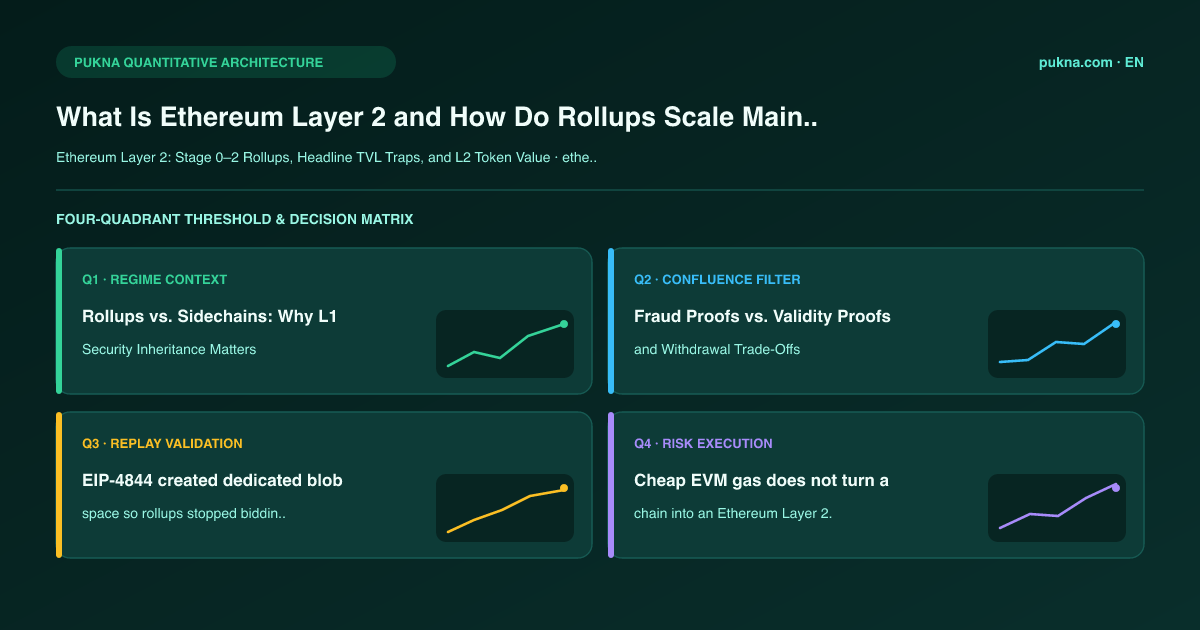
- Rollups vs. Sidechains: Why L1 Security Inheritance Matters
- How Do Optimistic and ZK Rollups Differ Across Stage 0–2 Security?
- Fraud Proofs vs. Validity Proofs and Withdrawal Trade-Offs
- Why Decentralization Stages Matter More Than Theoretical TPS
- Why Does Headline Layer 2 TVL Mask Mercenary Liquidity and Shutdown Risk?
- Reading Past Headline TVL: Stablecoin Stickiness and Net Sequencer Margin
- Interoperability Stacks and Why Incentive-Driven L2s Risk Closing
- Why Do Ethereum Layer 2 Coins Often Lag Network Growth and ETH?
- Why High L2 Transaction Volume Rarely Guarantees Token Appreciation
- FDV Unlock Overhang and Comparing L2 Coins Against Holding ETH
- From L2 Fundamentals to Risk-Managed Execution: A Multi-Dimensional Workflow
- Aligning L2 Token Selection with Macro Liquidity Regimes
- Validating Entry Quality and Drawdown Limits Before Committing Capital
- Frequently Asked Questions About Ethereum Layer 2
Ethereum Layer 2 rollups execute transactions off-chain while anchoring compressed EIP-4844 blob data to Ethereum mainnet, inheriting Layer 1 security guarantees that independent sidechains lack. Over 100 networks advertise cheap gas and high headline TVL, yet Stage 0–2 governance gaps, ETH-paid fees, and heavy FDV unlocks routinely decouple chain usage from L2 token returns. Headline TVL and transaction counts alone miss mercenary liquidity, sequencer halts, and sudden shutdowns, leaving single-metric screens blind across shifting regimes.
| Evaluation Pillar | Surface Misread | Verified Structural Check | Primary Failure Condition |
|---|---|---|---|
| Security Inheritance | All cheap EVM chains share Ethereum L1 security | Audit L1 blob posting, proof status, and Stage 0–2 maturity | Sidechain validator collusion or admin multisig contract capture |
| Ecosystem TVL | High headline TVL proves sticky organic adoption | Isolate native stablecoins and net sequencer margin from farms | Mercenary points capital leaves post-airdrop, starving fee income |
| L2 Token Accrual | Rising L2 volume lifts native L2 coins linearly | Check ETH gas fees, fee routing, and FDV unlock overhang | Monthly insider and grant unlocks overwhelm spot bid depth |
| Market Timing | Strong chain data overrides macro liquidity stress | Filter L2 beta using funding rates, DVOL, and net liquidity | Quarter-end funding squeezes or perp froth spark sharp drawdowns |
Key Takeaways
- True Ethereum Layer 2 rollups publish compressed transaction data to mainnet via EIP-4844 blobs, letting Ethereum enforce final state validity unlike independent sidechains.
- Decentralization stages (Stage 0, Stage 1, and Stage 2) matter far more for capital safety than marketed TPS because admin upgrade keys and single sequencers govern exits under stress.
- Unincentivized stablecoin balances and positive net sequencer margins identify durable rollups far better than headline TVL or points-farmed transaction spikes.
- Most rollups collect user gas in ETH while confining native coins to governance, leaving FDV unlock schedules and macro liquidity regimes in charge of L2 token returns.
What Is Ethereum Layer 2 and How Do Rollups Scale Mainnet?
Ethereum Layer 2 rollups cut user gas costs without leaving mainnet consensus. Each rollup batches hundreds of off-chain transactions, compresses the resulting state diffs, and posts them to Ethereum Layer 1 through EIP-4844 blobs so independent nodes can verify every balance. Even if a sequencer halts unexpectedly, mainnet still protects user exits.
How an Ethereum L2 Transaction Settles Step by Step
Every rollup transaction clears four stages before reaching Ethereum finality. That pipeline separates real mainnet fee mechanics from scaling hype and pinpoints where user capital depends on operator uptime.
- User submission and sequencer ordering: Wallets send signed transactions to a rollup sequencer, which orders the queue and returns near-instant soft confirmations.
- Off-chain execution and compression: The rollup virtual machine computes balance updates outside mainnet and strips redundant signature overhead from every batch.
- EIP-4844 blob posting to L1: The sequencer writes compressed batch data into temporary mainnet blob space instead of costly permanent calldata.
- Mainnet state-root verification: Ethereum L1 contracts finalize the new state root once challenge windows expire or cryptographic validity proofs verify.
EIP-4844 created dedicated blob space so rollups stopped bidding against standard mainnet swaps for permanent calldata. User gas fees dropped by an order of magnitude. Sequencers captured wider operating margins during quiet sessions, whereas Ethereum mainnet burned noticeably less fee revenue whenever blob targets sat below capacity. Those Layer 1 vs. Layer 2 fee economics now govern how value splits between execution layers and base settlement.
Rollups vs. Sidechains: Why L1 Security Inheritance Matters
Cheap EVM gas does not turn a chain into an Ethereum Layer 2. Traders routinely group independent sidechains and true rollups together because both run familiar wallets and Solidity tooling, yet their security models split apart during stress. Sidechains rely on an external validator set and a multisig bridge, meaning a compromised bridge quorum can drain locked collateral with zero Ethereum L1 recourse.
True rollups publish enough compressed state data to Ethereum mainnet so any independent node can rebuild every account balance from scratch. Should a sequencer freeze or censor orders during heavy volatility, mainnet contracts let holders force-include withdrawals directly on L1. Sidechains carry no equivalent L1 backstop.
How Do Optimistic and ZK Rollups Differ Across Stage 0–2 Security?
Optimistic and ZK rollups share Ethereum settlement but trade proving complexity against exit speed. Optimistic designs assume valid execution unless challenged over a roughly seven-day window, while ZK rollups verify cryptographic validity proofs before mainnet finalizes each batch. In live markets, admin upgrade keys outweigh raw proof math.
Fraud Proofs vs. Validity Proofs and Withdrawal Trade-Offs
Proof design determines how fast capital exits a rollup natively. Optimistic rollups such as Arbitrum One, OP Mainnet, and Base post state roots under an optimistic assumption and open a roughly seven-day challenge window for fault proofs. That delay carries real balance-sheet cost. Traders unwilling to wait route through third-party liquidity bridges, trading protocol finality for bridge contract exposure and solver inventory risk.
Zero-knowledge rollups such as Starknet, ZKsync Era, and Linea attach cryptographic validity proofs to every batch so Ethereum rejects invalid state transitions immediately. Canonical L1 withdrawals clear once proofs settle on-chain, though zkEVM circuits demand heavier prover engineering and operating budgets. Validiums push gas costs even lower by storing transaction data off-chain, adding data-availability committee risk. Every fee discount shifts trust somewhere else.
| Comparison Dimension | Optimistic Rollups | ZK Rollups | Validiums |
|---|---|---|---|
| Proof Mechanism | Interactive fault proofs on challenge | Upfront cryptographic validity proofs | Validity proofs plus off-chain attestation |
| Canonical L1 Withdrawal | ~7-day challenge window to mainnet | Minutes to hours after proof settlement | Fast once proof and committee sign |
| EVM Equivalence | High native EVM tooling compatibility | High, though zkEVM circuits add proving overhead | Custom VMs optimized for throughput |
| Data Availability | Ethereum L1 via EIP-4844 blobs | Ethereum L1 via EIP-4844 blobs | Off-chain committee or external DA |
| Primary Risk Surface | Fast-bridge crunch during 7-day exits | Prover circuit bugs and centralized provers | Data withholding blocks L1 escapes |
| Representative Networks | Arbitrum One, OP Mainnet, Base | ZKsync Era, Starknet, Linea | Immutable X, StarkEx app-chains |
Why Decentralization Stages Matter More Than Theoretical TPS
Most live rollups launch far short of trustless security. L2BEAT’s Stage 0, Stage 1, and Stage 2 rubric tests actual exit rights rather than marketed TPS by auditing proof systems and admin key powers. Stage 0 leaves bridge contracts exposed to instant operator rewrites. Stage 1 turns on working fraud or validity proofs, installs a high-threshold security council with outside signers, and enforces L1 escape hatches.
Stage 2 removes administrative training wheels altogether. Permissionless proofs govern every batch, security councils act strictly on proven on-chain bugs, and non-emergency contract upgrades trigger extended user exit windows before taking effect. Few production rollups clear that security bar.
Market crashes expose these governance gaps fast. During calm rangebound sessions, centralized sequencers feel seamless and third-party fast bridges clear in seconds. When liquidation cascades or stablecoin depegs hit, sequencers clog under arbitrage spam while solver liquidity evaporates across external bridges. Only Stage 1 and Stage 2 forced L1 exits protect self-custody in panic.
Why Does Headline Layer 2 TVL Mask Mercenary Liquidity and Shutdown Risk?
Headline TVL blends sticky capital with short-term points farming into one distorted figure. Across more than 100 competing Ethereum Layer 2 chains, only a small core holds durable stablecoin balances and positive net sequencer margins. Strip out subsidized farming first, or post-airdrop liquidity flight will catch you late.
Reading Past Headline TVL: Stablecoin Stickiness and Net Sequencer Margin
Raw TVL is the easiest rollup metric to inflate. Aggregators combine canonical L1-bridged collateral, externally wrapped tokens, and natively minted governance coins into a single headline figure that overstates usable depth. During points campaigns, mercenary capital loops wrapped ETH through recursive lending pools purely to farm airdrop multipliers. Headline TVL spikes overnight, then evaporates days after distribution.
Drop native token inflation and audit two cleaner metrics instead. First, track unincentivized stablecoin supply—focusing on native USDC and USDT held across quiet quarters without reward programs. Second, calculate net sequencer margin by subtracting L1 EIP-4844 blob rent and proof-verification bills from total organic user fees paid on the rollup. Positive unit margins sustain networks through bear markets; subsidized ghost chains bleed dry.
| Network | Architecture | Security Stage | Token Status | Activity vs. TVL Quality / Interop Stack & Structural Risk |
|---|---|---|---|---|
| Arbitrum One | Optimistic Rollup | Stage 1 | ARB (governance only) | Activity vs. TVL Quality: Deep native DeFi, sticky stablecoins, high perp turnover · Interop Stack & Structural Risk: Arbitrum Orbit; multi-year unlock overhang |
| Base | Optimistic (OP Stack) | Stage 1 | No native token (ETH gas) | Activity vs. TVL Quality: High organic consumer, DEX, and stablecoin velocity · Interop Stack & Structural Risk: OP Superchain; centralized sequencer operator |
| OP Mainnet | Optimistic (OP Stack) | Stage 1 | OP (governance & grants) | Activity vs. TVL Quality: Steady core DeFi; thesis relies on cluster fee share · Interop Stack & Structural Risk: OP Superchain; fragmented single-chain capture |
| Starknet | ZK Rollup (STARK) | Stage 0–1 | STRK (gas & staking) | Activity vs. TVL Quality: Specialized Cairo dev base; thinner DeFi TVL depth · Interop Stack & Structural Risk: Custom Cairo stack; non-EVM liquidity friction |
| ZKsync Era | ZK Rollup (zkEVM) | Stage 0 | ZK (governance & grants) | Activity vs. TVL Quality: Post-airdrop volume drop exposes farm sensitivity · Interop Stack & Structural Risk: Elastic Chain; intense EVM liquidity competition |
| Linea | ZK Rollup (zkEVM) | Stage 0 | Ecosystem token model | Activity vs. TVL Quality: Campaign-driven volume bursts; thinner organic DeFi depth · Interop Stack & Structural Risk: Consensys stack; operator upgrade-key control |
Interoperability Stacks and Why Incentive-Driven L2s Risk Closing
More than 100 Layer 2 chains now chase one finite liquidity pool. Modular rollup frameworks let teams spin up an EVM chain in hours, yet every launch fragments user balances and market-maker inventory across incompatible bridges. Major ecosystems counter that splintering through shared interoperability stacks: OP Superchain, Arbitrum Orbit, Polygon AggLayer, and ZKsync Elastic Chain. Capital steadily pools around deep DEX books and direct fiat ramps.
Two contrasting rollups show why token incentives never replace organic demand. Base built deep retail DEX turnover and sticky stablecoin balances without launching a native coin or running a points program. Incentive-heavy networks like Blast pulled massive early deposits through points and native-yield loops, only to face steep post-campaign capital flight and rising closure pressure once sequencer fees shrank. Mercenary TVL signals fragility, never moat.
Screen every Ethereum Layer 2 against four hard fundamental checks before sizing exposure:
- Verify security stage and exit path: Confirm Ethereum L1 data availability, active fault or validity proofs, and permissionless forced-inclusion withdrawals.
- Isolate native stablecoin retention: Track USDC and USDT float across unincentivized quarters instead of headline TVL bursts during airdrop campaigns.
- Check net sequencer profitability: Compare organic user fees against L1 EIP-4844 blob and prover bills during low-volatility sessions.
- Assess interoperability depth: Favor networks inside high-liquidity clusters with native fiat ramps over isolated chains reliant on token emissions.
Why Do Ethereum Layer 2 Coins Often Lag Network Growth and ETH?
Booming rollup traffic rarely lifts Layer 2 governance tokens in tandem. Most rollups collect transaction gas in ETH while giving native coins no enforceable claim on sequencer profit sharing. Pair thin circulating floats with multi-year investor unlocks, and structural selling steadily outpaces organic spot demand.
Why High L2 Transaction Volume Rarely Guarantees Token Appreciation
Chain activity and token value capture live on separate balance sheets. On Ethereum mainnet, every transaction pays gas in ETH and burns base fees, linking blockspace demand directly to net supply. Most Layer 2 rollups break that link. Users settle gas in ETH, sequencers pay L1 blob rent in ETH, and native L2 coins act strictly as DAO governance votes with no direct claim on sequencer revenue.
A few architectures tighten accrual by letting native tokens pay optional gas or stake inside prover and sequencer sets, as Starknet does with STRK. Even those structures face heavy cyclical drag. When speculative volume cools, fee yields compress much faster than mainnet collateral demand for ETH, leaving staking emissions to dilute holders.
| Asset Archetype | Core Token Utility | Sequencer / Fee Accrual | Supply & FDV Overhang | Regime Beta Behavior |
|---|---|---|---|---|
| Governance-Only L2 Coins | DAO voting and treasury grants | None or indirect treasury retention | High; low float with multi-year cliffs | High mania beta; chronic chop bleed |
| Gas & Staking L2 Coins | Optional gas, sequencer or prover staking | Partial routing offset by staking inflation | Moderate to high; emissions dilute fees | Tracks chain velocity; lags ETH risk-off |
| Tokenless L2s (e.g., Base) | No native coin; fees paid in ETH | Accrues to operator equity and L1 blobs | Zero native token unlock overhang | Indirectly lifts ETH and native app tokens |
| ETH (L1 Settlement Asset) | L1/L2 gas, DeFi collateral, blob rent | Direct base-fee burn and blob demand | Low net issuance; zero VC cliff unlocks | Shallower drawdowns; anchors sector depth |
FDV Unlock Overhang and Comparing L2 Coins Against Holding ETH
Unlock calendars break strong Layer 2 narratives more often than smart-contract bugs do. Many L2 tokens launch with thin circulating supply while locking most of their FDV behind team cliffs, early investor tranches, and multi-year ecosystem grants. Each monthly release dumps fresh inventory onto thin order books. Strong spot-led uptrends digest scheduled unlocks briefly, whereas sideways ranges turn steady emissions into a relentless grind lower.
Derivatives positioning creates a second trap for L2 token buyers. Spot-led bid vs. perp-driven froth looks identical on a raw price chart, yet both regimes unwind on completely different paths. When perpetual open interest climbs alongside elevated positive funding and flat spot volume, even modest macro pullbacks flush crowded longs into cascading liquidations. Conversely, negative Ethereum funding rate regimes ignite sharp short squeezes without proving genuine spot accumulation.
Staking mechanics spill straight into Layer 2 beta during stress. Validator exit-queue congestion and liquid-staking basis discounts drain DeFi collateral across rollups simultaneously, pushing expected shortfall (CVaR) far beyond calm-session volatility estimates. Isolated chain dashboards miss that cross-market squeeze. Cross-check unlock schedules inside Pukna’s 43-token research library alongside macro and on-chain regime diagnostics to test whether broader liquidity backs altcoin beta. Fundamentals build the watchlist, never the entry trigger.
From L2 Fundamentals to Risk-Managed Execution: A Multi-Dimensional Workflow
Sound Layer 2 fundamentals still fail during hostile liquidity or mistimed entries. Filter exposure through three sequential gates: rollup security and unit economics, macro-derivatives liquidity conditions, and multi-timeframe execution timing. Audit historical drawdowns first, because thesis conviction never replaces disciplined risk budgeting.
Aligning L2 Token Selection with Macro Liquidity Regimes
Layer 2 coins trade as high-beta liquidity proxies first. Even a Stage 1 rollup posting healthy sequencer margins sells off sharply when real yield headwinds and a tightening dollar liquidity impulse hit risk assets. Macro plumbing hits order books well before on-chain metrics weaken. Dealer balance-sheet pressure—visible through Standing Repo Facility (SRF) take-up and quarter-end funding squeezes—thins out perpetual basis and altcoin depth days ahead of any drop in active wallets. Check aggregate crypto market liquidity trends alongside crowded retail sentiment shifts before sizing L2 beta.
Options markets sharpen that macro filter further. Compare Bitcoin implied volatility pricing against trailing price swings through the implied-versus-realized volatility (VRP) spread across Deribit and CME, flagging hedged stress ahead of macro prints or Friday 08:00 UTC expiry cliffs. Regime context also flips identical futures signals: rising open interest with flat funding confirms institutional accumulation in trends, whereas the same climb with stretched funding warns of squeeze risk in froth. Never read derivatives positioning without funding context.
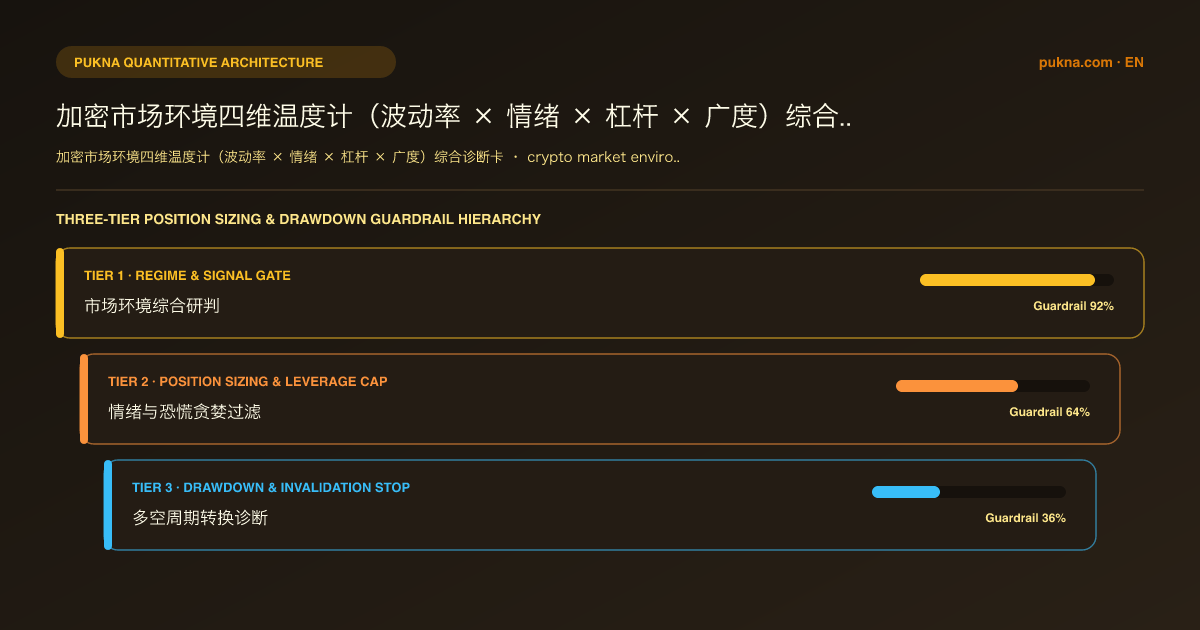
| Environment Pillar | Overheated / Fragile Zone | Balanced Constructive Zone | Capitulation / Value Zone |
|---|---|---|---|
| Volatility (DVOL & VRP) | Compressed IV before binary catalysts or frantic upside spikes | Orderly IV convergence matching realized movement | Panic IV surges flushing forced leverage and hedges |
| Market Sentiment | Extreme greed fueled by policy headlines and retail FOMO | Measured optimism backed by steady spot accumulation | Broad pessimism with washed-out short-term speculators |
| Derivatives Leverage | Crowded positive funding, wide perpetual basis, high OI | Neutral funding rate with balanced long-short positioning | Negative funding washes and flushed open interest |
| Liquidity & Breadth | Narrow rallies concentrated in low-float altcoin pockets | Expanding total market cap and sticky stablecoin inflows | Thin altcoin bids; defensive rotation to BTC and ETH |
No single gauge calls turning points alone; four-pillar alignment filters hostile headwinds.
Validating Entry Quality and Drawdown Limits Before Committing Capital
Strong Layer 2 theses still fail on sloppy timeframe alignment. Work top-down like a quant desk: map the dominant trend and major supply shelves on 1d charts before touching lower intervals. Filter structural setups across 4h and 1h views, standing aside whenever a breakout prints a failed auction and acceptance back inside the value area. Reserve 15m charts strictly for entry execution once higher timeframes agree.
Manual spreadsheets break fast when screening dozens of pairs across four timeframes. Pukna pairs its 8-dimension, 39-indicator environment library with multi-timeframe causal signal quality across 42 mainstream USDT pairs—including ETH and major Layer 2 tokens—on 15m, 1h, 4h, and 1d charts. Its 0–100 P-score evaluates combined peak return and final return inside the horizon_bars window relative to surrounding ordinary candles. Fifty marks only the neutral average-candle baseline; it gauges relative return quality, never win-rate probability.
Clean signal logic still never guarantees live tradability. Before subscribing to real-time alerts, audit personal AUTO paper simulations across conservative 1x–3x integer leverage to inspect historical net equity curves, win rates, and maximum drawdowns. Fat-tail risk budgeting matters most in altcoin beta. Whenever core environment gauges—including fear-greed, btc-dvol, btc-put-call, btc-funding, btc-long-short, and total-market-cap—tilt toward leveraged euphoria rather than spot inflows, cut simulated leverage to 1x or stay flat.
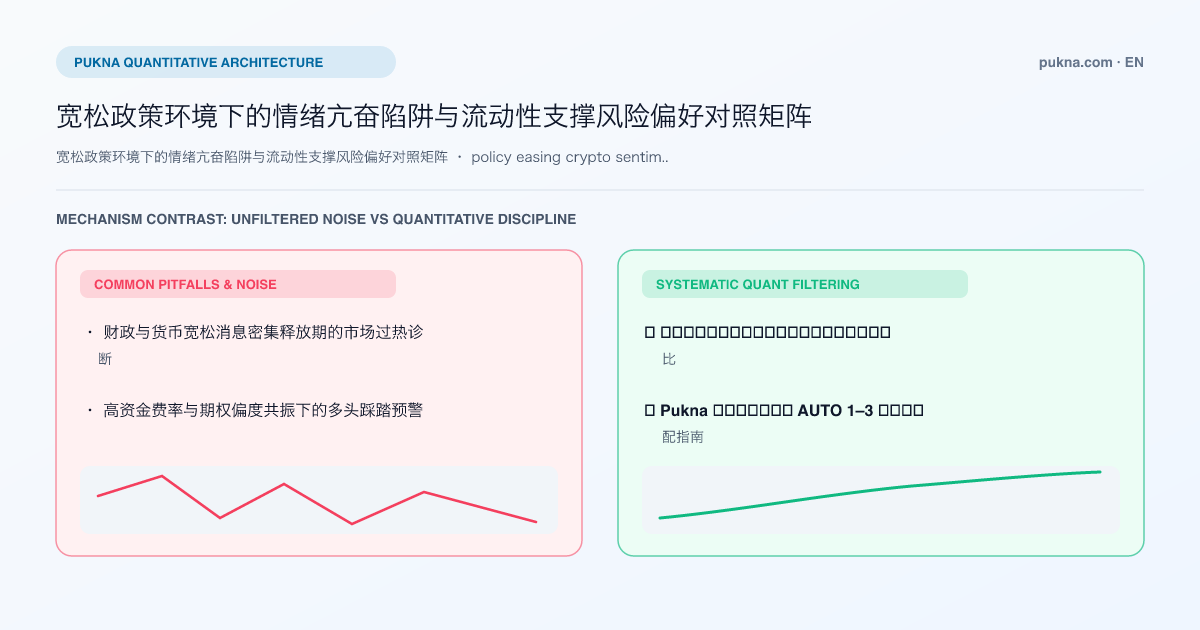
| Environment Dimension | Headline-Driven Policy Euphoria (Fragile) | Liquidity-Backed Risk-On (Durable) | Environment & AUTO Risk Protocol |
|---|---|---|---|
Capital & Breadth (total-market-cap) |
Stalling total cap; gains narrow to thin L2 alts | Broad market cap expansion backed by spot inflows | Require broad capitalization confirmation before adding L2 beta |
Sentiment & Options (fear-greed, btc-dvol, btc-put-call) |
Greed spikes with erratic DVOL and lopsided skew | Balanced sentiment, orderly DVOL, steady put-call ratio | Avoid chasing greed extremes when options price tail stress |
Derivatives Crowding (btc-funding, btc-long-short) |
Elevated positive funding and crowded long ratios | Neutral funding rates with balanced venue positioning | Skip perp-driven froth; require high 4h/1d P-score alignment |
| Leverage & Drawdown Control | Sharp liquidation cascades on minor macro reversals | Higher tolerance for pullbacks within spot trends | Cap AUTO simulation leverage at 1x or stay flat in fragile regimes |
| Research Stage | Fragmented Manual Stack | Unified Quantitative Workflow |
|---|---|---|
| L2 Fundamental Screening | Cross-tabbing L2BEAT, Dune queries, and separate unlock calendars | Side-by-side asset profiles inside the 43-token research library |
| Macro & Derivatives Filter | Checking disconnected funding, DVOL, and sentiment screenshots | Synchronized 8-dimension, 39-indicator market environment hub |
| Execution & Drawdown Audit | Eyeballing unfiltered price charts with subjective stops and sizing | 15m–1d causal signals, 0–100 P-score triage, and 1x–3x AUTO equity review |
Run five pre-trade checks before committing capital to any Ethereum Layer 2 token:
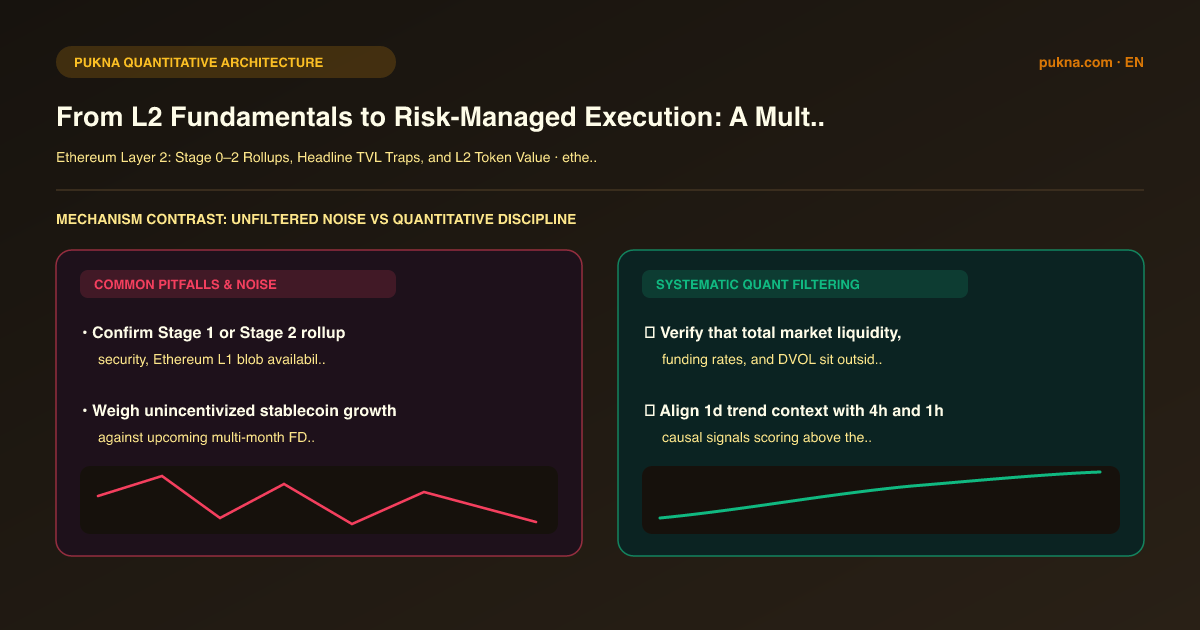
- Confirm Stage 1 or Stage 2 rollup security, Ethereum L1 blob availability, and positive net sequencer margin.
- Weigh unincentivized stablecoin growth against upcoming multi-month FDV token unlock schedules.
- Verify that total market liquidity, funding rates, and DVOL sit outside overheated leverage extremes.
- Align 1d trend context with 4h and 1h causal signals scoring above the 50 neutral P-score baseline.
- Review historical net equity curves, win rates, and maximum drawdowns inside 1x–3x integer-leverage AUTO simulations before enabling real-time alerts.
Frequently Asked Questions About Ethereum Layer 2
How many Ethereum Layer 2 networks are there?
More than 100 live and launching Ethereum Layer 2 networks—spanning Optimistic rollups, ZK rollups, and validiums—now compete for users and developers. Activity remains sharply top-heavy. A small core led by Arbitrum, Base, and OP Mainnet captures most sticky stablecoin liquidity, DEX volume, and net sequencer fees, while dozens of smaller chains lose traffic once token incentives end.
Why do some major Ethereum Layer 2 networks like Base not have a token?
Rollups never need a native coin to settle transactions. Users pay gas directly in ETH while Ethereum mainnet enforces state finality, letting networks like Base collect net sequencer fees in ETH without investor unlock overhang. Teams that issue native coins use them chiefly for DAO governance, ecosystem grants, or early liquidity rewards rather than mandatory gas.
What happens to your funds if an Ethereum Layer 2 network closes?
Fund recovery depends entirely on the rollup’s decentralization stage. On Stage 1 and Stage 2 rollups posting data to Ethereum L1, holders can reconstruct balances from mainnet blobs and force withdrawals through L1 contracts even if the sequencer halts. On Stage 0 chains or validiums, an unresponsive operator or upgrade multisig can still freeze or delay user funds.
Are Ethereum Layer 2 coins a better fundamental bet than ETH?
Not automatically, because ETH and Layer 2 coins carry opposite value-capture mechanics. ETH pays gas across most rollups, settles EIP-4844 blob demand, and faces zero VC cliff unlocks. Individual L2 tokens offer higher upside beta during liquidity expansions, yet governance-only utility and steady FDV dilution trigger deeper drawdowns in choppy regimes. Treat L2 coins as tactical beta, never passive ETH substitutes.
Put this into practice
Create a free account to browse live signals and test your own rules.