Contents6 sections
- What Are RWA Tokenized Assets and How Do Wrappers Differ from RWA Tokens?
- On-Chain Flow & DeFi TVL Diagnostic Matrix
- Off-Chain SPV Wrappers vs. Exchange-Traded Governance Tokens
- Why Fiat Stablecoins Sit Outside Yield-Bearing RWA Analysis
- Which Real-World Asset Classes Can Be Tokenized with Usable Liquidity?
- Why Sovereign Debt and Money-Market Funds Dominate On-Chain Volume
- Private Credit, Equities, Gold, and Real Estate Liquidity Bottlenecks
- Benchmarking RWA Exit Depth Against Composable DeFi Yield Mechanics
- How Do RWA Tokenized Assets Behave Across Macro Interest-Rate and Liquidity Regimes?
- High-Rate, Range-Bound Markets: Defensive Carry Into Tokenized Treasuries
- Rate-Easing and Liquidity Expansion: Yield Compression and Sector-Token Beta
- Extreme Volatility and Credit Stress: Redemption Queues and Correlation-to-One
- Why Do Raw RWA TVL Readings and Headline Forecasts Fail?
- Accounting Scope Gaps: Represented vs. Distributed Assets and Stablecoin Bloat
- The TVL-to-Token Disconnect and Nominal Credit Yield Illusions
- Order-Book Fragility, Vesting Overhangs, and Cross-Library Verification
- Multi-Factor Verification Framework and Risk-Managed RWA Research Workflow
- Four-Pillar Institutional Diligence Audit for Tokenized Wrappers
- Manual Headline Tracking vs. Multi-Dimensional Quantitative Workflow
- Multi-Timeframe Signal Filtering and Drawdown-Bounded Execution Rules
- Frequently Asked Questions
RWA tokenized assets are blockchain instruments backed by enforceable off-chain claims on U.S. Treasuries, private credit, equities, gold, or property, distinct from non-yielding fiat stablecoins and liquid protocol governance tokens. Raw TVL figures mislead whenever KYC-gated funds accumulate supply without secondary depth or fee capture, since durable flows track Treasury-to-DeFi spreads above 100 bps and T+0/T+1 redemption capacity. Sound allocation requires cross-checking bankruptcy-remote custody wrappers, settlement rails, and macro rate regimes across both asset wrappers and sector tokens.
What Are RWA Tokenized Assets and How Do Wrappers Differ from RWA Tokens?
Exchange-traded RWA tokens rarely own the underlying asset. Buying a protocol governance coin on a spot exchange gives you zero legal title to U.S. Treasuries, private loans, or commercial buildings. Only regulated wrappers backed by off-chain custody entities carry enforceable claims on principal and yield. Blurring those two structures explains most capital misallocation in tokenized finance.
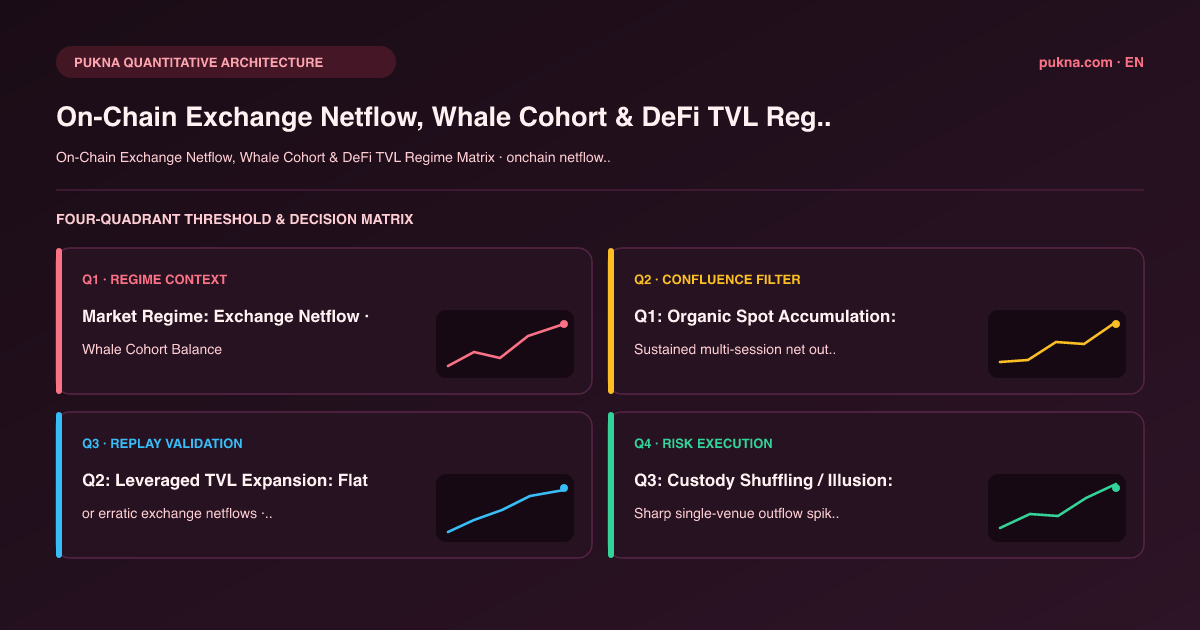
On-Chain Flow & DeFi TVL Diagnostic Matrix
Cross-validating exchange netflow, whale balance changes, and organic TVL to separate spot accumulation from collateral leverage.
| Market Regime | Exchange Netflow | Whale Cohort Balance | DeFi TVL Composition | Structural Interpretation |
|---|---|---|---|---|
| Q1: Organic Spot Accumulation | Sustained multi-session net outflows from spot venues | Net expansion across long-tenure non-exchange clusters | Stablecoin-backed DEX pools and unleveraged staking grow | Supply migrates to cold storage and productive on-chain utility with low forced-liquidation risk. |
| Q2: Leveraged TVL Expansion | Flat or erratic exchange netflows | Whale balances stagnant; transfers recycle between protocols | TVL rises mainly via recursive borrowing and wrapped collateral | Apparent ecosystem growth masks fragile collateral chains sensitive to funding and volatility shocks. |
| Q3: Custody Shuffling / Illusion | Sharp single-venue outflow spikes | Total non-exchange whale holdings remain unchanged | TVL and active protocol fee generation stay flat | Internal wallet consolidation or custodian migration creates false scarcity without new net demand. |
| Q4: Inventory Distribution | Persistent net inflows toward active order books | Long-horizon whale cohorts trim balances into strength | TVL contracts as liquidity providers exit into stable assets | Available sell-side inventory increases on venues while on-chain capital shifts toward defensive liquidity. |
| Instrument Type | Legal Claim & Yield | Access & KYC Gate | Secondary Exit Rail | Primary Valuation Driver |
|---|---|---|---|---|
| Direct RWA-Backed Wrappers | SPV or trust claim on off-chain yield or metal | Strict KYC/AML allowlist; often accredited only | Issuer mint/redeem rail; thin DEX pools | Off-chain NAV, coupon yield, credit risk |
| Tokenized Equity & Property Notes | Synthetic debt note or LLC equity interest | Jurisdiction-gated KYC and transfer locks | Permissioned ATS or gated bulletin boards | Underlying stock or appraised property value |
| Fiat-Backed Stablecoins | Par dollar redemption; issuer retains reserve yield | Permissionless secondary; KYC for direct mint | Deep 24/7 CEX and DeFi liquidity | Dollar peg stability and reserve liquidity |
| Liquid RWA Governance Tokens | Protocol voting rights; rarely direct asset yield | Permissionless 24/7 spot and perp trading | Centralized exchanges and AMM spot pools | Crypto beta, fee switches, token unlocks |
Off-Chain SPV Wrappers vs. Exchange-Traded Governance Tokens
A Special Purpose Vehicle (SPV) segregates off-chain collateral inside a bankruptcy-remote entity at a qualified custodian, blocking creditors from seizing client reserves if the software issuer fails. Governance tokens carry no such shield. Buying a protocol’s exchange-traded token prices adoption multiples, fee-switch speculation, and crypto liquidity beta rather than legal title to Treasury bills or loan receivables.
Market-cap aggregators routinely blur this boundary by lumping speculative governance coins and regulated fund shares under one RWA tag. That grouping masks real drawdown risk. During crypto selloffs, wrapped T-bill shares stay near par while the issuer’s governance token slides with mid-cap altcoins. Our RWA tokenization depth and yield framework maps this collateral-versus-equity split in detail.
Why Fiat Stablecoins Sit Outside Yield-Bearing RWA Analysis
Fiat-backed stablecoins hold short-dated Treasury bills and overnight reverse-repo collateral, yet they are payment rails rather than yield-bearing RWA investments. Issuers pocket the reserve coupon instead of passing interest to holders. Folding dollar stablecoins into RWA total value locked inflates headline supply by roughly an order of magnitude, burying actual institutional demand for yield-passing wrappers.
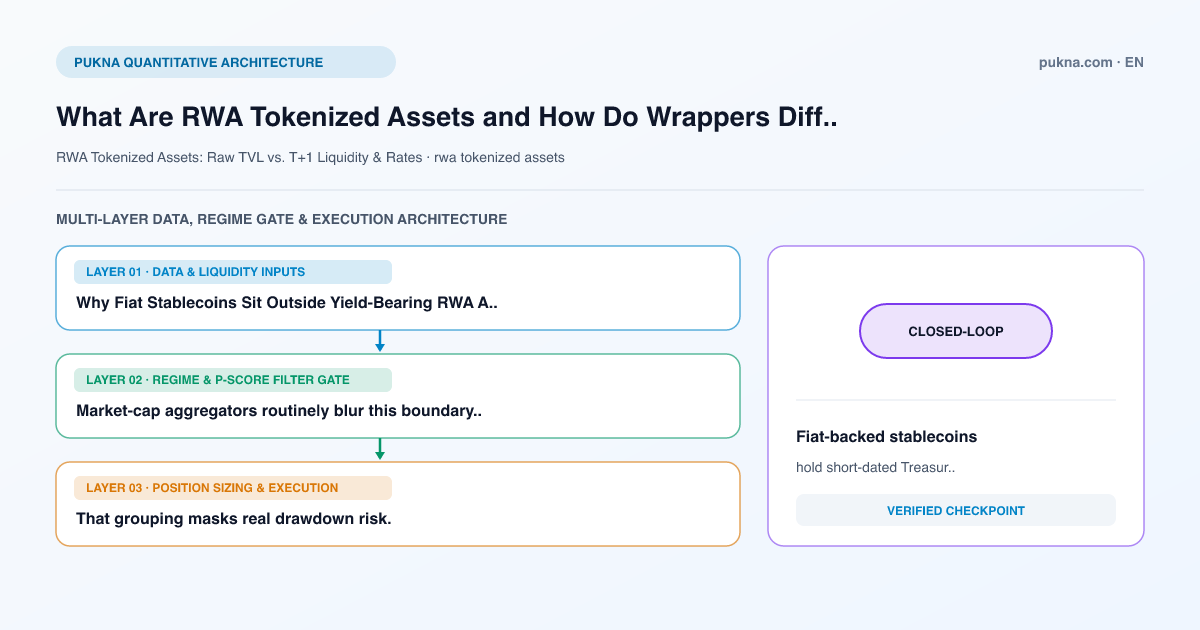
Hard invalidation trigger: reject any RWA wrapper immediately if its offering documents omit a named bankruptcy-remote SPV, an independent qualified custodian, and contractual holder redemption terms. Once legal title clears that gate, the next practical audit tests which tokenized asset classes actually settle with usable secondary market depth.
Which Real-World Asset Classes Can Be Tokenized with Usable Liquidity?
Putting an illiquid asset on-chain never creates instant market depth. Usable exit liquidity concentrates overwhelmingly in tokenized U.S. Treasuries and money-market funds because T-bills already clear trillions in legacy repo markets. By contrast, private credit, tokenized stocks, bullion, and real estate stay bottlenecked by transfer gates, appraisal lags, and issuer redemption queues.
| Asset Class | Yield & Valuation Cadence | Settlement & KYC Gate | Secondary Exit Depth | Primary Failure Risk |
|---|---|---|---|---|
| U.S. Treasuries & Money Markets | Short-term T-bill coupon; daily NAV | T+0 USDC or T+1 bank; KYC allowlist | Deep primary redemption; institutional collateral use | Off-hours redemption queues and issuer concentration |
| Private Credit Pools | Fixed or floating loan APR; periodic audit | Fixed lockups or epoch exits; accredited KYC | Minimal secondary books; issuer-bound exits | Borrower default and overstated gross APY |
| Tokenized Equities | Price track plus synthetic dividends; market hours | T+1/T+2 underlying; geo-fenced KYC | Thin weekend books; fragmented trading venues | Corporate-action tracking drift and venue gaps |
| Tokenized Gold | Zero native yield; continuous spot feed | 24/7 on-chain; physical redemption KYC | Moderate CEX and DEX depth; stress slippage | Custodial vault audit lag and storage fees |
| Tokenized Real Estate | Net rental distributions; quarterly appraisals | Jurisdiction-gated transfers; LLC onboarding | Illiquid bulletin boards; steep NAV discounts | Stale appraisals and forced-exit haircuts |
Why Sovereign Debt and Money-Market Funds Dominate On-Chain Volume
Short-dated U.S. Treasury bills carry minimal rate-duration sensitivity, transparent daily NAV marks, and deep institutional repo liquidity, making sovereign paper the cleanest collateral for blockchain rails. Settlement speed locks in that advantage. While bank wires clear on T+1 cutoffs, leading tokenized money-market wrappers hold dedicated stablecoin liquidity buffers that give allowlisted treasuries near T+0 atomic exits.
Institutional prime brokers and permissioned lending desks increasingly accept tokenized T-bills as yield-bearing margin collateral. Idle stablecoins carry an immediate opportunity drag. When on-chain borrowing sits below lending utilization inflection points tracked in DeFi lending pool utilization benchmarks, sovereign coupons beat baseline pool yields. DAO treasuries and funds then sweep dormant dollars into tokenized T-bill wrappers.
Private Credit, Equities, Gold, and Real Estate Liquidity Bottlenecks
Private credit vaults pitch double-digit coupons backed by fintech loan books, trade invoices, or commercial receivables, yet liquidity stops cold at the smart-contract boundary. Secondary order books barely exist. Because capital stays locked until fixed loan maturities or gated withdrawal epochs, a single delinquent originator can freeze senior and junior redemptions months past schedule.
Tokenized equities and real estate inherit legacy market frictions that smart contracts cannot erase: stock venues close on weekends, and property deeds rely on quarterly appraisals. Off-hours gaps punish forced sellers. When weekend macro news hits, tokenized stocks suffer a widening bid-ask spread because dealers cannot hedge inventory on shuttered exchanges. Tokenized property shares often clear 10% to 25% below stale appraisals.
Tokenized gold sits in the middle tier, pairing 24/7 on-chain transfers with vaulted bullion bars while generating zero native yield. Storage and custody fees steadily erode real return. Physical bar redemption also enforces high minimum bar weights and full KYC onboarding, leaving smaller accounts exposed to exchange order-book slippage whenever volatility spikes.
Benchmarking RWA Exit Depth Against Composable DeFi Yield Mechanics
Judging RWA wrapper coupons in isolation misses the active opportunity cost of on-chain capital. Crypto treasuries and trading desks weigh sovereign T-bill yields daily against AMM swap fees, lending pool utilization, and validator staking queues. The reference table below maps composable DeFi liquidity and fee-adjusted net-return mechanics directly alongside permissioned RWA constraints.
| Research Scenario | Core Criterion | Empirical Takeaway | Full Study |
|---|---|---|---|
| Screening AMM liquidity pools | Swap-fee APR vs. emissions and Vol/TVL | High LP APYs fail if swap fees do not offset AMM curve impermanent loss. | Crypto Liquidity Pools: AMM Curves, Impermanent Loss Math & Vol/TVL Screening → |
| Auditing DeFi lending markets | Pool utilization, exit depth, and base yield | High lending APYs often mask thin exit liquidity, subsidies, or tight liquidation margins. | DeFi Lending: High APY vs. Utilization, Exit Depth, and Liquidation Risk → |
| Evaluating liquid staking tokens | Reward accounting, exit queues, and depth | LSTs keep tokens transferable, but exit queues and thin books create depeg risk. | Liquid Staking: Yield vs. Exit Liquidity and Depeg Risk → |
| Modeling V2/V3 LP net returns | Net LP PnL vs. fee-to-IL breakeven thresholds | Gross impermanent loss differs from net loss once fees and reward breakevens are included. | DeFi Impermanent Loss Calculator: V2/V3 & Fee Breakeven → |
| Choosing staking vs. yield farming | Same-asset, same-period net dollar return | Higher headline APY can yield less in dollars once fees and asset price risk are counted. | Crypto Staking vs Yield Farming: Returns, Liquidity & Risk → |
Hard invalidation trigger: reject any liquid-exit claim if primary redemptions exceed T+2 or secondary pools absorb under 1% of circulating supply before hitting 50 bps of slippage. Next, trace how macro interest-rate regimes reverse capital flows between sovereign wrappers and liquid RWA governance tokens.
How Do RWA Tokenized Assets Behave Across Macro Interest-Rate and Liquidity Regimes?
Rising tokenized Treasury TVL signals opposite flows across rate cycles. Under restrictive policy rates, sovereign wrappers pull defensive stablecoins out of on-chain pools while starving speculative altcoins of liquidity. Once central banks ease and net dollar liquidity expands, T-bill carry compresses, perpetual basis widens, and capital rotates toward higher-beta RWA governance tokens.
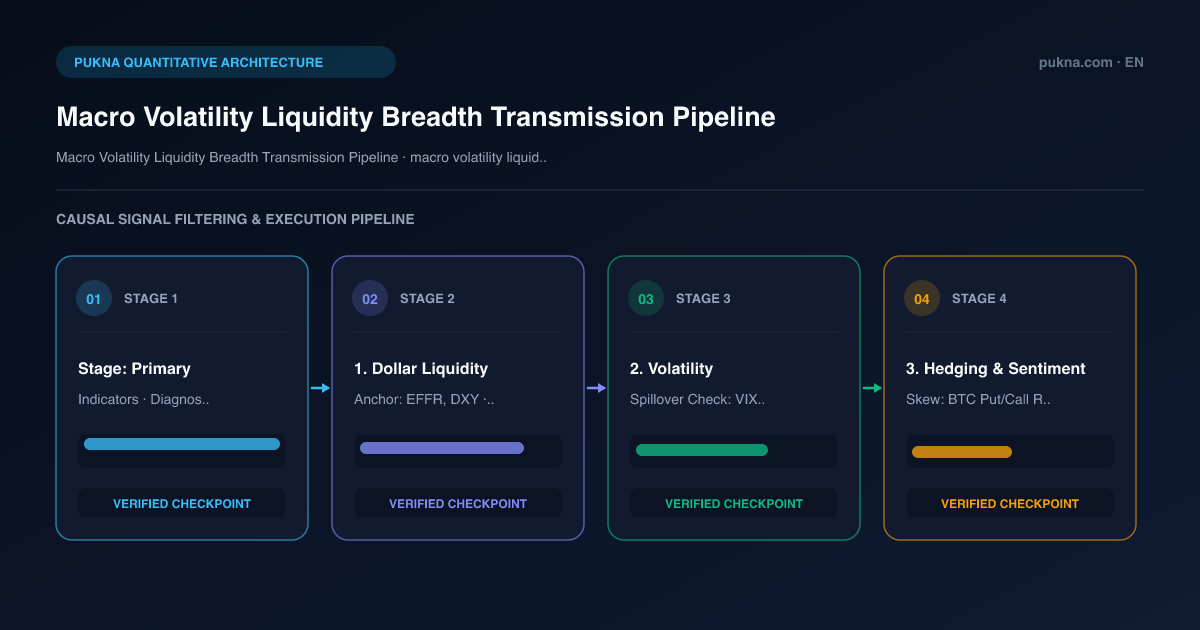
Cross-Asset Volatility, Liquidity & Breadth Regime Pipeline
| Stage | Primary Indicators | Diagnostic Signal | Regime Classification Output |
|---|---|---|---|
| 1. Dollar Liquidity Anchor | EFFR, DXY | Tightening rates + rising DXY vs easing liquidity + softening DXY | Sets baseline capital cost and global risk-asset discount pressure |
| 2. Volatility Spillover Check | VIX, BTC DVOL | Co-moving VIX/DVOL spike vs isolated crypto DVOL expansion | Separates systemic macro de-risking from crypto-native gamma repricing |
| 3. Hedging & Sentiment Skew | BTC Put/Call Ratio, Fear & Greed | Elevated Put/Call defensive skew vs normalized hedging demand | Identifies whether institutional desks are paying for downside protection |
| 4. Market Breadth Confirmation | Total Crypto Market Cap | Broad cap expansion vs narrow defensive concentration | Maps state to Broad Expansion, Narrow Rotation, Macro De-risking, or Reset |
| Macro & Crypto Regime | Treasury vs. DeFi Spread | Tokenized T-Bill Flows | Redemption & Spread Impact | Liquid RWA Token Beta |
|---|---|---|---|---|
| High-Rate / Range-Bound Crypto | Positive (+100 to +300 bps) | Steady defensive inflows | Stable T+0/T+1 par primary exits | Range-bound; lags wrapper TVL growth |
| Rate-Easing / Liquidity Expansion | Negative (-200 to -800 bps) | Flattening or mild rotation out | Tight spreads; active collateral reuse | High upside beta; multiple expansion |
| Credit Stress / Liquidation Shock | Volatile; acute cash flight | T-bill flight; private credit freezes | Off-hours queues and widening spreads | Correlation-to-one selloff; deep drawdowns |
High-Rate, Range-Bound Markets: Defensive Carry Into Tokenized Treasuries
Elevated policy rates generate real yield headwinds and tighten the dollar liquidity impulse, shrinking risk budgets for leveraged crypto trades. On-chain borrowing yields compress first. Perpetual futures basis, the annualized spread between futures and spot prices, flattens into single digits while funding resets near neutral. Tokenized T-bills then out-earn baseline DeFi stablecoin pools by 100 to 300 basis points.
That positive carry spread creates a structural divergence that traps linear TVL buyers. Tokenized Treasury balances climb steadily as crypto treasuries park idle stablecoins at sovereign rates. Yet liquid RWA governance tokens frequently stall or bleed lower because crypto market-cap breadth dynamics stay defensive and desks prefer par-value T-bill carry over altcoin volatility.
Rate-Easing and Liquidity Expansion: Yield Compression and Sector-Token Beta
When policy rates step down and net dollar liquidity expands, capital transmission flips across tokenized markets. Sovereign T-bill coupons compress quarter by quarter. Expanding speculative leverage lifts crypto open interest, pushing perpetual funding and DeFi stablecoin borrow rates 200 to 800 basis points above Treasury yields. Static cash wrappers quickly lose their carry edge.
Under easing liquidity, flat or gently declining tokenized Treasury TVL signals risk-on capital rotation rather than protocol failure. Liquid RWA governance tokens then capture the upside beta. As market sentiment regime shifts move from defensive caution into broad risk appetite, exchange-traded sector tokens reprice on higher adoption multiples even while T-bill minting slows.
Extreme Volatility and Credit Stress: Redemption Queues and Correlation-to-One
Macro credit shocks and forced crypto deleveraging expose the sharpest gap between sovereign wrappers, credit vaults, and liquid governance tokens. Cross-asset volatility spikes together. When equity VIX and Bitcoin DVOL surge in tandem, the implied volatility vs. realized volatility (VRP) spread widens rapidly. Options desks immediately bid downside puts far above trailing realized price swings.
Weekend liquidation cascades drain instant stablecoin buffers on tokenized money-market wrappers within hours, forcing late redeemers into T+1 bank queues while private credit vaults halt withdrawals altogether. Governance tokens take far steeper losses. On thin order books, a sharp liquidity sweep (stop-hunt wick) clears clustered retail stops as leveraged open interest flushes, dragging RWA tokens down with high-beta altcoins.
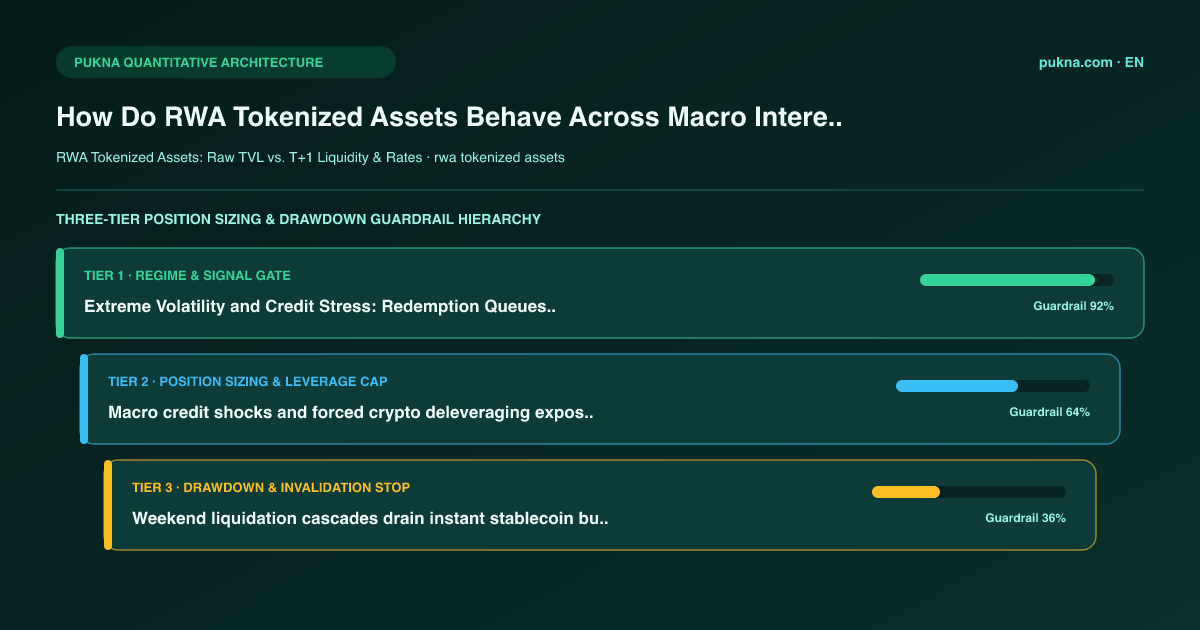
Hard invalidation trigger: invalidate bullish RWA governance-token positioning whenever Treasury-to-DeFi yield spreads widen past +200 bps while Bitcoin DVOL climbs and net dollar liquidity tightens. Next, strip out the five accounting and token-supply traps that make raw RWA TVL leaderboards misleading.
Why Do Raw RWA TVL Readings and Headline Forecasts Fail?
Headline RWA TVL dashboards regularly disagree by an order of magnitude. Data providers apply conflicting rules for fiat stablecoins and walled bank ledgers, creating massive headline gaps. Worse, expanding off-chain fund AUM rarely funnels direct fee revenue to exchange-traded governance tokens. Auditing five recurring distortions separates real secondary liquidity from inflated headline accounting.
| Raw Headline Distortion | Structural Blind Spot | Empirical Failure Counter-Example | Multi-Factor Verification Check |
|---|---|---|---|
| Stablecoin Inclusion Divergence | Lumps non-yield dollar rails into RWA totals | Aggregate charts leap from tens to hundreds of billions overnight | Exclude fiat stablecoins; track yield-bearing wrappers separately |
| Represented vs. Distributed Ledgers | Counts private bank ledgers as open DeFi supply | Institutional bond pilots log high TVL with zero DeFi transfers | Filter strictly for transferable public-chain distributed supply |
| TVL-to-Governance Fee Disconnect | Assumes wrapper AUM equals tokenholder cash flow | Issuers scale Treasury funds without activating token fee switches | Audit live protocol fee share and on-chain treasury inflows |
| Nominal Credit APY Illusion | Ignores borrower default losses and workout delays | Double-digit headline pool turns negative after one impaired tranche | Compute default-adjusted net yield and junior loss buffers |
| Unlock Overhangs vs. Thin Books | Ignores scheduled vesting cliffs and DEX depth | Large insider unlocks depress prices despite rising wrapper TVL | Compare 90-day unlock dollar value against 2% order-book depth |
Accounting Scope Gaps: Represented vs. Distributed Assets and Stablecoin Bloat
Public RWA market estimates swing from tens of billions on-chain to multi-trillion consulting targets because reports blend distributed assets with represented assets. That accounting boundary changes everything. Distributed assets settle natively on public blockchains with transferable custody and auditable smart-contract supply. Represented assets only mirror institutional back-office records on closed permissioned ledgers inaccessible to open crypto liquidity.
Multi-trillion consulting decks routinely stack private-bank bond ledgers, commercial property pilots, and payment stablecoins into one headline forecast. Reading those figures as direct catalysts for exchange-traded RWA coins commits a basic scope error. Walled bank settlement rails contribute neither public spot volume, on-chain collateral turnover, nor fee capture to permissionless protocol tokens.
The TVL-to-Token Disconnect and Nominal Credit Yield Illusions
Chasing an RWA protocol’s governance token whenever its Treasury wrapper logs fresh TVL inflows is a recurring trap. Wrapper scale rarely translates into tokenholder cash flow. Institutional money-market wrappers charge thin annual fees of roughly 15 to 35 basis points for custodians, legal entities, and fund administration. Almost nothing remains to route back to governance tokens.
Private-credit dashboards compound the distortion by quoting gross borrower coupons instead of default-adjusted net returns. One impaired tranche wipes out years of accrued interest. Trade-finance and SME credit pools often concentrate loans across a handful of off-chain originators with no secondary bid. Headline coupons of 10% to 15% therefore overstate realized returns once delinquencies and workout haircuts hit.
Order-Book Fragility, Vesting Overhangs, and Cross-Library Verification
Even fee-generating RWA protocols often launch governance tokens with low circulating float and heavy multi-year insider vesting cliffs. Thin order books amplify every unlock. On concentrated-liquidity DEX pools, just-in-time (JIT) liquidity sniping and LP fee dilution inflate apparent market depth. Single-block MEV bots inject temporary liquidity solely to capture swap fees without bearing inventory risk, leaving true multi-block exit capacity far thinner than headline pool TVL suggests.
Relying on isolated TVL leaderboards also misses crowded derivatives positioning and narrowing market breadth, especially when derivatives retail-versus-whale positioning skew tilts sharply one way. Single indicators fail under regime stress. Cross-checking macro rates, liquidity, and derivatives conditions inside Pukna’s 8-dimension environment research library (39 indicators) and 43-token research library replaces headline extrapolation with auditable market-structure evidence.
Hard invalidation trigger: step aside from any liquid RWA governance token whenever 90-day scheduled unlock supply exceeds 3x average daily spot volume on primary venues. Next, consolidate these filters into a four-pillar wrapper audit and drawdown-bounded quantitative execution workflow.
Multi-Factor Verification Framework and Risk-Managed RWA Research Workflow
Audit legal claims before opening a single price chart. Manual headline tracking blurs bankruptcy-remote wrapper safety with high-beta governance-token volatility, leaving portfolios exposed during liquidity shocks. Pairing a four-pillar custody and exit-depth checklist with multi-timeframe causal filtering and bounded leverage testing enforces strict drawdown discipline across shifting interest-rate cycles before live deployment.
Four-Pillar Institutional Diligence Audit for Tokenized Wrappers
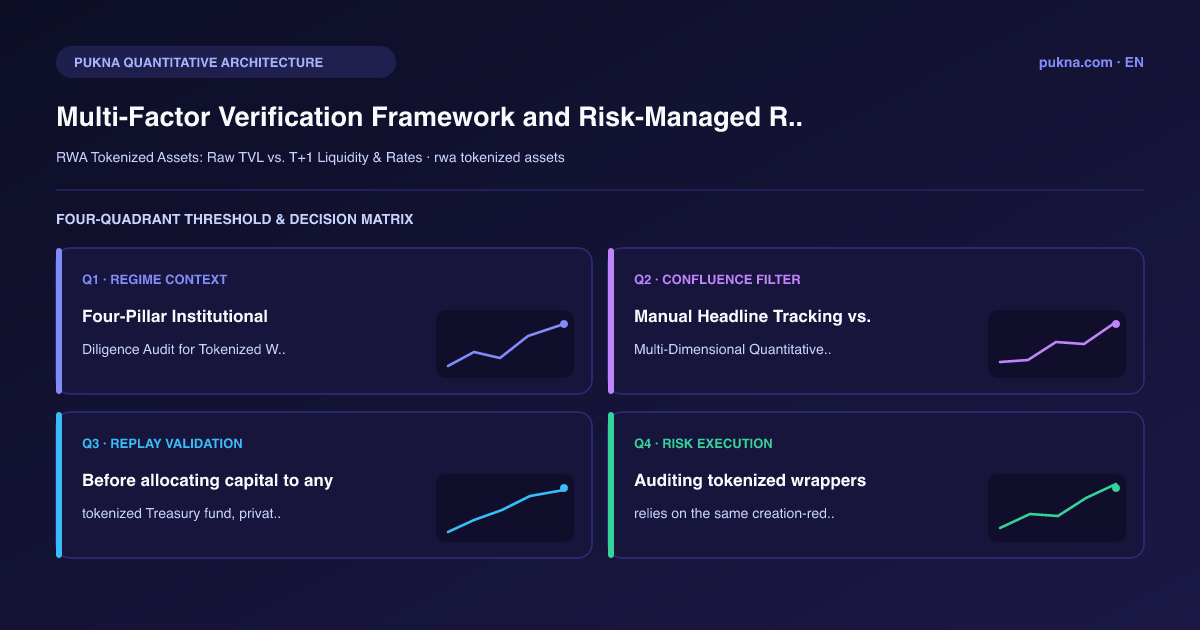
Before allocating capital to any tokenized Treasury fund, private-credit vault, or asset wrapper, evaluate the structure against four pass-fail gates. One failed pillar disqualifies the instrument immediately.
- Bankruptcy-Remote Legal Claim & Custody: Verify a named SPV or regulated fund entity, an independent qualified custodian, and recurring third-party reserve attestations isolating holder collateral from issuer solvency risk.
- Primary Mint-Redeem & Secondary Depth: Confirm contractual settlement cutoffs (T+0 stablecoin buffer or T+1 bank wire), explicit KYC transfer restrictions, and secondary slippage below 30 bps at target ticket size.
- Default-Adjusted Real Yield Spread: Deduct management fees, custodial charges, and credit-loss reserves, requiring net yield to exceed composable stablecoin lending benchmarks by at least 75 to 100 bps before accepting lockups.
- Macro Rate & Breadth Regime Alignment: Match sovereign-wrapper weight versus governance-token beta to dollar liquidity direction, Treasury-to-DeFi yield spreads, and cross-asset volatility regimes instead of lagging TVL headlines.
Manual Headline Tracking vs. Multi-Dimensional Quantitative Workflow
Auditing tokenized wrappers relies on the same creation-redemption discipline behind spot and futures ETF flow filters, which separate genuine directional inflows from hedged cash-and-carry basis trades. Manual dashboards blur that distinction. The table below contrasts ad-hoc headline tracking against a structured multi-factor quantitative workflow across wrapper auditing, regime filtering, and risk sizing.
| Verification Stage | Manual Headline / TVL Tracking | Multi-Factor Quantitative Workflow | Risk-Control Impact |
|---|---|---|---|
| Scope & Wrapper Audit | Reads blended sector TVL leaderboards | Separates distributed wrappers, stablecoins, and governance tokens | Eliminates legal-claim and fee-capture illusions |
| Macro & Liquidity Regime | Treats rising TVL as a linear buy signal | Maps 8-dimension macro, rate, sentiment, and derivatives indicators | Prevents buying governance beta during liquidity squeezes |
| Entry Timing & Filtering | Chases single-timeframe headline breakouts | Cross-checks 4-timeframe causal signals and relative return quality | Filters out thin-book stop-hunt false breaks |
| Leverage & Drawdown Sizing | Picks leverage from recent narrative momentum | Audits historical equity curves, win rates, and max drawdowns at 1–3x | Caps tail-risk drawdowns before deploying live alerts |
Multi-Timeframe Signal Filtering and Drawdown-Bounded Execution Rules
Around macro rate catalysts, single-timeframe charts routinely misfire during thin liquidity sweeps. Researchers filter those fakeouts on Pukna by pairing 4-timeframe causal candlestick signals (15m/1h/4h/1d) across 42 major USDT pairs with the P relative quality score (0–100) across horizon_bars. A score of 50 marks neutral performance relative to nearby candles. Higher scores rank stronger combined peak and final return quality, never win-rate probability.
Position leverage demands the same discipline, because higher multiples compound volatility drag once Bitcoin DVOL spikes and perpetual basis flips negative. Stress-test historical drawdowns before taking live signals. Running an AUTO simulated win-rate and max-drawdown audit compares historical equity curves across 1x, 2x, and 3x integer leverage. Subscribe to AUTO real-time strategy alerts only after historical tail risk fits your cap.
- Cap Single-Issuer Wrapper Exposure: Limit any single tokenized money-market issuer or stablecoin redemption rail to no more than 25% of defensive reserve capital.
- Enforce Exit-Liquidity Floors: Require documented T+0 or T+1 primary redemption for Treasury wrappers and at least 5x position size inside 2% order-book depth for liquid tokens.
- Step Down Leverage in Stress Regimes: Reduce AUTO strategy leverage from 3x or 2x toward 1x whenever cross-asset equity volatility and Bitcoin DVOL expand concurrently.
- Separate Sovereign Carry from Sector Beta: Account for tokenized Treasury coupons separately from liquid RWA governance tokens so defensive yield never disguises altcoin drawdowns.
Hard invalidation trigger: pause directional RWA sector-token alerts immediately if simulated 2x historical maximum drawdown breaches your risk cap or primary stablecoin redemption buffers drop below 10%. Use the reference Q&A below to verify core legal, liquidity, and rate-regime definitions quickly.
Frequently Asked Questions
What are RWA tokenized assets, and what legal rights do they grant?
RWA tokenized assets are on-chain tokens backed by legally enforceable claims on off-chain U.S. Treasuries, private credit loans, gold bars, or equities. Legal protection comes strictly from the off-chain wrapper, usually a bankruptcy-remote Special Purpose Vehicle (SPV) or regulated fund held at a qualified custodian. Without documented custody and redemption rights, a token conveys zero off-chain title.
How does a tokenized U.S. Treasury differ from an RWA protocol governance token?
A tokenized U.S. Treasury is a KYC-gated fund share that tracks sovereign NAV and passes short-term T-bill coupons to holders. By contrast, an RWA governance token trades permissionlessly on crypto exchanges, pricing platform adoption expectations, unlock schedules, and market beta. Governance holders rarely receive legal claims on Treasury collateral or coupon income.
Why do tokenized U.S. Treasuries dominate on-chain RWA liquidity over real estate?
Tokenized U.S. Treasuries dominate on-chain liquidity because underlying T-bills settle in deep institutional repo markets with daily NAV marks and T+0 or T+1 redemption rails. Real estate stays fragmented across local deed registries, quarterly appraisals, and jurisdiction-gated transfers. Putting a deed on-chain cannot create secondary exit depth when underlying buyers stay scarce.
Why do public RWA TVL trackers and consulting reports show vastly different totals?
Headline totals diverge by orders of magnitude because data providers apply conflicting accounting scopes. Strict on-chain trackers count only distributed, transferable public-chain assets and strip out fiat-backed stablecoins. Expansive consulting forecasts merge non-yielding stablecoins with represented bank-ledger records that never touch public DeFi liquidity or trade on open secondary venues.
How do interest-rate cuts affect tokenized Treasuries versus liquid RWA tokens?
Interest-rate cuts lower short-term Treasury coupons, compressing the carry edge of tokenized money-market funds over DeFi stablecoin lending and crypto futures basis. That narrowing spread often cools defensive T-bill minting as capital rotates outward along the risk curve. At the same time, expanding dollar liquidity widens crypto market breadth, lifting upside beta for liquid RWA governance tokens.
Put this into practice
Create a free account to browse live signals and test your own rules.