Contents6 sections
- What Are RWA Tokenized Treasuries and How Do They Work On-Chain?
- Legal Wrappers, Off-Chain Custody, and Smart-Contract Mint/Burn Rails
- Rebasing vs. Accumulating NAV Shares and 24/7 Settlement Mechanics
- Why Does Headline RWA TVL Overstate Tokenized Treasury Liquidity?
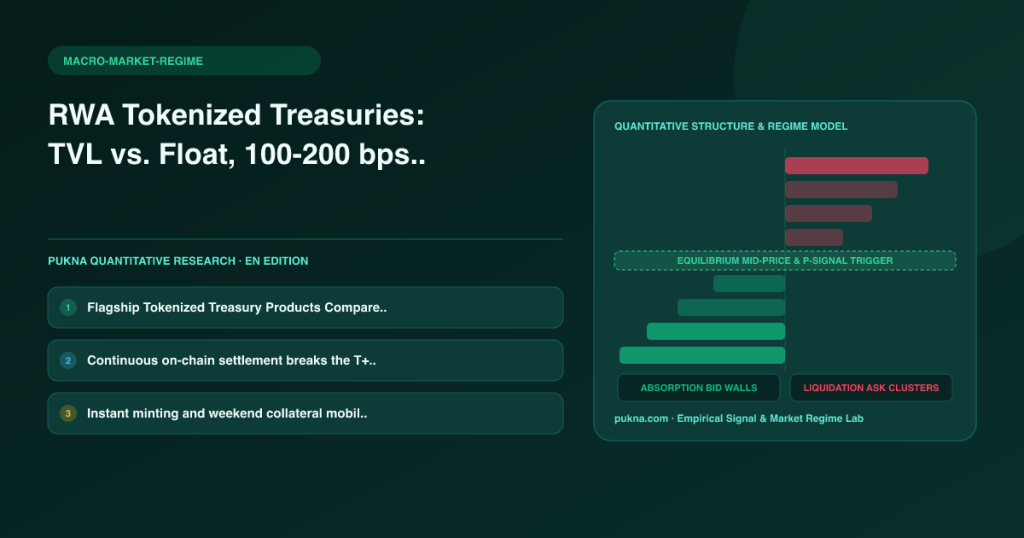
- Flagship Tokenized Treasury Products Compared: Access, Chains, and Collateral Use
- Total Value vs. Transferable Market Cap: Why Headline RWA TVL Masks Liquidity Friction
- Tokenized Treasuries vs. Private Credit and Tokenized Stocks: Where Risks Diverge
- Why Sovereign T-Bills Scaled Ahead of Tokenized Stocks and Private Credit
- Custodial, Smart-Contract, and Jurisdictional Risks to Audit
- How Do Tokenized Treasury Yields Drive Crypto Sector Rotation?
- Crypto Market Breadth and Implied Volatility Regime Guardrails
- The On-Chain Hurdle Rate: T-Bill Yields vs. DeFi Lending and Stablecoin Velocity
- Reading Rate-Regime Inflections Across RWA, Stablecoins, and Risk-On Crypto Sectors
- How Can Traders Turn Macro RWA Regimes Into Multi-Timeframe Risk Controls?
- Avoiding the Timeframe Mismatch Between Monthly RWA Flows and Intraday Price Cycles
- A Four-Step Quantitative Checklist for Regime Filtering and Leverage Discipline
- Frequently Asked Questions
RWA tokenized Treasuries (BUIDL, OUSG, USDY, BENJI, USTB, USYC) are on-chain fund shares backed by short-duration U.S. government bills, legally distinct from non-yielding stablecoins like USDC. Standardized sovereign debt scales faster on-chain than tokenized equities, yet rising balances act as an on-chain hurdle rate whenever T-bill yields beat DeFi lending pools by 100 to 200 basis points. Because allowlisted ledgers conceal thin secondary float, confirming crypto rotation requires checking transferable supply, stablecoin velocity, and derivatives basis together.
What Are RWA Tokenized Treasuries and How Do They Work On-Chain?
Tokenized Treasuries place regulated fund shares on blockchain rails. Each token represents a direct legal claim on short-duration U.S. Treasury bills and overnight repurchase agreements held off-chain. Unlike payment stablecoins whose issuers pocket reserve interest, these structures stream net sovereign yield straight to verified wallet holders.
Legal Wrappers, Off-Chain Custody, and Smart-Contract Mint/Burn Rails
Before any token mints on-chain, asset managers form a regulated money-market fund, a Delaware statutory trust, or a bankruptcy-remote special purpose vehicle (SPV) to ring-fence client reserves. Qualified custodians hold the physical U.S. bills and overnight repo positions inside segregated brokerage accounts. On-chain tokens only mirror those vaulted claims.
Eligible buyers complete Know Your Customer (KYC) and anti-money-laundering screening with a licensed transfer agent before their addresses reach the smart-contract allowlist. Approved wallets wire dollars or send USDC to mint shares at daily Net Asset Value (NAV). Permissionless wallets cannot mint directly.
Do not confuse tokenized Treasuries with fiat stablecoins. Holding USDC or USDT leaves the sovereign coupon with the issuer while paying token holders zero interest. Regulated Treasury wrappers deduct 15 to 50 basis points in annual management fees and pass the remaining dollar yield through to investors.
Independent fund administrators compute closing NAV every U.S. business day and push verified attestations to smart-contract oracles so on-chain balances match vault holdings. Redemptions run in reverse, burning tokens to release bank wires or instant USDC from liquidity buffers. Off-chain settlement still anchors final liquidity.
Rebasing vs. Accumulating NAV Shares and 24/7 Settlement Mechanics
Issuers distribute sovereign interest across two distinct accounting rails. Rebasing tokens maintain a fixed $1.00 target price and credit accrued coupon income by minting fractional units into holder wallets. Accumulating tokens keep share counts constant while NAV climbs steadily with daily yield accrual.
Both models deliver identical gross yield. Deploy $100,000 into a 4.5% net rebasing wrapper, and your wallet holds roughly 100,375 tokens priced at $1.00 after 30 days. Hold an accumulating wrapper at the same rate, and your 100,000 shares stay unchanged while NAV rises to $1.00375.
DeFi protocol engineers strongly favor accumulating shares when wiring collateral into automated lending and margin vaults. Most smart contracts track static token counts and can trap or misallocate accrued coupons whenever wallet balances expand automatically. Corporate treasurers lean the other way, preferring $1.00 rebasing units for clean par-value bookkeeping.
Continuous on-chain settlement breaks the T+1 banking freeze that strands collateral inside traditional Treasury ETFs from Friday afternoon until Monday morning. Tokenized Treasury wrappers backed by USDC liquidity buffers transfer 24/7 across allowlisted addresses. Prime desks can cover weekend margin calls without selling spot crypto into thin books.
| Dimension | Traditional T-Bill ETF | Permissioned Tokenized MMF (BUIDL, BENJI) | Offshore / Wrapped Yield Token (USDY, USYC) |
|---|---|---|---|
| Settlement Cycle | T+1 business days; closed weekends | T+0 to T+1; 24/7 transfers among allowlisted wallets | T+0 USDC teller mint/redeem; 24/7 mobility |
| KYC & Access | Standard brokerage account | Strict wallet allowlist (Qualified Purchaser or 1940 Act) | Non-U.S. KYC (Reg S) or institutional allowlist |
| Yield Accrual | Monthly cash brokerage dividend | Daily accrual paid via new units or $1.00 share credit | Continuously accumulating NAV (or rebasing opt-in) |
| DeFi Utility | None on-chain | Permissioned institutional pools and margin rails | Approved DeFi lending vaults and derivatives margin |
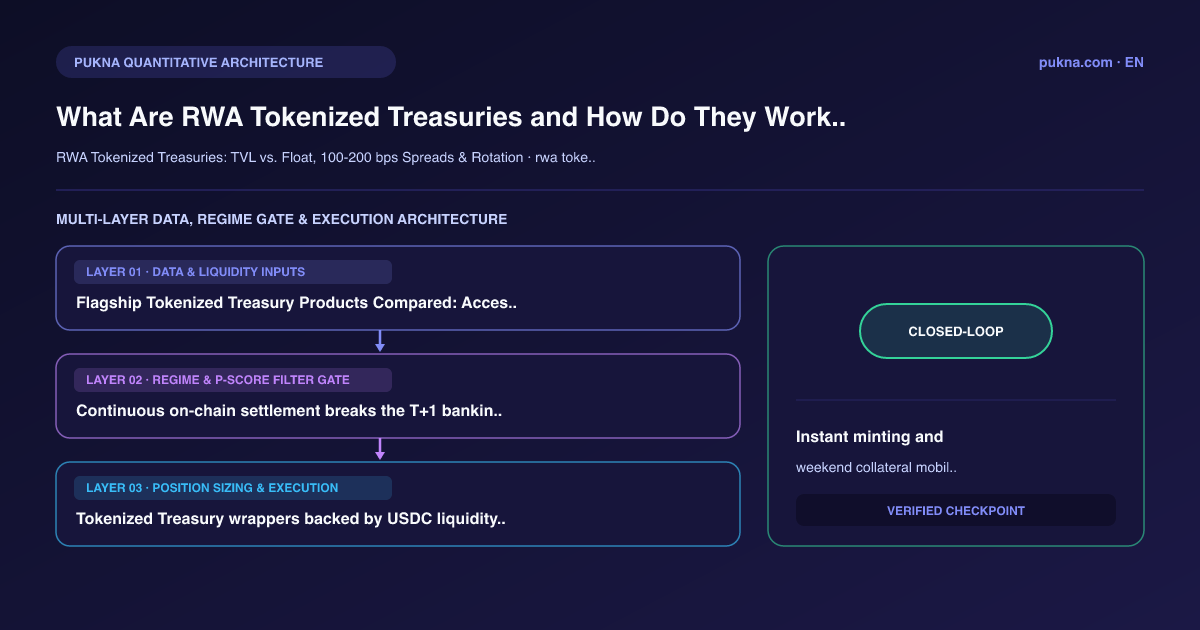
Instant minting and weekend collateral mobility look seamless in fund prospectuses, yet public RWA dashboards report billions in locked balances while decentralized exchange pools stay strikingly thin. Why do multi-billion-dollar Treasury ledgers barely move open-market spot depth? That gap exposes the central distortion inside headline RWA metrics.
Why Does Headline RWA TVL Overstate Tokenized Treasury Liquidity?
Headline RWA TVL is not tradable float. Between 60% and 85% of tokenized Treasury supply sits inside allowlisted institutional wallets barred from open decentralized exchanges. Counting those restricted custody ledgers as active crypto buying power distorts liquidity models and inflates short-term altcoin inflow estimates.
Flagship Tokenized Treasury Products Compared: Access, Chains, and Collateral Use
Identical sovereign backing masks stark structural divides across leading tokenized Treasury wrappers. Regulatory regimes separate institutional-only Qualified Purchaser funds from non-U.S. Regulation S notes and U.S.-registered 1940 Act mutual funds. Each legal gate governs minimum ticket sizes, wallet eligibility, and secondary collateral reach.
BlackRock’s BUIDL and Superstate’s USTB target U.S. Qualified Purchasers through allowlisted smart contracts built for treasury cash management and prime-broker margin. Ondo’s OUSG routes institutional capital into Treasury wrappers backed by 24/7 USDC redemption rails. Franklin Templeton’s BENJI takes a broader 1940 Act mutual-fund structure, logging eligible U.S. share ownership directly on public blockchains.
Offshore wrappers chase wider secondary circulation. Ondo’s USDY issues bankruptcy-remote secured notes solely to non-U.S. investors, unlocking secondary DeFi transfers once an initial compliance lockup expires. USYC backs short Treasury bills and reverse-repo holdings with rapid USDC smart-contract tellers widely pledged as off-exchange derivatives margin.
Multichain deployment follows institutional custody tooling rather than speculative retail volume. Issuers anchor primary liquidity on Ethereum for audited compliance standards, then expand to Solana, Arbitrum, Stellar, Polygon, and Avalanche to cut settlement gas. Examining Ethereum and Bitcoin settlement trade-offs clarifies why programmable allowlist tokens concentrate on smart-contract chains instead of Bitcoin’s base layer.
| Product | Issuer & Legal Structure | Investor Tier | Yield & NAV Design | Primary Chains / Collateral & Redemption |
|---|---|---|---|---|
| BUIDL | BlackRock / Securitize; BVI liquidity fund | U.S. Qualified Purchasers | $1.00 target NAV; monthly token payout | Primary Chains: Ethereum, Arbitrum, Optimism, Polygon, Avalanche, Solana, Aptos · Collateral & Redemption: Institutional margin; instant USDC facility |
| OUSG | Ondo Finance; Delaware T-bill fund | U.S. Qualified Purchasers | Accumulating (OUSG) or rebasing (rOUSG) | Primary Chains: Ethereum, Polygon, Solana · Collateral & Redemption: 24/7 instant USDC mint/redeem rails |
| USDY | Ondo Finance; SPV secured notes | Non-U.S. investors (Reg S lockup) | Accumulating (USDY) or rebasing (rUSDY) | Primary Chains: Ethereum, Solana, Arbitrum, Mantle, Sui, Aptos, Noble · Collateral & Redemption: Transferable non-U.S. DeFi collateral |
| BENJI | Franklin Templeton; U.S. 1940 Act fund | Eligible U.S. retail & institutions | Stable $1.00 NAV; daily yield accrual | Primary Chains: Stellar, Polygon, Arbitrum, Avalanche, Base, Ethereum, Solana · Collateral & Redemption: Regulated transfer agent; wallet transfers |
| USTB | Superstate; Delaware statutory trust | U.S. Qualified Purchasers | Continuously accumulating NAV | Primary Chains: Ethereum and supported EVM chains · Collateral & Redemption: T+0 stablecoin mint/redeem; DeFi margin |
| USYC | Hashnote / Circle; offshore T-bill & repo | Non-U.S. & eligible institutions | Continuously accumulating NAV | Primary Chains: Ethereum and multi-chain rails · Collateral & Redemption: Instant USDC teller; derivatives margin |
Total Value vs. Transferable Market Cap: Why Headline RWA TVL Masks Liquidity Friction
Public trackers conflate locked custody ledgers with circulating tokens. Headline TVL counts every minted share on institutional allowlists, even when wallets can only redeem directly with the fund issuer. Transferable Market Cap isolates shares legally permitted to move across secondary wallets and DeFi pools.
Trace one institutional mint to see why. Suppose a prime desk mints $400 million of a permissioned Treasury wrapper to post off-exchange futures margin. RWA dashboards immediately register a $400 million TVL surge, yet 2% spot order book depth (real limit-order liquidity within 2% of mid-price) across major altcoins does not budge.
Instant USDC redemption tellers typically hold just 5% to 15% of fund assets in cash reserves for T+0 liquidity. During sharp Saturday sell-offs, institutional withdrawals can drain those smart-contract buffers within hours and push remaining redemptions onto Monday banking wires. Weekend exit capacity has a hard ceiling.
Institutional cash behaves nothing like mercenary DeFi liquidity. Yield farmers abandon pools when emissions drop 200 basis points, whereas corporate treasurers leave tokenized T-bills parked across quarters to earn sovereign carry and post margin simultaneously. If allowlists still constrain open trading, why did sovereign bills outscale tokenized stocks and private credit?
Tokenized Treasuries vs. Private Credit and Tokenized Stocks: Where Risks Diverge
Standardized sovereign debt scales where complex claims stall. Short-duration U.S. Treasury bills offer uniform maturities, deep overnight repo liquidity, and zero corporate actions to reconcile on-chain. Private credit and tokenized equities introduce default duration, rigid lockups, and fragmented securities laws that block collateral adoption.
Why Sovereign T-Bills Scaled Ahead of Tokenized Stocks and Private Credit
A 90-day U.S. Treasury bill barely flinches during rate shocks: even a sudden 100-basis-point yield jump moves its market price by roughly 0.25%. That minimal duration risk keeps collateral haircuts tight for crypto prime brokers managing leveraged books. Short bills behave almost like yield-bearing cash.
Tokenized equities stumble on operational complexity. Public stocks require cross-border dividend withholding, stock splits, proxy voting, and national transfer-agent rules that clash with 24/7 smart contracts. Splitting liquidity between off-hours crypto wrappers and Wall Street venues widens bid-ask spreads instead of adding depth.
Private credit introduces an asymmetric liquidity trap. On-chain credit pools lend USDC to off-chain fintech originators or trading firms inside fixed 30-to-180-day lockup tranches. Higher advertised yields pay strictly for borrower default exposure; once a counterparty misses a coupon, secondary exits disappear overnight.
Exogenous dollar cash flows also separate T-bills from crypto-native yields. Unlike native staking and yield farming structures funded by token inflation, validator emissions, or volatile swap fees, tokenized Treasuries distribute external sovereign interest. Every over-collateralized DeFi lending pool must now clear that benchmark.
| RWA Sub-Sector | Yield Source | Credit & Default Risk | Regulatory & Operational Friction | Redemption Liquidity |
|---|---|---|---|---|
| Tokenized U.S. Treasuries | Short T-bills and overnight Treasury repo | Minimal sovereign default; custodian operational risk | KYC allowlists; zero corporate actions | High: T+0 USDC cap plus T+1 primary bills |
| Tokenized Private Credit | Corporate and fintech borrower interest | Direct default, underwriting, and recovery risk | Complex off-chain legal loan enforcement | Low: 30–180 day tranche lockups |
| Tokenized Equities / Stocks | Dividends and equity price gains | Issuer earnings and business-cycle risk | Severe: transfer agents, splits, voting, taxes | Fragmented: thin off-hours depth |
| Tokenized Commodities | Zero native yield (spot less storage fee) | Vault custody and bar-audit risk | Physical assaying and local bullion rules | Moderate: liquid spot gold; costly delivery |
Custodial, Smart-Contract, and Jurisdictional Risks to Audit
Sovereign credit backing never eliminates operational risk. Treating tokenized T-bills as unconditional digital cash overlooks four structural fault lines that surface under market stress.
- Custodian and Cash-Sweep Concentration: Underlying bills sit at banks or broker-dealers while overnight cash sweeps into repo counterparties. Verify legal segregation between client securities and custodian balance sheets.
- SPV Bankruptcy Remoteness: Separate the regulated fund entity from the software firm operating the token interface. Ring-fenced SPVs block vendor creditors from seizing Treasury collateral during platform insolvency.
- Smart-Contract Admin Controls: Compliant securities contracts retain administrator keys to pause transfers, freeze sanctioned addresses, or burn and reissue lost shares. Permissionless immutability does not apply here.
- Jurisdictional Geofencing Locks: Regulation S wrappers forbid transfers to U.S. wallets. Routing tokens through unverified bridges or VPN-masked addresses risks compliance freezes at redemption.
Once institutions audit those custody rails, tokenized Treasuries stop behaving like passive cash storage. They anchor an active tokenized Treasury yield floor that competes head-to-head with DeFi lending pools and perpetual basis desks. How do shifts along that sovereign yield floor steer capital rotation across crypto sectors?
How Do Tokenized Treasury Yields Drive Crypto Sector Rotation?
Sovereign T-bill yields set crypto’s on-chain hurdle rate. When tokenized Treasuries outpay DeFi stablecoin lending by 100 to 250 basis points, idle USDC drains into defensive wrappers and starves high-beta altcoins. Once policy easing compresses sovereign yields below crypto carry, stablecoins rotate rapidly back into risk-on sectors.
Yield spreads alone still miss half the tape because price direction, rally breadth, and implied volatility move on distinct axes. Pairing net advance breadth across a pre-fixed liquid sample with 30-day Bitcoin implied volatility (DVOL) against its historical window median prevents mistaking narrow Bitcoin squeezes for broad altcoin rotation. That regime framework draws directly on the Deribit DVOL index methodology and S&P Digital Assets Indices methodology.
Strict classification boundaries govern every quadrant. Net advance breadth is an article-level research calculation rather than an unverified platform indicator, and readings sitting at zero breadth, exact median DVOL, or incomplete samples stay unclassified. Treat these quadrants strictly as descriptive market filters, never standalone trading triggers.
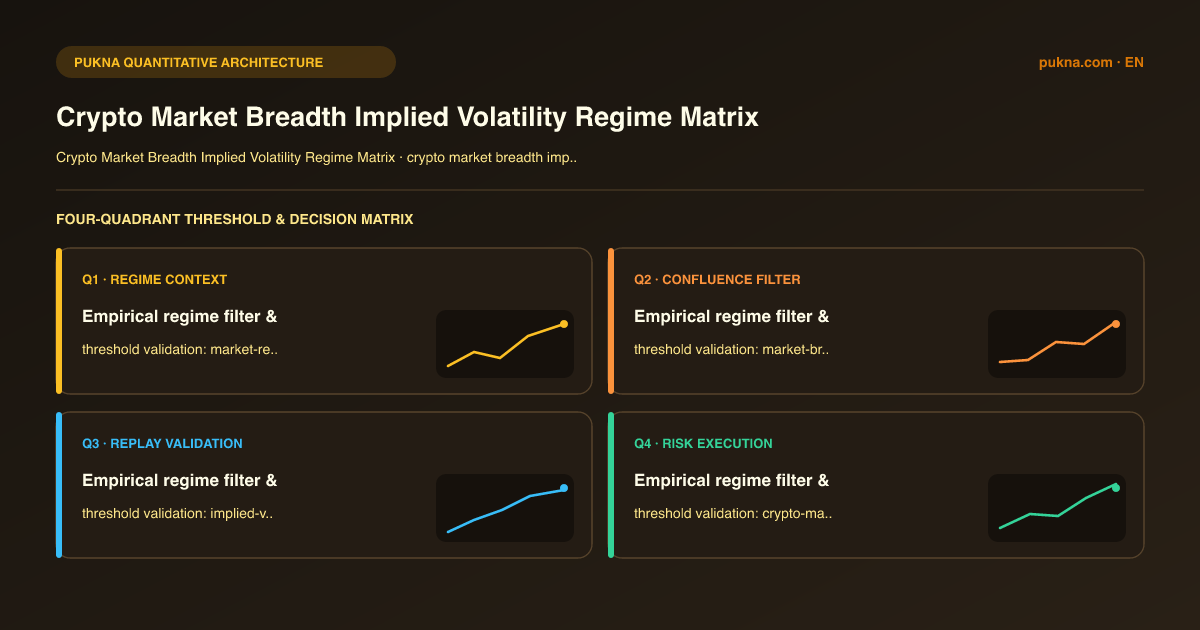
Crypto Market Breadth and Implied Volatility Regime Guardrails
| Diagnostic Axis | Empirical Criterion & Execution Guardrail |
|---|---|
| Net Advance Breadth (X-Axis) | Compute (Advancing Pairs − Declining Pairs) / Valid Sample Count over a pre-fixed universe and return window; stay neutral at zero breadth. |
| Relative BTC DVOL (Y-Axis) | Compare 30-day annualized implied volatility (DVOL) to its pre-defined historical window median rather than static absolute levels; hold neutral at exact median. |
| Regime Interpretation Boundary | DVOL prices expected volatility rather than direction, and funding measures carry cost rather than depth; treat quadrants as descriptive filters, never standalone buy/sell signals. |
The On-Chain Hurdle Rate: T-Bill Yields vs. DeFi Lending and Stablecoin Velocity
Before tokenized Treasuries scaled across major chains, DAO treasuries and crypto funds endured multi-day correspondent banking delays whenever rotating USDC back into sovereign bills. Allowlisted desks now shift millions between decentralized money markets and tokenized T-bill wrappers within minutes. Idle stablecoins immediately reprice against the sovereign benchmark.
Elevated front-end rates turn that settlement rail into a steady liquidity drain. When short T-bills pay 4.5% to 5.0% against 2.5% to 3.5% in DeFi lending pools, DeFi borrow-spread compression pulls idle USDC into BUIDL, OUSG, or USYC. Stablecoin velocity drops, yet rising RWA balances alone never guarantee bearish spot flows.
Single-indicator reads break down during institutional basis expansions. Tokenized Treasury supply can climb alongside spot Bitcoin ETF inflows while 8-hour perpetual funding holds near +0.01% (roughly 10.95% annualized). That +0.01% reading frequently marks the exchange interest-rate clamp rather than crowded longs, with incoming T-bill tokens backing delta-neutral basis carry.
Derivatives desks scale that flow through cross-venue funding dispersion and delta-hedged carry rotation. By posting yield-bearing Treasury tokens as off-exchange margin, firms stack the sovereign coupon atop short perpetual futures hedged against long spot positions. Total open interest rises steadily, yet organic directional bids for mid-cap altcoins stay flat.
Rotation reverses once policy easing pulls front-end rates lower alongside the Secured Overnight Financing Rate (SOFR). Falling T-bill yields lower the hurdle rate right as leveraged traders return to borrow stablecoins, pushing lending protocols past their 80% to 90% utilization kink. Variable borrow rates jump immediately.
Once DeFi stablecoin supply yields beat tokenized T-bills by 150 to 300 basis points, stablecoin velocity accelerates across spot books. Capital exits defensive cash wrappers for liquid Layer 1 chains, AI infrastructure, DePIN networks, and major altcoins. Cross-checking U.S. equity volatility risk gauges beside composite crypto sentiment gauges confirms whether inflows reflect durable risk appetite or a fragile short-covering bounce.
Negative funding exposes rapid arbitrage unwinds under stress. When perpetual basis collapses below zero, delta-neutral desks unwind spot-long and perp-short legs, sweeping freed USDC directly back into tokenized T-bill wrappers. Monitoring negative funding and open interest shifts distinguishes mechanical carry exits from forced spot capitulation.
Reading Rate-Regime Inflections Across RWA, Stablecoins, and Risk-On Crypto Sectors
Identical RWA inflow numbers carry opposite meanings across volatility regimes. Linear rules misfire whenever crypto shifts between low-volatility chop, trending breadth expansion, and violent liquidation cascades. Branching your read by market state eliminates those false positives.
Under sticky Treasury yields and muted volatility, steady RWA inflows mark capital hibernation rather than imminent altcoin deployment. Stablecoin velocity stalls, perpetual funding sticks near the +0.01% exchange clamp, and mid-cap breakouts repeatedly fade back into range. Cash preservation outperforms frequent directional chasing here.
During a rate-cut transition with rising net advance breadth, slowing RWA inflows paired with faster stablecoin velocity confirm healthy risk deployment. Comparing options implied and realized volatility spreads alongside rising coin-margined open interest shows whether funds are buying upside convexity rather than hedging static carry. Only when both climb together does directional rotation hold.
High-DVOL liquidation cascades with deeply negative breadth flip sudden RWA minting into emergency parking. Leverage flushes violently across perpetual order books as cross-asset correlations spike toward one and bid depth thins. Buying early bounces before implied volatility crests invites costly whipsaws.
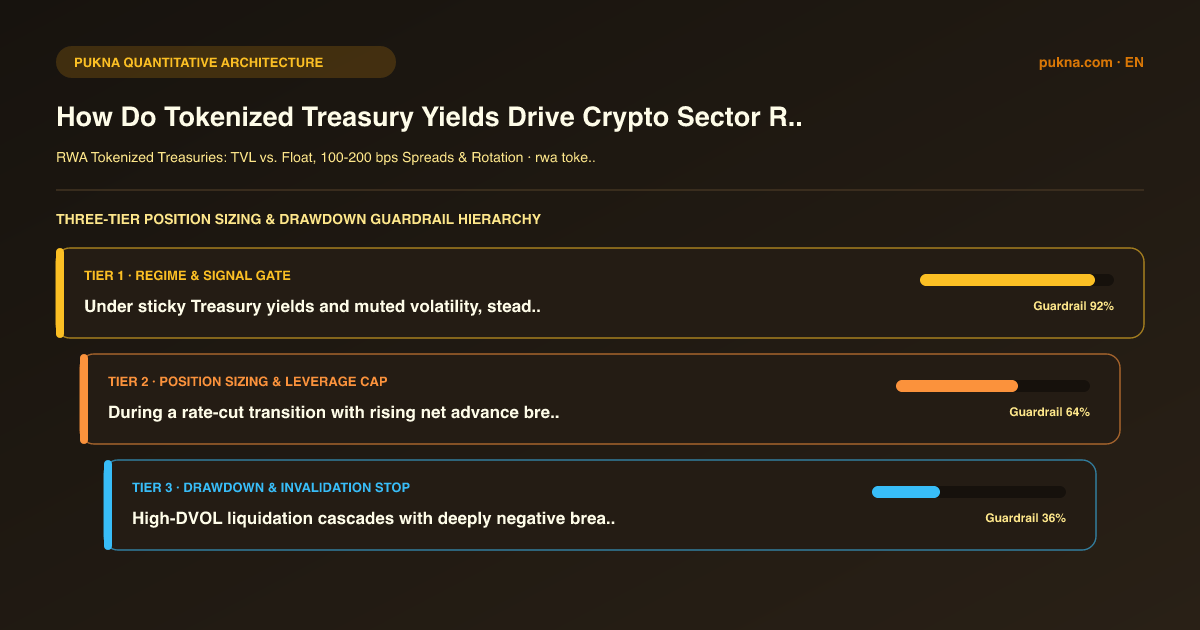
| Macro & Yield Regime | T-Bill vs. DeFi Spread | Stablecoin Velocity & Basis | RWA Inflow Slope | Leading Sectors & Invalidation Guardrail |
|---|---|---|---|---|
| Regime 1: Sticky High Yields & Tight Liquidity | T-bills lead by +100 to +250 bps | Low velocity; clamped +0.01% 8h funding | Steady defensive inflows into allowlisted wrappers | BTC dominance and cash RWA; invalidated if DeFi utilization tops 85% |
| Regime 2: Rate-Cut Compression Transition | Spread narrows toward 0 bps | Velocity inflects higher; basis beats T-bills | Inflows flatten or pivot to margin collateral | Large-cap L1s and liquid RWA infra; invalidated if DVOL spikes on macro shock |
| Regime 3: Liquidity Expansion & Risk-On | DeFi & basis lead by +150 to +300 bps | High velocity; expanding open interest and broad breadth | Redemptions or flat TVL as USDC deploys | Broad L1, AI, DePIN, and major altcoin rotation; invalidated on overheated funding |
Watching Treasury spreads, stablecoin velocity, equity volatility, and funding across six disconnected browser tabs creates costly lag at regime turns. Auditing those drivers together inside the Pukna 8-dimension environment research library (39 indicators) and 43-token research library separates defensive cash parking from delta-hedged collateral growth.
Diagnosing a macro regime still leaves the hardest execution hurdle unresolved. Sovereign yield cycles unfold across quarters, whereas major crypto pairs routinely swing 15% inside a single trading session. How do traders convert slow RWA regimes into disciplined multi-timeframe risk controls?
How Can Traders Turn Macro RWA Regimes Into Multi-Timeframe Risk Controls?
Macro regimes cannot time intraday entries. Sovereign yield curves and institutional RWA balances shift across weeks and months, while crypto pairs reprice across 15m, 1h, 4h, and 1d volatility cycles. Bridging that horizon mismatch requires strict top-down filtering and hard leverage ceilings.
Avoiding the Timeframe Mismatch Between Monthly RWA Flows and Intraday Price Cycles
Headline narrative trading blows up accounts through horizon mismatch. Buying a mid-cap RWA token solely because tokenized Treasury TVL crossed a round milestone ignores thin order books and crowded short-term funding. Even a correct six-month macro call gets stopped out in 48 hours on poor entry timing.
Slow macro flows suffer rapid information coefficient (IC) decay—meaning their predictive correlation fades sharply—when forced onto short intraday bars. Frequent rebalancing across thin mid-cap books adds slippage, spread crossing, and funding drag that shave 1.5% to 3.0% off annual returns. Zero-slippage backtests rarely clear the live fee-breakeven hurdle.
Drawdown recovery scales asymmetrically. A -50% drawdown demands a +100% rally just to break even, while an -80% loss requires a +400% recovery from the trough. Closed-trade performance sheets also hide severe intraday floating drawdowns that liquidate over-leveraged accounts well before price rebounds.
Integer leverage caps draw firm survival lines. Stepping from 1x spot to 3x leverage triples adverse price swings before perpetual funding fees even hit the account. A routine 12% spot pullback costs 12% at 1x, yet carves a 36% drawdown at 3x.
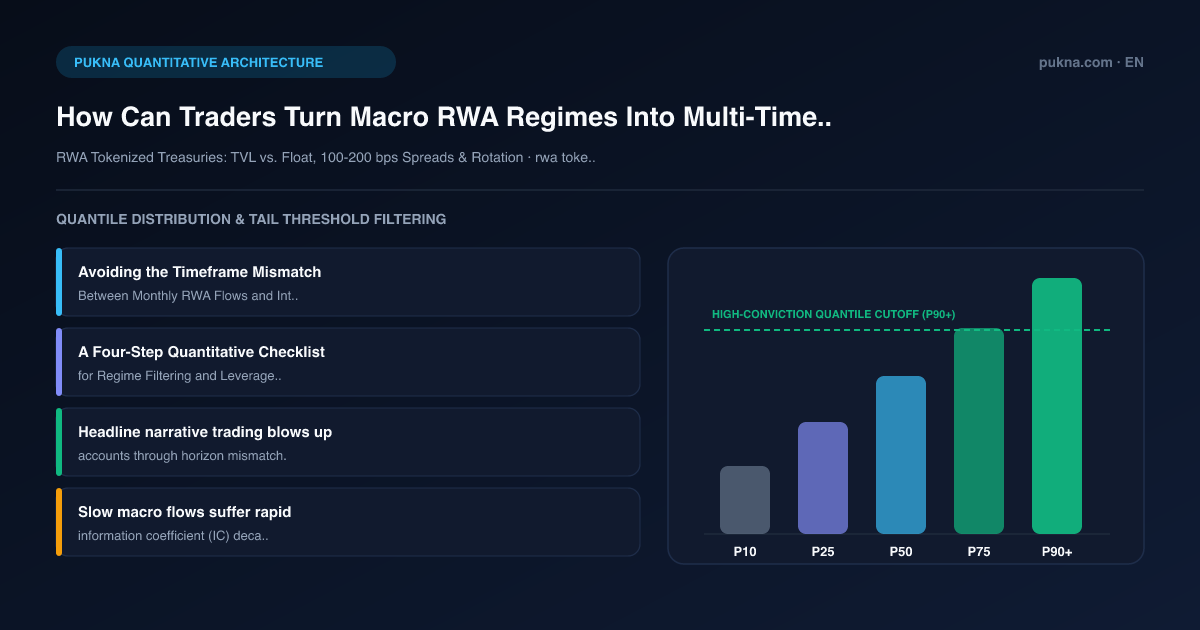
A Four-Step Quantitative Checklist for Regime Filtering and Leverage Discipline
Systematic desks decouple slow macro tailwinds from fast entry triggers. Running every setup through four verifiable checkpoints keeps macro conviction from mutating into oversized intraday risk.
- Audit Hurdle Rates and Volatility First: Check T-bill versus DeFi spreads, stablecoin velocity, equity volatility, and relative BTC DVOL before sizing risk. Cap exposure at 1x during central-bank policy windows or tight-liquidity regimes.
- Filter for Deep Liquidity and Broad Breadth: Concentrate execution on liquid USDT pairs where positive net advance breadth confirms multi-asset demand. Skip thin narrative tokens where a single market order clears 2% spot order book depth.
- Require Causal Multi-Timeframe Alignment: Anchor directional bias on 1d and 4h structure, then time entries on 1h and 15m candles. Demand rising coin-margined open interest alongside firm implied volatility before treating breakouts as directional.
- Stress-Test Equity Curves and Max Drawdown at 1x–3x Leverage: Verify worst-case downside before enabling automated execution. Inspect historical equity curves, simulated win rate, and worst peak-to-trough drawdown across 1x, 2x, and 3x integer leverage prior to activating live alerts.
| Stage | Ad-Hoc Narrative Headline Trading | Quantitative Regime-Aligned Execution |
|---|---|---|
| Macro Filter | Chases RWA TVL headlines without checking spreads | Audits T-bill vs. DeFi spread, velocity, and DVOL first |
| Asset Screen | Buys illiquid RWA micro-caps with heavy slippage | Selects deep USDT pairs backed by positive net breadth |
| Entry Timing | Enters on social news despite funding conflicts | Aligns causal 15m/1h/4h/1d structure with open interest and basis |
| Leverage Audit | Applies 5x–10x leverage without drawdown limits | Caps risk at 1x–3x integer leverage after drawdown review |
Separating macro bias from chart timing requires point-in-time candlestick metrics rather than hindsight drawings. Inside Pukna, traders review 4-timeframe causal candlestick signals (15m/1h/4h/1d) across 42 major USDT pairs, each paired with a P relative quality score (0–100) across horizon_bars. A score of 50 matches ordinary surrounding candles, while higher readings measure stronger peak gain and terminal return inside the preset window. Treat P strictly as relative return quality, never win probability.
Pair that candlestick screen with hard historical downside verification. An AUTO simulated win-rate and max-drawdown audit across 1x, 2x, and 3x integer leverage lets you inspect the full historical equity curve before subscribing to real-time push alerts. Confirming peak-to-trough loss limits upfront protects capital when macro rate transitions turn choppy.
| Research Scenario | Core Criterion | Empirical Takeaway | Full Study |
|---|---|---|---|
| Screening AMM liquidity pools | Swap-fee APR vs. emissions and Vol/TVL | High LP APYs fail if swap fees do not offset AMM curve impermanent loss. | Crypto Liquidity Pools: AMM Curves, Impermanent Loss Math & Vol/TVL Screening → |
| Auditing DeFi lending markets | Pool utilization, exit depth, and base yield | High lending APYs often mask thin exit liquidity, subsidies, or tight liquidation margins. | DeFi Lending: High APY vs. Utilization, Exit Depth, and Liquidation Risk → |
| Evaluating liquid staking tokens | Reward accounting, exit queues, and depth | LSTs keep tokens transferable, but exit queues and thin books create depeg risk. | Liquid Staking: Yield vs. Exit Liquidity and Depeg Risk → |
| Modeling V2/V3 LP net returns | Net LP PnL vs. fee-to-IL breakeven thresholds | Gross impermanent loss differs from net loss once fees and reward breakevens are included. | DeFi Impermanent Loss Calculator: V2/V3 & Fee Breakeven → |
| Choosing staking vs. yield farming | Same-asset, same-period net dollar return | Higher headline APY can yield less in dollars once fees and asset price risk are counted. | Crypto Staking vs Yield Farming: Returns, Liquidity & Risk → |
Frequently Asked Questions
How do tokenized U.S. Treasuries differ from standard USDC or USDT stablecoins?
Tokenized U.S. Treasuries are yield-bearing securities backed by regulated fund or SPV claims on short-duration government bills, whereas USDC and USDT are non-yielding payment stablecoins. Stablecoin issuers retain reserve interest in exchange for permissionless decentralized liquidity. Tokenized Treasury wrappers pass net sovereign yield to KYC-verified holders, trading open retail composability for regulated dollar carry.
Can retail crypto investors buy tokenized Treasury funds like BUIDL or OUSG directly?
Most retail wallets cannot purchase institutional wrappers like BUIDL or OUSG directly. Both products enforce smart-contract allowlists limited to U.S. Qualified Purchasers who clear high net-investment thresholds and full KYC onboarding. Eligible U.S. retail investors can instead access 1940 Act vehicles like BENJI through approved apps, while non-U.S. holders typically use Regulation S notes such as USDY after compliance lockups.
Why is tokenized RWA Total Value much larger than circulating RWA market cap?
Headline RWA Total Value counts every minted share on-chain, including restricted institutional balances locked inside corporate or prime-broker wallets. Transferable market cap measures only shares legally free to move across secondary wallets and DeFi pools. Because allowlisted reserves rarely enter open exchanges, headline TVL overstates deployable crypto liquidity.
How do rising or falling Treasury yields impact crypto sector rotation?
Short-duration Treasury yields anchor crypto’s on-chain hurdle rate for idle stablecoins. Whenever sovereign yields sit 100 to 250 basis points above DeFi lending rates, treasuries park USDC in defensive RWA wrappers, slowing stablecoin velocity and pressuring altcoin depth. When policy easing pulls front-end rates below DeFi carry and perpetual basis, capital rotates back into liquid Layer 1s, AI, and DePIN sectors.
Put this into practice
Create a free account to browse live signals and test your own rules.