Contents7 sections
- What Is RWA Tokenization? Wrapper Claims vs. Governance Tokens
- Legal Claims vs. On-Chain Ledger Records
- Tokenized Yield Wrappers vs. RWA Governance Tokens
- How Does RWA Tokenization Work Across Legal Rails and Asset Classes?
- End-to-End Issuance Lifecycle: Custody to Redemption
- Asset-Class Liquidity, Whitelists, and Settlement Gaps
- Why Identical RWA TVL Growth Signals Opposite Macro Regimes
- High-Rate Risk-Off: Defensive Treasury Yield Absorption
- Rate-Cut Risk-On: Liquidity Spillover into High-Beta Tokens
- 24/7 Stress Regimes vs. T+1 and T+2 Settlement Lags
- Raw RWA TVL vs. Verified Depth: Metric Blind Spots and Legal Breaks
- Why Headline RWA TVL Diverges Across Trackers
- Permissioned Whitelists, Stale NAV Oracles, and Queue Risk
- Legal Wrapper Failures and Cross-Border Regulatory Splits
- How to Filter RWA Regimes and Narrative Exposure Quantitatively
- Separating Macro Rate Confirmation from Narrative Hype
- Cross-Timeframe Signal Alignment and Relative Quality Scoring
- How to Size RWA Rotation Exposure and Stress-Test Drawdowns
- Regime-Invalidation Thresholds and Liquidity Haircuts
- Stress-Testing Rotation Exposure Before Live Execution
- Frequently Asked Questions
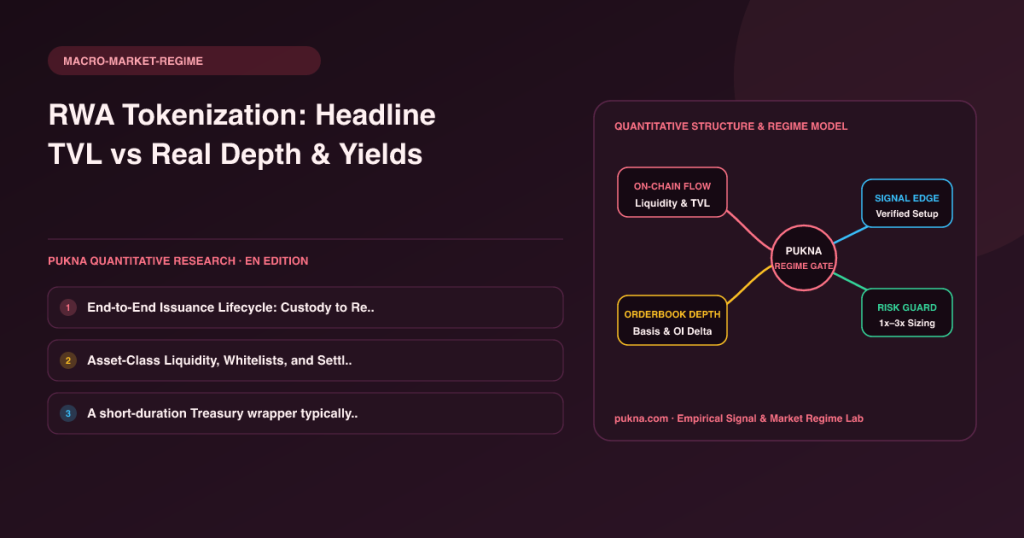
RWA tokenization issues on-chain claims over off-chain assets via legally binding SPVs, trusts, or regulated funds, separating asset-backed instruments from fiat stablecoins and protocol governance tokens. Headline RWA total value locked (TVL) often inflates tradable depth 3x to 10x with permissioned mints or stablecoins, while ex-stablecoin liquidity and Treasury-to-DeFi yield spreads drive real flows. Multi-dimensional checks across legal enforceability, off-chain settlement latency, and macro interest-rate regimes must precede any allocation to yield wrappers or sector-rotation risk.
| Instrument Category | Legal Claim Structure | Yield Source | Transferability & KYC Gate | Secondary Liquidity Depth / Macro-Regime Beta |
|---|---|---|---|---|
| Tokenized RWA Claims (T-Bills, Private Credit, Equities) | Contractual claim on a bankruptcy-remote SPV, trust, or licensed fund | Off-chain sovereign interest, loan coupons, or asset cash flows | Permissioned; KYC-whitelisted wallets with issuer freeze controls | Secondary Liquidity Depth: High primary redemption (T-bills); thin secondary DEX books · Macro-Regime Beta: Defensive / low beta; tracks interest-rate spreads |
| Fiat-Backed Stablecoins | Redeemable cash-equivalent liability backed by reserve bills and deposits | Retained by issuer (typically 0% native pass-through to holders) | Permissionless wallet transfers; KYC required for primary minting | Secondary Liquidity Depth: Deepest 24/7 CEX and DEX quote-currency liquidity · Macro-Regime Beta: Zero directional beta; acts as dry-powder liquidity proxy |
| RWA Protocol Governance Tokens | No direct legal title to underlying Treasury bills or physical assets | Speculative price appreciation; optional protocol fee-sharing models | Permissionless trading across global spot and perpetual venues | Secondary Liquidity Depth: Moderate-to-high liquid CEX/DEX books with wide volatility · Macro-Regime Beta: High crypto beta; moves with risk-on altcoin liquidity |
What Is RWA Tokenization? Wrapper Claims vs. Governance Tokens
An on-chain token creates zero legal title by itself; enforceable ownership depends entirely on the off-chain legal wrapper behind the contract.
Legal Claims vs. On-Chain Ledger Records
Code cannot override bankruptcy law. When an institution tokenizes short-duration U.S. Treasuries, corporate loans, or vaulted gold, an off-chain special purpose vehicle (SPV) or statutory trust holds actual property title. The blockchain ledger only tracks who holds a verified contractual claim against that segregated entity. Without ring-fenced legal documentation, an on-chain token moves database entries rather than enforceable property rights.
Unlike permissionless decentralized finance (DeFi) collateral, regulated RWA tokens embed transfer restrictions directly into smart contracts so only identity-verified wallets can hold shares. Issuers also retain pause, freeze, and forced-recovery functions mandated by securities law. That control satisfies regulators, yet it blocks open DeFi composability.
Tokenized Yield Wrappers vs. RWA Governance Tokens
Governance tokens do not pay Treasury yields. Buying a tokenized money market fund gives an accredited holder exposure to benchmark sovereign interest minus sponsor management fees, with minimal principal volatility. Buying the protocol’s liquid governance token instead delivers equity-like exposure to crypto market risk, token emissions, and narrative demand. Treating both instruments as interchangeable RWA exposure breaks risk control.
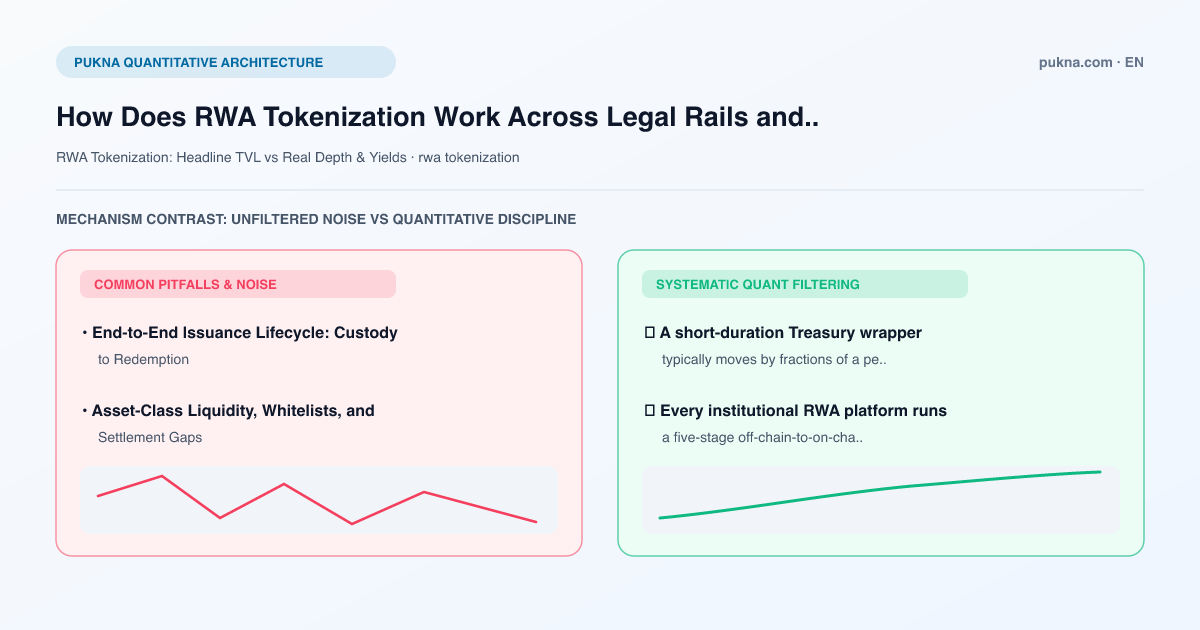
A short-duration Treasury wrapper typically moves by fractions of a percent during a selloff, whereas liquid RWA governance tokens routinely drop 40% to 70% peak-to-trough alongside broader altcoins. Cash flows, custody rights, and liquidity rails share almost nothing across the two instruments. Understanding that split starts with how off-chain origination connects to on-chain settlement.
How Does RWA Tokenization Work Across Legal Rails and Asset Classes?
Every institutional RWA platform runs a five-stage off-chain-to-on-chain bridge where custody segregation and redemption latency determine real tradability.
End-to-End Issuance Lifecycle: Custody to Redemption
Tokenization starts in legal structuring, not Solidity code. First, an asset originator underwrites the underlying securities or loans and transfers title into a bankruptcy-remote SPV or regulated fund. Second, a qualified third-party custodian holds the collateral in segregated accounts insulated from the issuer’s corporate balance sheet. Third, independent administrators and data oracles publish verified net asset value (NAV) and proof-of-reserve attestations on-chain.
Identity-aware token standards such as ERC-3643 and ERC-1400 check Know Your Customer (KYC) registry approval before minting shares into an investor’s wallet. Issuers select underlying chains by weighing L1 and L2 settlement fee economics against institutional security requirements. Primary redemptions then burn tokens on-chain and wire fiat or stablecoins back once banking settlement clears. Without registry clearance, transfers simply fail.
Analysts comparing tokenization platforms or issuers should audit four neutral operational criteria before trusting reported scale:
- Wrapper Bankruptcy Remoteness: Confirm whether assets sit inside a legally ring-fenced SPV or statutory trust rather than on the operating company’s balance sheet.
- Custodian Segregation & Attestation: Verify qualified third-party custody and whether reserve audits publish daily, weekly, or only quarterly.
- Smart-Contract Permissioning Transparency: Inspect ERC-3643 or ERC-1400 freeze, clawback, and whitelist governance keys for centralized single-point failure risk.
- Audited Primary Redemption SLA: Check contractual cash-out windows—whether atomic stablecoin liquidity exists or exits wait for T+1 to T+2 banking rails.
Asset-Class Liquidity, Whitelists, and Settlement Gaps
Not all tokenized assets share equal market depth. Standardized instruments with continuous institutional pricing scale quickly, whereas idiosyncratic physical assets remain trapped behind thin order books and slow settlement windows.
| Asset Class | Typical Legal Wrapper | Accreditation & KYC Gate | Off-Chain Settlement Lag | Secondary Liquidity & Core Friction |
|---|---|---|---|---|
| Tokenized U.S. Treasuries & MMFs | Bankruptcy-remote SPV or licensed Reg D / Reg S fund | Institutional or accredited whitelist; high minimum ticket | T+0 stablecoin minting; T+1 traditional banking wire | Deep primary redemption and growing DeFi collateral use; low duration risk |
| Private Credit Pools | Loan-origination SPV or closed-end credit trust | Strict institutional KYC and jurisdictional screening | Fixed 30- to 90-day+ lockups and maturity windows | Minimal secondary turnover; opaque borrower underwriting and default risk |
| Tokenized Equities & ETFs | Custodial trust or synthetic depository receipt | Geo-fenced KYC whitelist; restricted U.S. retail access | T+1 equity clearing; closed on weekends and holidays | Fragmented off-hours spreads and weekend gap risk against cash closes |
| Vaulted Commodities (Gold) | Allocated physical vault trust | Retail KYC required for physical bar redemption | T+1 to T+3 vault settlement for primary delivery | Moderate CEX/DEX spot liquidity; ongoing vault storage fees |
| Fractional Real Estate | Property-specific LLC or REIT structure | Jurisdiction-locked KYC and investor caps | Weeks to months for underlying property liquidation | Thin secondary order books, wide bid-ask spreads, and stale appraisals |
Short-duration Treasuries lead institutional adoption for structural reasons. Daily benchmark pricing, deep underlying dealer markets, and near-zero duration risk let funds support rapid primary redemptions. Yet that defensive profile creates a paradox: why does surging Treasury TVL coincide with a bear market in one cycle and an altcoin rally in another?
Why Identical RWA TVL Growth Signals Opposite Macro Regimes
Rising RWA TVL signals defensive risk-off parking when sovereign yields beat DeFi rates, but marks risk-on rotation once liquidity expands and spreads compress.
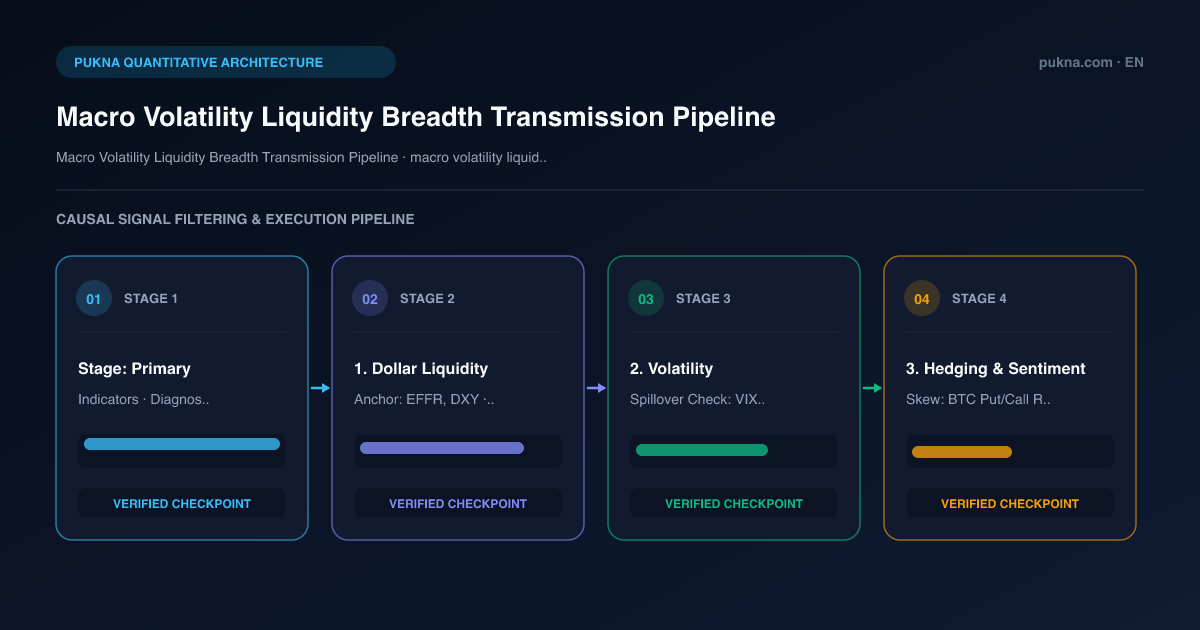
A raw TVL chart hides the direction of risk appetite. Tokenized asset flows sit downstream of dollar borrowing costs, dollar net liquidity versus money supply, and equity volatility spillover regimes. Before interpreting RWA minting as bullish or defensive, analysts must trace how macro liquidity transmits across volatility, derivatives hedging, and market breadth.
Cross-Asset Volatility, Liquidity & Breadth Regime Pipeline
| Stage | Primary Indicators | Diagnostic Signal | Regime Classification Output |
|---|---|---|---|
| 1. Dollar Liquidity Anchor | EFFR, DXY | Tightening rates + rising DXY vs easing liquidity + softening DXY | Sets baseline capital cost and global risk-asset discount pressure |
| 2. Volatility Spillover Check | VIX, BTC DVOL | Co-moving VIX/DVOL spike vs isolated crypto DVOL expansion | Separates systemic macro de-risking from crypto-native gamma repricing |
| 3. Hedging & Sentiment Skew | BTC Put/Call Ratio, Fear & Greed | Elevated Put/Call defensive skew vs normalized hedging demand | Identifies whether institutional desks are paying for downside protection |
| 4. Market Breadth Confirmation | Total Crypto Market Cap | Broad cap expansion vs narrow defensive concentration | Maps state to Broad Expansion, Narrow Rotation, Macro De-risking, or Reset |
High-Rate Risk-Off: Defensive Treasury Yield Absorption
High policy rates drain speculative DeFi demand. When tighter policy triggers real yield headwinds and weakens the dollar liquidity impulse, short-duration Treasury yields often beat decentralized stablecoin lending rates by 150 to 300 basis points. Decentralized autonomous organization (DAO) treasuries and corporate desks rationally sweep idle stablecoins into tokenized T-bills. Headline RWA TVL climbs even as spot crypto prices slide.
Contracting net dollar liquidity compresses valuation multiples across speculative crypto sectors even while regulated Treasury wrappers hit record issuance. Buying RWA protocol governance tokens simply because tokenized T-bill TVL prints a new high is a classic regime error. Unless broader liquidity expands, that inflow reflects defensive duration parking rather than risk-on appetite. Defensive flows rarely lift governance beta.
Rate-Cut Risk-On: Liquidity Spillover into High-Beta Tokens
Falling benchmark rates flip the yield advantage back on-chain. As policy eases and net stablecoin supply expands, Treasury yields drop while on-chain borrowing demand and perpetual basis—the annualized futures premium over spot—climb. Capital no longer needs to park defensively in tokenized bills. Instead, excess liquidity migrates outward into higher-beta sectors, including liquid RWA infrastructure tokens and leveraged DeFi protocols.
Healthy easing regimes pair narrowing Treasury-to-DeFi yield spreads with rising open interest (active derivative contracts), steady funding demand, and broad altcoin rotation breadth. Under those conditions, tokenized RWA expansion complements speculative adoption instead of draining on-chain liquidity. Liquid RWA tokens then sustain relative strength against Bitcoin.
24/7 Stress Regimes vs. T+1 and T+2 Settlement Lags
Off-chain banks close when crypto liquidations peak. During sudden weekend selloffs, crypto perpetual futures and lending protocols liquidate continuously while off-chain Treasury custodians and banking wires remain offline until Monday. Crypto implied volatility (DVOL)—expected 30-day price swings—spikes, widening the implied volatility vs. realized volatility (VRP) spread as desks bid up downside hedges.
Redemption bottlenecks can break tight NAV pegs during forced deleveraging. Because KYC whitelists restrict which market makers can hold and redeem regulated RWA collateral, secondary pools thin out exactly when liquidations accelerate. Meanwhile, perpetual venues often hit an exchange-specific funding cap that throttles payouts despite steep futures discounts. Traders posting tokenized RWA collateral for weekend margin face sudden haircuts before Monday redemptions reopen.
| Macro & Liquidity Regime | Treasury vs. DeFi Yield Spread | Tokenized T-Bill Minting | RWA Governance Beta vs. BTC | Primary Analytical Failure Mode |
|---|---|---|---|---|
| High-Rate Tight-Liquidity (Risk-Off) | Positive (+150 to +300 bps favoring T-bills) | Strong defensive inflows from idle stablecoins | Underperforms BTC; rallies fade quickly | Mistaking defensive yield parking for bullish altcoin rotation |
| Rate-Cut Expanding-Liquidity (Risk-On) | Compressing or negative as DeFi rates climb | Moderate or flat; capital migrates on-chain | Outperforms BTC during broad liquidity expansion | Staying overweight low-yield T-bills while high-beta sectors break out |
| 24/7 Stress & Weekend Settlement Gap | Distorted by sudden DeFi liquidation spikes | Paused primary mint/burn until Monday T+1 rails | Sharp correlation-to-one downside selloff | Assuming 24/7 atomic redemption parity during closed banking hours |
Mapping macro regimes still leaves a second distortion layer. Popular analytics dashboards frequently report conflicting RWA totals because their inclusion rules mix tradable liquidity with locked institutional wrappers. Before sizing any allocation, analysts must strip away inflated TVL and verify actual market depth.
Raw RWA TVL vs. Verified Depth: Metric Blind Spots and Legal Breaks
Raw RWA TVL blends stablecoins, non-circulating institutional mints, and stale off-chain valuations, creating severe blind spots in both liquidity and legal recourse.
Why Headline RWA TVL Diverges Across Trackers
Two reputable analytics dashboards can report wildly conflicting RWA totals. Some aggregators include fiat-backed stablecoins and issuer-held uncirculated treasury wallets inside headline TVL, while stricter trackers isolate only distributed, ex-stablecoin tokenized securities. Blending stablecoins into RWA totals inflates apparent sector scale by 5x to 10x without representing new tokenized debt, equity, or credit demand.
Just as desks separate hedged arbitrage versus directional spot flows in ETFs, institutions routinely mint tokenized funds as collateral for basis trades rather than directional bets. Treating aggregate TVL as net bullish demand misses offsetting short hedges and internal treasury reshuffling. Nominal mints are not organic buying.
Permissioned Whitelists, Stale NAV Oracles, and Queue Risk
Locked institutional TVL is not tradable order-book depth. A tokenized money market fund showing hundreds of millions in on-chain supply may sit across fewer than fifty corporate wallets that rarely trade on secondary markets. Always check 2% spot order book depth—actual resting limit orders within 2% of mid-price—before assuming a ticker can absorb systematic size without severe slippage.
Stale NAV oracles mask real-time credit impairment. While short-duration Treasury wrappers price daily against liquid dealer quotes, tokenized private-credit pools and fractional real estate often update off-chain valuations monthly or quarterly. On-chain prices can stay pinned near par long after a borrower misses payments, shifting sudden mark-to-market losses onto late redeemers.
Legal Wrapper Failures and Cross-Border Regulatory Splits
Immutable ledgers cannot rescue flawed off-chain contracts. If an issuer commingles custody funds, omits perfected liens, or uses weak SPV transfer terms, bankruptcy courts treat token holders as general unsecured creditors. Cryptographic proof of wallet ownership enforces zero priority over senior off-chain lenders when legal title fails.
U.S. SEC Regulation D and S exemptions bar domestic retail buyers, while Europe’s MiCA framework and regulators across Singapore, the UAE, and India enforce separate licensing gates. Because compliance contracts enforce those borders on-chain, identical assets fracture across incompatible regional pools. Global liquidity breaks into siloed books.
| Raw Metric or Assumption | Hidden Distortion Mechanism | Verified Diagnostic Metric | Practical Portfolio Consequence |
|---|---|---|---|
| Stablecoin-Inclusive Headline TVL | Counts fiat stablecoins and idle issuer wallets alongside yield wrappers | Ex-stablecoin distributed RWA value and unique active holders | Prevents overestimating organic adoption by 3x to 10x |
| Total Permissioned Mint Supply | Whitelisted institutional holdings rarely circulate on open venues | 2% spot order book depth and 30-day secondary turnover ratio | Avoids entering illiquid assets with severe exit slippage |
| Static Off-Chain NAV Feed | Monthly or quarterly private-credit appraisals lag borrower distress | Delinquency rate, borrower concentration, and secondary market discount | Flags hidden credit impairment before redemption queues freeze |
| Borderless On-Chain Token Label | Regional securities law geo-fences wallets across US, EU, and Asia | Jurisdictional transfer eligibility and primary redemption venue list | Eliminates sudden wallet transfer blocks and stranded collateral |
Spotting TVL distortions is only half the job. Translating macro rate gates, legal wrapper audits, and order-book checks into live entries demands a repeatable cross-timeframe filter. Without that discipline, accurate macro calls still fail at execution.
How to Filter RWA Regimes and Narrative Exposure Quantitatively
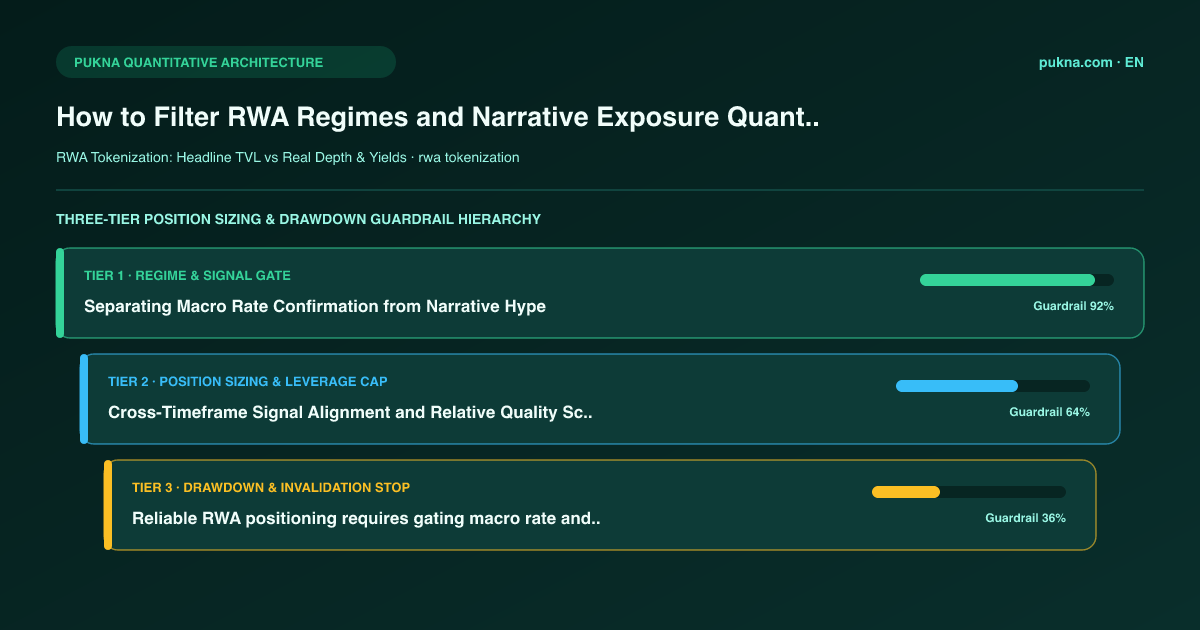
Reliable RWA positioning requires gating macro rate and liquidity conditions first, auditing wrapper enforceability second, and confirming liquid price action across four timeframes.
Separating Macro Rate Confirmation from Narrative Hype
Start every RWA thesis at the macro rate layer. Before treating a protocol announcement or TVL headline as a durable catalyst, cross-check policy interest rates, real yields, dollar net liquidity, and stablecoin issuance velocity. Pair those liquidity gauges with composite market sentiment shifts and perpetual account directional skew to verify whether crowded leverage is already vulnerable to a flush.
Before checking any price chart, separate regulated yield wrappers from high-beta governance tokens, confirm third-party custody and redemption windows, and verify whether secondary turnover supports your target size. Skipping structural due diligence converts a clean macro read into uncompensated legal or exit risk. Audit the wrapper first.
Cross-Timeframe Signal Alignment and Relative Quality Scoring
Single-candle breakouts routinely fail during regime transitions. Even when macro liquidity leans constructive, chasing an isolated 15-minute spike in a liquid crypto pair invites mean-reversion whipsaws. Confirming directional alignment across 15m, 1h, 4h, and 1d horizons filters out short-lived narrative squeezes that clash with higher-timeframe distribution.
Juggling disconnected macro feeds and four chart tabs slows execution. To streamline that verification loop, researchers can audit rates, liquidity, sentiment, derivatives, and on-chain context inside the Pukna 8-dimension 39-indicator environment library and 43-token research library. That shared baseline filters out hostile rate regimes before any entry triggers.
From there, evaluate 4-timeframe causal candlestick signals (15m/1h/4h/1d) across the 42-pair USDT universe using the P relative quality score (0–100) across horizon_bars. A score of 50 sets a neutral baseline matching surrounding ordinary candles, while higher readings reflect stronger combined peak and final return over the forecast window. P measures relative return quality, never win-rate probability.
| Verification Stage | Core Inputs Audited | Manual Multi-Tab Workflow | Unified Pukna Workflow |
|---|---|---|---|
| 1. Macro & Liquidity Gate | Policy rates, DXY, VIX/DVOL, net liquidity, sentiment, and derivatives skew | Manually cross-checking 6+ macro portals and CSV exports daily | Single-view audit across the 8-dimension, 39-indicator environment library |
| 2. Asset & Token Screening | Wrapper type vs. governance beta, supply dynamics, and liquidity tier | Scattered protocol docs, PDFs, and inconsistent TVL aggregators | Standardized fundamentals inside the 43-token research library |
| 3. Multi-Timeframe Confirmation | Synchronized price structure across 15m, 1h, 4h, and 1d bars | Switching multiple chart layouts with risk of look-ahead bias | Strictly causal K-line buy/sell signals across 42 major USDT pairs |
| 4. Quality vs. Win-Rate Split | Signal return quality vs. historical strategy drawdown behavior | Ad-hoc eyeballing without separating candle quality from hit rate | P relative quality score (0–100, 50 neutral) paired with separate historical simulation metrics |
For deeper empirical context on how benchmark interest rates, global liquidity, and institutional ETF flows shift crypto risk regimes, consult the companion studies below.
| Research Scenario | Core Criterion | Empirical Takeaway | Full Study |
|---|---|---|---|
| Identifying macro liquidity regimes | FRED M2SL year-over-year growth versus weekly net liquidity | M2 growth alone cannot establish when liquidity will support crypto prices, and fixed historical lag assumptions can break down. | Fed M2 Money Supply: FRED M2SL Growth vs. Net Liquidity for Crypto Regimes → |
| Assessing Bitcoin ETF buying pressure | Multi-day spot ETF flows, CME futures basis, perpetual funding and Treasury real yields | ETF inflows may reflect hedged positions rather than unhedged bullish exposure. | Spot Bitcoin ETF: Net Flows vs. CME Basis & Real Yields → |
| Bitcoin declines despite positive ETF flows | 5- and 20-session net flows, share creations, CME basis and real yields | Bitcoin can decline despite $500 million in ETF net inflows when broader market conditions remain unfavorable. | Spot Bitcoin ETF Net Inflows: Share Creations, CME Basis & Real Yields → |
| Evaluating Ethereum ETF exposure | Fund fees, forgone staking yield, 5- and 20-day flows and real yields | Management fees and potential staking opportunity costs of 3% or more can materially affect relative returns. | Spot Ethereum ETF: Fees, 3%+ Staking Drag, and Macro Flows → |
| Evaluating extreme market fear | Fear and Greed Index, macro liquidity, spot ETF flows and 15m–1d signal confirmation | Extreme fear is a sentiment observation, not sufficient evidence of a market bottom. | Crypto Fear and Greed Index: Lag, Macro Liquidity & Trading Limits → |
Even an accurate macro read and clean four-timeframe confirmation cannot protect capital if position sizing ignores settlement lags or drawdown math. Disciplined risk boundaries must govern every allocation before execution.
How to Size RWA Rotation Exposure and Stress-Test Drawdowns
Strict liquidity haircuts, pre-defined spread invalidation triggers, and 1x–3x leverage drawdown audits prevent RWA narrative trades from compounding tail losses.
Regime-Invalidation Thresholds and Liquidity Haircuts
Drawdowns compound asymmetrically against undisciplined position sizing. A 50% portfolio loss demands a 100% recovery simply to break even, while an 80% drawdown requires a 400% rebound. On thinner tokenized credit or governance pairs, execution slippage and weekend bid-ask widening can also erode 1.5% to 3% of annualized return. Apply heavier sizing haircuts to illiquid wrappers than to deep major USDT markets.
Trim defensive tokenized Treasury positions once on-chain stablecoin lending yields sustainably surpass sovereign T-bill rates during broad liquidity expansion. Conversely, cut high-beta RWA governance exposure immediately if real yields climb, dollar liquidity contracts, and Bitcoin’s higher-timeframe trend breaks down. Write those invalidation triggers before capital moves.
| Risk Dimension | Concrete Market Trigger | Required Portfolio Action | Quantitative Invalidation Boundary |
|---|---|---|---|
| Yield-Spread Inversion | DeFi stablecoin borrowing rates overtake T-bill yields during liquidity easing | Rotate incrementally from defensive yield wrappers toward liquid beta setups | Treasury minus DeFi yield spread stays negative across 10+ consecutive sessions |
| Secondary Discount to NAV | Tokenized RWA wrapper trades below off-chain NAV during weekend selloff | Halt leveraged collateral borrowing; queue primary redemption at Monday open | Secondary market discount widens past 0.75%–1.50% alongside delayed SLA |
| High-Beta Drawdown Cap | RWA governance token lags BTC while DVOL spikes and liquidity tightens | Cut directional size and revert to defensive cash or T-bill allocation | Position drawdown hits pre-set risk limit or 4h/1d structure breaks |
| Integer Leverage Ceiling | Systematic sector-rotation entries deployed on liquid USDT pairs | Restrict leverage strictly to audited 1x, 2x, or 3x integer tiers | Historical max drawdown at chosen leverage exceeds personal pain threshold |
Stress-Testing Rotation Exposure Before Live Execution
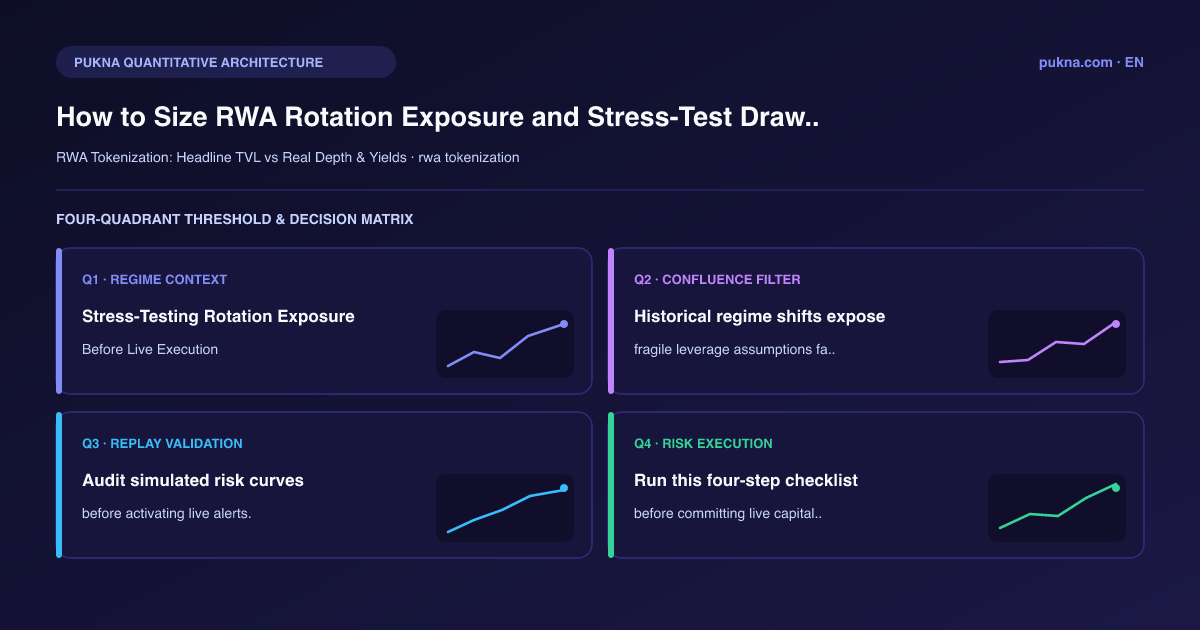
Historical regime shifts expose fragile leverage assumptions fast. Backtesting rotation rules only inside an easing bull market hides how sharply 3x leverage deepens equity-curve troughs when policy rates reprice higher. Inspect full path-dependent drawdowns across multiple volatility regimes instead of trusting isolated trade samples.
Audit simulated risk curves before activating live alerts. On Pukna, traders testing rotation setups across the 42-pair USDT universe can run an AUTO simulated win-rate and max-drawdown audit under 1x–3x integer leverage. Reviewing the historical equity curve, AUTO strategy win rate, and max drawdown alongside each signal’s P relative quality score separates past strategy behavior from single-candle return quality. Enable real-time push alerts only once drawdowns fit your cap.
Run this four-step checklist before committing live capital to any RWA wrapper or rotation trade:
- Verify the Macro Gate: Confirm whether the Treasury-to-DeFi yield spread and net dollar liquidity favor defensive yield absorption or risk-on beta rotation.
- Audit Legal & Redemption Rails: Confirm bankruptcy-remote SPV status, third-party custodian segregation, and T+0 versus T+1/T+2 exit latency.
- Separate Signal Quality from Hit Rate: Pair 4-timeframe causal alignment and P relative quality scoring (50 neutral baseline, never win probability) with independent historical win-rate statistics.
- Cap Drawdown Before Enabling Alerts: Stress-test historical equity curves and maximum drawdown under 1x–3x integer leverage before subscribing to real-time push alerts.
Frequently Asked Questions
What does RWA tokenization mean in crypto?
RWA tokenization issues blockchain-based tokens representing legally enforceable claims on off-chain assets like U.S. Treasuries, private credit, equities, gold, or real estate. Smart contracts alone cannot convey legal property title. Instead, an off-chain bankruptcy-remote SPV, statutory trust, or regulated fund holds the asset at a qualified custodian and binds on-chain transfers to enforceable ownership rights.
How does real-world asset tokenization work step by step?
Tokenization follows five institutional steps. First, an issuer underwrites the off-chain asset and places legal title inside a bankruptcy-remote SPV or trust. Second, a qualified custodian holds the collateral in segregated accounts. Third, independent oracles publish verified net asset value and reserve attestations on-chain. Finally, compliance standards like ERC-3643 mint KYC-whitelisted tokens and process primary redemptions back into fiat or stablecoins.
Are RWA crypto tokens backed directly by real-world assets?
Not all RWA tokens carry collateral backing. Tokenized yield wrappers, such as regulated Treasury bill funds, represent direct contractual claims on underlying sovereign securities held by a custodian. By contrast, liquid RWA protocol governance tokens act like high-beta crypto infrastructure equities. Holding a governance token grants protocol voting or fee-narrative exposure rather than direct legal title to underlying Treasury yields or real estate.
What are the biggest risks in RWA tokenization?
Four structural risks dominate tokenized real-world assets. First, weak SPV documentation or commingled custody can leave token holders as unsecured creditors during issuer insolvency. Second, KYC whitelists and regional securities rules fragment secondary liquidity pools across jurisdictions. Third, off-chain T+1 or T+2 banking rails create pricing discounts during 24/7 weekend crypto liquidations. Finally, headline TVL often blends stablecoins or idle mints, masking shallow tradable depth.
Put this into practice
Create a free account to browse live signals and test your own rules.