Cross Margin vs Isolated Margin: Liquidation & Corr>0.85
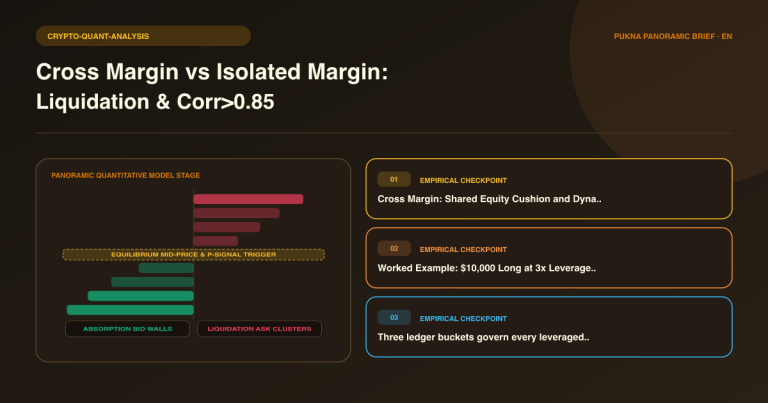
Shared collateral stretches liquidation distance, yet correlated crashes spread full-account contagion. Screen margin mode by 0.50/0.85 correlation, volatility, and venue rules.
Focused tactical notes on enforcing maximum drawdown thresholds, filtering extreme volatility anomalies, and running practical risk audits. Using Pukna's 8-dimension indicator library, causal candlestick signals, and AUTO strategy backtest metrics (1–3x integer leverage), these articles cover concrete parameter cutoffs, liquidity-regime pause rules, and post-drawdown review checklists across 42 USDT trading pairs. For the overarching structural framework, explore our complete guide in Position Sizing, Leverage & Drawdown Discipline (https://pukna.com/category/blog/empirical-trading-research/position-sizing-risk-management/).
Shared collateral stretches liquidation distance, yet correlated crashes spread full-account contagion. Screen margin mode by 0.50/0.85 correlation, volatility, and venue rules.
A trailing stop tracks favorable crypto swings, yet never guarantees a fill. Screen fixed % vs. ATR distances against realized volatility, book depth, and drawdown risk.
A 1:1 crypto hedge trades spot downside for funding drag and basis risk. Screen perps, dated futures, and protective puts by beta ratio, carry cost, and…
Sub-20 Fear & Greed troughs misfire when bid-ask spreads widen 2x–4x. Apply inverse-volatility sizing, DVOL and realized-vol filters, and ATR stops to cap drawdowns.
Full Kelly is highly sensitive to estimation errors. Compare Quarter- and Half-Kelly sizing using worked examples, leverage caps, correlation adjustments, and drawdown stress tests.
Fixed 5% stops can sit inside liquidation wicks. Compare 1.5x–3.5x ATR exits, DVOL, order-book depth, stop-limit buffers, and 1x–3x position sizing to manage drawdown.
Leverage determines margin, not planned dollar loss. Compare 0.5%–1.5% risk budgets using fee-adjusted formulas, BTC/ETH examples, ATR/Kelly models, Excel setup, and drawdown checks.
Trailing volatility peaks after liquidations finish in 24/7 crypto. Screen regimes with Deribit DVOL, rolling Z-scores, perp funding, and a 1d–15m drawdown checklist.
Full Kelly can produce deep drawdowns when costs and estimation errors erode trading edge. Calculate net-of-fee W and R, skip nonpositive Kelly outputs, and compare 0.25x–0.5x…
Single indicators invert polarity across volatility shifts. Filter all four crypto cycle phases using dollar liquidity, funding, coin OI, DVOL, and 1x–3x drawdown caps.
Crypto trading bots fail from regime mismatch and biased backtests, not speed. Compare bot stacks, screen 15m–1d causal setups after costs, and replay drawdowns at 1x–3x…