Contents6 sections
- Cardano vs. Ethereum at a Glance: Architecture, Liquidity, and Risk Matrix
- Core Protocol and Market Structure Comparison Matrix
- How Do EUTxO Determinism and EVM Rollups Differ in Execution and Staking?
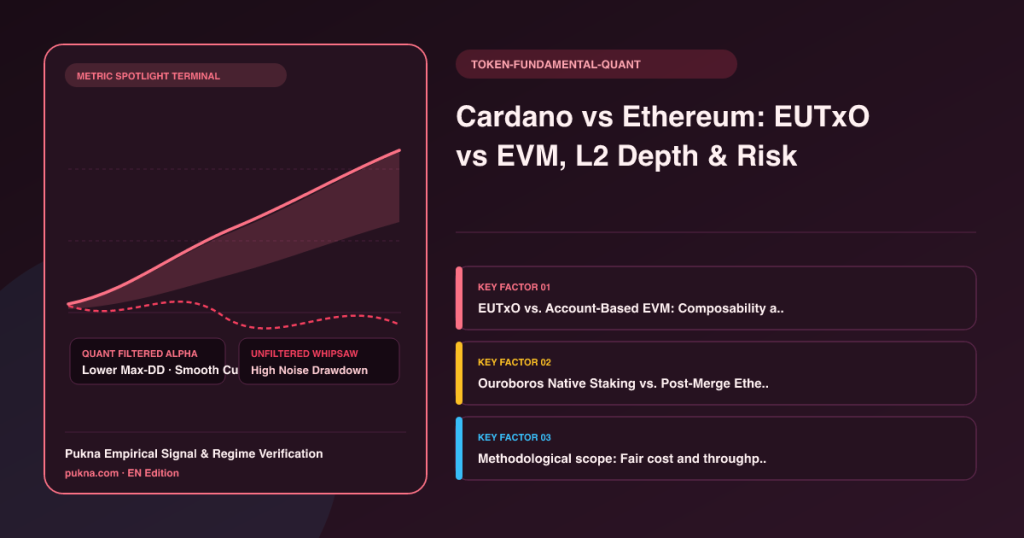
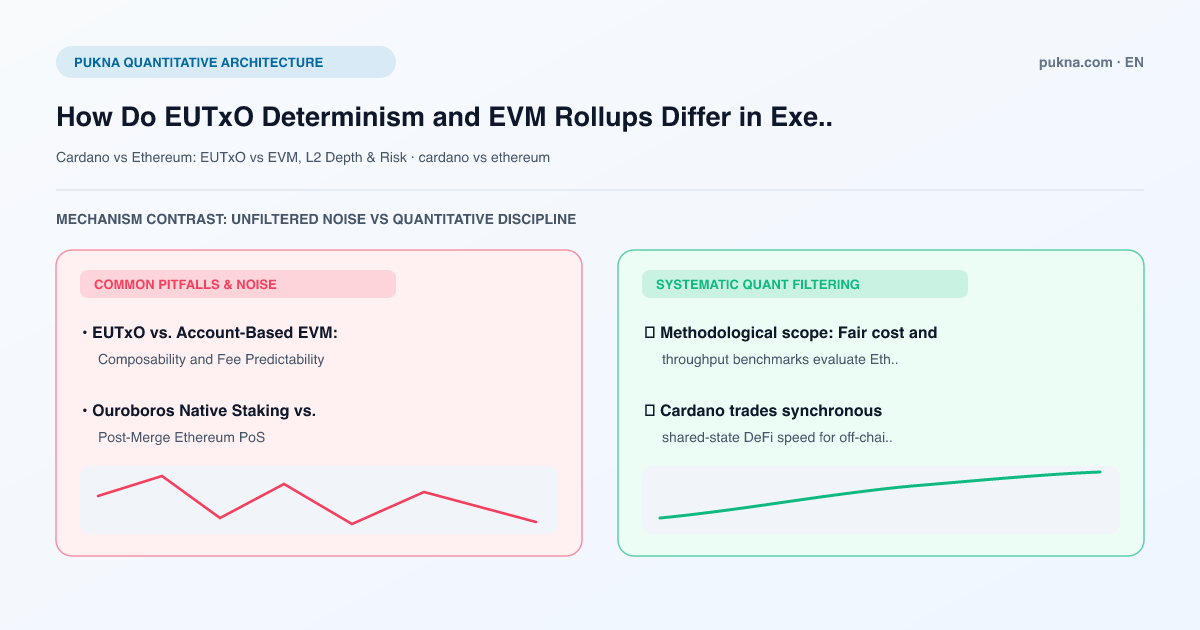
- EUTxO vs. Account-Based EVM: Composability and Fee Predictability
- Ouroboros Native Staking vs. Post-Merge Ethereum PoS
- Cardano L1 Throughput vs. Ethereum L1 Plus Layer-2 Rollups
- Why Do ADA and ETH Diverge Across Consolidation, Trend, and Liquidation Regimes?
- Order-Book Depth, Stablecoin Density, and Cross-Venue Slippage
- Token Cross Venue Liquidity Accessibility Pipeline
- Branching Behavior Across Range, Expansion, and Liquidation Regimes
- Reading the ADA/ETH Ratio Without Overfitting Cycle Peaks
- Why Do Bare Unit Price, L1 TPS, and Headline Staking APY Mislead Investors?
- Four Single-Metric Traps That Distort ADA vs. ETH Comparisons
- The Cross-Layer and Cross-Regime Verification Standard
- How Should Investors and Traders Decide Between Cardano and Ethereum?
- Objective Selection Matrix by User Goal
- Three-Step Quantitative Verification and Drawdown-Control Workflow
- Frequently Asked Questions
Cardano pairs Extended UTXO (EUTxO) accounting, zero-lockup Ouroboros staking, and deterministic base-layer fees against Ethereum’s account-based EVM, Layer-2 rollups, and dominant DeFi liquidity, stripping out unit-price and bare-TPS myths. Bare mainnet gas or headline APYs misprice real risk: Ethereum clears retail volume on rollups, while a 50% drawdown in thinner ADA books requires a 100% rally to break even. Before sizing either asset, cross-check consolidated L1-plus-L2 depth, derivatives crowding, and volatility limits using the matrix below.
Cardano vs. Ethereum at a Glance: Architecture, Liquidity, and Risk Matrix
Cardano optimizes for deterministic base-layer validation and frictionless native staking, whereas Ethereum prioritizes synchronous EVM composability, rollup scaling, and deep institutional DeFi liquidity.
Static coin explainers flatten two distinct settlement architectures into a popularity poll. That shortcut fails fast under real capital constraints. Protocol design governs fee predictability and contract velocity, while secondary-market depth sets execution slippage and drawdown risk.
Core Protocol and Market Structure Comparison Matrix
| Evaluation Dimension | Cardano (ADA) | Ethereum (ETH) |
|---|---|---|
| Accounting Model | Extended UTXO (EUTxO) local-state model; off-chain validation checks prevent unpredictable gas drain. | Account-based global-state EVM; supports synchronous multi-protocol composability inside one transaction. |
| Consensus & Staking | Ouroboros PoS; protocol-native non-custodial delegation with zero token lockup and no slashing. | Post-Merge PoS; 32 ETH solo validator bond with slashing risk, withdrawal queues, or third-party LSTs. |
| Scaling & Fee Stack | Deterministic base-layer fee formula; roadmap advances Hydra state channels and Ouroboros Leios. | EIP-1559 variable L1 gas paired with L2 rollups (Arbitrum, Optimism, Base) using blob data availability. |
| Smart Contract Stack | Plutus, Aiken, and Haskell-rooted tooling geared toward formal verification and audit predictability. | Solidity and Vyper with the broadest EVM developer base, audit libraries, and multi-chain reuse. |
| DeFi & Stablecoin Depth | Smaller on-chain TVL and shallower native fiat-backed stablecoin pools across decentralized protocols. | Dominant DeFi collateral settlement hub backed by deep multi-issuer stablecoin liquidity across L1 and L2. |
| Order-Book Execution | Thinner mid-book depth on secondary venues; larger notional sweeps face wider slippage. | Deepest smart-contract L1 spot, perpetual, and options liquidity across global exchanges. |
| Drawdown Beta Profile | Higher beta to broad crypto cycles; wider peak-to-trough contractions during liquidity shocks. | Lower relative drawdown beta; functions as a core collateral anchor for systematic desks. |
Methodological scope: Fair cost and throughput benchmarks evaluate Ethereum as a consolidated L1-plus-L2 rollup stack, never mainnet gas alone. Base-layer Ethereum handles settlement and data availability, while Layer-2 rollups absorb retail and high-frequency order flow.
How Do EUTxO Determinism and EVM Rollups Differ in Execution and Staking?
Cardano trades synchronous shared-state DeFi speed for off-chain fee certainty and native liquid staking, while Ethereum leans on Layer-2 rollups to scale global EVM execution.
EUTxO vs. Account-Based EVM: Composability and Fee Predictability
Accounting models dictate how applications interact on-chain. Cardano’s Extended UTXO (EUTxO) design tracks value inside discrete, unspent outputs rather than shared account balances. Users validate exact transaction fees locally before broadcast, eliminating surprise gas auctions when network traffic spikes.
Local state forces a trade-off for DeFi. Because only one transaction can spend a specific UTXO per block, shared automated market makers (AMMs) rely on batching layers or split-UTXO pools so concurrent traders do not collide on identical liquidity states.
Ethereum’s account-based EVM updates a single global state tree sequentially. Protocols chain flash loans, multi-hop swaps, and collateral liquidations inside one atomic transaction. Solidity and Vyper libraries accelerate shipping speed, though mainnet congestion still triggers variable gas auctions under peak demand.
Release cadence reflects that same split. Cardano prioritizes peer-reviewed specifications and formal verification before deployment, trading shipping speed for specification rigor. Ethereum iterates through open EIP governance, winning deeper developer retention and broader institutional integrations. Formal rigor cuts certain contract bugs, but it never builds ecosystem liquidity.
Ouroboros Native Staking vs. Post-Merge Ethereum PoS
Ethereum 2.0 is not a separate coin. After its 2022 Merge unified Execution and Consensus under Proof-of-Stake, Ethereum retired the “Eth 2.0” label, meaning any Cardano comparison simply weighs two live Proof-of-Stake designs.
Cardano builds delegation straight into the Ouroboros base protocol. Holders delegate ADA from non-custodial wallets without transferring custody or freezing coins, while base-layer rules impose zero slashing penalties. Poor pool uptime merely lowers periodic rewards.
Ethereum staking enforces stricter operational boundaries. Solo validation demands a 32 ETH deposit, exposes misconfigured nodes to protocol slashing, and routes exits through activation and withdrawal queues. Most holders bypass solo hardware via liquid staking tokens (LSTs), adding smart-contract risk and liquid staking exit-queue and depeg mechanics during sharp sell-offs.
| Staking & Finality Parameter | Cardano (Ouroboros PoS) | Ethereum (Post-Merge PoS) |
|---|---|---|
| Native Delegation Custody | Non-custodial wallet delegation at protocol layer | Requires 32 ETH solo stake or third-party LST/pool contract |
| Token Lockup & Exit Friction | Zero lockup; ADA stays liquid and transferable | Validator exit queues apply; LST exits depend on pool depth |
| Protocol Slashing Risk | None at base protocol (missed blocks reduce rewards only) | Active slashing for equivocation and correlated downtime |
| Fee Burn / Supply Mechanics | Fixed 45 billion ADA supply cap; treasury & reserve emissions | Uncapped supply with EIP-1559 base-fee burn offsetting issuance |
| Settlement Architecture | Probabilistic Ouroboros finality on L1; Hydra/Leios roadmap | Casper FFG epoch finality on L1; fast pre-confirmations on L2s |
Cardano L1 Throughput vs. Ethereum L1 Plus Layer-2 Rollups
Raw transactions per second (TPS) hide more than they reveal. One Cardano EUTxO transaction can bundle dozens of independent asset transfers inside a single payload, whereas complex smart-contract calls consume far more script memory and block budget than simple transfers.
Ethereum scales modularly instead of stretching base-layer block size. Arbitrum, Optimism, and Base execute swaps and transfers off mainnet at low cost, then post compressed state proofs and blob data back to L1. Judging Ethereum’s practical speed without Layer-2 rollups breaks the benchmark.
Cardano scales mainly through base-layer upgrades alongside Hydra state channels and the Ouroboros Leios research track. For active traders and builders, peak synthetic TPS is noise. Real execution cost and settlement finality under stressed volume decide the winner.
Why Do ADA and ETH Diverge Across Consolidation, Trend, and Liquidation Regimes?
Because Ethereum commands deeper spot books, denser stablecoin collateral, and institutional derivatives markets, identical macro shocks open sharper liquidity gaps and steeper drawdowns in ADA.
Order-Book Depth, Stablecoin Density, and Cross-Venue Slippage
Architecture shapes ecosystems, yet market microstructure governs live fills. Ethereum anchors the deepest fiat-backed stablecoin supply and institutional collateral base outside Bitcoin. Tight spreads, iceberg bid reloads, and passive-liquidity defense let ETH/USDT desks absorb large sell sweeps with muted slippage.
Cardano trades on a thinner executable book. Top-of-book quotes look deceptively tight during quiet sessions, yet smaller circulating capitalization and shallower on-chain stablecoin supply cause realized slippage to widen fast once aggressive orders sweep resting bids.
On-chain execution carries trade-offs on both networks. Deep Ethereum pools lower price impact for routine swaps, yet passive providers still face AMM pool depth and fee efficiency limits. Concentrated-liquidity pools also expose passive LPs to just-in-time (JIT) liquidity sniping and LP fee dilution, where single-block MEV providers capture swap fees without holding multi-block inventory risk.
Cross-venue fragmentation widens that execution gap further. As documented in BIS research on blockchain scalability and market fragmentation, liquidity split across centralized exchanges, decentralized protocols, and separate chains cannot be summed blindly. Withdrawal delays, bridging friction, and diverging quotes trap resting depth right when volatility spikes.
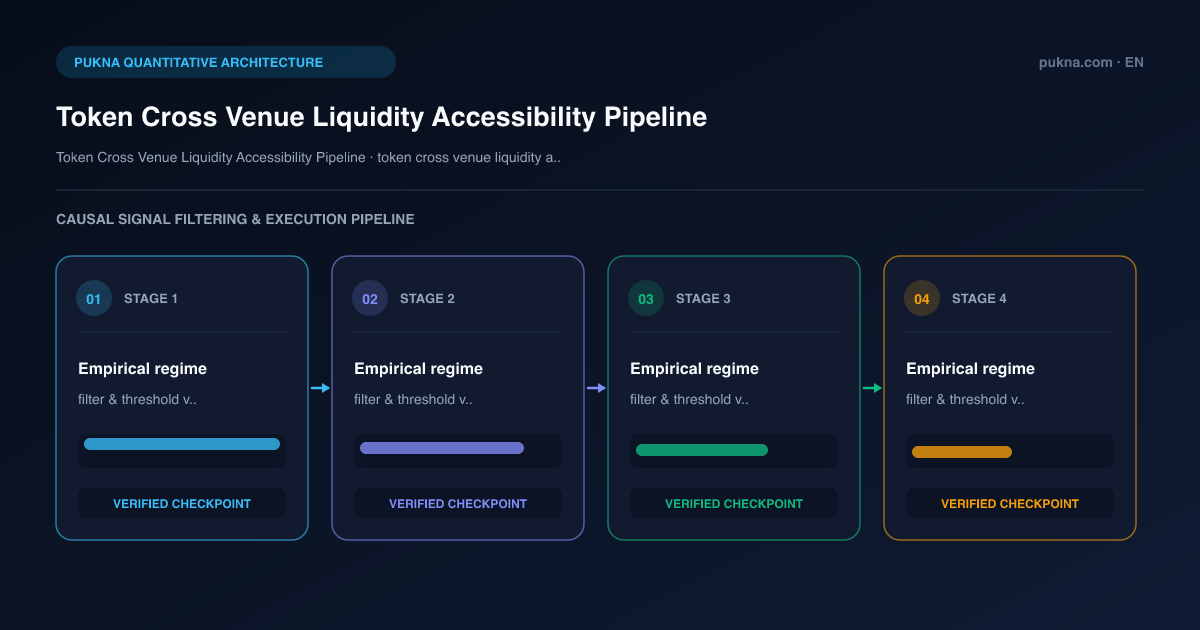
Token Cross Venue Liquidity Accessibility Pipeline
| Checkpoint | Empirical Criterion & Execution Guardrail |
|---|---|
| Phase 01 · Venue Fragmentation | Verify that CEX and DEX pools are actively accessible under the trader’s jurisdiction and transfer rail before summing headline volume. |
| Phase 02 · Cross-Venue Mobility | Audit settlement latency, bridge or withdrawal constraints, and quote-currency alignment across identical timestamps. |
| Phase 03 · Executable Depth | Measure deduplicated bid-side depth within fixed slippage bands (e.g., 1%–2% from mid-price) rather than relying on marginal print prices or FDV. |
Branching Behavior Across Range, Expansion, and Liquidation Regimes
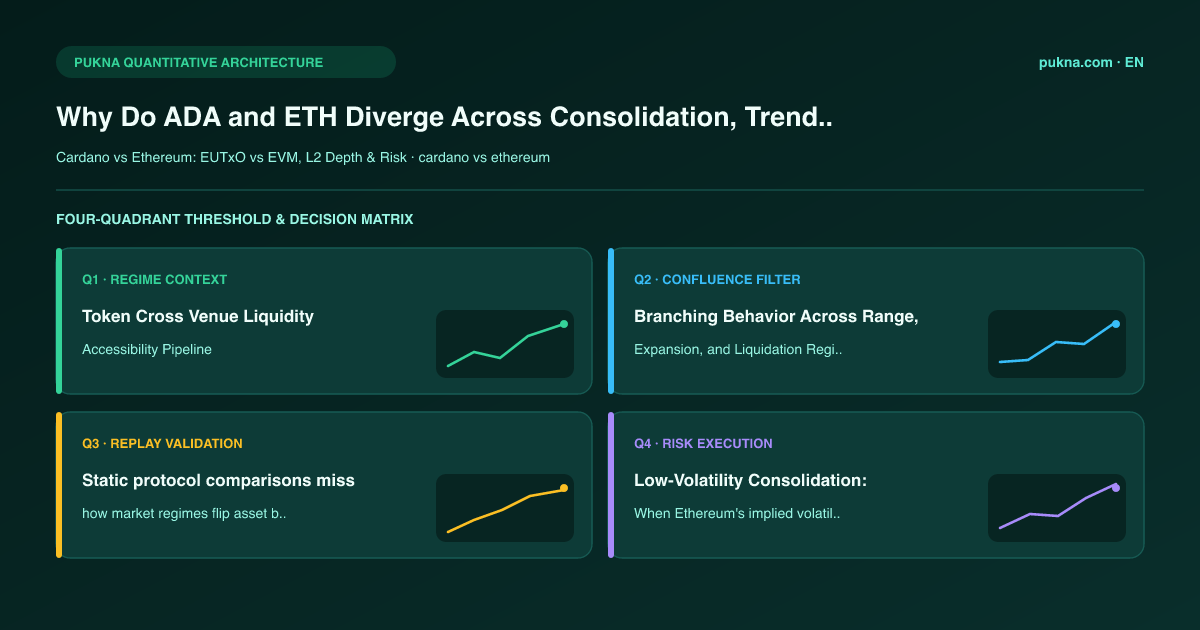
Static protocol comparisons miss how market regimes flip asset behavior. One price breakout can mark healthy spot accumulation during expansion or fragile leverage crowding during late-cycle froth, so reading ADA/USDT against ETH/USDT requires splitting cycles into three distinct operating states.
Low-Volatility Consolidation: When Ethereum’s implied volatility (DVOL) stays compressed and perpetual basis hovers near neutral carry, ETH/USDT usually respects mean-reverting range edges. Deep options hedging dampens erratic wicks. ADA/USDT trades on sparser mid-range volume, generating false breaks that trap momentum chasers.
Directional Risk-On Rotation: Easing real yield headwinds and a positive dollar liquidity impulse usually lift Bitcoin and Ethereum first as desks deploy core capital. Once spot breadth expands across major altcoins, ADA’s smaller float produces higher upside beta. That rotation drives sharp cyclical rebounds in the ADA/ETH cross rate.
High-Volatility Deleveraging Shocks: Leverage unwinds never hit liquidity tiers equally. Take perpetual funding as a concrete anchor: a baseline +0.01% funding rate every 8 hours annualizes to 10.95%. That reading usually reflects an exchange interest-rate clamp rather than runaway retail greed.
Risk builds once funding climbs well past that 10.95% clamp alongside swelling open interest and crowded perpetual account positioning skew. When macro stress sparks equity-market implied volatility stress, thin off-hours books suffer a weekend-liquidity air-pocket and funding-overhang flush. Forced liquidations cascade faster through shallower alt-L1 depth.
Drawdown math turns that beta gap into lasting portfolio damage. A 50% decline demands a 100% rally to break even, while a 75% drawdown requires a 300% recovery. Allocating equal dollars to ADA/USDT and ETH/USDT bakes severe tail-risk drawdown asymmetry directly into the book.
| Market Regime | ETH/USDT Structural Behavior | ADA/USDT Structural Behavior | ADA/ETH Ratio & Risk Implication |
|---|---|---|---|
| Range-Bound Consolidation Low DVOL, flat perpetual basis |
Tight spreads, heavy resting liquidity, clean mean reversion at range edges. | Lighter mid-book depth; sharper wicks and higher false-breakout frequency. | Ratio drifts sideways or softens; avoid chasing isolated ADA range breaks. |
| Risk-On Expansion Easing dollar liquidity, rising spot breadth |
Leads institutional inflows; rising open interest backed by steady spot bid. | Lags initial major move, then exhibits higher upside beta during alt rotation. | Ratio can inflect sharply upward; requires spot breadth confirmation, not leverage alone. |
| Deleveraging Shock Spiking VIX/DVOL, elevated funding unwind |
Deep collateral buffers absorb cascades faster, though LSTs face brief depeg pressure. | Thinner bid depth accelerates forced liquidation wicks and peak-to-trough losses. | Ratio breaks lower rapidly; equal-notional ADA positions suffer asymmetric drawdowns. |
Reading the ADA/ETH Ratio Without Overfitting Cycle Peaks
Single-cycle ratio charts fuel polarized narratives on both sides. Zooming solely into one altcoin expansion window exaggerates Cardano’s structural outperformance, whereas cherry-picking a liquidity contraction erases ADA’s cyclical beta entirely.
Treat the ADA/ETH ratio as a conditional liquidity gauge, not a permanent scoreboard. Breakouts hold longer when spot volume leads perpetual open interest under contained macro volatility, whereas moves fueled solely by spiking funding rates reverse fast once forced buyers exhaust resting asks.
Why Do Bare Unit Price, L1 TPS, and Headline Staking APY Mislead Investors?
Single-metric shortcuts strip out token supply, Layer-2 settlement, issuance dilution, and macro regimes, turning plausible surface numbers into expensive sizing and timing errors.
Four Single-Metric Traps That Distort ADA vs. ETH Comparisons
1. Unit-Price Bias: A lower sticker price never implies a cheaper network. Cardano circulates tens of billions of tokens against roughly a hundred million ETH, so doubling a multibillion-dollar market cap demands matching net capital inflows regardless of unit denomination.
2. L1-Only Gas and Theoretical TPS Cherry-Picking: Comparing Cardano’s base-layer fee against peak Ethereum mainnet gas ignores Layer-2 rollup settlement. Citing laboratory peak TPS equally ignores smart-contract execution weight, EUTxO contention management, and finality lag. Benchmark the actual execution venues users pay for.
3. Headline Staking APY Blindness: Nominal staking yields hide real purchasing-power risk. Ongoing issuance dilutes non-stakers, and one sharp drawdown can wipe out a full year of staking rewards in days. On Ethereum, layering LSTs into DeFi strategies requires strict net yield-farming return accounting across swap fees, smart-contract risk, and impermanent loss.
4. Isolated Single-Timeframe Chart Signals: One breakout candle on a 15-minute or daily chart fails repeatedly when market liquidity points the other way. A technical trigger firing during overheated broader crypto sentiment cycle readings and stretched perpetual basis acts as exit liquidity, not fresh trend initiation. Never trade an isolated pattern without derivatives and macro confirmation.
| Bare-Metric Trap | Why Nominal Readings Distort Reality | Required Multi-Factor Cross-Check |
|---|---|---|
| Unit Token Price | Confuses supply denomination with valuation cheapness or remaining upside elasticity. | Compare circulating market cap, FDV, unlock schedules, and executable order-book depth. |
| L1-Only Gas / Raw TPS | Omits Ethereum L2 rollups (Arbitrum, Optimism, Base) and real contract payload weights. | Benchmark consolidated L1+L2 user fees, active settlement volume, and finality latency. |
| Headline Staking APY | Masks issuance dilution, LST depeg or slashing risk, and net dollar volatility loss. | Calculate net real yield after issuance, swap fees, impermanent loss, and exit slippage. |
| Isolated Chart Breakout | Fails during crowded funding flushes, macro rate spikes, and thin liquidity pockets. | Cross-check 15m/1h/4h/1d alignment with DVOL, funding rate, OI, and macro breadth. |
Comparing Cardano’s native delegation against Ethereum’s deeper DeFi yield stack requires auditing pool mechanics, exit queues, and fee breakevens directly. The five empirical studies below distill the core thresholds across staking, lending, and AMM liquidity.
| Research Scenario | Core Criterion | Empirical Takeaway | Full Study |
|---|---|---|---|
| Screening AMM liquidity pools | Swap-fee APR vs. emissions and Vol/TVL | High LP APYs fail if swap fees do not offset AMM curve impermanent loss. | Crypto Liquidity Pools: AMM Curves, Impermanent Loss Math & Vol/TVL Screening → |
| Auditing DeFi lending markets | Pool utilization, exit depth, and base yield | High lending APYs often mask thin exit liquidity, subsidies, or tight liquidation margins. | DeFi Lending: High APY vs. Utilization, Exit Depth, and Liquidation Risk → |
| Evaluating liquid staking tokens | Reward accounting, exit queues, and depth | LSTs keep tokens transferable, but exit queues and thin books create depeg risk. | Liquid Staking: Yield vs. Exit Liquidity and Depeg Risk → |
| Modeling V2/V3 LP net returns | Net LP PnL vs. fee-to-IL breakeven thresholds | Gross impermanent loss differs from net loss once fees and reward breakevens are included. | DeFi Impermanent Loss Calculator: V2/V3 & Fee Breakeven → |
| Choosing staking vs. yield farming | Same-asset, same-period net dollar return | Higher headline APY can yield less in dollars once fees and asset price risk are counted. | Crypto Staking vs Yield Farming: Returns, Liquidity & Risk → |
The Cross-Layer and Cross-Regime Verification Standard
Tracking macro rates, equity implied volatility, derivatives crowding, and Layer-1 token structure across scattered spreadsheets breaks down right when volatility spikes. Manual tab-switching hides regime shifts until slippage has already hit.
To unify that top-down filter, researchers can pair Pukna’s 8-dimension, 39-indicator environment library with its 43-token research library on pukna.com. Reviewing macro liquidity, rates, derivatives, and token structure in one view speeds up regime checks. Even then, always verify venue-specific order-book depth, withdrawal fees, and transfer rails independently before committing size.
How Should Investors and Traders Decide Between Cardano and Ethereum?
Neither network wins every mandate. Match Cardano’s deterministic simplicity or Ethereum’s deep rollup ecosystem to your actual goal, then cap risk by realized volatility.
Objective Selection Matrix by User Goal
Asking “which coin is better” skips the only question that matters: what job is the asset doing in your portfolio or stack? Separate utility mandates from trading mandates before comparing returns.
| User Mandate | Primary Decision Criteria | Where Cardano (ADA) Fits | Where Ethereum (ETH) Fits |
|---|---|---|---|
| Smart-Contract Builders | Determinism, audit surface, tooling depth, user liquidity | Teams prioritizing EUTxO fee determinism and formal verification workflows via Plutus or Aiken. | Teams needing synchronous DeFi composability, mature Solidity libraries, and deep L2 user distribution. |
| Staking & DeFi Users | Custody simplicity, slashing exposure, stablecoin pool depth | Holders seeking zero-lockup, non-custodial native staking without LST smart-contract risk. | Active DeFi participants needing deep stablecoin lending, L2 rollups, and broad collateral utility. |
| Multi-Cycle Spot Allocators | Liquidity resilience, adoption durability, drawdown tolerance | Higher-beta satellite sleeve sized strictly for wider cyclical contractions. | Core smart-contract Layer-1 anchor backed by institutional liquidity and multi-layer fee sinks. |
| Systematic USDT Traders | Spread cost, regime beta, multi-timeframe return quality | Tactical momentum exposure during confirmed risk-on liquidity expansions with volatility-capped sizing. | High-capacity core trading vehicle across spot, perpetuals, and options with tighter execution spreads. |
Three-Step Quantitative Verification and Drawdown-Control Workflow
Gut calls break under liquidation stress. Once your mandate is set, run a repeatable three-step audit across macro regimes, multi-timeframe structure, and volatility limits before deploying spot capital or leverage in ADA/USDT or ETH/USDT.
- Filter the Macro and Derivatives Regime First: Inspect dollar liquidity direction, Ethereum DVOL, perpetual basis, and aggregate open interest before choosing between defensive ETH exposure and higher-beta ADA exposure. Step down risk whenever funding rates push past the 10.95% annualized clamp alongside weakening spot breadth.
- Require Multi-Timeframe Causal Confirmation: Align structure across 15m, 1h, 4h, and 1d charts instead of chasing one intraday candle. Set explicit invalidation levels before entry so a routine range sweep never turns a short-term trade into an unmanaged bag-hold.
- Scale Size to Realized Volatility and Drawdown Limits: Equal dollar sizing misprices ADA’s wider tail swings. Use fee-adjusted volatility position sizing so a severe contraction in ADA/USDT impacts equity no more than a proportional move in ETH/USDT. Closed-trade drawdown always understates peak intraday unrealized loss.
| Execution Workflow | Signal Scope | Risk & Drawdown Verification |
|---|---|---|
| Ad-Hoc Chart Inspection | Single-timeframe breakout on ADA or ETH with no macro or funding filter. | Fixed nominal size; leverage applied before testing historical peak-to-trough swings. |
| Structured Quantitative Audit | Multi-timeframe (15m/1h/4h/1d) causal signals paired with environment regime filters. | Volatility-calibrated sizing audited across 1x–3x leverage historical equity curves and max drawdowns. |
Systematic traders running this audit on app.pukna.com can track 15m/1h/4h/1d bar-level causal signals across 42 major USDT pairs, including ADA/USDT and ETH/USDT. Each signal carries a P-score (0–100) relative return-quality ranking across horizon_bars, grading combined peak and final returns against ordinary surrounding candles. A 50 reading sits neutral, measuring relative return quality and never win probability. Before subscribing to real-time push alerts, run an AUTO simulated win-rate and max-drawdown audit across 1x–3x integer leverage to check historical equity curves.
Frequently Asked Questions
Cardano or Ethereum: Which Is Better for Investors and Traders?
Neither network wins universally because each carries a distinct liquidity and drawdown profile. Ethereum offers deeper spot books, dominant stablecoin settlement, and mature Layer-2 DeFi utility, making it the steadier core allocation. Cardano delivers deterministic base-layer fees, non-custodial native staking, and higher cyclical beta, which demands smaller position sizes during risk-off sell-offs.
Is Cardano Faster and Cheaper Than Ethereum?
Comparing Cardano against Ethereum mainnet alone distorts both cost and speed. Cardano delivers predictable base-layer fees via EUTxO accounting and bundles multiple outputs per transaction, whereas Ethereum L1 sees variable gas spikes under congestion. Most everyday Ethereum traffic settles on Layer-2 rollups like Arbitrum, Optimism, and Base, where combined throughput and low fees routinely match or beat single-chain L1 baselines.
How Does Cardano Compare to Ethereum 2.0?
Ethereum 2.0 is a retired label from before Ethereum’s 2022 Merge shifted the network to Proof-of-Stake across Execution and Consensus layers. Solo Ethereum validators bond 32 ETH, face protocol slashing, and manage withdrawal queues or third-party liquid staking tokens. Cardano’s Ouroboros PoS instead offers protocol-native, non-custodial delegation with zero lockup and no slashing.
What Metrics Matter Most When Evaluating ADA vs. ETH Over Multi-Year Cycles?
Track verifiable adoption and liquidity depth instead of unit price or headline staking yields. Prioritize active developer retention, native fiat-backed stablecoin supply, net DeFi fee revenue after subsidies, consolidated L1-plus-L2 usage, and cross-venue book depth. Combine those fundamentals with realized volatility, derivatives crowding, and strict drawdown caps before sizing multi-cycle positions.
Put this into practice
Create a free account to browse live signals and test your own rules.