Crypto Technical Indicators: 24/7 Filters & Failure Modes
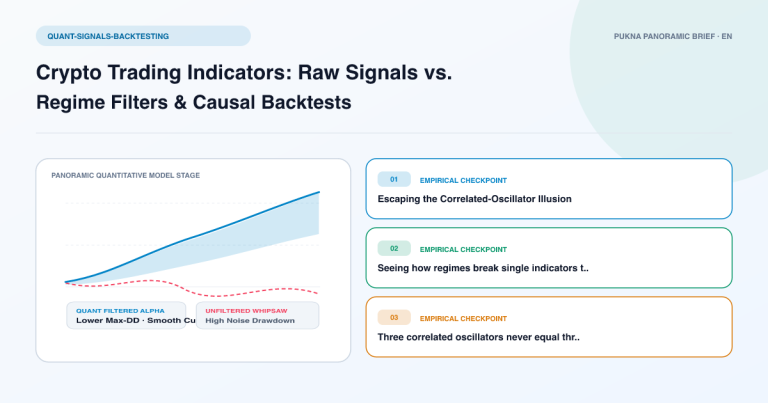
Five oscillators only recount one price series, while crypto's fat tails break ±2σ bands. Combine four non-redundant indicator families with regime gates and causal drawdown tests.
Focused on execution-grade diagnostics, this tag aggregates tactical guides on causal bar-close locking, eliminating look-ahead leakage, and calibrating specific quantitative parameters. Review practical audit checklists covering P-score threshold filtering above the 50 neutral baseline across horizon_bars, handling extreme candle-wick anomalies in 15m–1d data, and stress-testing AUTO strategies across 1–3x integer leverage for drawdown resilience. For the overarching structural framework, explore our complete guide in Quantitative Signals & Empirical Backtesting (https://pukna.com/category/blog/crypto-quant-analysis/quant-signals-backtesting/).
Five oscillators only recount one price series, while crypto's fat tails break ±2σ bands. Combine four non-redundant indicator families with regime gates and causal drawdown tests.
No single indicator survives every crypto regime. Pair non-redundant 3-layer stacks with macro and derivatives regime filters, then backtest causally at bar close.
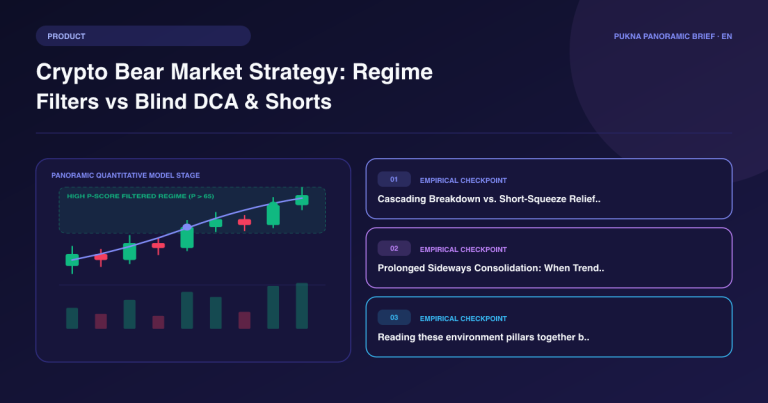
Static dip-buying and reflex shorting break when bear volatility shifts. Classify three sub-regimes with DVOL and perp basis, audit causal backtests, and enforce drawdown caps.
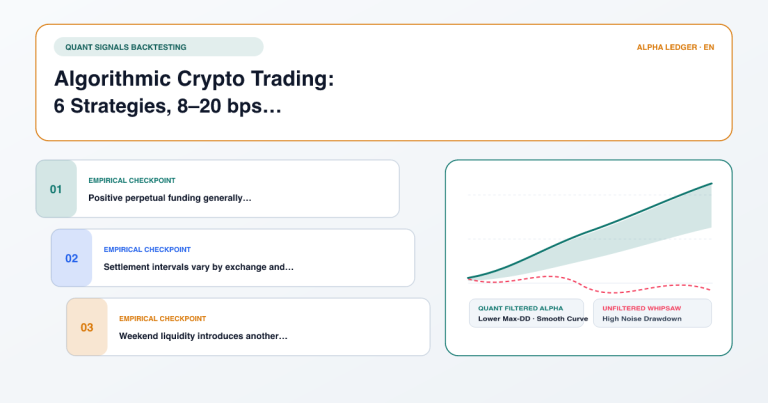
Algorithmic crypto trading automates execution, not market edge. Compare six strategies across market regimes, account for 8–20 bps fee scenarios and open interest distortions, and audit…
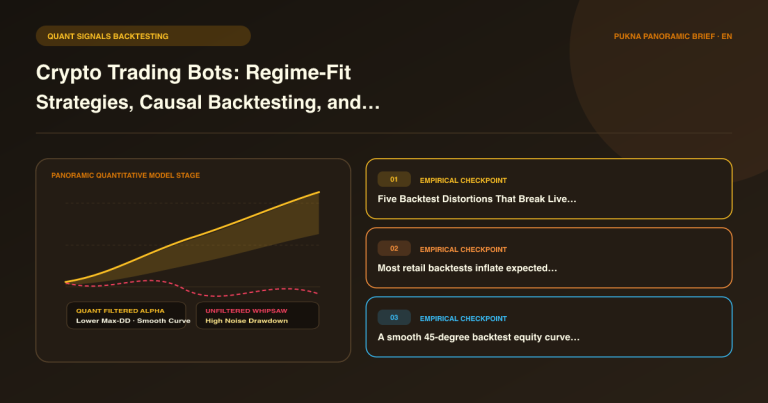
Crypto trading bots fail from regime mismatch and biased backtests, not speed. Compare bot stacks, screen 15m–1d causal setups after costs, and replay drawdowns at 1x–3x…
Textbook indicators misfire under 24/7 crypto leverage. Align 15m–1d structure, filter funding and macro regimes, and run causal backtests with a 6-point checklist.