Contents7 sections
- How Do Tokenized US Treasuries Differ From Wrappers, Bonds, and Stablecoins?
- Direct Permissioned Treasury Funds vs. Composable DeFi Wrappers
- T-Bills, Long-End Treasury Bonds, and Fiat Stablecoins: Duration and Yield Mechanics
- How Do Custody, NAV Oracles, and Multi-Chain Settlement Rails Operate?
- Off-Chain Custody, Transfer Agents, and Instant Stablecoin Redemption Buffers
- Cross-Border Settlement and Multi-Chain Rails Across Ethereum, XRPL, and L2s
- Why Do Rising Tokenized Treasury Inflows Signal Opposite Crypto Regimes?
- Measuring the Net Yield Spread Against DeFi Lending and Perpetual Basis
- High-Rate Defensive Cash Flight vs. Rate-Cut Collateral Expansion
- Weekend Liquidity Shocks, Off-Hours Discounts, and Market-Breadth Cross-Checks
- Crypto Market Breadth Implied Volatility Regime Matrix
- Why Do Headline AUM and Nominal APY Mislead RWA Rotation Calls?
- Wrapper Double-Counting and Whale Concentration on RWA Dashboards
- Fee Drag, Realized Carry, and the RWA Governance-Token Attribution Trap
- Where Do Legal Perimeters and Redemption Queues Break Under Stress?
- Securities Exemptions, Bankruptcy Remoteness, and Payment-Stablecoin Rules
- Smart-Contract Compliance Controls and Redemption-Queue Stress Boundaries
- How to Cross-Check Treasury Flows With Multi-Timeframe Crypto Signals
- Cross-Checking Macro Rate Indicators with Multi-Timeframe Causal Signals
- Pre-Allocation Checklist, Drawdown Stress-Testing, and Invalidation Triggers
- Frequently Asked Questions
Tokenized US Treasuries represent short-duration U.S. government debt or Treasury money-market fund shares on-chain, distinct from non-yielding fiat stablecoins, synthetic yield tokens, and T+1 ETFs. Headline AUM and gross T-bill APY mask 15–50 bps of fee drag, KYC allowlists, and wrapper overlap, while the Net Yield Spread against DeFi and perpetual basis yields reveals true regime direction. Compare wrapper structures, custody rails, and macro rate indicators in the tables below before inferring crypto sector rotation from sovereign inflows.
How Do Tokenized US Treasuries Differ From Wrappers, Bonds, and Stablecoins?
Structure dictates real yield and exit liquidity. Permissioned fund tokens, composable DeFi wrappers, long-end sovereign bonds, and fiat stablecoins behave as separate risk assets even when backed by identical U.S. debt.
| Instrument Type | Legal Claim | Maturity & Duration | Eligibility Gate | Fee Drag (bps) / Redemption Cutoff / DeFi Collateral Utility |
|---|---|---|---|---|
| Direct Permissioned Treasury MMF Token | Bankruptcy-remote fund share or SPV note | Short-end T-bills & repo (<3–12m; <0.3 yr) | KYC allowlist; Accredited / Qualified Purchaser | Fee Drag (bps): 15–35 bps management · Redemption Cutoff: T+0/T+1 Fedwire; optional 24/7 USDC pool · DeFi Collateral Utility: Restricted to allowlisted institutional venues |
| Composable DeFi Yield Wrapper | Indirect claim via wrapper SPV or non-U.S. note | Underlying T-bill fund (<3–12m) | Non-U.S. KYC for primary mint; freer secondary swap | Fee Drag (bps): 20–50 bps stacked fund + wrapper · Redemption Cutoff: 24/7 DEX / buffer swap; primary T+1 · DeFi Collateral Utility: Broad permissionless lending & perp margin |
| Long-End Tokenized Treasury Bond | Direct or SPV-backed sovereign note/ETF share | 7–30 year Treasuries (6–17 yr duration) | Accredited / Reg D or Reg S KYC | Fee Drag (bps): 15–40 bps issuer + underlying ETF · Redemption Cutoff: Primary T+1; thinner secondary DEX books · DeFi Collateral Utility: Low; rate volatility triggers steep haircuts |
| Non-Yielding Fiat Stablecoin | 1:1 redeemable payment liability | Issuer holds T-bills; holder receives 0% | Open secondary wallet holding; KYC for mint | Fee Drag (bps): 0 bps explicit; issuer retains full yield · Redemption Cutoff: 24/7 deep DEX & CEX spot liquidity · DeFi Collateral Utility: Universal base collateral & settlement rail |
Direct Permissioned Treasury Funds vs. Composable DeFi Wrappers
Not every tokenized T-bill is open to DeFi. Direct money-market fund tokens represent bankruptcy-remote shares of registered funds or ring-fenced SPVs issued exclusively to KYC-verified wallets. Smart-contract allowlists reject transfers to unverified addresses on-chain, keeping direct shares off permissionless DEXs.
Composable wrappers bypass that friction with a two-layer legal structure, similar to institutional fund-and-wrapper pairings like Ondo’s lineup. A regulated issuer holds permissioned fund shares off-chain and mints a transferable receipt or non-U.S. note on public chains. Secondary liquidity opens immediately across DeFi pools. Portability is not free: holders absorb 20–50 bps in stacked fees, steep primary mint minimums, and an added smart-contract layer.
T-Bills, Long-End Treasury Bonds, and Fiat Stablecoins: Duration and Yield Mechanics
Duration separates cash equivalents from rate speculation. A three-month tokenized T-bill carries roughly 0.25 years of duration, so a 100 bps rate jump trims market price by just 25 bps. A 20-year tokenized Treasury bond carries near 15 years of duration, dropping roughly 15% on that same 100 bps shock.
Yield mechanics diverge just as sharply across wrappers and stablecoins. Rebasing tokens expand holder balances daily, whereas accumulating tokens keep token counts constant and lift net asset value (NAV) per share. Fiat stablecoins hold similar short-end T-bills underneath, yet issuers pocket the entire coupon and pay wallet holders 0%.
Checking these duration profiles against macro interest-rate and liquidity data for Treasury yields and reserve flows shows whether capital seeks cash parking or rate beta. Legal structure still leaves one blind spot open. Off-chain custodians and settlement rails decide how fast those claims convert back into cash.
How Do Custody, NAV Oracles, and Multi-Chain Settlement Rails Operate?
Tokens move continuously, yet primary issuance still follows U.S. banking hours. Qualified custodians, regulated transfer agents, NAV oracles, and pre-funded stablecoin buffers connect legacy Fedwire clearing to 24/7 blockchain execution.
Off-Chain Custody, Transfer Agents, and Instant Stablecoin Redemption Buffers
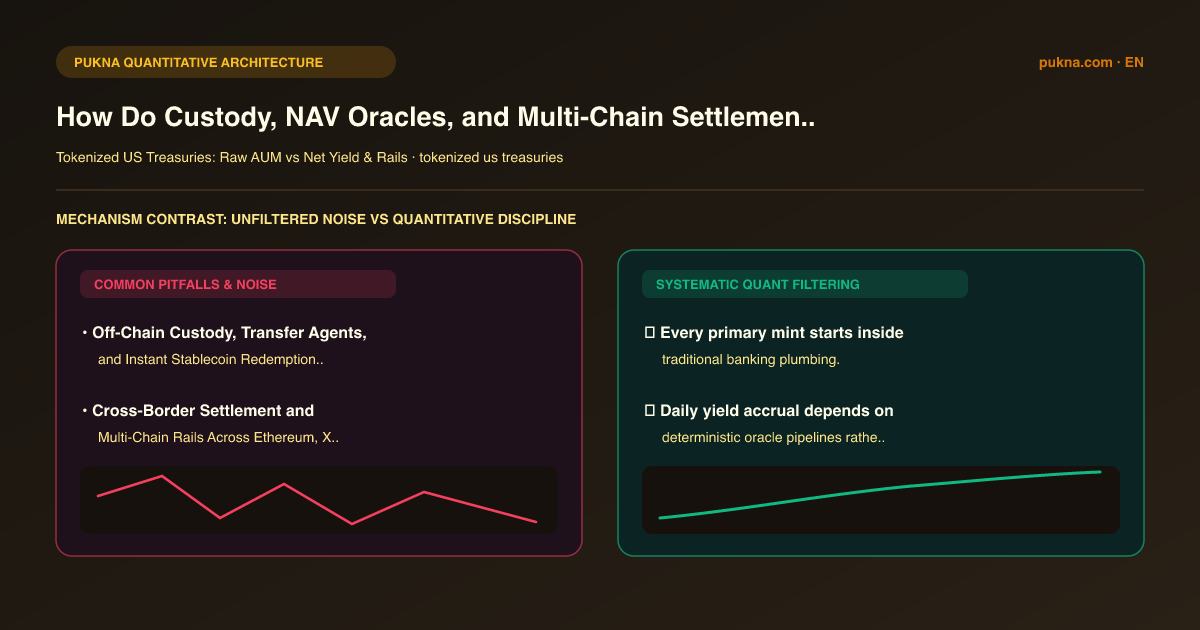
Every primary mint starts inside traditional banking plumbing. An eligible institution wires USD or USDC to the issuer, whose broker-dealer buys short-end T-bills or overnight reverse repos held at a qualified bank custodian. A registered transfer agent updates the legal shareholder registry and authorizes on-chain token issuance only after off-chain CUSIP settlement clears.
Daily yield accrual depends on deterministic oracle pipelines rather than spot market trading. After U.S. Treasury markets close, fund administrators calculate end-of-day NAV per share and push signed attestations via NAV and Proof-of-Reserve oracles. Rebasing contracts adjust supply across allowlisted wallets, while accumulating tokens step up their on-chain redemption ratio.
Primary burns still follow T+0 or T+1 Fedwire and DTC cutoffs. Leading issuers bridge that gap with 24/7 instant-redemption pools funded by USDC reserves. Desks swap Treasury tokens into stablecoins atomically on weekends. That escape hatch works only until the buffer runs dry.
Cross-Border Settlement and Multi-Chain Rails Across Ethereum, XRPL, and L2s
Cross-border sovereign settlement exposes the real advantage of tokenization. Traditional international Treasury transfers cross correspondent banks, time-zone cutoffs, and multi-day clearing lags that trap weekend collateral. Public blockchains compress that settlement chain into single-block finality, though every network trades DeFi depth against native compliance controls.
| Settlement Rail | Primary Institutional Strength | Compliance Primitives | Execution Cost Profile | Key Structural Trade-Off |
|---|---|---|---|---|
| Ethereum Mainnet | Deepest collateral TVL & institutional DeFi ecosystem | ERC-20 / ERC-3643 allowlists & admin freeze hooks | Higher gas on small tickets; negligible on $1M+ blocks | Mainnet gas spikes widen costs during volatility |
| XRPL (XRP Ledger) | Fast cross-border settlement & native order-book DEX | Protocol-level trustlines, authorized freeze & clawback | Sub-cent deterministic ledger transaction fees | Thinner permissionless DeFi lending depth than EVM |
| Ethereum L2s & Alt-L1s | High throughput for frequent margin rebalancing | Native or bridged compliance token standards | Low per-transfer execution costs | Liquidity fragmentation & bridge messaging risk |
Ethereum dominates yield-bearing margin workflows where collateral plugs directly into lending markets. XRPL fits cross-border treasury desks that prioritize deterministic sub-cent fees, protocol trustlines, and authorized clawback controls. Fast rails move collateral smoothly. Yet settlement speed alone never reveals whether inflows signal defensive fear or fresh risk appetite.
Why Do Rising Tokenized Treasury Inflows Signal Opposite Crypto Regimes?
Identical Treasury inflows mean opposite things across interest-rate regimes. Rising on-chain AUM reflects bearish cash flight when sovereign yields beat crypto carry, yet signals bullish collateral expansion once leverage demand flips the spread negative.
Measuring the Net Yield Spread Against DeFi Lending and Perpetual Basis
Nominal T-bill APY misleads traders because capital migrates on relative opportunity cost. Institutional desks ignore raw coupon headlines and track the Net Yield Spread in historical percentiles or Z-scores against DeFi stablecoin supply and annualized perpetual basis.
Net Yield Spread Formula: Net Yield Spread = (Gross T-Bill Yield − Management & Wrapper Fee Drag) − Benchmark On-Chain Yield (DeFi Stablecoin Supply APY or Annualized Perpetual Basis)
Desk math makes the polarity obvious. Suppose short-term T-bills yield 4.50% gross while issuer and wrapper fees take 35 bps, leaving 4.15% net. When DeFi stablecoin supply pays 2.65%, the Net Yield Spread widens to +150 bps toward Treasuries. That gap creates firm real yield headwinds for high-beta crypto.
High-Rate Defensive Cash Flight vs. Rate-Cut Collateral Expansion
In a High-Rate Defensive Regime, real yield headwinds collide with a contracting dollar liquidity impulse. Once the Net Yield Spread clears +100 to +150 bps in favor of Treasuries, desks rotate out of volatile altcoins into on-chain T-bills. Headline RWA trackers print fresh AUM highs while spot crypto liquidity thins out.
In a Rate-Cut / Risk-On Collateral Regime, rising Treasury AUM flips polarity. Falling policy rates compress sovereign coupons while returning crypto leverage pushes stablecoin borrow yields and perp-basis contango above T-bills. Desks stop parking idle cash and pledge Treasury tokens as yield-bearing margin collateral. Capital efficiency rises across majors and DeFi until cash-and-carry yield compression flattens the basis.
| Market & Liquidity Regime | Net Yield Spread Anchor | Signal Meaning of Rising Treasury AUM | Secondary Discount Risk | Crypto Sector Rotation Bias |
|---|---|---|---|---|
| High-Rate Defensive | > +100 to +150 bps (T-bills > DeFi/Basis) | Defensive cash flight & idle parking | Low during weekday Fedwire hours | Bearish drag on high-beta altcoins |
| Rate-Cut / Risk-On Collateral | < 0 to -150 bps (Basis/DeFi > T-bills) | Yield-bearing margin collateral expansion | Minimal; deep two-way USDC demand | Constructive rotation into BTC, ETH & DeFi/RWA |
| Weekend Liquidity Shock | Sudden basis inversion & borrow spike | Urgent deleveraging & collateral exit | High; off-hours USDC buffers exhaust | Forced de-risking; avoid illiquid bounces |
Weekend Liquidity Shocks, Off-Hours Discounts, and Market-Breadth Cross-Checks
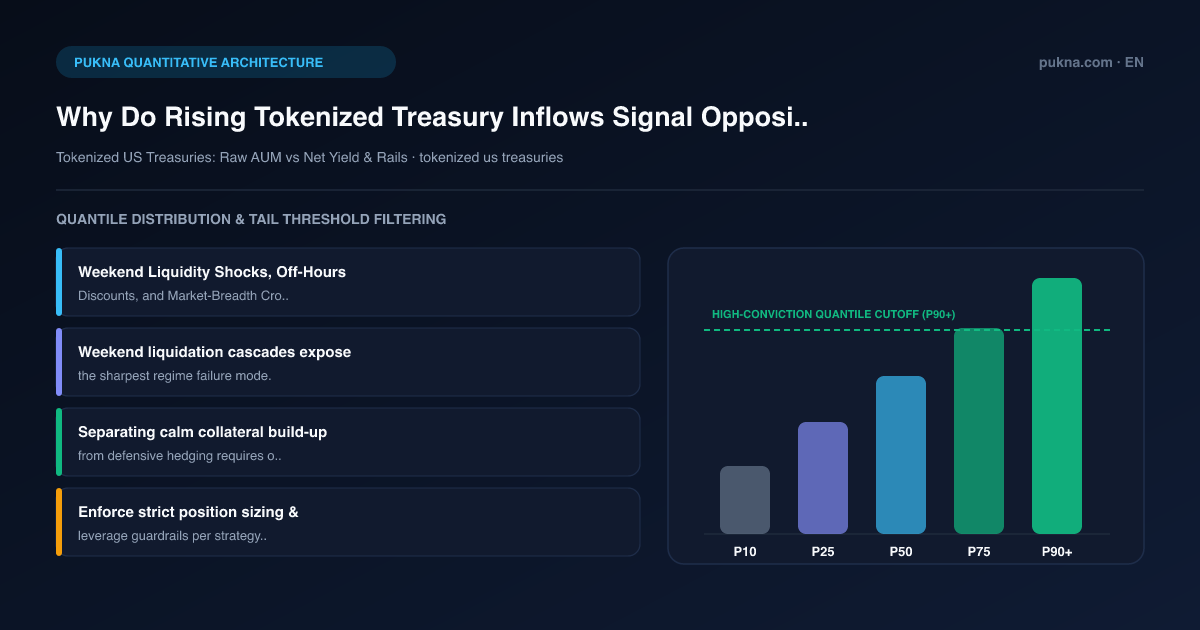
Weekend liquidation cascades expose the sharpest regime failure mode. When crypto sells off violently on a Saturday while U.S. banks remain shut, leveraged desks dump Treasury tokens for USDC to cover margin calls. Instant-redemption buffers can empty within hours, forcing a widening bid-ask spread and secondary market discounts even when off-chain T-bills remain fully intact.
Separating calm collateral build-up from defensive hedging requires options and macro volatility checks. Inspect crypto options volatility pricing alongside US equity volatility benchmarks to measure tail-risk hedging demand. A widening implied volatility vs. realized volatility (VRP) spread paired with narrow advancing breadth points to defensive hoarding, not healthy rotation.
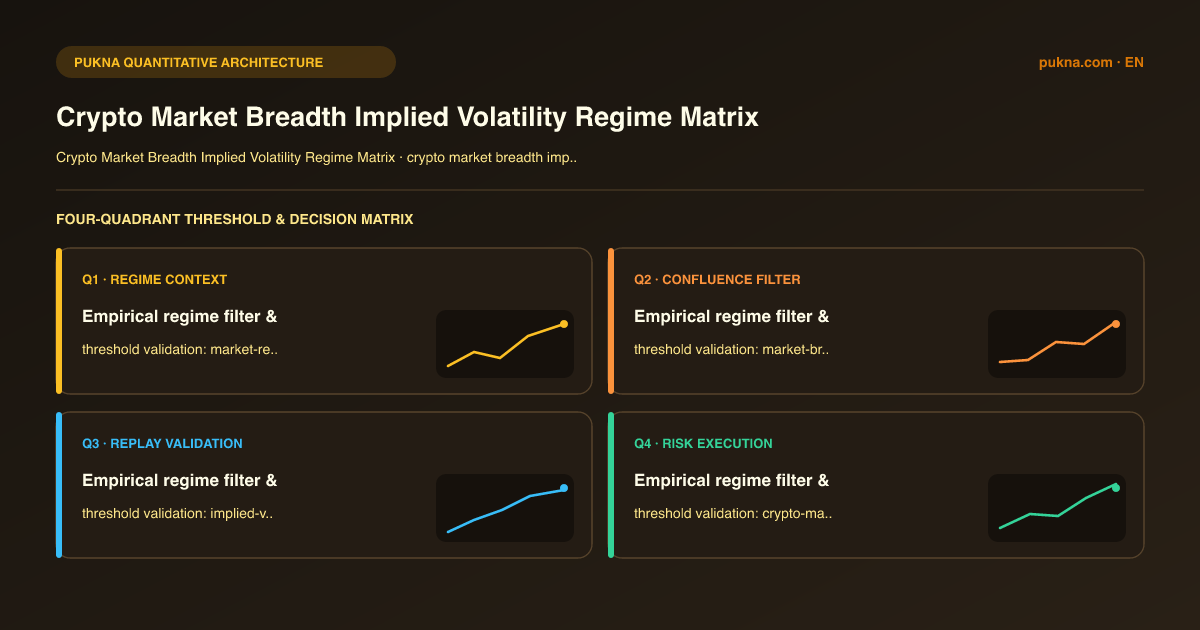
Market direction, participation breadth, and volatility pricing operate as distinct research layers. Compute research-layer Net Advancing Breadth as (Advancing − Declining) / Valid Sample Count over a pre-fixed pair universe and uniform return window. Pair that breadth score with BTC DVOL versus its rolling historical median under Deribit DVOL and S&P Digital Assets standards, leaving boundary ties unclassified.
Crypto Market Breadth Implied Volatility Regime Matrix
| Checkpoint | Empirical Criterion & Execution Guardrail |
|---|---|
| Phase 01 · Volatility Axis | Measure BTC DVOL against a pre-set trailing historical median rather than fixed absolute thresholds; leave exact median ties or incomplete feeds unclassified. |
| Phase 02 · Breadth Axis | Apply the research-layer Net Advancing Breadth ratio over a pre-selected pair sample and consistent return interval; avoid forcing calls when breadth equals zero. |
| Phase 03 · Cross-Check Guardrail | Combine quadrant state with total crypto market cap, BTC funding rates, and Treasury Net Yield Spreads; quadrants describe market context rather than standalone buy/sell triggers. |
Even an accurate regime matrix fails when fed distorted input data. Public RWA trackers frequently inflate apparent Treasury inflows through silent accounting overlap.
Why Do Headline AUM and Nominal APY Mislead RWA Rotation Calls?
Raw RWA dashboards systematically overstate net inflows and realized yield. Auditing wrapper double-counting, top-wallet skew, fee drag, and disconnected tokenomics prevents false sector-rotation bets before committing capital.
Wrapper Double-Counting and Whale Concentration on RWA Dashboards
Layered wrappers routinely double-count identical collateral. Suppose an institution mints $100 million in permissioned Treasury fund shares and locks them inside a DeFi wrapper or yield-bearing stablecoin. Unadjusted RWA trackers often sum both contracts into $200 million of headline AUM. Actual net fiat inflow is still $100 million.
Whale concentration distorts flow readings just as severely. A single DAO treasury migration or market-maker mint can inflate protocol TVL by 30% overnight while unique wallet counts stay flat. Without auditing top-ten holder share and secondary DEX turnover, analysts confuse isolated balance-sheet shuffling with broad institutional adoption.
Fee Drag, Realized Carry, and the RWA Governance-Token Attribution Trap
Headline T-bill coupons never hit on-chain wallets intact. Deduct 35 bps in stacked issuer and wrapper fees plus 15 bps for minting, gas, and off-hours exit spreads from a 4.50% gross yield, and realized carry falls to 4.00%. Tax friction on rebasing tokens and DeFi borrow-yield compression during LST recursive looping unwinds trim net returns even further.
Equating protocol AUM with governance-token upside causes the costliest RWA rotation errors. Growing tokenized Treasury AUM on a protocol does not mechanically lift its governance token. If management fees accrue strictly to an off-chain equity issuer while token unlock emissions expand circulating supply, token holders face steady dilution despite record dashboard TVL.
| Headline Reading | Accounting or Market Distortion | Adjusted Verification Metric | Regime Invalidation Condition |
|---|---|---|---|
| Rising Total Treasury AUM | Wrapper & yield-stablecoin collateral double-counting | Deduplicated primary-custodian net mint/burn flows | Net inflows flatten once recursive wrapper overlap is removed |
| Surging Protocol TVL | Single DAO treasury rebalance or market-maker mint | Top-10 holder concentration & unique wallet growth | Secondary DEX volume stagnates despite headline TVL jump |
| Gross T-Bill Headline APY | Ignores 15–50 bps fee drag, gas & off-hours exit spreads | Realized Net Carry minus DeFi/perp benchmark yield | Weekend secondary discounts wipe out 30+ days of accrued coupon |
| AUM Growth = Bullish Token | Equity-only fee capture & ongoing unlock emissions | Protocol fee-switch accrual vs. net token dilution | Governance token lags BTC even as issuer AUM hits highs |
Stitching deduplicated Treasury flows across fragmented trackers breaks down during sudden macro shifts. Cross-check rate spreads against spot risk-appetite gauges and Bitcoin trader positioning skew before acting on any RWA headline.
Direct Workflow Audit: Pukna consolidates macro, rate, liquidity, sentiment, derivatives, and on-chain datasets inside its 8-dimension 39-indicator environment library and 43-token research library. Checking those metrics in one workspace verifies whether sovereign inflows match genuine market-wide risk appetite instead of wrapper overlap.
Clean accounting strips out fake flow signals, yet spreadsheets cannot eliminate legal tail risk. Custody structures and redemption rules still govern worst-case capital recovery.
Where Do Legal Perimeters and Redemption Queues Break Under Stress?
U.S. sovereign collateral never eliminates wrapper legal risk or redemption friction. Securities exemptions, SPV bankruptcy remoteness, stablecoin-yield rules, and redemption-queue limits determine whether holders exit cleanly at par during correlated withdrawals.
Securities Exemptions, Bankruptcy Remoteness, and Payment-Stablecoin Rules
Securities law draws hard borders around who can touch tokenized Treasuries. U.S. institutional tokens typically rely on Reg D private placements for Accredited Investors and Qualified Purchasers, or on registered 40-Act money-market structures overseen by regulated transfer agents. Non-U.S. wrappers use Reg S exemptions, blocking U.S. addresses through smart-contract allowlists and geofenced onboarding.
Bankruptcy remoteness decides whether investor collateral survives an issuer default. Ring-fenced SPVs and regulated funds hold segregated Treasury CUSIPs at independent qualified custodians, shielding token holders from corporate insolvency. Omnibus structures lacking clean asset segregation turn sovereign backing into an unsecured claim against the issuing company.
Payment-stablecoin legislation reinforces structural demand for tokenized Treasury funds. Major regulatory frameworks restrict payment stablecoin issuers from passing Treasury interest directly to holders, keeping payment tokens strictly focused on commerce and settlement. Cash-rich DAOs and corporate treasuries therefore shift idle reserve balances into regulated Treasury tokens to earn compliant sovereign yield.
Smart-Contract Compliance Controls and Redemption-Queue Stress Boundaries
Regulated on-chain assets carry mandatory administrative overrides. Smart contracts for compliant Treasury tokens routinely embed admin-controlled freeze, clawback, and forced-burn functions to enforce sanctions compliance, court orders, or lost-key recovery. Lending protocols accepting tokenized Treasuries must price forced-freeze risk into collateral caps rather than assuming immutable bearer behavior.
Liquidity breaks fastest where banking calendars collide with crypto volatility. During multi-day U.S. market holidays, NAV oracles pause while perpetual futures trade nonstop, opening secondary pricing discounts. If correlated margin calls exhaust instant USDC pools, remaining holders fall into T+1 primary redemption queues or issuer-enforced liquidity gates.
| Risk-Boundary Dimension | Institutional Standard | Critical Failure Mode | Verification Step |
|---|---|---|---|
| Legal & SPV Structure | Bankruptcy-remote SPV or registered 40-Act fund | Unsegregated corporate balance-sheet IOU | Audit offering docs & legal ring-fencing opinion |
| Custodian Segregation | Independent qualified bank / prime custodian | Issuer-commingled omnibus brokerage account | Verify third-party monthly CUSIP attestations |
| Redemption Buffer & Gates | Transparent 24/7 USDC pool + T+0/T+1 primary | Opaque pool limits or unilateral withdrawal gates | Compare live buffer size to top-5 holder share |
| Oracle & NAV Cadence | Signed daily NAV & Proof-of-Reserve feeds | Holiday staleness or unverified manual updates | Confirm stale-price circuit breakers in DeFi pools |
| Compliance Admin Controls | Multi-sig governance with narrow legal scope | Unilateral EOA key controlling mint/freeze logic | Inspect verified bytecode & timelock constraints |
Auditing legal structures caps counterparty tail risk. Turning macro Treasury regimes into disciplined crypto execution still requires structured timing and drawdown verification.
How to Cross-Check Treasury Flows With Multi-Timeframe Crypto Signals
Macro Treasury flows frame the backdrop; causal price confirmation governs entry. Pairing deduplicated yield spreads with multi-timeframe causal filters and conservative drawdown tests stops desks from chasing late RWA narratives.
Cross-Checking Macro Rate Indicators with Multi-Timeframe Causal Signals
Macro narratives move faster than durable price trends. Once deduplicated Treasury inflows and the Net Yield Spread align with central-bank liquidity, screen target tokens inside the 43-token research library. Then confirm entry structure using Pukna 4-timeframe causal candlestick signals (15m/1h/4h/1d) covering 42 mainstream USDT pairs.
Disciplined filtering separates return quality from win odds. Each bar-level signal pairs with a P relative quality score (0–100) across horizon_bars, where a P=50 neutral baseline matches surrounding ordinary candles. Higher scores capture stronger combined peak gain and final return inside that window. They measure relative return quality strictly, never win probability.
| Execution Stage | Manual Multi-Tab Tracking | Structured Multi-Factor Quantitative Workflow |
|---|---|---|
| Macro & Rate Context | Fragmented RWA dashboards, spreadsheets & macro headlines | Unified 8-dimension, 39-indicator macro, liquidity & derivatives matrix |
| Sector & Asset Screening | Chasing narrative gainers after extended moves | Filtering rate-regime alignment across the 43-token research library |
| Entry Timing & Quality | Subjective chart reads or single-indicator triggers | Causal 15m/1h/4h/1d signals across 42 USDT pairs with P score (50 = neutral) |
| Drawdown Stress-Testing | Guessing leverage live without historical baselines | Auditing equity curves, win rates & max drawdowns at 1x–3x integer leverage |
| Thesis Invalidation | Reactive exits after whipsaws or weekend liquidity gaps | Pre-committed spread-reversal, buffer-drain & multi-timeframe break rules |
Pre-Allocation Checklist, Drawdown Stress-Testing, and Invalidation Triggers
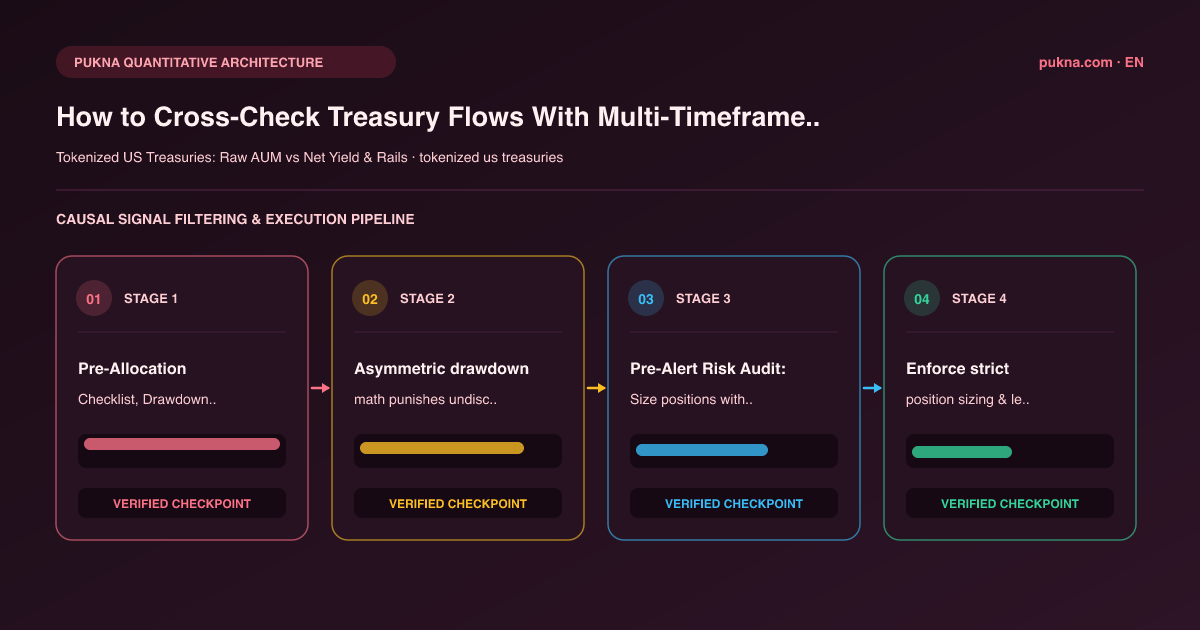
Asymmetric drawdown math punishes undisciplined leverage quickly. A -50% drawdown requires a +100% rebound just to break even, and weekend collateral gaps accelerate leveraged losses fast.
Pre-Alert Risk Audit: Size positions with net-of-fee fractional sizing math first. Inside Pukna AUTO, audit historical equity curves, simulated win rates, and maximum drawdowns across 1x to 3x integer leverage over past rate cycles before enabling real-time push alerts.
- Deduplicate Macro Flows: Strip wrapper overlap and top-wallet skew from RWA trackers. Cross-check verified net mints against central-bank liquidity, stablecoin supply, and derivatives inside the 8-dimension, 39-indicator environment library.
- Classify the Net Yield Spread: Subtract DeFi stablecoin supply or annualized perpetual basis from net T-bill carry. Label the market as High-Rate Defensive, Rate-Cut Collateral Expansion, or Weekend Liquidity Shock.
- Verify Multi-Timeframe Causal Signals: Screen assets from the 43-token research library against 15m, 1h, 4h, and 1d causal signals across the 42 mainstream USDT pairs. Read the P score (0–100, neutral at 50 across
horizon_bars) strictly as relative return quality, never win probability. - Run an AUTO Risk Audit: Review historical equity curves, simulated win rates, and maximum drawdowns at 1x to 3x integer leverage across prior rate shocks. Enable real-time push alerts only once drawdown limits hold.
- Enforce Hard Invalidation Triggers: Pre-commit objective de-risking exits before entering. Cut exposure if the Net Yield Spread swings +100 bps back toward cash, instant USDC buffers drain, or multi-timeframe causal trends break.
Frequently Asked Questions
How do tokenized US Treasury bills, Treasury funds, and long-end Treasury bonds differ in duration and yield accrual?
Tokenized Treasury bills and money-market fund tokens hold U.S. debt maturing in under 3 to 12 months, keeping duration below 0.3 years with minimal price swing. Long-end tokenized Treasury bonds carry 6 to 17 years of duration, so a 100 bps rate jump cuts token prices sharply. Yield accrues via daily rebasing balances or an accumulating NAV per share, net of 15–50 bps in annual fees.
What is the practical difference between a tokenized Treasury wrapper, a direct money-market fund token, and a fiat stablecoin?
Direct money-market fund tokens are bankruptcy-remote shares restricted to KYC-allowlisted institutional wallets, which blocks permissionless DeFi use. Composable wrappers hold those shares inside a secondary SPV or non-U.S. note to enable open DEX trading and margin utility, adding wrapper fees and smart-contract risk. Fiat stablecoins deliver universal 24/7 liquidity without allowlists, yet issuers keep the Treasury coupon and pay wallet holders 0%.
Who can mint, hold, and redeem tokenized US Treasuries, and how do KYC allowlists and fees restrict DeFi composability?
Primary mints and T+0 or T+1 Fedwire redemptions require KYC onboarding plus Accredited Investor, Qualified Purchaser, or non-U.S. Reg S eligibility. Smart-contract allowlists block unverified transfers, keeping direct institutional tokens out of permissionless lending pools. Even with wrappers or 24/7 USDC buffers, 15–50 bps annual fees, gas costs, and weekend buffer caps trim realized carry under stress.
Put this into practice
Create a free account to browse live signals and test your own rules.