Fibonacci Retracement Crypto: Raw 0.618 vs Regime Filters
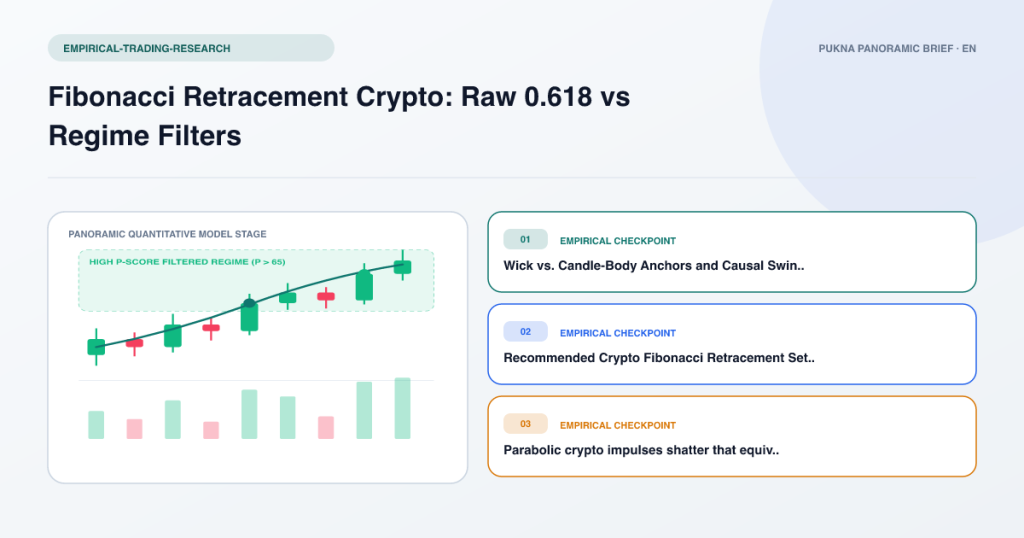
Static 0.618 bids fail in crypto chop and liquidation wicks. Anchor log-scale swings, screen four market regimes, and pair volume confluence with ATR stops to filter pullbacks.
This tactical hub gathers hands-on technical analysis guides focused on quantitative threshold calibration, extreme price-spike filtering, and pre-execution verification checklists. Rather than broad theory, these notes break down how to separate high-P-score setups from the 50-point neutral candlestick baseline across 15m, 1h, 4h, and 1d charts on 42 USDT pairs, isolate noise during liquidity sweeps or macro shocks, and inspect horizon_bars return dispersion alongside AUTO 1–3x leverage max drawdown limits before subscribing to live signal pushes. For the overarching platform architecture and multi-timeframe framework, explore the full overview in product (https://pukna.com/category/product/). [https://pukna.com/category/blog/crypto-quant-analysis/]
Static 0.618 bids fail in crypto chop and liquidation wicks. Anchor log-scale swings, screen four market regimes, and pair volume confluence with ATR stops to filter pullbacks.
No single indicator survives every crypto regime. Pair non-redundant 3-layer stacks with macro and derivatives regime filters, then backtest causally at bar close.
Bollinger Band touches measure volatility dispersion, not overbought ceilings. Separate range fades from %B>1 band-walks using BandWidth, spot volume, and regime checks.
Textbook indicators misfire under 24/7 crypto leverage. Align 15m–1d structure, filter funding and macro regimes, and run causal backtests with a 6-point checklist.